Aisle decoration for an Indian wedding costs between ₹15,000 for a simple petal carpet with basic column markers and ₹2.5 lakh+ for a full floral arch tunnel, with most mid-range designs — quality columns, petal carpet, entrance arch — landing at ₹60,000–₹1.2 lakh. This guide presents 20 aisle concepts, from traditional South Indian banana-trunk columns to candle-only minimalism, with realistic costs for each and the safety constraints we design around. The aisle is the path every guest and every camera watches during the procession, which is why it deserves this level of attention. Aisle decor is one element within the full decor budget — our Bangalore wedding decor cost guide gives the complete picture; for the Bangalore venue context, our Bangalore weddings guide.
The Role of the Aisle in Indian Wedding Ceremonies
Unlike the Western church model — a single long aisle leading to an altar — Indian wedding aisles are more varied in their usage and arrangement. In many South Indian ceremonies, the bride is brought in under a canopy of cloth held by her uncles, and the path she walks is as important as the destination. In North Indian ceremonies, the groom's baraat entry (which may come from outside the venue) and the bride's subsequent entry often use different paths or the same path in sequence. Christian Indian weddings follow the church aisle model most closely.
The key design decisions for any Indian wedding aisle: width (determined by the number of people in the procession and the accessibility needs of family members), length (a longer aisle is more dramatic; a shorter one is more intimate), height (overhead elements dramatically increase the sense of occasion), and the relationship between the aisle and the seating (guests should have clear sightlines to the procession).
Safety is a genuine consideration that gets too little attention. Petal carpets are beautiful but can be slippery, particularly for older guests in sandals or slippers. Candles on the aisle floor create trip hazards. Any overhead arch or tunnel must be structurally stable and cleared for safety. We plan every aisle with safety as a primary constraint, not an afterthought.
20 Aisle Decoration Concepts
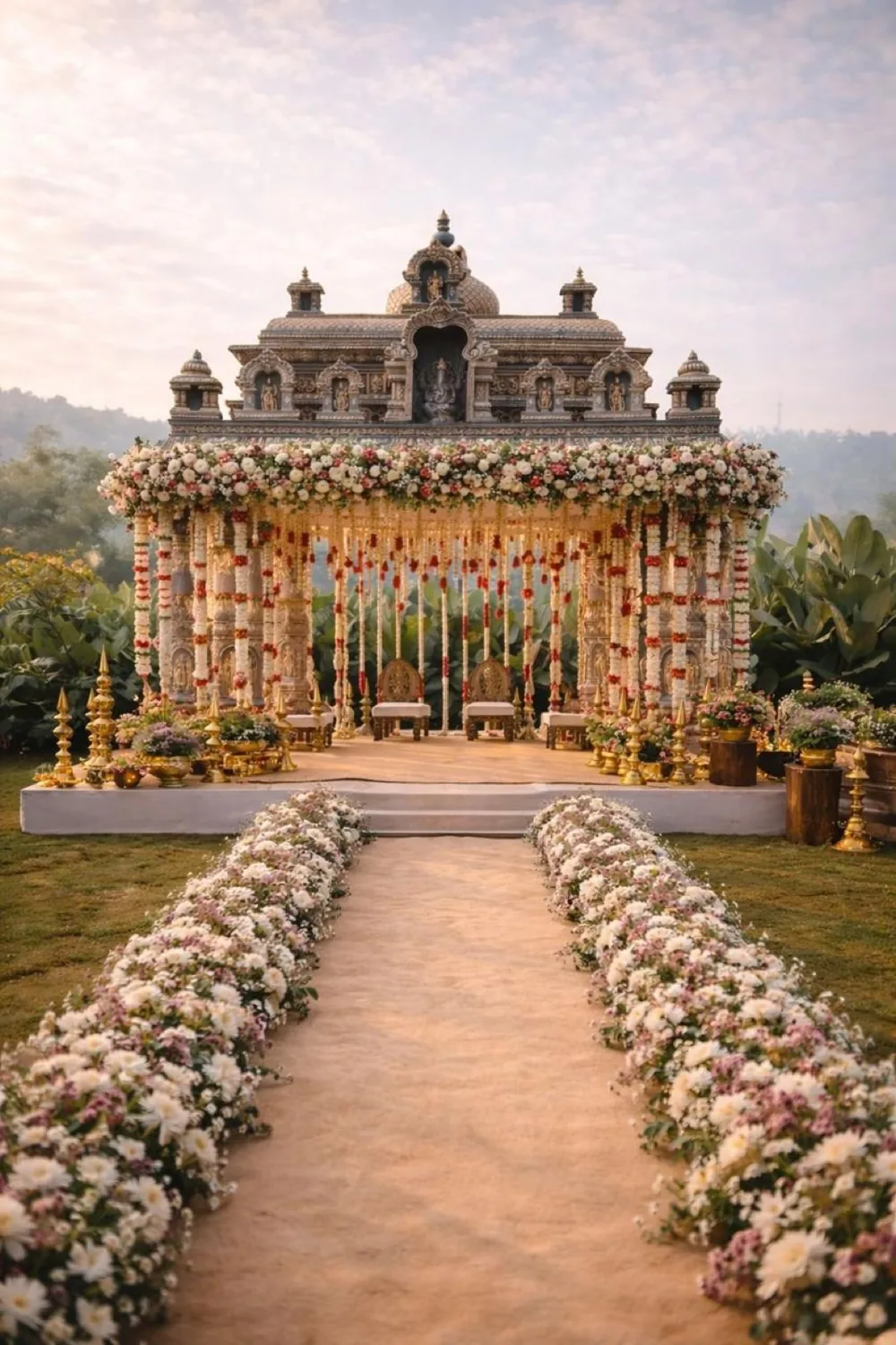
1. Classic Petal Carpet
Rose petals laid in a continuous carpet from the aisle entrance to the mandap. The most photographed aisle choice in Indian weddings. Variations: all-red rose petals (passionate), all-white (pure, elegant), marigold (traditional, vibrant), or a mix of turmeric-dusted petals and fresh roses (specifically South Indian). The challenge: fresh petals become slippery underfoot. We lay petals on a fabric or carpet base, not directly on marble or tile. Cost: ₹8,000–₹30,000 depending on length and flower quality.
2. Flower Column Aisle Markers with Candles
Tall floral column arrangements (1.5–2 metres) placed at 2–2.5 metre intervals flanking the aisle. Each column has a candleholder at its base. The columns define the aisle boundary clearly, create vertical interest, and provide photographic depth as the bride processes through them. This is the most versatile aisle marker design — it works in any venue, any style, any scale. Cost: ₹4,000–₹10,000 per column pair.
3. Tall Pampas Grass Urns Flanking the Aisle
Large ceramic or metal urns filled with tall pampas grass, placed at the aisle entrance and at the mandap end, with smaller pampas arrangements flanking at intervals. The soft, feathery quality of pampas grass creates a romantic, slightly ethereal aisle atmosphere that is distinct from the more formal floral column approach. Cost: ₹3,000–₹7,000 per pair.
4. Floral Arch Tunnel at Aisle Entrance
Not a single arch at the entrance, but a series of arches creating a tunnel — typically 3–5 arches at 1.5 metre intervals — through which the bride processes. The effect is one of the most dramatic in wedding design. The bride's approach and passage through the tunnel is unmissable photographically. Cost: ₹1.5–₹4.5 lakh for a full floral tunnel of 5–6 arches.
5. Low Floral Garland on Ground
Marigold and rose garlands laid on the ground defining the aisle edges — not a carpet, but a border. This is more stable underfoot than a petal carpet (the garland cord is flat and does not slide) while providing a clear visual definition of the aisle path. Works beautifully for traditional South Indian and North Indian ceremonies. Cost: ₹5,000–₹18,000 depending on length and flower quality.
6. Lantern-Lined Aisle
Decorative lanterns placed at regular intervals along both edges of the aisle, with candles or tea lights inside. This is an evening ceremony standard — the warm lantern glow creates a processional atmosphere unlike any other. Works at outdoor venues and garden ceremonies particularly well, but equally beautiful in a ballroom. Cost: ₹2,500–₹6,000 for a standard lantern-lined aisle (lanterns on hire).
7. Coconut and Banana Leaf Columns — Traditional South Indian
Banana trunk sections or banana leaf sheaves erected as columns flanking the aisle, decorated with marigold garlands, coconut at the top, and mango leaf strings (torana) strung between pairs. This is the most authentically South Indian aisle design — rooted in centuries of temple decoration practice. It creates an immediately recognisable sense of occasion for South Indian families. Cost: ₹15,000–₹40,000 for a fully dressed banana column aisle.
8. Rose Petals and Floating Candle Pools
At the aisle edges, shallow brass or terracotta bowls filled with water, floating rose petals, and floating candles. The petal carpet runs between them. The effect at twilight or in a dimly lit ceremony — the glow of floating candles reflected in water, the fragrance of fresh roses — is almost impossibly romantic. Cost: ₹12,000–₹28,000.
9. Tropical Leaf Columns with Orchids
Tall columns of tropical foliage (palm, banana leaf, monstera) with orchid garlands or orchid clusters at the top. This is the outdoor Bangalore wedding aisle marker — at home at Taj West End's garden or Golfshire's estate. The tropical columns have presence and scale without the formality of a traditional floral column. Cost: ₹5,000–₹12,000 per pair.
10. Mirror Ball Columns with Floral Accents
Disco mirror ball columns (typically 30–40 cm spheres on stands) with floral garlands around the base. At a sangeet or contemporary reception, the mirror balls catch and scatter light beautifully. This is an unambiguously festive choice. Not appropriate for traditional Hindu ceremonies; perfect for cocktail aisles and sangeet entries. Cost: ₹3,000–₹7,000 per pair (mirror ball hire plus florals).
11. Tree Trunk Columns with Cascading Flowers
Actual tree trunks (or highly convincing fabricated versions) as aisle columns, with cascading flower garlands draped from their branches. This is the garden-wedding elevated — the columns feel grown rather than placed. Works at heritage venues and outdoor settings. Cost: ₹8,000–₹18,000 per pair.
12. Tulle Draping with Fairy Lights
Sheer tulle fabric draped in a canopy over the aisle, interwoven with fairy lights. The bridal procession happens under a glowing fabric cloud. This is a specifically evening choice — the fairy lights in tulle create a soft luminescence that photographs beautifully. Requires an overhead structure to drape from (aisle columns with cross-beams, or ceiling rigging in a ballroom). Cost: ₹25,000–₹60,000.
13. Grass Aisle with Wildflower Edges
At outdoor venues, a strip of real or artificial turf grass as the aisle carpet, with wildflower arrangements along its edges. This is the most naturalistic aisle option — it feels like walking through a garden meadow. Appropriate for Coorg, Golfshire, and any property with strong landscape character. Cost: ₹15,000–₹35,000.
14. Marigold Rope Runner Between Columns
Pairs of floral columns flanking the aisle, connected by marigold garland ropes suspended at waist height between each pair. The garland ropes define the aisle boundary while providing a continuous floral ceiling at low level — visually distinctive and deeply Indian in vocabulary. Cost: ₹18,000–₹40,000 for a full aisle.
15. Single Colour Petal Carpet
The simplest and most powerful version of the petal carpet: a single colour only. All-red rose petals — intense, passionate, unmistakable. All-white rose petals — clean, bridal, timeless. All-mauve or burgundy — sophisticated and unusual. The discipline of a single colour is more powerful than a random mix. Cost: ₹10,000–₹25,000.
16. Moss Carpet Aisle
Sheet moss laid as the aisle carpet, creating a forest-floor processional path. Appropriate only for destination venues with a natural/earthy character (Coorg, forest properties, vineyard venues). In the right setting, a moss carpet aisle is one of the most striking and unusual processional experiences available. Cost: ₹20,000–₹45,000.
17. Rose Petal Heart Pathway for Mehendi
At the mehendi function, rather than a formal processional aisle, a heart-shaped petal pathway leading to the mehendi seating area for the bride. This is a whimsical, romantic touch appropriate for the informal joy of the mehendi celebration. Cost: ₹4,000–₹8,000.
18. Geometric Iron Frames with Blooms as Aisle Markers
Geometric black iron frames (square, arch-shaped, or diamond form) positioned at aisle intervals, with florals arranged in or around the frames. The contemporary aesthetic — strong graphic shapes with organic florals — creates a striking aisle that works particularly well at modern hotels. Cost: ₹5,000–₹12,000 per pair (frame hire plus florals).
19. Candle-Only Aisle — Minimal, Dramatic at Night
No flowers. No columns. Only candles — dozens of pillar candles in hurricane glass cylinders, placed at regular intervals along both edges of the aisle, with a petal carpet between them. At night, this is extraordinarily atmospheric. The restraint is the design. Cost: ₹12,000–₹25,000 (candles, hurricane glasses, petal carpet).
20. Photo Installation Aisle
Framed photographs of the couple — childhood, courtship, travel, family — placed on easels or small stands along the aisle, with flowers at each. Guests arriving at the ceremony walk through the couple's story before witnessing the next chapter. This is a deeply personal touch that creates conversation and emotional engagement before the ceremony even begins. Cost: ₹15,000–₹35,000 (printing, frames, florals).
Safety Considerations for Aisle Decoration
The safety conversation is essential. Petal carpets — beautiful as they are — become slippery when compressed underfoot, particularly on polished marble or tile. We always specify a non-slip underlay beneath petal carpets, or restrict them to carpet-on-carpet applications. Elderly guests, in particular, should have a clear non-petal path if mobility is a concern.
Candles on the aisle floor create trip hazards for both the bridal procession and any guests who move during the ceremony. Hurricane glass cylinders mitigate the flame risk but do not eliminate the trip hazard of the vessel itself. All floor-level aisle elements must be positioned far enough from the walking path to eliminate foot contact.
Floral arch tunnels and overhead aisle elements must be structurally certified before any person walks under them. We anchor all overhead aisle structures independently and test them with load before the first guest enters. This is not paranoia — it is professional practice.
The aisle is the journey. We design it with the care it deserves — beautifully, safely, and in a way that creates the photographs you will keep forever.
Begin Your Story