Bangalore is home to India's most culturally mixed couples. Panigrahana specialises in designing ceremonies that honour both families with equal depth and beauty.
Checking dates for July 2026–27?Tell us your date & guest count — we’ll confirm availability and send a realistic budget the same day.
No Indian city produces more intercultural couples than Bangalore. The reasons are structural: the tech industry — concentrated in Bangalore more than anywhere else in India — draws talent from every state, every community, and every cultural background. Whitefield, Koramangala, and Sarjapur Road are home to professionals from Tamil Nadu, West Bengal, Telangana, Punjab, Rajasthan, Maharashtra, Gujarat, and every other state, living as neighbours and colleagues.
Cross-cultural Bangalore wedding — two traditions, one ceremony, designed by Panigrahana
The culture of Bangalore's professional class accelerates this mixing. Unlike more homogeneous metros, Bangalore's social environment actively encourages mixing across community lines — in the office, in apartment complexes, at startup events and alumni networks. Relationships form across the cultural divides that would be harder to cross in Chennai or Kolkata or Ahmedabad.
The result is a wedding market where Panigrahana estimates more than 40% of the Bangalore weddings we plan involve couples from different regional or cultural backgrounds. This is not a niche. This is a defining feature of Bangalore weddings in 2026.
We have developed specific methodologies for cross-cultural wedding planning over years of working with these couples. The core principle is that a cross-cultural wedding is not a compromise between two traditions — it is the creation of something new that incorporates the best of both. Done well, a cross-cultural Bangalore wedding is more interesting, more meaningful, and often more visually distinctive than a single-tradition event.
The Numbers
40%+
of Panigrahana's Bangalore weddings involve couples from different cultural backgrounds
6+
distinct community combinations we have planned in Bangalore in the last two years alone
200+
total Panigrahana weddings in Bangalore — the accumulated experience behind every recommendation
Who We Plan For
Cross-Cultural Combinations We Plan in Bangalore
Every intercultural combination has its own specific ritual, aesthetic, and family dynamic considerations. These are the most common pairings we work with.
Tamil × Kannadiga
One of the most common South Indian cross-cultural combinations in Bangalore. Both Brahmin traditions share Vedic roots but differ in specific rituals, muhurtham timing conventions, and aesthetic sensibility. The design bridge is often elegant South Indian gold-and-floral, drawn from both traditions' shared palette.
Bengali × South Indian
The Bangalore IT corridor has made this pairing extremely common. Bengali weddings have a distinctive aesthetic — red and white, laal-paar, a specific warmth and expressiveness — that contrasts beautifully with the structured formality of Tamil or Kannadiga ceremonies. The design synthesis is one of our favourite creative challenges.
Telugu × Punjabi
A pairing that requires particular thought about ceremony sequencing — Telugu weddings are typically morning muhurtham events, while Punjabi weddings build to an evening ceremony. Separating the ceremonies across two days, with a shared reception, is often the most satisfying approach. The visual contrast — South Indian floral grace meets North Indian jewel tones — can be spectacular.
Marathi × South Indian
Marathi wedding traditions share some Vedic foundations with South Indian traditions, which can make a combined ceremony more achievable. The Marathi preference for clean, precise aesthetics harmonises well with South Indian floral traditions. Ganesh puja as the opening ceremony is a natural point of unity for both families.
Gujarati × Kannadiga
The garba and Kannadiga music traditions both centre on community celebration, making the reception particularly joyful for this combination. The ceremony challenge is reconciling Gujarati wedding ritual timing conventions with Kannadiga muhurtham requirements — achievable with careful planning and experienced priests from both communities.
Hindu × Christian
Interfaith weddings require the most thoughtful sequencing — typically a Hindu muhurtham ceremony and a Christian blessing on consecutive days. The design language must bridge two quite different aesthetics: the warm, floral exuberance of a Hindu wedding and the elegant simplicity of a Christian celebration. Panigrahana has a specific framework for Hindu-Christian wedding design.
How We Do It
Our Approach to Cross-Cultural Ceremonies
There are two broad structural models for intercultural weddings. The right choice depends on the communities involved, the families' priorities, and the guest experience you want to create.
Separate Ceremony Days
Dedicated · Unhurried · Each tradition full
Day One: Community A's complete ceremony at a dedicated time and space
Day Two: Community B's complete ceremony with its own ritual integrity
Shared reception on either evening — both families and all guests together
Neither tradition is compressed or abbreviated
Requires a two-day venue booking — slightly higher cost but higher quality of experience
Best for: when both families have strong traditional expectations and multiple non-negotiable rituals
Combined Ceremony
Unified · Creative · Something New
A single ceremony designed to weave both traditions' most meaningful moments together
Requires careful dramaturgy — choosing, sequencing, and contextualising each ritual
Both priests participate, often with coordinated transitions
Some rituals may be compressed — both families must agree on what is essential
Creates a genuinely unique ceremony that tells the couple's specific story
Best for: couples who are designing their own tradition and have aligned families
Managing Two Priests
The Priest Coordination Brief
The most common anxiety for cross-cultural couples is managing two priests — two authorities, potentially two sets of opinions about ritual timing and structure. Panigrahana's approach is to treat both priests as collaborators in a ceremony design process, not as independent actors. Before the event, we produce a written ceremony brief that both officiants review and approve. This brief documents the sequence, the timing, the transition points between traditions, and any shared prayers or blessings. When both priests know the plan and have agreed to it, the ceremony runs with clarity and grace.
We maintain relationships with experienced priests from all major South Indian traditions (Tamil Iyer, Tamil Iyengar, Telegu Brahmin, Kannada Brahmin, Kodava) as well as North Indian officiants (Punjabi, Gujarati, Marathi) and Christian clergy across denominations. We match the right officiants to each wedding, and we do the coordination so the couple does not have to manage two independent religious authorities.
Design for Two Traditions
Finding the Design Bridge
The visual language of a cross-cultural wedding is the most complex design problem in wedding planning. Done poorly, it looks split and incoherent. Done well, it is more interesting and distinctive than any single-tradition event.
Every cross-cultural decor design begins with a single question: what does each community's aesthetic consider non-negotiable? For Bengali families, it is often the laal-paar palette — red and white, pure and auspicious. For Kannadiga families, it might be the abundance of fresh jasmine and marigold. For Punjabi families, jewel tones and warmth. For Tamil families, specific banana-leaf and mango-leaf arrangements. We map these non-negotiables first.
Then we find the bridge. Sometimes it is colour — two communities that might initially seem aesthetically opposed often share a common reverence for a specific colour that can become the anchor. Sometimes it is material — both communities might share an affinity for fresh flowers over artificial, or for natural fabrics. Sometimes the bridge is structural — both ceremonies take place under a canopy, and we design a canopy form that incorporates elements from both traditions.
The result is always something singular. A Bengali-Kannadiga wedding we designed used a palette of deep red (Bengali), marigold gold (Kannadiga), and ivory — with a floral installation that used both jasmine (Kannadiga) and tuberose (Bengali) in a single arrangement. The aesthetic was utterly coherent and completely specific to this couple. It could not have come from a catalogue. It was made for them.
Design Bridges We Have Found
Bengali × Kannadiga
Laal-paar red meets marigold gold — a palette richer and warmer than either tradition alone.
Telugu × Punjabi
South Indian floral architecture meets North Indian jewel-tone textiles. Separation by function day; unified reception in a Mughal garden aesthetic both families love.
Marathi × Tamil
Both traditions share an affinity for clean, structured floral arrangements. An ivory-and-green palette with dense floral columns honoured both aesthetics.
Hindu × Christian
Warm gold for Day One, white-and-garden for Day Two. A visual throughline in the stationery and signage family unified both days.
Where to Celebrate
Best Venues for Cross-Cultural Weddings in Bangalore
Cross-cultural weddings require venues with genuine flexibility — spaces that can accommodate two different ceremony setups, kitchens with breadth to execute multi-cuisine catering, and experienced staff who are comfortable with complex multi-day events.
A Tamil Bride from Mylapore, a Kodava Groom from Madikeri
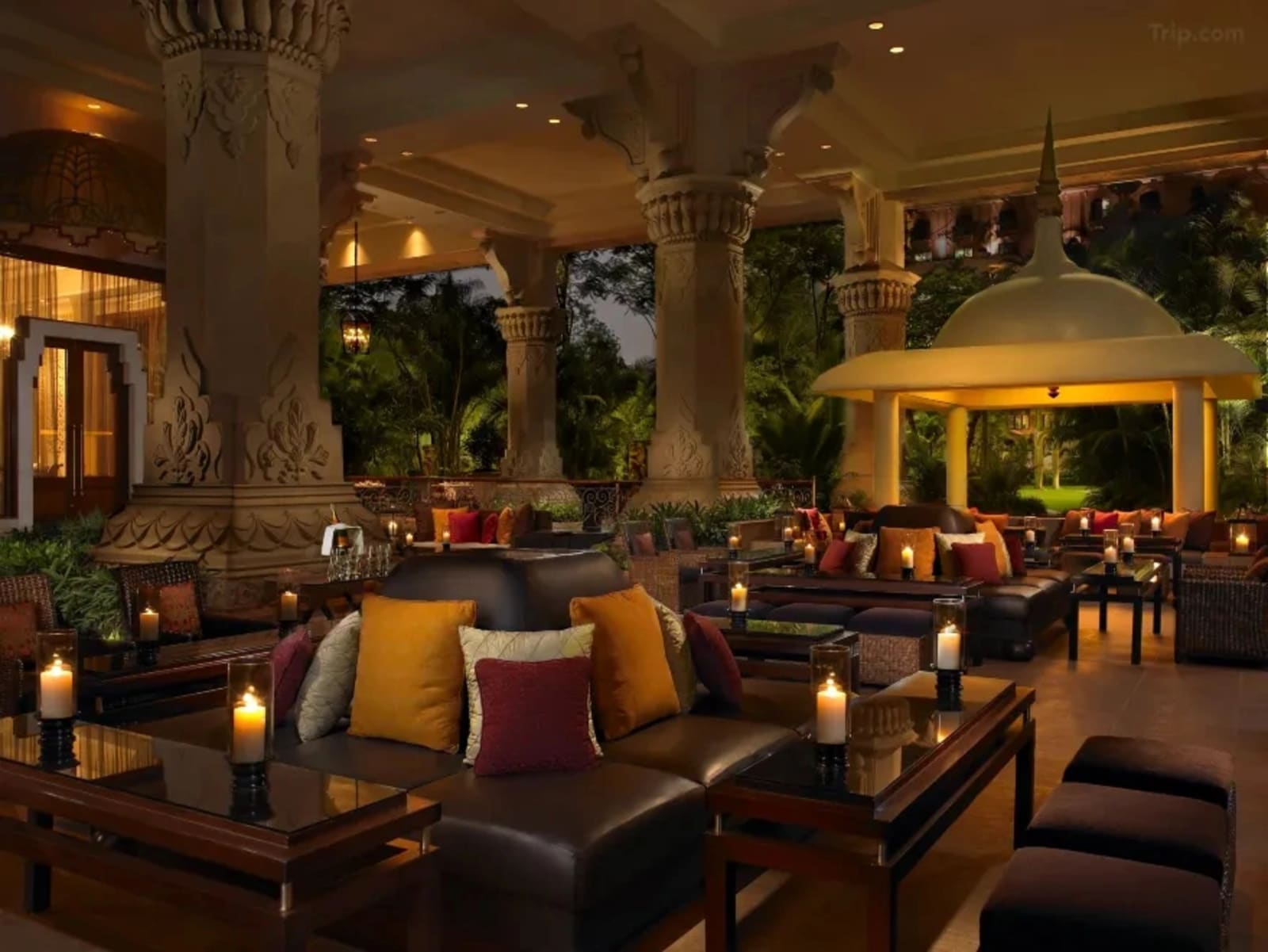
The Tamil family had a clear muhurtham requirement — 7:30 AM on the wedding day — and a complete set of Tamil Brahmin ceremonies that could not be abbreviated. The Kodava family wanted a full Nerchas the preceding evening and a proper Koda Keranda procession on the wedding morning. We ran a Tamil muhurtham ceremony in The Leela Palace's garden at dawn, transitioning into the Koda Keranda procession by 9 AM. By 11 AM both families were sharing breakfast together. The evening reception featured both a Karona Kali performance and Bharatanatyam from a dancer who was the bride's cousin. The result was a two-day celebration that neither family could have designed alone.
FAQ
Cross-Cultural Wedding Questions Answered
How do we handle two different priests for a cross-cultural wedding?
Panigrahana coordinates both priests as part of our planning process. We produce a written ceremony brief that both officiants review and approve — documenting the sequence, timing, and transition points between traditions. Most experienced priests in Bangalore who work with intercultural weddings are comfortable with a coordinated dual-ceremony model. The key is giving each community's ceremony its own dedicated time so neither feels secondary.
Can we combine both communities' rituals into one single ceremony?
Yes — and it can be extraordinary when done with genuine care. A combined ceremony requires deciding which rituals from each tradition are non-negotiable, which can be compressed, and how the transitions between traditions are handled. Panigrahana has produced combined ceremonies for Tamil-Bengali, Telugu-Punjabi, and Hindu-Christian couples. The key is treating the ceremony design as a creative act — not a compromise, but a synthesis that creates something genuinely new.
How do we manage catering for two different food traditions?
Two approaches: a single menu that incorporates signature dishes from both communities, or a dual-station buffet where both cuisines are presented with equal pride. For large weddings at hotel venues, most premium Bangalore hotels can execute either approach. The key is ensuring neither cuisine feels like an afterthought — both should receive equal menu real estate and kitchen attention. We brief the catering team on the cultural significance of specific dishes.
What if the two families have conflicting ideas about decor?
This is one of the most common cross-cultural wedding challenges — and entirely solvable. We begin by understanding what each family considers non-negotiable symbolically, then design a visual language that incorporates those elements organically rather than splitting the decor down the middle (which looks incoherent). The resulting aesthetic is often more distinctive and beautiful than either family's original vision. Conflicts about decor almost always resolve when families see that both their communities' symbols have been honoured thoughtfully.
Do you have experience with Hindu-Christian interfaith weddings in Bangalore?
Yes. Panigrahana has produced Hindu-Christian interfaith weddings at The Leela Palace and Taj West End, among other venues. These typically involve a Hindu muhurtham on one day and a Christian blessing or church ceremony on another, with a shared celebration in between. We have developed specific design frameworks that bridge these two very different aesthetics with coherence and beauty.
Tell us about your families, your traditions, and the experience you want to create for everyone in the room. We will design a wedding that honours both communities with genuine depth and beauty.