South Indian Wedding Decor — Ancient Beauty, Modern Precision
Last updated: June 2026
The aesthetic traditions of Tamil Nadu, Karnataka, Andhra, and Kerala are among the world's richest. Panigrahana designs South Indian wedding decor that honours each.
South Indian wedding decor is not a monolithic aesthetic. It is a family of five deeply distinct visual traditions — Tamil, Kannadiga, Telugu, Keralite, and Kodava — each with its own symbolic vocabulary, preferred materials, colour logic, and spatial sensibility. What looks correct and auspicious at a Tamil Brahmin wedding may be entirely wrong for a Nair ceremony in Kerala, or a Kamma wedding in Andhra. The differences are not superficial. They run deep into religious practice, regional craft traditions, and community memory.
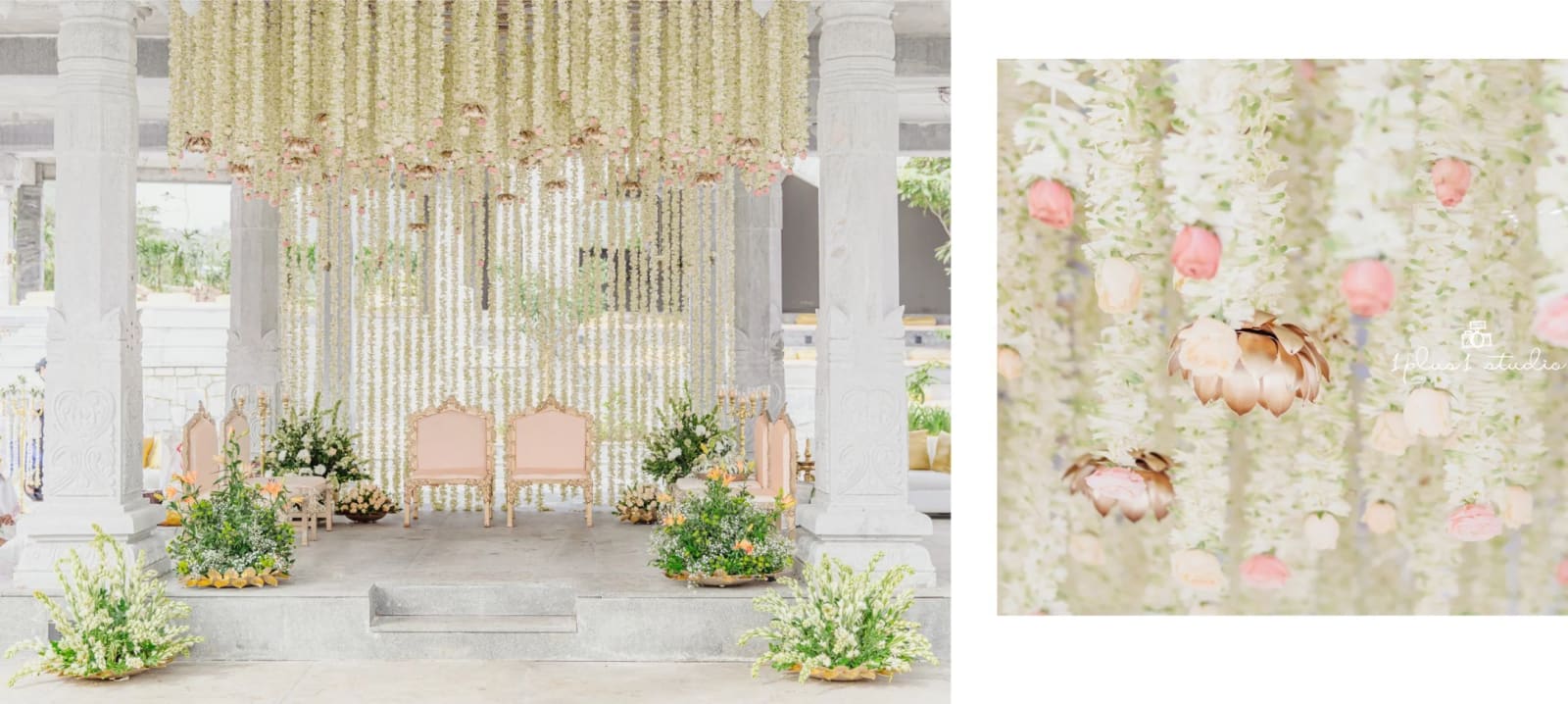
South Indian wedding decor — jasmine garlands, banana fibre mandap and brass kuthuvilakku in Bangalore
Panigrahana's in-house design team has spent a decade studying these distinctions — not from books, but from planning hundreds of South Indian weddings across Bangalore's diverse communities. We understand why a Tamilian family insists on kuthuvilakku at specific positions, why banana fibre is non-negotiable for certain Telugu mandap structures, and why a Kerala family may prefer an absence of marigold entirely. This knowledge is not incidental to our work — it is the foundation.
Bangalore is a particularly interesting city for South Indian decor because it draws all five traditions. A single weekend in our studio's calendar might involve a Kannadiga wedding at The Leela Palace on Friday, a Tamil wedding at ITC Gardenia on Saturday, and a Telugu wedding at a garden venue on Sunday. The city's cosmopolitan character means we operate across the full breadth of the South Indian aesthetic spectrum, often simultaneously.
Studio Facts
Traditions We Design For
Tamil · Kannadiga · Telugu · Keralite · Kodava
Founding Background
Architecture — which means mandap design, spatial composition, and material logic are native skills
Jasmine Sourcing
Direct from Mysore and Bangalore's Hebbal flower market — same-day delivery for peak freshness
South Indian Weddings Designed
120+ across Bangalore
Materials & Vocabulary
The Building Blocks of South Indian Wedding Decor
Every South Indian wedding aesthetic is constructed from the same primary materials, deployed in community-specific combinations. Understanding each element is the first step to designing with authenticity.
✿
Fresh Jasmine (Malligai / Mogra)
The most important floral element in South Indian wedding decor — bar none. Jasmine carries sacred significance across all Dravidian traditions. Panigrahana sources jasmine directly from Mysore farms (for premium malligai) and Bangalore's Hebbal flower market. We control the entire supply chain: ordering the right volume (a large Kannadiga wedding may require 1,500 jasmine strings), storing at 10–12°C overnight, stringing in-house on the morning of the event, and staging within two hours of the ceremony. The freshness window for maximum fragrance and appearance is 6–8 hours — we engineer the timeline around this.
❧
Banana Stems & Palm Fronds
Banana stems (vazhai thandu) are the structural backbone of traditional South Indian wedding entrances and mandap pillars. They create towering arched gateways, flank the processional path, and frame the mandap perimeter with a distinctly organic grandeur that no synthetic material can replicate. Panigrahana sources banana stems from farms within 80km of Bangalore. Palm fronds are used for overhead coverage, creating natural canopy effects at entrance gates. The combination of banana stem and palm frond produces an architecture that is simultaneously ancient and dramatic — particularly when lit from below with warm LED lamps.
◈
Turmeric, Vermillion & Kumkum
The yellow-red palette of South Indian weddings is not an aesthetic choice — it is a ritual one. Turmeric (manjal) represents purity, auspiciousness, and the protective force of the divine. Vermillion (kumkum) carries the concentrated energy of Shakti. Together, they define the colour logic of Tamil and Telugu wedding spaces in particular. In contemporary decor, Panigrahana uses turmeric yellow as a primary palette tone — in fabric drapers, in fresh flower selections (marigold for the yellow register), and in lighting design. The result is a space that reads as simultaneously ancient and curated.
◎
Brass & Bronze
The lamp-stand (kuthuvilakku) is perhaps the single most sacred object in the South Indian wedding space. Its positioning, height, and lighting sequence follow precise ritual logic that varies by community. Beyond the kuthuvilakku, brass and bronze vessels — kumbham (pots), uruli (wide bowls), bells — create a visual vocabulary of antiquity and sanctity. Panigrahana maintains a curated collection of antique and artisan-made brass pieces sourced from Tamil Nadu and Kerala craft centres. We do not use lacquered replicas. The patina of genuine brass under warm lamplight is unmistakable.
☙
Mango Leaf Torans
The mango leaf toran (thoranam) is the universal welcome marker of the South Indian home and ceremonial space. It is hung above every doorway and threshold — signalling auspiciousness, the presence of Lakshmi, and the sanctification of the space for ritual. Regional variations are subtle but real: Tamil torans tend to be tied with turmeric-dipped string; Kannadiga torans often incorporate coconut and banana flower elements; Kerala torans may use specific varieties of mango leaf considered more auspicious. Panigrahana designs and installs torans as part of the integrated decor package — not as an afterthought.
⬡
Kolam & Rangoli
Floor art is a structural element of South Indian wedding design — not an add-on. Kolam (in Tamil tradition) is drawn with rice flour, creating intricate geometric and floral patterns that sanctify the threshold and processional path. Muggulu (in Telugu tradition) is similarly geometric but often larger in scale, sometimes filling entire ceremony floors. Panigrahana employs dedicated kolam and muggulu artists for our South Indian weddings. For contemporary interpretations, we also work with floral rangoli — creating patterns in fresh petals that photograph beautifully and biodegrade naturally after the event.
Regional Design Traditions
Four Distinct Aesthetic Languages
Each South Indian tradition has a visual language shaped by its region's history, religion, and craft heritage. Designing authentically means starting here.
Tamil Wedding Decor
Vivid · Sacred · Architecturally formal
Tamil wedding decor is characterised by its Kanchipuram silk aesthetic — rich jewel tones of deep red, turmeric yellow, and emerald green, drawn from the silk sarees that define Tamil ceremonial dress. The mandap is typically a formal, structured space with banana fibre columns wrapped in turmeric-yellow fabric, kuthuvilakku at precise ritual positions, and Kolam art on the approach path. Jasmine is omnipresent — not just in garlands but as ceiling strings, mandap draping, and in the bride's hair. The overall mood is ornate, sacred, and deeply colour-saturated.
Kannada Wedding Decor
Warm · Sandalwood-inspired · Subtly refined
Kannadiga wedding decor shares much of the Tamil vocabulary — banana stem, jasmine, brass — but deploys them within a warmer, more muted palette. Sandalwood-inspired browns and ochres replace the vivid jewel tones of Tamil decor. The influence of Mysore's royal craft tradition is visible in the use of gold thread woven elements, Mysore-style painting motifs, and a general preference for refined rather than maximalist composition. The mandap tends to be elegant rather than elaborate — the Kannadiga aesthetic rewards restraint more than the Telugu or Tamil traditions do.
Telugu Wedding Decor
Maximalist · Floral-dense · Architecturally bold
Telugu wedding decor is the most maximalist of the South Indian traditions. Heavy floral carpets — typically marigold and chrysanthemum, sometimes stretching across the full ceremony floor — are a defining visual. Banana trunk arches reach towering heights at the entrance, often eight to ten feet tall. Muggulu floor art is large and elaborate. The Kanjivaram silk reference appears in deep purples, peacock blues, and hot pinks. The overall aesthetic is unapologetically grand — Telugu wedding decor is designed to fill large spaces and create a feast for the eyes. At The Leela Palace's main ballroom, a Telugu mandap setup can be genuinely spectacular.
Kerala Wedding Decor
Minimal · Refined · Profoundly elegant
Kerala wedding decor is the most understated of the South Indian traditions — and the most difficult to execute well. The aesthetic is built on restraint: white blossoms (particularly white lotus and jasmine), fresh banana leaf as the primary structural element, brass kumbham and uruli vessels, and subtle gold accents. There are no heavy floral carpets, no vivid colour blocking. The beauty is in the quality of materials, the precision of arrangement, and the quiet sacredness of a space that is designed for ritual, not spectacle. For architecture-trained designers, Kerala decor is the purest expression of less-is-more applied to wedding ceremony space.
2026 Design Direction
Contemporary South Indian Decor Trends
Tradition and modernity are not opposites. The most compelling South Indian weddings today hold both simultaneously.
Architect-Designed Mandaps
Couples are increasingly rejecting the standard flower-draped arch mandap in favour of architect-designed structures that reference specific traditional architectures — Hampi's sculpted pillars, the corbelled ceilings of Chettinad mansions, the carved stone gopura of temple architecture. Panigrahana's founding architectural background makes this our core competency. We design mandap structures from first principles: load-bearing calculations, material studies, spatial sequence from procession to ceremony. The result is a mandap that is a genuine architectural object, not a decorated stage set.
White & Jasmine Minimalism
Influenced partly by Kerala's restraint and partly by contemporary design sensibility, some Bangalore couples — particularly those from Tamil and Kannadiga communities — are choosing an all-white-and-jasmine palette. No marigold, no heavy colour. Just white blossoms, fresh jasmine strings, and the warm glow of brass lamps against a cream fabric backdrop. The effect is serene, photogenic, and deeply sophisticated. It requires precision — the lack of colour means every arrangement must be architecturally perfect.
Kolam Digital Projection + Live Florals
One of the most striking developments in South Indian wedding decor over the last two years is the combination of digital projection kolam (projected floor patterns that animate and evolve through the ceremony) with live fresh flower arrangements. The digital layer allows for far greater intricacy than hand-drawn kolam; the live floral layer provides the organic materiality that no projection can replicate. At Panigrahana, our in-house A/V team works alongside our floral designers to choreograph the two systems — projected kolam in the entrance corridor, fresh flower mandap at the ceremony, digital lighting that shifts between the two.
Copper & Oxidised Silver Metalware
Brass remains the sacred standard — no material substitution happens for ritually significant objects like the kuthuvilakku. But for decorative metalware — vessels, stands, lamp holders, table accents — contemporary South Indian wedding design is moving toward copper (warmer, more immediate) and oxidised silver (for a cooler, more contemporary mood). These choices are design decisions, not ritual ones, and they open up visual combinations that traditional brass alone does not permit.
Honest Pricing
South Indian Wedding Decor Cost in Bangalore
Decor investment ranges widely based on venue scale, material quality, and the number of functions requiring full decoration. Here is an honest reference guide.
Full hotel ballroom transformation — floor kolam art + jasmine ceiling installation + custom mandap + reception design₹22 – 35 lakhs+
Panigrahana full multi-day production (all 3–4 functions, consistent design language across all)₹25 – 50 lakhs+
These figures include materials, in-house fabrication, installation, and breakdown. They exclude venue rental and catering. For a specific quote, start the conversation here.
Can South Indian decor work in a 5-star hotel ballroom?
Absolutely — and when done well, it can be breathtaking. The key is translating the vocabulary (banana stem, jasmine, brass, turmeric) into the scale and grandeur that a large ballroom demands. Panigrahana has executed traditional South Indian decor at The Leela Palace, Taj West End, and ITC Gardenia — hotel settings where our architect-designed mandaps become the centrepiece of a 20,000 sq ft space. The contrast between the hotel's modern interiors and the organic warmth of natural South Indian materials creates an extraordinary visual impact.
How long does jasmine last at a wedding?
Fresh jasmine (malligai or mogra) typically lasts 12–18 hours after stringing when kept in cool, humid conditions. For weddings, we coordinate sourcing so jasmine arrives fresh on the morning of the event. We use chilled staging areas for assembled garlands. Strategic placement — avoiding direct sunlight, air-conditioning vents, and heat sources — extends longevity. For multi-day functions, we reschedule fresh deliveries for each event day. The fragrance peaks in the first 6–8 hours, which is usually when the ceremony is happening.
Is banana stem decoration sustainable?
Banana stems are one of the most sustainable decorative materials available. They are a natural byproduct of banana cultivation — the trunk is cut after the fruit harvest, and using it for decor prevents waste. The material is completely biodegradable. Panigrahana sources banana stems from farms within 100km of Bangalore. After the wedding, the material composts easily. This is one of the reasons traditional South Indian wedding materials are genuinely ecological — these traditions evolved before sustainability was even a concept.
What is the difference between Tamil and Telugu wedding decor?
Tamil wedding decor is characterised by a Kanchipuram silk aesthetic — bright jewel tones, elaborate kuthuvilakku arrangements, banana fibre mandaps with turmeric-yellow overlay, and kolam floor art. The overall mood is ornate and sacred. Telugu decor tends to be more maximalist in floral volume — heavy marigold and chrysanthemum carpets, elaborate banana trunk arches, and muggulu floor art. Both traditions use jasmine extensively, but Telugu decor typically layers more flowers overall. Panigrahana's team has deep familiarity with both traditions and designs each wedding around the specific community's vocabulary.
Can we have a contemporary feel while keeping traditional South Indian elements?
Yes — and this is one of Panigrahana's specialities, born from our architectural background. We approach it as a design problem: identifying the essential vocabulary of a tradition (the elements that carry meaning and aesthetic distinctiveness) and expressing them within a contemporary spatial framework. A jasmine ceiling installation over a clean, architect-designed mandap structure is both deeply traditional and visually modern. Copper lamp-stands replacing ornate brass, white jasmine replacing marigold — we can calibrate the level of contemporaneity precisely to where you want to sit on the spectrum.
Begin Here
Design Your South Indian Wedding in Bangalore
Tell us your community tradition, your venue, and your aesthetic instinct. We'll design a South Indian wedding space that is unmistakably yours.