Goa is the only place in India where you can marry against a backdrop of a 17th-century Portuguese fort, in a laterite-stone colonial mansion, or in a bougainvillea-draped courtyard that has hosted generations of the same Goan Catholic family. This heritage is not decorative — it is structural, physical, and extraordinary. For couples who want a wedding that feels genuinely unlike any other, Goa's Portuguese heritage properties offer something that cannot be fabricated in any hotel ballroom. Heritage venues cluster in North Goa — our North Goa vs South Goa guide gives the geographic context. For overall venue planning, read our complete Goa weddings guide and our destination wedding Goa cost guide for heritage venue pricing ranges.
This guide covers the full range of heritage wedding possibilities in Goa — from the major resort properties that have incorporated heritage architecture to the private mansion experiences that remain hidden from most wedding planning conversations.
Heritage venues in Goa, compared
Each figure below is the venue’s own page, factsheet or public listing on the date shown. Where a venue publishes nothing, the cell says so: ask for it in writing before you shortlist.
| Venue and setting | How it charges | Capacity | Rooms | Outside decorators | Source, checked |
|---|---|---|---|---|---|
| Taj Fort Aguada Resort & Spa, Sinquerim: on the headland below Fort Aguada; Taj calls it the first luxury hotel in Goa | No rental or plate published; Taj quotes catering per plate for each function, plus a room block | Upper Bay View lawn: 200 at round tables, 350 standing | 131 | Permitted | Taj events factsheet and WedMeGood, 27 Sep 2026 |
| The Yellow House, IHCL SeleQtions, Anjuna: a restored Portuguese villa with a modern wing | No wedding or catering rate published | Elegancia ballroom: 80 at a reception | 49 | Not published | IHCL factsheet, 27 Sep 2026 |
| The Postcard Cuelim, South Goa: six rooms around a 350-year-old chapel | No wedding price, package or capacity published; rooms are sold through the group’s own booking page | Not published | 6 | Not published | Hotel page, 26 Sep 2026 |
| Fort Tiracol, Pernem | Plates from ₹2,000 veg / ₹2,500 non-veg; in-house catering only | 35–100 | 8 | Permitted | WedMeGood, 5 Sep 2026 |
| Cotta Mansion, Agaçaim: listed as an Indo-Portuguese heritage venue | Plates from ₹600 veg / ₹800 non-veg; in-house or outside catering | 700–1,000 on the lawn | Not listed | Permitted | WedMeGood, 5 Sep 2026 |
Understanding Goa's Heritage Landscape
The Portuguese ruled Goa for 451 years, from 1510 to 1961. This extraordinary tenure left behind a layered architectural inheritance: Catholic churches and convents in Old Goa, baroque mansions in Panjim's Fontainhas neighbourhood, laterite-stone colonial bungalows across the Old Conquests talukas, coconut estate farmhouses with their distinctive tiled verandahs, and military fortifications like Fort Aguada that defined the coastline. Each of these typologies offers different wedding possibilities.
The Five Heritage Typologies Available for Weddings
- Portuguese forts. Fort Aguada is the most wedding-accessible, incorporated into the Taj Fort Aguada Resort. The fort ruins create ceremony backdrops of extraordinary drama — thick laterite walls, cannon mounts, ocean views from the ramparts. These spaces are technically under the resort's management and can be used as photography locations and ceremony adjacents.
- Colonial mansions (Portuguese bungalows). The grandest of these are the Catholic Goan family mansions — some now converted to boutique heritage hotels, others available for private hire. Properties like Casa Portuguesa in South Goa, and several estates in the Saligao and Anjuna hinterland, represent the most authentic heritage wedding canvas.
- Fontainhas heritage houses. Panjim's Latin Quarter is Goa's most photographed heritage neighbourhood — a labyrinth of pastel-painted colonial row houses, narrow lanes, and Catholic chapels. These cannot typically be hired for large weddings, but they are extraordinary locations for pre-wedding shoots and intimate civil ceremonies.
- Heritage-incorporated resort properties. Several of Goa's major resorts are built on or around heritage estates. Alila Diwa Goa is set within a working coconut grove with a heritage farmhouse aesthetic. The Taj Fort Aguada incorporates the fort. These offer the most accessible heritage experience with full resort infrastructure behind it.
- Catholic churches. For Christian couples, Goa's baroque Catholic churches — the Basilica of Bom Jesus (UNESCO), Se Cathedral, Church of St Francis of Assisi in Old Goa — offer the most extraordinary wedding backdrops in the country. These require the standard church wedding process (baptism certificates, banns of marriage) and are not available to non-Christians for ceremonies.
The Taj Fort Aguada Resort — Wedding at a 17th-Century Fort
The Taj Fort Aguada is the most immediately accessible heritage wedding in Goa for most couples. The resort wraps around the base of the historic Fort Aguada — a Portuguese military installation built in 1612, one of the best-preserved Portuguese forts in Asia. The fort itself is maintained by the Archaeological Survey of India, and while events cannot be held within the protected monument zone, the grounds and views around it are extraordinary.
Ceremony setups at the Taj Fort Aguada use the fort as a visual anchor — couples exchange vows on lawns with the fort's thick laterite walls rising behind them, the lighthouse tower visible above. The Sinquerim Beach below the fort offers ceremony options with the fort headland visible from the sand. The result is a wedding setting with five centuries of history in the frame.
The resort itself — the main Taj Fort Aguada building — is a colonial-era structure, not a modern hotel built to look old. The stone corridors, arched windows, and Portuguese tile work throughout the property give the accommodation blocks genuine character. Guests staying here experience the heritage in their rooms, not just at the ceremony.
- Capacity: the Upper Bay View lawn takes 200 at round tables or 350 standing, and the Aguada Ballroom 170 standing (Taj events factsheet, checked 27 September 2026)
- Rooms: 131 rooms, villas and suites (Taj); WedMeGood and Cvent list 143
- Food: no per-plate rate is published (WedMeGood lists the price on request, checked 27 September 2026); Taj quotes menus per function and date
- Best for: couples who want genuine heritage architecture, more intimate guest counts, and North Goa's surrounding vibrancy
Alila Diwa Goa — Heritage Estate Aesthetic
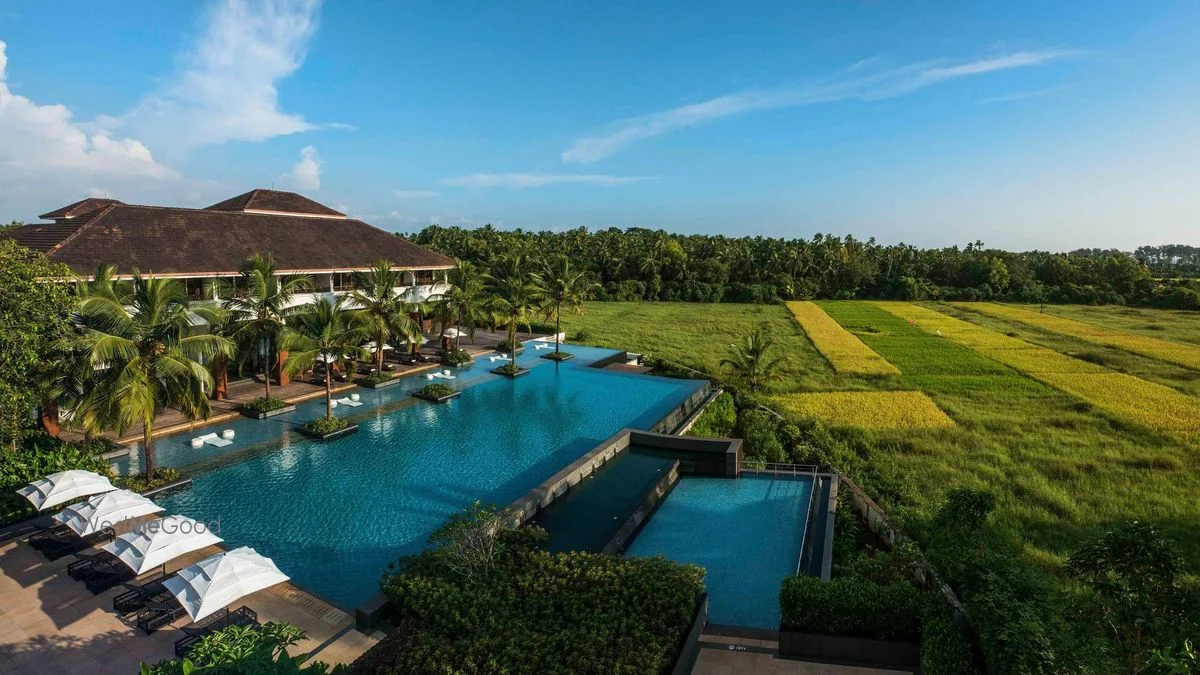
Alila Diwa is not a converted historic building — it is a purpose-built contemporary resort that has been designed in deep dialogue with the traditional Goa farmhouse vernacular. Set within a working coconut and cashew estate in Majorda, South Goa, the resort's architecture references the traditional Portuguese-Goan estate home: terracotta-tiled pitched roofs, laterite stone detailing, shaded verandahs, and a relationship with the land that feels genuinely rooted.
For couples who want the aesthetic and spirit of heritage Goa without the operational complexities of working within a genuinely protected building, Alila Diwa is the most elegant solution. The estate landscape — rice paddies, coconut groves, the gentle Goa hinterland — creates a wedding environment that is entirely different from the beachfront resort experience and entirely specific to Goa.
Private Mansion Weddings — The Hidden Heritage Option
The most extraordinary heritage wedding experience in Goa is one that most couples never find: the private Portuguese mansion hire. There are several dozen significant Portuguese-Catholic family mansions in Goa — some in the Old Conquests talukas of Bardez, Tiswadi, and Salcete — where families will, under the right circumstances and for an appropriate venue fee, allow a wedding to be held on the premises.
These properties are not hotels. They have no event infrastructure — no in-house catering, no PA system, no AV, no dedicated event coordination. Every element must be brought in. But what they offer in exchange is architectural intimacy and authenticity that no hotel can replicate. You are not just in a property designed to look like colonial Goa. You are in a house where the same family has lived for six generations, surrounded by heirloom furniture, original Portuguese tiles, and a garden of mature trees that have been growing since before the Portuguese left.
Finding and securing these properties requires a planner with established Goa relationships. They are not listed on any platform. They are available through personal networks, and the arrangements require careful legal and logistical preparation.
Fontainhas — Panjim's Latin Quarter for Photography and Civil Ceremonies
Fontainhas in Panjim is one of India's most photographically distinctive neighbourhoods — a warren of lanes lined with pastel yellow, blue, green, and ochre Portuguese colonial row houses, their shuttered windows and iron balconies draped in bougainvillea, Mando music drifting from open doorways. It is one of the few surviving Latin Quarters in Asia.
For weddings, Fontainhas functions primarily as an extraordinary photography backdrop — for pre-wedding shoots, for bridal portraits after a ceremony elsewhere, or for the documentary story of a wedding day. The narrow streets, the textures, the colour: photographers consistently describe Fontainhas as among the most rewarding portrait environments in India.
A small number of heritage houses in Fontainhas can also be hired for intimate civil ceremonies or cocktail events — typically for 30–60 guests. The logistics require everything being brought in and a detailed plan for guest movement through narrow lanes. For couples who value authenticity above convenience, it is an experience unlike anything else.
Design Principles for Heritage Goa Venues
The most common mistake at heritage Goa venues is over-decorating. Modern Indian wedding decor — heavy fabricated mandap structures, LED flower walls, neon signs, aggressive lighting rigs — works well in blank hotel ballrooms precisely because those spaces need intervention. Heritage architecture does not. It has texture, history, and visual interest built into every surface. Your decor must enhance that, not compete with it.
- Use organic and natural materials. Dried florals, tropical foliage, local wildflowers, and woven elements work with laterite stone and terracotta tile. Fresh rose walls and artificial flowers look incongruous against 400-year-old stone.
- Prioritise candlelight and warm-toned artificial light. Stone walls absorb cold LED light badly. Warm-spectrum lighting — candles, lanterns, warm-white string lights — flatters heritage interiors magnificently.
- Minimise structure, maximise organic arrangements. Instead of a fabricated mandap frame, consider a natural arch of curved bamboo poles with cascading florals. The space should feel grown, not constructed.
- Let the architecture breathe. Resist the impulse to cover every surface. A single outstanding installation — a floral chandelier in a vaulted hall, a cascade of jasmine over a stone doorway — will photograph far more powerfully than a room full of competing elements.
- Choose a palette that references Goa. Terracotta, ochre, deep teal, ivory, and soft gold reference Goa's architectural palette. Blush pink and millennial purple belong in a different chapter.
Legal Considerations for Heritage Venue Events
Any event at or adjacent to an ASI-protected monument requires explicit permission from the Archaeological Survey of India's Goa circle. The Taj Fort Aguada's management handles this routinely for their events, but if you are independently planning an event involving any protected monument, obtain written permission well in advance. Fines for unauthorised events at protected sites can be significant, and events are sometimes stopped mid-function when permissions are not in order.
Private mansion events require standard event permission from the local panchayat or municipal authority, noise permission for late-night events (Goa has strict noise ordinances after 10pm), and food safety compliance if external caterers are being brought in. Your wedding planner should handle all of this — but verify explicitly that they have done so, not assumed it.
Heritage-listed properties under the Goa State Heritage Conservation Committee carry their own set of restrictions on alterations to the structure, installation of temporary structures, and event duration. For most one-day wedding events these are manageable, but understand the constraints before you fall in love with a venue.
The Photography Advantage of Heritage Goa Venues
Every professional photographer who works regularly in Goa will tell you the same thing: heritage venues produce the most interesting images. Modern hotel venues offer clean, controlled environments that are technically reliable but visually predictable. Heritage venues offer the opposite — technically more challenging (variable natural light, uneven surfaces, unpredictable elements) but visually extraordinary.
The elements that make heritage Goa photography exceptional: thick laterite stone walls that catch warm-raking light beautifully; original wooden doors with their grain and age; terracotta tile floors that reflect candlelight; iron window grilles that create natural framing; courtyard light wells that produce soft, directional natural light; and the textures of age — paint peeling elegantly, moss on stone, the patina of well-used surfaces. These cannot be recreated in a hotel setting, regardless of budget.
The pre-wedding shoot advantage is particularly strong. Fontainhas at golden hour, the Fort Aguada ramparts, an Alila Diwa estate courtyard at blue hour — these produce images that are immediately distinctive, specifically Goan, and timeless in a way that a luxury hotel pool setting rarely achieves.
Cost Range for Heritage Venue Weddings
Heritage venue events in Goa span an extraordinary range depending on the property type. A ceremony and reception at the Taj Fort Aguada for 200 guests follows standard 5-star pricing: expect ₹50–90 lakh for the full event package inclusive of venue, F&B, and basic event services. A private mansion hire for 80 guests involves the venue fee (₹3–8 lakh for the property depending on size and prominence), plus the full cost of bringing in your own catering, infrastructure, and decor — which can add another ₹15–30 lakh. The Alila Diwa for a 150-guest wedding lands in the ₹40–70 lakh range.
The cost model for private heritage properties is fundamentally different from hotel events: you pay less for the venue and more for the logistics of creating an event from scratch. The overall total is often comparable, but the allocation differs significantly. Understand this before comparing quotes.
Explore Taj Fort Aguada Resort in detail, speak with our Goa wedding planning team about heritage property access, or see our beach wedding decor guide for design inspiration that works in Goa's natural and heritage settings.
Frequently Asked Questions
Can I get married at a heritage property in Goa?
Yes, many heritage properties in Goa are available for weddings — Portuguese mansions, converted colonial bungalows, and estates like Alila Diwa. Some ASI-protected monuments (Basilica of Bom Jesus, Old Goa churches) do not permit weddings on their grounds but are excellent for photography. Always verify heritage status and event permissions before booking.
What is the best heritage wedding venue in Goa?
The Taj Fort Aguada Resort is Goa's most impressive heritage wedding venue — set within a working 17th-century Portuguese fort with ceremony options overlooking the fort ruins and the Arabian Sea. For a more intimate heritage experience, converted Portuguese mansions in Panjim's Fontainhas district offer extraordinary character for smaller celebrations.
How do I decorate a heritage venue in Goa without overwhelming it?
The principle for heritage Goa venues is restraint: let the architecture breathe. Use organic florals — tropical foliage, dried pampas, local wildflowers — rather than heavy fabricated structures. Warm candlelight and lanterns complement stone walls far better than cold LED uplighting. The venue itself is the decor; your additions should enhance, not compete.
What are the photography advantages of a heritage Goa venue?
Heritage Goa venues offer textures that no modern hotel can replicate: thick laterite stone walls, arched doorways with original wooden doors, terracotta tile floors, ornate iron balustrades, and bougainvillea-draped courtyards. These elements create naturally layered, atmospheric images that look timeless rather than obviously 'wedding.'
Plan Your Heritage Goa Wedding
Let's Find Your Perfect Heritage Venue
We know every significant heritage property in Goa — including those that aren't publicly listed. Tell us your vision and guest count.
Start the Conversation