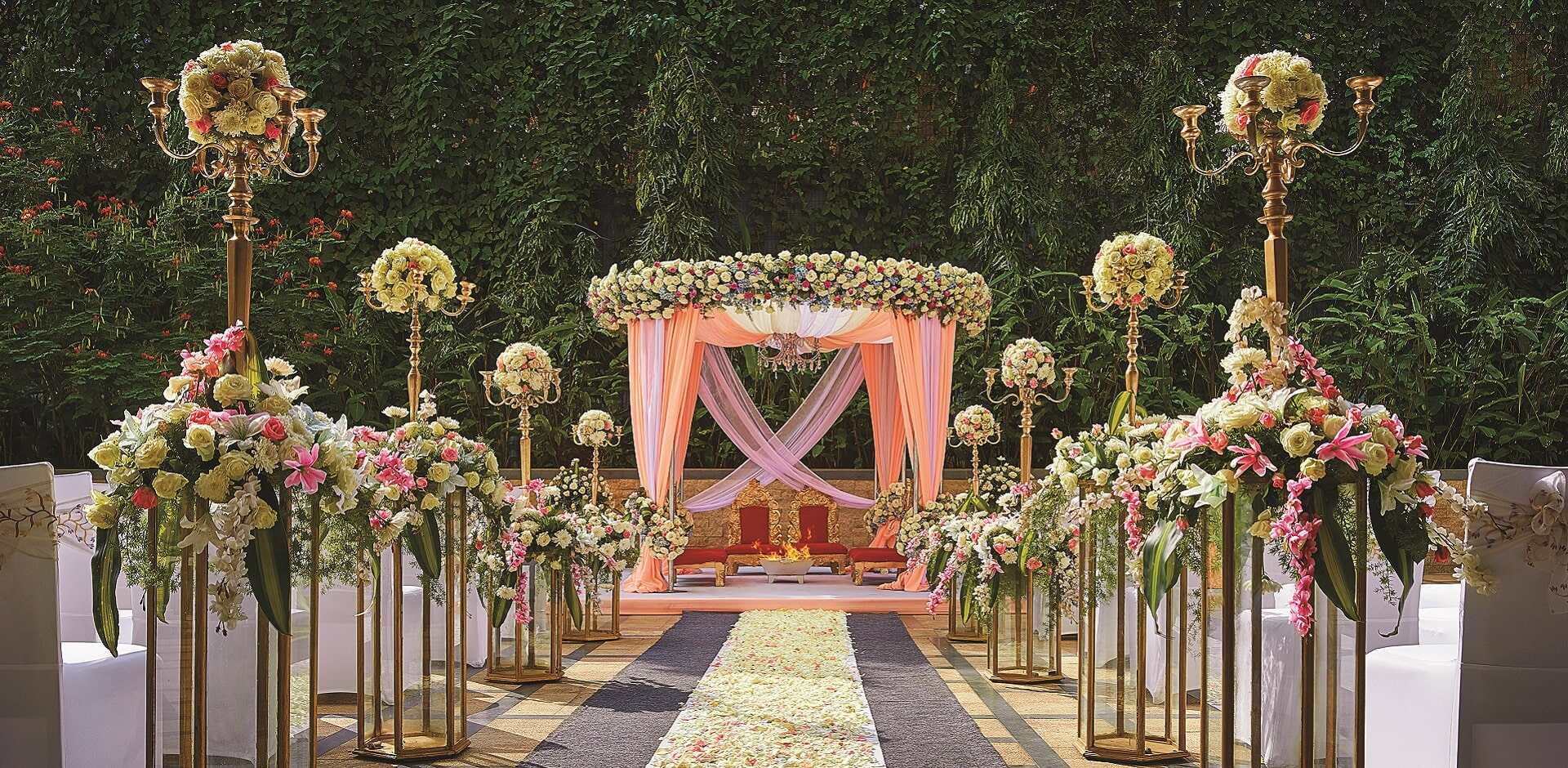
Beach mandaps collapse. Not often, but often enough that every experienced Goa wedding decorator has a story. The wind gets under a canopy. The poles were not driven deep enough. The florals were too heavy for the frame. The ceremony happens, everything looks beautiful — and then the coastal breeze at 5pm puts the entire structure sideways. Proper beach mandap design prevents this. It starts with understanding that a beach mandap is not a hotel mandap placed outdoors — it is an entirely different structural challenge. For the ceremonial context the mandap serves, read our complete South Indian Hindu wedding ceremony guide; for the full multi-day wedding structure it sits within, our multi-day Hindu wedding planning guide.
The Engineering Challenge Nobody Mentions
In a hotel ballroom, a mandap sits on level, solid flooring. You can use tension wires from ceiling anchor points, bolt elements to the floor, and use the architectural structure of the room to stabilise everything. On a beach, the surface is loose granular material with variable compaction. There is no ceiling. The wind is a constant force, not an occasional gust. Temperature and humidity cycle through the day, affecting fabric draping and floral hydration simultaneously.
A mandap that is structurally adequate for a ballroom will fail these conditions without modification. The modification is not complicated — but it must be intentional and executed correctly.
Foundation Methods — Anchoring in Sand
The foundation is the only element of a beach mandap design that is entirely non-negotiable. Everything else is aesthetics. The foundation is safety.
- Sand bag ballast at every upright. Each vertical pole needs a minimum of 20kg of sand-bag weight at its base. For a four-post mandap, that is 80kg total ballast minimum — more in exposed North Goa locations where coastal winds are stronger.
- Poles driven, not placed. Bamboo uprights must be driven into the sand by a minimum of 45–60cm. A pole sitting on the surface is a sail. Use a mallet and drive them before any other assembly begins.
- Cross-bracing at mid-height. Horizontal bamboo or lightweight metal members connecting the uprights at 1.5–2m height. This single addition dramatically reduces lateral flex under wind load. It is the most overlooked structural intervention in beach mandap construction.
- Guying wires for large structures. For mandaps over 3.5m tall or those with a full fabric canopy, additional stability through guying — tension wires angled away from the structure to buried anchors — may be necessary. A structural engineer should assess this for any very large beach mandap.
Bamboo vs Metal — The Frame Question
This is a question couples ask often, and the answer is more nuanced than either camp typically admits.
Bamboo is visually beautiful for a beach mandap. It is organic, warm, and entirely congruent with the tropical beach environment. It is also naturally flexible, which means it absorbs some wind load rather than transmitting it rigidly through the structure. The disadvantages: bamboo joints are weaker than welded metal, and bamboo of variable quality is commonly used in Goa.
Metal frames are structurally superior in every meaningful dimension. They are stiffer, stronger, easier to bolt together securely, and do not have material quality variation. The disadvantages: they are cold, industrial, and entirely wrong aesthetically for most beach mandap designs.
Our solution, and the one we use for all Panigrahana beach mandaps: a concealed metal pipe frame as the structural skeleton, with bamboo cladding and floral coverage providing the visual finish. You get the engineering confidence of metal and the aesthetic warmth of bamboo. The metal frame is entirely invisible in photographs.
Canopy Design Options — Wind Resistance First
The canopy is the biggest wind-catching surface of any mandap. Design it wrong and the structure becomes dangerous in coastal winds. Design it right and it is the most beautiful element of the whole ceremony.
- Open canopy (no fabric). The most wind-resistant option. A mandap defined by its floral elements — garland swags between the posts, a trailing floral crown along the top beam — with no solid fabric to catch the wind. Visually beautiful and photographically stunning in natural light.
- Partial canopy (fabric over the couple only). A compromise that provides shade and visual overhead presence for the ceremony without creating a full wind surface. The fabric section is tied tightly to the frame and kept small in area.
- Full fabric canopy. Can be done on a beach — but requires the fabric to be properly tensioned and weighted, and the frame to be significantly heavier than you would use indoors. In sheltered beach locations (hotel beach sections with windbreaks), full fabric canopies are achievable. In exposed open beach settings, they require engineering review.
- Floral ceiling canopy. A garland grid ceiling is heavier than fabric and needs a proportionally stronger frame, but distributes wind load less uniformly than fabric. Spectacular when executed correctly — the weight of florals actually provides some stability. Ensure the frame can support the load.
Floral Design for Sea Air
The florals on a beach mandap must be selected for the conditions, not chosen from a general wedding moodboard. Sea air is salt-laden, humid, and warm. It degrades cut flowers faster than any indoor condition.
- Use for the day, not the week. All beach mandap florals should be considered single-day flowers — setup on the morning of the ceremony, not the previous day. Even hardy tropicals will show their best at 4–6 hours of freshness.
- Tropical for structure, classic for accent. Birds of paradise, anthuriums, and heliconias form the structural floral elements that will last all day. Use garden roses and lilies only as accent pieces in the more sheltered inner portions of the mandap.
- Marigold and banana stem for day ceremonies. Traditional South Indian mandap materials — marigold garlands and banana stem columns — are actually well-suited to beach conditions. They are hardy, aromatic, and create a beautifully authentic aesthetic against the blue sea backdrop.
- Mist before the ceremony. A fine water mist on the floral arrangements 30 minutes before ceremony start extends their appearance through the event. Simple and effective.
Height, Orientation, and Colour
Three design decisions that are often underweighted in beach mandap planning:
- Keep height under 4m. Wind force on a surface increases with the square of height above ground. A 4m mandap catches significantly more wind force than a 3m one. Unless the beach is genuinely sheltered, 3–3.5m is the maximum height we recommend for safety and structural confidence.
- Orient the couple correctly. Determine the sun's position at your exact ceremony time and location. The couple should face away from the sun — not into it. Squinting into a lens, or a photographer shooting into direct backlight, is avoidable with a compass and a ceremony time confirmed before design is finalised.
- Colour against the sea. Ivory and white photograph magnificently against the blue sea and pale sand — the contrast is elegant and timeless. Vibrant yellows and corals pop dramatically against the sand and create bold, joyful images. Deep jewel tones (emerald, burgundy) can look heavy in full daylight on a beach — save them for evening events.
For floral selection in Goa conditions, read Floral Decor for Goa Weddings. For the full beach wedding decor brief, read Beach Wedding Decor in Goa. To discuss your specific beach mandap vision, speak to our Goa team. Theming each function differently — how the mandap's design language connects to the ceremony decor on either side. Mandap design ideas 2026 — the indoor reference point for any beach adaptation.
Frequently Asked Questions
How do you anchor a mandap on sand?
A beach mandap is anchored using sand bags at each upright base (minimum 20kg per corner), bamboo or metal poles driven 45–60cm into the sand — not placed — and horizontal cross-bracing at mid-height. For larger mandaps or very windy beach locations, additional ballast and structural review is required. The anchoring is a safety requirement, not a design choice.
What type of mandap is best for a beach wedding?
For a beach wedding, the optimal mandap design is low-profile (under 4m tall) with an open or partial canopy, using a concealed metal internal frame with bamboo external cladding. Open canopies are significantly more wind-resistant than full fabric covers. The combination of metal engineering and bamboo aesthetics gives you structural confidence and visual warmth.
How much does a beach mandap cost in Goa?
A basic beach mandap in Goa costs ₹1.5–3 lakh. A fully designed beach mandap with premium florals, custom canopy, and proper structural engineering costs ₹4–8 lakh. At the luxury tier with original structural fabrication and imported florals, ₹10–15 lakh. The engineering and anchoring element is non-negotiable — it is a safety requirement, not an optional upgrade.
Plan Your Beach Mandap
We Design Beach Mandaps That Are Beautiful and Safe
Our team has built beach mandaps across every Goa venue type. Tell us your beach, your ceremony time, and your vision.
Start the Conversation