South Indian wedding decor is experiencing a genuine renaissance. After a decade in which many urban South Indian couples drifted toward a pan-Indian wedding aesthetic — the same suspended floral canopies, the same pale-and-white mandaps, the same European-inspired tablescapes — a significant wave of couples is returning to their cultural roots. Not out of obligation, but out of conviction. They want to know what the mango leaf toran means, why the banana stem stands at the mandap entrance, what the kolam pattern outside the venue door is saying. They want South Indian wedding decor that is true — not Instagrammed heritage, but the real thing, executed with modern design intelligence. This guide explores that territory.
What Defines Traditional South Indian Wedding Decor
Traditional South Indian wedding decor draws almost entirely from the natural world and from daily ritual practice. The elements that recur across Karnataka, Tamil Nadu, Andhra Pradesh, and Kerala weddings share a deep ecological logic — they use what the land provides abundantly, and each element has both practical and symbolic function.
The Core Elements and Their Meaning
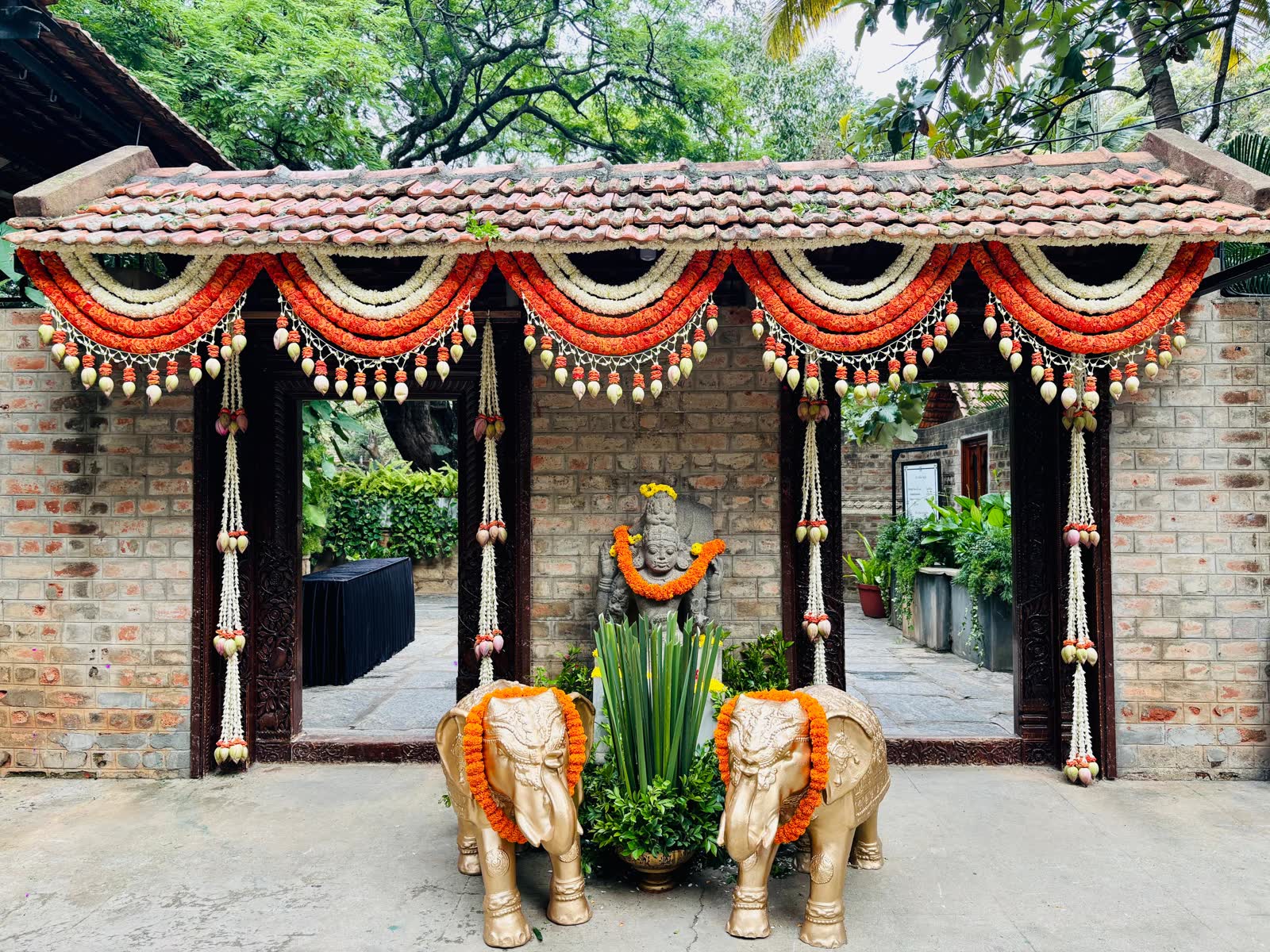
Banana stems at the mandap entrance are not decorative afterthoughts — the banana plant symbolises fertility, prosperity, and completeness. In Karnataka and Tamil Nadu tradition, the banana stem is placed at the entry to the ritual space as an invocation of these qualities. Executing them well means choosing fresh, properly sized stems and placing them with intention, not as an afterthought flanking a photo-op backdrop.
Mango leaves are used in toranas (door garlands) across South India. The mango leaf is considered auspicious — it welcomes positive energy and prosperity. In traditional decor, the torana is made fresh the morning of the event, the leaves still bright green, slightly fragrant. Contemporary interpretations often use dried or spray-painted mango leaves, which misses the point entirely — the symbolism is tied to the freshness and vitality of the living leaf.
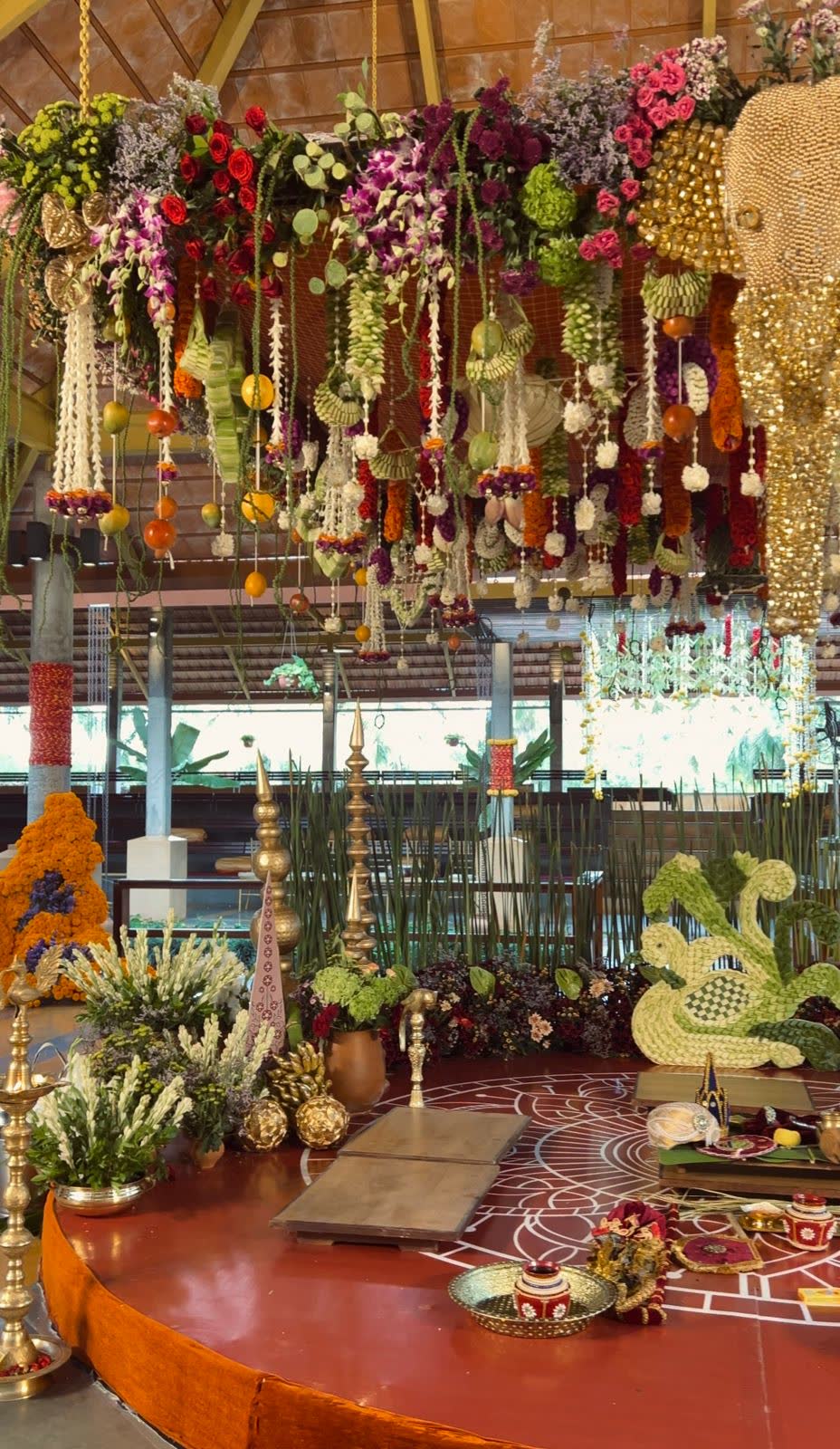
Marigold in South Indian weddings is not simply orange flower decoration. The marigold is auspicious, readily available, and its scent is inseparable from the olfactory memory of South Indian celebration. Petal paths, garland strings between pillars, marigold fringe on the mandap — these are not generic Indian wedding elements. They are specifically South Indian in their density and application.
Kolam — the geometric pattern drawn in rice flour at the threshold — is arguably the most profound decorative act in South Indian tradition. It is drawn fresh each morning, ephemeral by design, inviting prosperity and good spirits into the space. At a wedding venue, a well-executed kolam outside the entrance communicates something that no amount of flower decoration can replicate: cultural literacy and intentionality.
- Banana stems — fertility, prosperity, placed at mandap entry
- Mango leaf torana — auspiciousness, must be fresh
- Marigold — celebration, scent, abundance — used densely
- Kolam — drawn in rice flour, ephemeral, threshold blessing
- Brass oil lamps (kuthuvilakku) — divine presence, light
- Turmeric and kumkum — ritual purity, applied to structural elements
- Jasmine garlands — worn by bride, also used in hair and decor
Why Traditional South Indian Decor Is Having a Revival
The explanation for the current revival of traditional South Indian wedding decor is straightforward once you understand the psychology: contemporary Indian couples are rejecting aesthetic genericness. When every wedding featured the same suspended floral ring, the same white-and-gold mandap, the same European-style tablescape regardless of whether the couple was from Madurai or Mangalore or Mysore, a corrective impulse was inevitable.
The couples coming to us at Panigrahana who want traditional South Indian decor are not conservative or backward-looking. They are highly educated, globally travelled professionals who understand that specificity is more interesting than genericness. They want a wedding that could only belong to their family, their culture, their geography. That is a sophisticated design instinct.
Contemporary South Indian Decor — Keeping the Heritage, Elevating the Execution
Contemporary South Indian wedding decor is not traditional decor with better Instagram angles. It is traditional decor with a designer's eye applied to proportion, material quality, and spatial arrangement. The banana stem is still there — but it is selected for uniformity, dressed with a jasmine garland of superior quality, and placed with spatial precision. The kolam is still drawn at the threshold — but by a master artist, in a design that is specific to this couple and this occasion.
The material upgrade is significant. Traditional decor often used whatever was available locally and quickly. Contemporary execution uses the same elements but sources the best version: marigold from specialist growers in specific shades, jasmine from the finest suppliers, brass lamps that are genuinely antique or beautifully crafted rather than mass-produced. The intention is identical; the execution is elevated.
Colour Contrasts — Traditional vs Contemporary
Traditional South Indian colour palettes are vivid and unapologetic: red, green, yellow, and gold are the dominant notes. Red is auspicious — it appears in the bride's silk, in the kumkum dots, in the festive textiles. Green in mango leaves and banana. Yellow in marigold and turmeric. Gold in the jewellery, the brass, the silk borders.
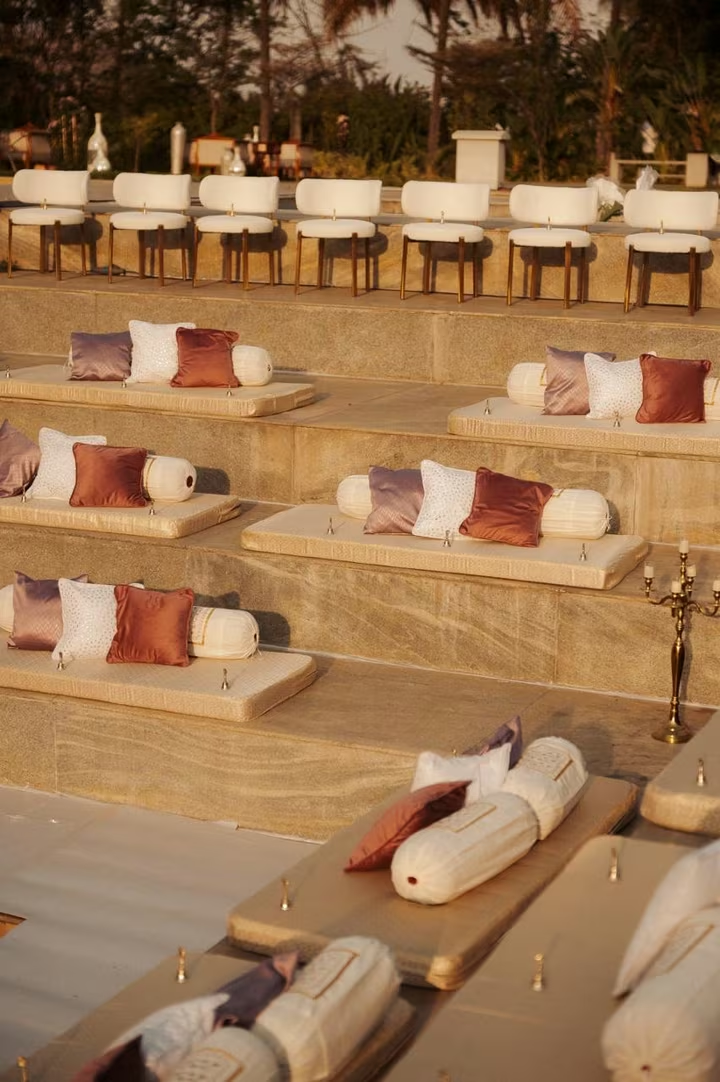
Contemporary South Indian decor retains these reference points but shifts the surrounding palette. Instead of the full traditional palette across every element, a contemporary approach might use terracotta as the foundational tone (a more restrained, earthy version of the traditional red-orange), cream and warm ivory as the neutral, sage as the green accent, and gold as the metallic thread. The traditional colours appear — but concentrated in the most important elements: the bride's attire, the brass lamps, the marigold moments.
Materials — The Most Visible Difference
Traditional South Indian decor uses natural, biodegradable materials: banana leaf, coir rope, clay pots, cotton fabric, and fresh botanicals. These materials have an authenticity and a fragrance that synthetic alternatives cannot replicate. They also have a particular quality in photography — they absorb and scatter light in ways that feel warm and alive.
Contemporary South Indian decor adds materials that traditional settings did not use: linen and raw cotton in natural tones, hand-hammered brass vessels, rattan and bamboo structural elements, unpolished marble. These materials share the natural, artisanal quality of traditional South Indian materials while extending the vocabulary to include more structural design possibilities.
The materials to avoid in a contemporary South Indian context: plastic florals, synthetic silk draping, spray-painted props, mass-produced festival items from catalogue suppliers. These undermine the entire intention.
South Indian Mandap Design — Then and Now
The traditional South Indian mandap is structurally simple and ritually specific: four posts, a canopy, an orientation aligned with the ritual requirements, and decoration that is primarily botanical. The low ceiling of the traditional mandap is not a limitation — it creates intimacy, draws the eye to the couple and the priest, and makes the ritual space feel contained and sacred.
Contemporary South Indian mandap design often extends this structure while keeping its essential character. Taller posts with refined proportions. A canopy that uses traditional fabric — Kanjivaram silk, Mysore silk, handwoven cotton — in place of generic organza. Floral work that uses traditional South Indian flowers — marigold, jasmine, chrysanthemum — in contemporary arrangements rather than replicated from a standard catalogue.
For weddings at Taj West End Bangalore or Leela Palace Bangalore, the challenge is integrating a South Indian mandap into a venue that was not built for it. The solution is always to honour the mandap's internal logic — its proportions, its botanical language, its orientation — rather than adapting it to fit the venue's existing aesthetics. The mandap is the point. The venue is the setting.
What to Keep Sacred, What to Modernise
This is the most important question for any couple navigating traditional and contemporary South Indian decor. Our view, developed through producing hundreds of South Indian weddings in Bangalore and beyond: keep sacred the ritual elements (everything required by the ceremony itself — the fire, the stones, the toranas, the kolam), elevate through the supplementary design choices (the fabric quality, the floral execution, the lighting, the overall spatial arrangement).
Do not replace ritual elements with aesthetic approximations. Do not substitute a paper kolam print for a drawn kolam. Do not swap fresh mango leaves for silk ones. These elements earn their place through their authenticity — the freshness, the fragrance, the impermanence — and that quality cannot be designed in.
We understand what every element means and how to honour it beautifully. Let's create a South Indian wedding that is genuinely yours.
Begin Your Story