A 500-guest wedding in Bangalore is not a 100-guest wedding at five times the scale. It is a categorically different kind of event — with categorically different requirements for design, infrastructure, logistics, and professional management. The elements that make a 100-guest wedding beautiful (restraint, intimacy, considered details) need to be completely rethought for a 500-person production. At this scale, decor must work from 40 metres away. The mandap that looks exquisite in a photograph loses its visual impact when 500 people are sitting around it. The details that define quality at intimate scale become invisible in a crowd. Understanding what scale does to design decisions is the first step to getting a 500-guest Bangalore wedding right. For the full cost picture at scale, our Bangalore wedding decor cost guide covers 500-guest decor; for which venues have the infrastructure, our Bangalore weddings guide; and our garden wedding decor guide for the most popular large-scale outdoor format.
Venues That Handle 500 Guests in Bangalore
Not every large Bangalore hotel is appropriate for 500-guest weddings. Capacity is necessary but not sufficient — the venue also needs to have the infrastructure, the service capability, and ideally the character that a 500-person wedding requires.
- Leela Palace Bangalore: The grand lawn and ballroom combination handles 500+ guests with genuine luxury infrastructure. The palace aesthetic is appropriate for large Indian wedding scale — it does not feel empty when filled. The combination of indoor and outdoor spaces allows different functions to use different zones.
- Sheraton Grand Bangalore: One of Bangalore's largest convention-capable hotels, the Sheraton Grand has the infrastructure for very large productions — power supply, loading docks, rigging points, pre-approved vendor relationships. It lacks the heritage character of Leela or Taj but compensates with operational reliability.
- JW Golfshire: The estate grounds comfortably accommodate 500 outdoors in the October–February window. The Nandi Hills backdrop at this scale creates an extraordinary visual context. Infrastructure is excellent for a non-city property.
- Utsavaa and Panchavati Pavilion: Dedicated wedding venues specifically designed for large-scale Indian wedding productions. Less character than a premium hotel but operationally well-suited for complex multi-function programmes.
- Marriott Whitefield and Renaissance Bangalore: The eastern corridor hotels have large convention spaces and 500+ capacity in their grand ballrooms. The newer construction means good infrastructure and fewer heritage restrictions.
The Scale Law — How Decor Changes at 500 Guests
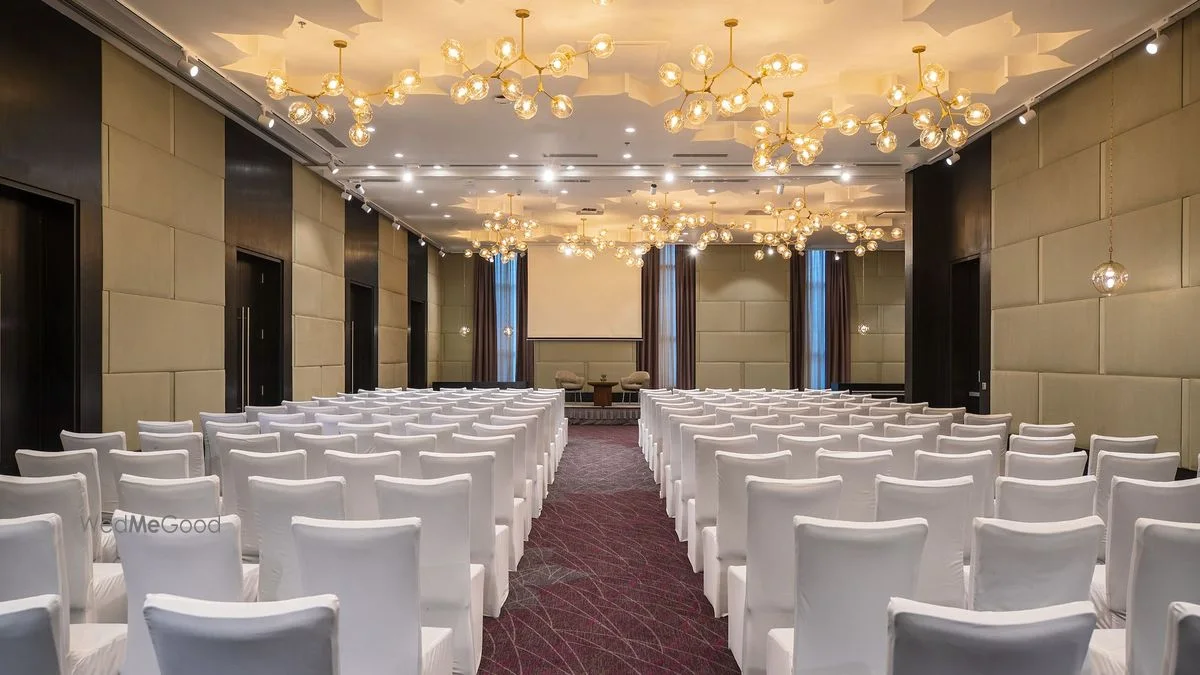
Here is the most important design principle for 500-guest weddings: every decor element needs to be approximately three times larger than your intuition says. The mandap that seems tall enough in a sketch will look low when viewed from 40 metres. The flower column that appeared substantial in isolation will read as a thin line when surrounded by 500 people and their chairs and movement and ambient visual noise.
At 500 guests, the mandap must be architectural — typically 6–8 metres tall for the apex, with a visual spread of at least 8–10 metres wide to read across the room. Floral column installations flanking the stage need to be at least 3 metres tall. Stage backdrops need to be full floor-to-ceiling treatments. The dining table centrepieces need to be either very tall (1.2–1.5 metres for alternating tables) or very lush at low height — the middle height of 60–80 cm gets lost entirely.
Colour at scale: saturated, deeply committed colour palettes work better than subtle, nuanced ones. A palette of champagne and ivory with gold accents photographs beautifully at intimate scale but reads as a visual whisper across a 500-person dining room. Deep ivory with strong gold and burgundy — or a committed jewel tone — holds its visual identity at scale.
Lighting as Infrastructure at Scale
At 500 guests, lighting is not an aesthetic choice — it is infrastructure. The power requirement for a proper 500-guest event lighting plan (stage lighting, room uplighting, table-level ambient, AV systems) typically exceeds venue power supply, requiring one or more generators. Load calculation and generator sizing is done 4–6 weeks before the event, not the week before.
Rigging at scale: the ceiling of a 500-person ballroom is 10–15 metres high. Getting lighting fixtures, hanging florals, or chandelier installations to that height requires scaffolding or rigging crews, which typically need 2–3 days of access before the event. This rigging access timeline must be coordinated with the venue — it cannot be improvised.
Stage lighting for a 500-guest wedding requires proper theatrical-grade equipment: moving heads, gobos, hazer machines for beam visibility, and a lighting desk operator who programmes the show. This is not the same as the standard event lighting that hotel AV teams operate — it is a production-level requirement.
Multi-Zone Design for 500-Guest Events
A 500-person wedding reception is typically divided into zones for operational and experiential reasons. Common zones: a cocktail pre-function area (where guests gather and mingle before the dining room opens), the main dining room, the ceremony/stage zone within the dining room, a dance floor, and often a separate lounge area or dessert station.
Each zone requires its own design logic and its own lighting programme. The cocktail area is typically brighter, more convivial, designed for standing and moving guests. The dining room transitions from a social pre-dinner lighting to a more atmospheric dinner-service mode. The stage is always the brightest point in the room. The dance floor, once activated, switches to a different energy entirely.
Zone transitions — the way guests move from cocktail to dining to dancing — are themselves design opportunities. The moment the dining room doors open should be a reveal. The transition to dancing should be a shift. These curated moments make the difference between a reception that feels produced and one that feels like things just happened.
The Mandap at Scale
The ceremony mandap at a 500-guest wedding must be visible and legible from every seat in the room. This creates specific structural requirements: height, breadth, and visual clarity from all angles. A mandap that is beautiful from the front aisle but unreadable from the side or back is a failure at this scale.
We typically design 500-guest mandaps as three-dimensional structures — visible from 270 degrees — rather than the flat-front backdrop approach that works at smaller scales. The structure must have visual depth and dimensionality, with floral installations that read from distance (large-headed blooms, bold colour, structural height) rather than the intricate detail that works in close-up photography.
The aisle at 500 guests needs to be at least 3–3.5 metres wide to allow comfortable couple processional and photography without guests encroaching. Aisle markers need to be substantial — minimum 1.8 metres tall — to define the aisle perimeter clearly in a densely seated room.
Logistics Reality — Trucks, Teams and Timeline
A substantial 500-guest wedding decor production in Bangalore typically involves:
- 8–15 trucks of materials arriving at the venue over 2–3 days — structural elements, florals (in refrigerated transport), lighting and electrical equipment, fabric, furniture
- 60–100 installation team members working in rotating shifts across 3–5 setup days, including structural fabricators, floral team, electrical crew, and finishing team
- 1 production manager on site full-time from setup day 1 through event end, managing the sequence, quality, and troubleshooting
- 5–7 days of pre-planning meetings with the venue, including loading dock access scheduling, electrical load assessment, rigging point identification, and decor plan approval
- Floral procurement starting 7–10 days before the event for exotic or imported blooms, with final delivery 36–48 hours before installation
The timeline starts 6–8 weeks before the event for a major 500-guest production — not 2 weeks, not 3 weeks. The planning horizon is significantly longer at this scale.
Sound, AV, and Decor Integration
At 500 guests, sound and AV are structural design considerations, not afterthoughts. Speaker placement at scale — typically delay speaker towers at regular intervals through a large room — affects the visual design of the room. Projection screens or LED video walls on stage affect the backdrop design. The position of the mixing console (a physical structure, typically 4–6 square metres) must be incorporated into the floor plan.
We require AV and lighting design to be developed simultaneously, not sequentially. A stage backdrop designed without knowing where the projection screen goes will require revision. A floral hanging installation designed without knowing the rigging weight limits will need to be redesigned. At 500-guest scale, all production disciplines must be coordinated from the beginning.
Budget Range for 500-Guest Wedding Decor in Bangalore
A single-function 500-guest event (either ceremony or reception) with professional decor in Bangalore typically starts at ₹25 lakh and reaches ₹75 lakh for premium productions. A complete three-function programme (sangeet, ceremony, reception) for 500 guests at a premium property ranges from ₹60 lakh to ₹1.5 crore+ depending on the elaborateness of the brief and the level of floral and lighting production involved.
The cost-per-guest calculation is instructive. At ₹50 lakh for 500 guests, you are spending ₹10,000 per head on decor. At a 100-guest wedding with ₹15 lakh of decor, you are spending ₹15,000 per head — and getting a more concentrated, intimate visual result. Scale is not more cost-efficient for decor; it is more expensive because of the infrastructure overhead. The choice of 500 guests is almost never a budget optimisation.
Our team has the infrastructure, relationships, and experience to produce 500-guest weddings at Bangalore's major venues. Logistics, design, and execution — handled entirely by us.
Begin Your Story