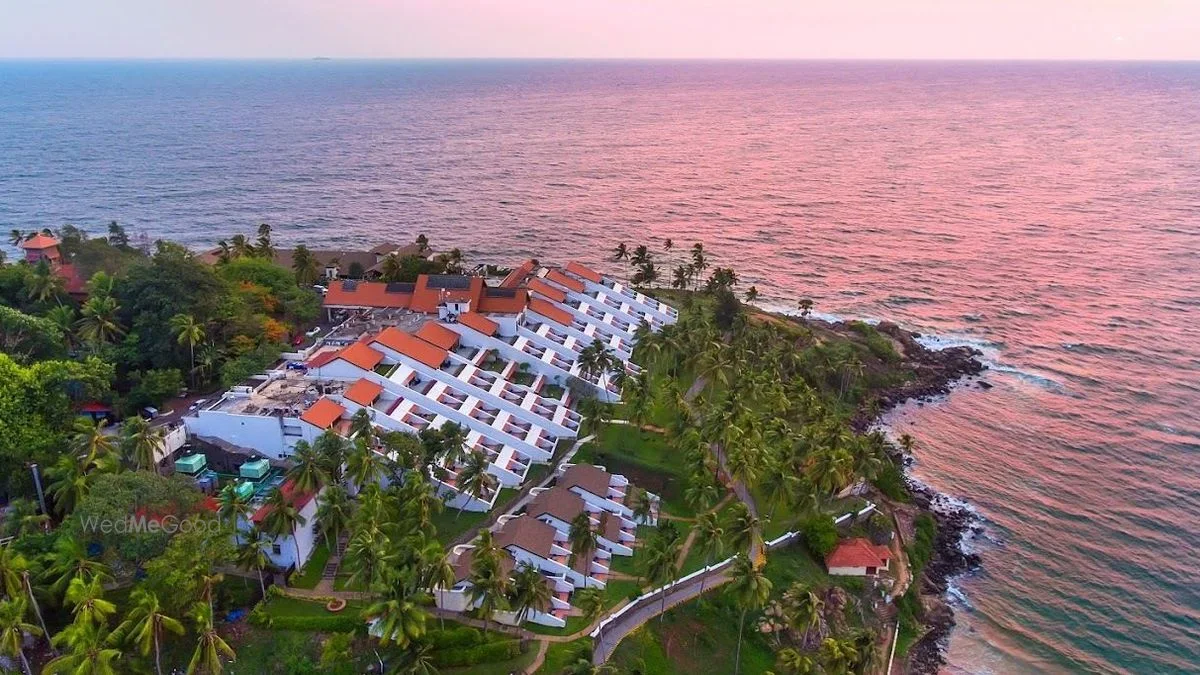
There are wedding venues in India with extraordinary natural settings. And then there is The Leela Kovalam at Trivandrum — a property perched 35 feet above the Arabian Sea on a red laterite cliff, where the wedding setting is not just beautiful but actively dramatic. The sea does not merely appear in the distance here. It is below you, audible, vast, and present in every moment of the ceremony. For the full Kerala venue context, read our complete Kerala weddings guide; clifftop venue costs at The Leela are in our Kerala wedding cost breakdown.
Designing wedding decor at a clifftop venue like the Leela Kovalam requires a completely different framework from a beach, backwater, or hotel ballroom setting. The view is not a backdrop — it is the primary design element. Wind is not a minor consideration — it is a central structural challenge. The photography is not just good — it is among the most dramatic wedding photography available at any Indian venue. This guide covers all of it.
What Makes The Leela Kovalam Different From Every Other Venue
The Leela Kovalam in Trivandrum occupies one of the most dramatic natural positions of any luxury resort in India. The clifftop lawn and ceremony spaces have an unobstructed view of the Arabian Sea — not a narrow sea glimpse but a 180-degree horizon of open ocean. At sunset, the sea turns gold and crimson. At night, the dark water stretches to the horizon, lit only by the moon and distant ships.
What this means for decor is fundamental: the view is already doing extraordinary visual work. Your mandap, your florals, your lighting — none of these should compete with what is already there. The design discipline required here is not "how do we fill the space?" but "how do we frame what is already there?"
The Frame-the-View Principle — The Governing Design Logic
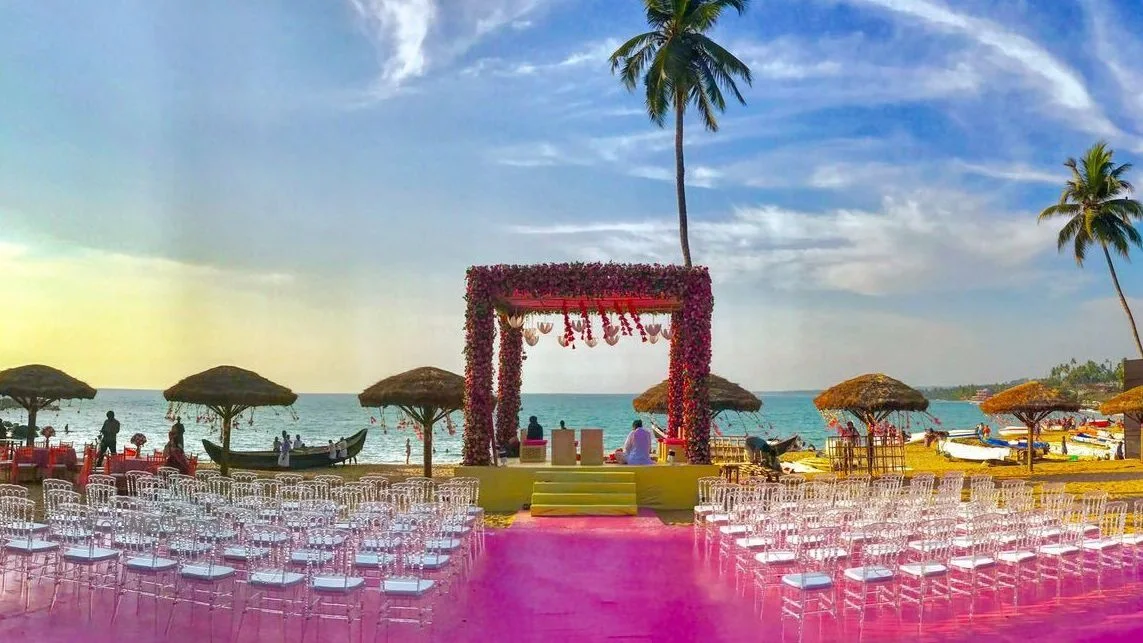
This is the single most important design principle for the Leela Kovalam: minimise what competes with the view, maximise what frames it. In architectural terms, this is the logic of the picture window — the room is designed to draw your eye to the view, and every element in the room is subordinate to that purpose.
Applied to wedding decor: the mandap structure should be open, allowing the sea to be visible through and around it. The floral arrangements should be low (flanking the ceremony space) or hanging (above, without blocking the horizon), never tall and solid between the couple and the sea. The colour palette should harmonise with the sea and sky rather than creating a competing visual focal point.
Event Spaces at Leela Kovalam
The Clifftop Lawn
The primary ceremony space at the Leela Kovalam is the clifftop lawn — a level grass surface at the edge of the cliff with an unobstructed sea view. This is where the most spectacular ceremony setups happen. Capacity for a ceremony is approximately 150–200 guests seated. The mandap is positioned at the cliff edge, with the congregation seated facing the sea — the couple framed by the horizon at sunset is one of the most photographed images in Indian destination wedding photography.
The Infinity Pool Terrace
The infinity pool terrace is an exceptional setting for intimate ceremonies or cocktail events. The pool's infinity edge appears to merge with the sea horizon below — one of the most architecturally dramatic settings at any Indian resort. Design here must be extremely minimal — the setting is already complete. A few nilavilakku lamps, loose floral arrangements, and candlelight are all that is required.
Indoor Spaces
The Leela Kovalam's indoor function spaces are available for mehendi, reception dinners, and monsoon-season events. They are luxurious but conventional by comparison with the clifftop settings — they are the backup, not the primary experience.
Mandap Design for Clifftop Kovalam
A closed mandap canopy at the Leela Kovalam is a serious design mistake. A full fabric canopy blocks the sea view from the couple and from the congregation. It converts the most spectacular natural backdrop in India into a ceiling of fabric. Every couple who has seen the photographs later wishes they had left the horizon visible.
- Open mandap structure. A slim structural frame — two or four vertical columns supporting a minimal overhead element — that defines the ceremony space without enclosing it. The sea is visible on all sides. The couple is framed by the structure with the horizon behind them.
- Floral garland canopy. A garland ceiling of jasmine and white orchids strung between columns allows filtered light and air through while creating a defined ceremonial overhead presence. The sea breeze moves the garlands gently. It is beautiful and wind-tolerant.
- Low nilavilakku placement. The nilavilakku should be placed at the couple's level or below — not on a tall pedestal that introduces vertical competition with the horizon line. A low polished granite plinth with the lamp at waist height keeps the view clear while maintaining the ritual significance of the lamp.
- Minimal backdrop. No solid backdrop at the Leela Kovalam. The sea is the backdrop. If any backdrop element is used, it should be sheer white fabric lightly tensioned — translucent, not opaque — so the sea is visible through it in the ceremony images.
Wind Management — The Non-Negotiable Discipline
At 35 feet above the Arabian Sea, the Leela Kovalam clifftop experiences coastal wind conditions that are significantly stronger than at beach level. Onshore winds in the afternoon and evening are the norm from October to March. Every single structural element in the ceremony decor must be designed and anchored for wind.
- Metal armature, not bamboo-only. All structural elements should use a concealed steel or aluminium frame. Bamboo cladding can be used for visual beauty, but the structural member must be metal. A bamboo-only structure at clifftop Kovalam in afternoon wind conditions is an unreliable gamble.
- Minimum 40kg base weights. Every vertical structural column must be weighted with a minimum of 40kg at the base — sandbags, concrete blocks, or purpose-made ballast. For taller columns (over 3 metres), increase to 60–80kg per base.
- Tensioned fabric, not draped fabric. Loose fabric draping that looks beautiful in still conditions becomes a sail in coastal wind. All fabric in the ceremony space should be tensioned tightly to its structural attachment points — pulled and secured rather than loosely hanging.
- Floral arrangements in weighted containers. All floral arrangements must be in containers with sufficient weight to stay stable. No tall, narrow vases. Broad-base containers with internal weighting. Test every arrangement by tipping it slightly — if it moves easily, add weight.
- Wind rehearsal. We always conduct a wind rehearsal at clifftop venues: walk every element of the setup in the wind conditions of the afternoon before the event, identify anything that moves, and rectify it before the ceremony.
Florals for Clifftop Kovalam — Tropical and Wind-Resistant
The clifftop environment demands the same floral discipline as a beach wedding — but with the additional challenge of elevation wind. Garden roses and peonies are beautiful in still indoor conditions. At clifftop Kovalam in the afternoon breeze, rose petals detach and scatter across the ceremony space. The correct floral choices are tropical and structurally robust.
- Orchids (dendrobium). The most reliable clifftop floral. Waxy petals, no individual petals to detach, widely available, and beautiful in the tropical light. Use in white, purple, or pale pink.
- Anthuriums. Single large waxy blooms on stiff stems. Structurally robust, humidity and wind tolerant, dramatic in large arrangements. Available in white and red — white is most versatile at Kovalam.
- Heliconia. The large tropical flower with boat-shaped bracts. Extraordinarily structurally robust — designed by nature for tropical conditions. Photographically spectacular.
- Jasmine garlands. The traditional Kerala garland, used on the mandap frame and nilavilakku. Secured to the structure rather than hanging loose — in a clifftop breeze, secured garlands are beautiful and alive. Loose garlands become problematic.
- Tropical foliage. Large-leaf monstera, philodendron, banana leaf sections used as ground-level arrangement material or as backdrop framing. Heavy, wind-stable, and photographically powerful against the sea backdrop.
Lighting for Clifftop Evenings — Complement, Not Compete
The Leela Kovalam at sunset is one of the most spectacular natural light experiences in India. The Arabian Sea at 6:15pm, the sky moving through coral and gold to deep blue — this is not something your lighting should try to compete with. It is something your lighting should extend into the evening, after the natural light fades.
- Ceremony timing for natural light. If possible, schedule the ceremony start for approximately 4:30–5:00pm, so the ritual concludes in the golden hour. The couple is photographed at the mandap with the golden sea behind them as the ceremony reaches its conclusion. The lighting design can then take over as the evening progresses.
- Warm amber everywhere. As the natural light fades, warm amber (2700K) LED wash on the ceremony space, the mandap, and the surrounding area creates a continuous warmth from daylight to evening. Avoid cool white LEDs — they create an institutional quality that conflicts with the romantic clifftop setting.
- Candle and lantern accents. Clustered lanterns along the clifftop lawn edge and candles on dinner tables give the sense of fire-lit celebration at height above the sea. The wind makes open flames unreliable — use enclosed candle lanterns rather than open candles.
- No lasers or large-scale LED displays. These compete with the natural night sky and the sea and destroy the intimacy of the clifftop setting. They are tools for ballrooms and grounds-level productions. On a clifftop above the Arabian Sea at night, they are exactly the wrong aesthetic choice.
The Photography — What to Expect
Wedding photography at the Leela Kovalam produces some of the most dramatically beautiful images available at any venue in India. The couple framed against an open sea horizon in the golden hour — the sky moving from gold to pink to deep blue behind them, the red laterite cliff below — is a composition of extraordinary natural beauty.
Your photographer must understand clifftop light management: the contrast between the lit interior of the mandap and the bright sea horizon is significant, requiring a photographer experienced with high-contrast outdoor conditions. Backlit couple shots with the sea and sky behind them are the signature image of a Leela Kovalam wedding — ensure your photographer has a specific brief for this composition.
Best Time of Year — Season and Planning
October to March is the ideal window for a Leela Kovalam wedding. December to February is peak season with clear skies and calm sea conditions. October and November carry northeast monsoon risk — manageable with indoor backup but not risk-free. March is warm but typically clear. Avoid April through September entirely: the Arabian Sea monsoon brings fierce winds, rough seas, and heavy rain to Kovalam from June to September, and the pre-monsoon heat of April and May is uncomfortable for guests.
See full venue details at The Leela Kovalam. For the most intimate clifftop option in Kerala, see Niraamaya Surya Samudra. To speak with our Traditional Kerala wedding decor and flowers — how to layer traditional Kerala florals over a clifftop setting. Kovalam and Varkala beach wedding guide — the broader coastal Kerala wedding context. Kerala wedding planning team, we are available any time.
Frequently Asked Questions
What makes the Leela Kovalam different for wedding decor?
The Leela Kovalam sits 35 feet above the Arabian Sea on a cliff — there is no beach below, just rock and open sea. The view is the primary decor element, which means every design decision should frame the view rather than compete with it. Open mandap structures work far better than closed canopied structures. Wind is a significant factor and all structures must be anchored more securely than at ground-level beach venues.
When is the best time of year for a wedding at Leela Kovalam?
October to March is the ideal window. December to February is peak season with clear skies and calm sea. October and November carry northeast monsoon risk. March is the last reliably good month before pre-monsoon heat. Avoid April to September entirely — the Arabian Sea monsoon is active and the clifftop is fully exposed.
What florals work best at a clifftop venue like Leela Kovalam?
Wind-resistant tropical florals are essential: dendrobium orchids and anthuriums are the best choices, with waxy petals that are largely unaffected by wind and sea air. Heliconias add tropical drama and are structurally robust. Jasmine and mogra garlands work well when secured to the mandap structure. Avoid garden roses as primary florals in clifftop sea air — rose petals detach and scatter in the breeze.
How do you anchor decor structures on a clifftop?
Clifftop anchoring uses metal armature (bamboo cladding over steel frames), weighted bases of minimum 40–60kg per structural column, and cross-bracing at multiple heights. Fabric elements must be tensioned tightly rather than left to drape loosely. No decor element should be assumed to stay in place without testing in actual wind conditions — we always conduct a wind rehearsal the afternoon before the event.
Plan Your Leela Kovalam Wedding
The Most Dramatic Wedding Setting in South India
Panigrahana has designed weddings at the Leela Kovalam's clifftop. We know every wind condition, every light angle, every photography moment. Let us plan yours.
Begin Your Story