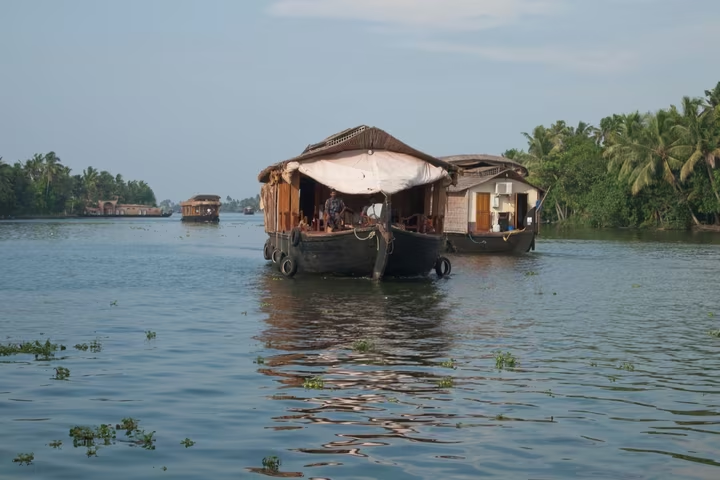
An interfaith wedding in Kerala rests on two pillars: a civil registration under the Special Marriage Act, 1954 — whose 30-day notice period means filing 6–8 weeks before your celebration date — and one or two ceremonial celebrations, most commonly a Hindu kalyanam in the morning followed by a Christian blessing service at the same venue that evening. Kerala suits interfaith couples better than any other Indian destination because its faith communities have lived side by side for centuries, and its backwater, beach, and hill-station venues carry no single religious visual language. For the full Kerala destination context, read our complete Kerala weddings guide; interfaith ceremony costs are in our Kerala wedding cost breakdown.
Quick Answer · Interfaith in Kerala
A Hindu–Christian wedding in Kerala has three parts: the legal marriage and two ceremonies. We plan the legal side under the Special Marriage Act, 1954, which any two people can use whatever their religion: 30 days’ residence in the district, a 30-day notice and three witnesses. The Hindu and Christian ceremonies then take a morning and an evening, or a day each.
A Catholic church wedding is possible when the Catholic partner’s bishop grants a dispensation from “disparity of cult”; the marriage is then valid in the Church but not counted as a sacrament, and the parish makes the application (Wikipedia, Special Marriage Act, 1954 and Marriage in the Catholic Church, both read 27 September 2026). Give each family its own ceremony, its own time and its own catering brief.
Why Interfaith Couples Choose Kerala
In our experience with interfaith couples across India, Kerala comes up repeatedly as the preferred destination for several interconnected reasons.
- Genuine religious pluralism: Kerala is not a state where religious tolerance is a recent policy achievement — it is a lived, centuries-old cultural reality. Interfaith couples report feeling less conspicuous, less anxious about social judgement in Kerala than in many other Indian destination wedding locations.
- Neutral natural landscape: The backwaters, the beaches, the hill stations — none of these landscapes carry the strong Rajput, Mughal, or Hindu temple visual associations that characterise many North Indian destination wedding settings. Kerala's landscape is visually pluralistic. It belongs to everyone.
- Architectural neutrality of the venues: Kerala's finest resort properties — Kumarakom Lake Resort, Taj Bekal, The Leela Kovalam, CGH Earth properties — are architecturally contemporary or traditionally Kerala vernacular. They do not embed a religious visual language that one community might feel excludes them.
- Accessibility and quality: Kerala is a relatively short flight from most of India's major cities and has some of the country's finest five-star resort properties. The combination of extraordinary natural beauty and world-class hospitality at a price point more accessible than Udaipur or Maldives makes it compelling.
The Legal Foundation — Registrar Marriage and the Special Marriage Act
An interfaith wedding in India requires a civil registration under the Special Marriage Act, 1954, regardless of what ceremonial celebrations the couple chooses to have. This is the legal marriage. The ceremonies — Hindu, Christian, civil, or combined — are the celebratory expression of the marriage, but the SMA registration is the legal instrument.
- Notice period: Both parties must give notice at the Marriage Registrar's office in the district where at least one party has resided for 30 days. The notice is displayed for 30 days, during which any person may file an objection.
- Documents required: Birth certificates (or school leaving certificates as proof of age), proof of residence, photographs, and an affidavit stating religion, marital status, and absence of prohibited relationship. The specific list varies slightly by district.
- Witnesses: Three witnesses are required for an SMA registration, all of whom must be present at the registrar's office on the day of registration.
- Timing strategy: File notice 6–8 weeks before your planned celebration date, to ensure the 30-day notice period is complete before the ceremony. Many couples complete the registrar's office formalities in the city where they are based, then travel to Kerala for the ceremonial celebration.
- What SMA registration means for the ceremony: Completing the SMA registration does not preclude having religious ceremonies. Most interfaith couples register legally under the SMA and then have one or two ceremonial celebrations — a Hindu ceremony, a Christian blessing service, or both — as the public celebration.
Combining Hindu and Christian Ceremonies — A Two-Ceremony Structure
The most common interfaith combination in Kerala is Hindu and Christian — Kerala having significant Hindu and Christian populations in close geographic proximity. Panigrahana has managed several Hindu-Christian interfaith weddings in Kerala and has developed a specific approach to this combination.
The Morning Hindu Ceremony
The Hindu ceremony typically takes place in the morning — a Kerala-style Hindu kalyanam or a Vedic marriage ceremony, depending on the Hindu partner's regional tradition and family's preference. In Kerala, the Hindu ceremony centres on the exchange of garlands (mala exchange), the tying of the thali, and the Vedic homa (sacred fire ritual). The ceremony requires a priest, a properly constructed mandap, and approximately 2–3 hours. For non-Kerala Hindu families, the specific ritual form is agreed upon with the priest in advance.
The Afternoon or Evening Christian Blessing
It is important to be specific about what is possible: most mainstream Christian denominations in Kerala will not perform a full sacramental marriage ceremony for an interfaith couple. What is possible — and what most interfaith couples choose — is a Christian blessing service, conducted by a pastor or priest sympathetic to interfaith unions. This is not a sacrament; it is a prayer of blessing, a reading of scripture, and a pastoral acknowledgement of the marriage. A growing number of independent Christian ministers in Kerala are willing to conduct these ceremonies with dignity and theological care. The blessing service is typically held in the late afternoon or evening, in the resort garden or on the lawn, with both families present.
The Transition Between Ceremonies
The moment between the Hindu ceremony and the Christian blessing — the transition that says "this wedding belongs to both worlds" — is one of the most important design challenges in an interfaith Kerala wedding. Panigrahana's approach is to build this transition into the programme deliberately: a shared meal where both families are seated together (not separately), a musical interlude that draws on both traditions (a Kerala classical piece, followed by a hymn, for example), and a brief welcome address from the couple that speaks to what this union means to them. This is not incidental — it is the emotional and social heart of the interfaith celebration.
Managing Family Dynamics — The Most Important Planning Work
The most experienced interfaith wedding planners will tell you that the hardest part of planning an interfaith wedding is not the logistics — it is the family dynamics. Both families must feel honoured, included, and not minimised by the other family's traditions. Panigrahana's approach to family dynamics at interfaith weddings is built on several principles.
- Early briefing: We ask to meet (or call) the senior members of both families early in the planning process — before any ceremony design is finalised — to understand their non-negotiables, their concerns, and their hopes. Many concerns dissolve when families realise their traditions will be fully and respectfully represented.
- Symmetry in ceremony time and visibility: If the Hindu ceremony receives a 3-hour slot in the morning, the Christian service must not feel like an afterthought in 30 minutes in the evening. The time allocation, decor investment, and programme prominence given to each tradition must feel equal.
- Separate and shared seating: For ceremonies, both families will typically be seated together. For meals, some families prefer to begin with their own community around them before the tables are mixed for later courses. This is worth discussing explicitly rather than leaving to chance.
- A single planner who carries both families: One of the worst mistakes in interfaith wedding planning is having a "Hindu wedding planner" and a "Christian wedding planner" who don't communicate. Panigrahana is the single point of contact for the entire event — we speak to both families, hold both ceremony briefs, and ensure that every vendor team understands the full picture.
Creating a Unified Decor Language
Panigrahana's design philosophy for interfaith weddings is not fusion — not a mandap with a cross on it, or a church arch decorated with marigolds. Fusion decor almost always displeases both families. The goal is a unified visual language that is culturally resonant for both traditions without being exclusively from either.
- Natural Kerala elements as neutral ground: Banana leaves, coconut fronds, tuberose garlands, and jasmine are used in both Hindu and Christian Kerala weddings. They are culturally neutral and visually extraordinary. Building the decor foundation on these elements creates a setting that is unmistakably Kerala without asserting a specific religious identity.
- Ceremony-specific elements: The mandap is built for the Hindu ceremony with specific Hindu iconographic elements. The Christian ceremony space uses a floral arch and candles. These are distinct settings, clearly demarcated, not mixed together.
- Photography brief: The photography team must be explicitly briefed on the interfaith context — to capture the emotional moments of both ceremonies with equal care and attention, and to document the moments of connection between the two families as they become one.
Kerala Christian weddings: the parish, the banns and the marriage course. Kerala community wedding guide: how each community’s calendar and customs shape the plan. Kerala wedding cost breakdown for 2026.
Frequently Asked Questions
How does the Special Marriage Act work for an interfaith wedding in Kerala?
The Special Marriage Act, 1954 provides the legal framework for marriage between individuals of different religions. Both parties must give notice at the Marriage Registrar's office in a district where at least one has resided for 30 days. The notice is displayed for 30 days; if no objection is received, the marriage is solemnised and registered. Many interfaith couples file notice 6–8 weeks before their planned celebration date to ensure the legal registration is complete before the ceremonies.
Can we have two separate ceremonies — one Hindu and one Christian — at the same venue?
Yes — two separate ceremonies at the same property on the same day or consecutive days is one of the most common structures for interfaith weddings in Kerala. The Hindu ceremony (Vedic homa or Kerala kalyanam) typically takes the morning slot; the Christian blessing service takes the afternoon or evening. The transition between ceremonies — including seating, meals, and programme — is a critical design moment that Panigrahana plans with particular care.
How do we create decor that works for both families at an interfaith wedding?
The most successful approach establishes a shared visual language without forcing fusion. White and gold work for both Hindu and Christian traditions. Natural Kerala elements — banana leaves, tuberose, jasmine, coconut fronds — are culturally neutral and visually extraordinary. Ceremony-specific elements (mandap for Hindu, floral arch for Christian) are kept distinct and not mixed together. The goal is coherence, not blending.
Is Kerala a good destination for interfaith couples?
Kerala is exceptionally well-suited to interfaith couples. It has one of India's most genuine traditions of religious pluralism — centuries of faith communities living side by side. The landscape is visually neutral and non-denominational. Premium resort properties carry no specific religious visual language. And the natural backdrop — backwaters, beaches, tea estates — transcends religious association entirely.
Plan Your Interfaith Kerala Wedding
Two Traditions, One Celebration — Beautifully Managed
Panigrahana has managed interfaith weddings across denominations and communities in Kerala. We handle the legal, ceremonial, decor, and family dynamics with equal care — so you can focus on each other.
Begin Your Story