Kerala wedding trends in 2026 reflect a broader shift in how India's most discerning couples are thinking about celebration. The post-pandemic reset of priorities — fewer guests, deeper experiences, more honest connection — has combined with Kerala's specific natural gifts to produce a wedding culture that is genuinely exciting. The trends in this guide are not theoretical: they are drawn directly from what Panigrahana couples are requesting, what's working visually, and what has replaced the ideas that defined Kerala weddings three years ago. This is what Kerala weddings look like in 2026. For planning context, read our complete Kerala weddings guide; for how trends affect the budget, our Kerala wedding cost breakdown.
Trend 1 — Houseboat Mehndi Parties
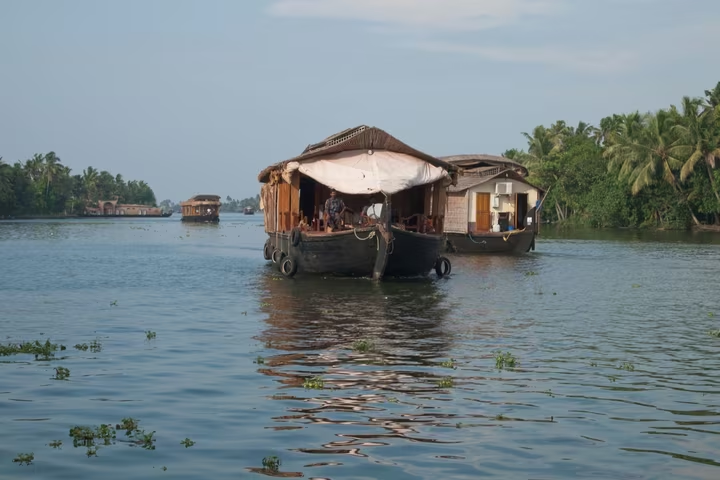
The mehndi party has moved onto the water. A decorated traditional kettuvallam (rice boat), moored at a backwater resort or navigating slowly through the canals, is the 2026 setting for the mehndi function at Kerala destination weddings. The visual logic is irresistible: the bride seated on the bow deck surrounded by her closest friends, the mehndi artist working in the natural light, the coconut palms lining both banks of the canal behind them, the still backwater reflecting the entire scene. Twenty to forty guests. A live musician on board playing Carnatic classical or Malayalam folk. A floating floral installation above the gathering — tuberose and marigold garlands hung from the boat's roof beams, trailing over the side to the water surface. This is what's replacing the hotel mehndi room.
What's out: Hotel banquet mehndi functions with DJ and LED backdrop. What's in: An intimate kettuvallam experience that creates photographs guests will still be looking at in twenty years.
Trend 2 — Floating Flower Mandalas
A floating flower mandala — a large geometric circular arrangement of cut flowers and petals on the surface of a pool or water body — has become the defining visual element of 2026 Kerala weddings. The mandala is typically 2–4 metres in diameter, assembled at dawn by a team of floral designers, and placed at the ceremony pool or on the backwater beside the ceremony lawn. The couple's arrival at the ceremony is framed against the mandala; the drone shot from above captures the full geometric complexity. As the ceremony progresses, petals drift and the mandala dissolves — a living, ephemeral element in the ceremony design. This is Kerala's answer to the floral arch. More complex, more photogenic, more in keeping with the water-centric landscape.
Trend 3 — Jungle-Canopy Mandaps
The most distinctive mandap design emerging from Kerala in 2026 is what we're calling the jungle-canopy mandap: a structure built not from fabric and metal but from living green — bamboo poles, coconut fronds, banana leaves, and trailing tropical vines, with filtered light coming through the canopy rather than electric lighting. The aesthetic is deeply connected to Kerala's forest and plantation landscape. At CGH Earth properties and at resort spaces adjacent to jungle or estate land, the jungle-canopy mandap feels genuinely at home — not a constructed decoration, but an extension of the environment. White tuberose and wild orchids are the florals of choice. The result photographs as something simultaneously ancient and contemporary.
Trend 4 — Sustainable Palm-Leaf Decor
Kerala's traditional palm-leaf weaving craft (palapola) — long used for everyday domestic purposes — is being elevated into luxury wedding decor in 2026. Woven palm-leaf ceiling installations, intricate kolam-style floor patterns made from dried palm and rice flour, and palm-leaf woven table centrepiece structures are replacing the synthetic and imported decor elements that dominated Kerala weddings a decade ago. The craft is genuinely skilled; there are a handful of Kerala artisan collectives producing palm-leaf decor at a level of precision and artistry appropriate for luxury settings. Panigrahana partners with these collectives directly, and the result is wedding decor that is simultaneously sustainable, culturally rooted, and visually extraordinary.
Trend 5 — Micro-Destination Weddings (50–80 Guests)
This is the single most important trend in Kerala wedding planning for 2026. The micro-destination wedding — fifty to eighty guests, a full resort property taken over for two nights, an experience curated for the group rather than a show mounted for an audience — is growing faster than any other format. Couples who have attended large Indian weddings are choosing to celebrate differently: with the people who matter most, in a setting that allows genuine connection, with every detail personalised rather than production-line managed. Kerala is exceptionally well-suited to this format. Properties like Kumarakom Lake Resort, Coconut Lagoon, and Niraamaya Surya Samudra have a small enough footprint to be taken over completely by a group of 60–80 — and in doing so, create an immersive celebration that no 500-person ballroom event can replicate.
Trend 6 — Fusion Sadya-Cocktail Menus
The sadya-cocktail fusion is a 2026 Kerala wedding catering innovation that deserves its own category. The traditional sadya on banana leaf is served as the primary lunch; the evening cocktail dinner uses sadya elements as the base for creative reinvention — avial in individual ceramic cups as a cocktail snack, miniature banana-leaf platters as cocktail course presentations, payasam shots in glass test tubes as the pre-dessert. The overall aesthetic is Kerala culinary heritage presented with contemporary plating intelligence. This approach gives families who want to honour tradition the full sadya experience, while giving couples who want something visually unexpected for the evening the creative freedom to do something remarkable.
Browse all Kerala wedding venues to find the right property for your 2026 celebration. Read our guide to Traditional Kerala wedding decor and flowers — the foundational aesthetic that all 2026 trends are riffing on. Kerala wedding floral decor. Begin planning your 2026 Kerala wedding with Panigrahana.
Trend 7 — Drone Pre-Wedding Shoots at Munnar
Munnar has become the location of choice for 2026 Kerala pre-wedding shoots, and the drone has become the primary creative tool. The aerial view of the Munnar tea estate terraces — the geometric regularity of the tea-bush rows, the mist in the valleys, the couple as a small figure in an enormous green landscape — produces images with a scale and drama that ground-level photography cannot approach. The logistics are manageable: Munnar is a 4-hour drive from Kochi (or 1.5 hours from Cochin International Airport by road to Munnar). A pre-wedding shoot can be completed in a single dawn session (departing from the resort at 5:00am, shooting from 6:00–9:00am as the mist clears, returning by midday). The results justify every logistical complexity.
Trend 8 — AI-Generated Wedding Films
The use of AI video tools in post-production for wedding films is the most technically significant trend of 2026. Kerala wedding videographers are using AI-assisted colour grading tools that analyse the specific light quality of each location and automatically calibrate the colour palette — the golden backwater light, the cool Munnar mist, the warm amber of candlelit dinner — to a consistent cinematic standard. Some production houses are using AI tools to generate transitional footage and dream-sequence visual essays that complement the documentary footage. The films produced using these tools have a cinematic quality previously achievable only with Hollywood post-production budgets. Ask your Kerala wedding videographer specifically about their AI-assisted post-production workflow.
Trend 9 — Intimate Beach Ceremonies at Kovalam and Varkala
The intimate beach ceremony — 20 to 50 guests, bare feet on the sand, the sun setting over the Arabian Sea — is the defining Kerala wedding image of 2026. Kovalam's Lighthouse Beach and Varkala's clifftop beach are the two locations driving this trend. Both offer private beach access from adjacent resort properties; both have the sunset orientation (west-facing, Arabian Sea) that produces extraordinary evening ceremony photography. The ceremony structure is deliberately simple: no elaborate mandap, no LED backdrop, no stage. A flower arch or floating mandala on the water. Chairs set in a semicircle on the sand. The couple standing at the water's edge. This is the anti-spectacle trend in its purest form.
Trend 10 — Warm Amber Lighting Architecture
The era of cool white fairy lights at Kerala weddings is over. 2026 is the year of warm amber — 2200K to 2700K bulbs, Edison filament string lights, paper lanterns, brass lanterns, and beeswax candles used as the primary lighting language for evening ceremonies and dinner events. This lighting temperature works in harmony with Kerala's natural materials — the warm tone of teak, the golden zari of Kerala silk, the amber of the backwater at dusk — in a way that cool lighting never did. The visual coherence of a warm amber-lit dinner on a Kerala resort lawn, with the stars above and the water reflecting the candlelight, is as close to cinematic perfection as Kerala weddings get.
What's Out in 2026
- Overly produced LED video-wall backdrops for outdoor ceremonies
- Cold white fairy-light canopy installations
- Fake flower walls as ceremony or reception photo backdrops
- Theme weddings with forced concept (Bollywood, Maharaja) imposed on Kerala settings
- 500+ guest destination weddings where personal connection is impossible
- Imported flowers (roses, lilies) used as primary decor when Kerala's native flowers are more beautiful and more appropriate
- Identical DJ sets at every function — mehndi, sangeet, and reception each sounding the same
Frequently Asked Questions
What is the most popular wedding trend in Kerala for 2026?
The dominant trend is the micro-destination wedding — 50 to 80 guests, a single premium resort property taken over for two nights, with a level of personalisation that large weddings cannot provide. The houseboat mehndi party is the most specific Kerala expression: a mehndi ceremony on a decorated kettuvallam on the backwaters, with 20–40 guests, live music, and floating floral installations.
Is sustainable decor a real trend at Kerala weddings or just marketing?
Sustainable decor at Kerala weddings is genuinely real — and it is rooted in Kerala's existing material culture. Banana leaves, coconut fronds, palm-leaf weavings, and local flowers have always been part of Kerala ceremonies. The 2026 trend is the conscious elevation of these materials to luxury standard: precision-crafted palm-leaf ceiling installations, banana leaf floor art, locally sourced floral compositions that are composted after the wedding. The result is both more sustainable and more visually beautiful than synthetic alternatives.
What is a floating flower mandala and how does it work at a Kerala wedding?
A floating flower mandala is a large circular floral installation placed on a pool or calm water body — typically 2–4 metres in diameter, assembled from cut flowers, petals, and foliage in concentric geometric patterns. The couple's arrival at the ceremony is framed against the mandala; drones capture the full geometric complexity from above. As the ceremony progresses, petals drift and the mandala dissolves — creating a living, ephemeral element. It photographs exceptionally well from both eye level and above.
Plan Your 2026 Kerala Wedding
Every Trend Starts With the Right Planner
Panigrahana is at the forefront of Kerala wedding design in 2026. If any of these trends resonates with your vision, let's talk about how to build it into your celebration.
Begin Your Story