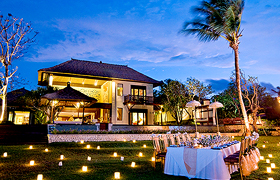

A Bali wedding costs 20–30% more than an equivalent Goa wedding — roughly INR 1.8–2.5 crore versus INR 1.3–1.8 crore for 100 guests at a luxury venue — and the right choice splits cleanly on guest list and travel appetite: Bali suits 30–120 internationally mobile guests who want visually distinctive photography and Balinese Hindu cultural depth; Goa suits weddings above 150 guests, older or passport-free guests, and zero travel friction. This comparison is the product of over 100 combined destination weddings across both locations. For a full Bali planning deep dive, read our complete Bali destination wedding guide; for a precise cost comparison, our honest Bali wedding cost breakdown in INR gives concrete figures for both destinations.
The Core Difference — International vs Domestic
The most fundamental difference between Bali and Goa for an Indian couple is not the scenery, the venues, or the cost — it is the psychographic signal the choice sends. A Goa wedding says: we love India, we love coastal beauty, we want our guests to have an easy, comfortable experience without the friction of international travel. A Bali wedding says: we are willing to go further, to ask more of our guests, to take on more logistical complexity, because the setting and the experience that Bali offers is worth it. Both signals are valid. Neither is superior. But they are genuinely different, and couples should make their choice with that difference in mind.
Cost Comparison — Bali is 20–30% More Expensive
A Bali wedding costs 20–30% more than an equivalent Goa wedding. This is a reliable estimate based on Panigrahana's experience managing both at luxury levels. The cost drivers are specific:
| Cost Factor | Goa | Bali |
|---|---|---|
| Flights (per person return) | INR 4,000–12,000 | INR 15,000–35,000 |
| 5-star resort room/night | INR 8,000–25,000 | USD 200–600 (~INR 17,000–50,000) |
| Venue hire (100 guests) | INR 8–18 lakhs | INR 12–28 lakhs |
| Decor and florals | INR 6–14 lakhs | INR 9–20 lakhs |
| Visa requirement | None (domestic) | USD 35/person (visa on arrival) |
| Indian catering quality | Excellent (in-house) | Good (specialist suppliers) |
For a 100-guest wedding at a luxury venue with 3-night hotel stay, a Goa wedding all-in might cost INR 1.3–1.8 crore; the equivalent Bali wedding INR 1.8–2.5 crore. The difference is real but not prohibitive — and for couples to whom the Bali setting and experience is the priority, it is entirely justifiable. The key is making the decision with full cost awareness rather than discovering the premium mid-planning.
Visa and Travel Logistics — Friction vs Ease
Goa requires zero travel friction for Indian guests: no passport required (Aadhaar or PAN suffices for domestic flights), no visa, familiar currency, familiar language (English and Konkani widely spoken), and direct flights from every major Indian city. The logistics of getting 100 Indian guests to Goa are fundamentally simple.
Bali requires a passport for all guests, a visa on arrival (USD 35, paid in USD cash or card at the airport), an international flight (typically 4–6 hours from major Indian cities), and navigation of a foreign currency (Indonesian Rupiah). For older guests, guests who have not travelled internationally before, or guests with health conditions, the friction is real and should be factored into the invitation list planning. Panigrahana provides all Bali wedding guests with a detailed pre-travel document covering visa requirements, currency exchange, health considerations, and airport logistics.
Venue Variety — Scale vs Intimacy
Goa's wedding venue infrastructure is more developed for large Indian weddings. The Taj Exotica, Grand Hyatt Goa, Leela Goa, Alila Diwa, and Park Hyatt Goa all have dedicated wedding teams, large ballrooms and outdoor spaces, in-house Indian catering, and experience managing 200–500 guest Indian wedding productions. Goa is where the Indian wedding industry has invested most heavily in destination wedding infrastructure over the past decade, and that investment shows in the quality, reliability, and scale of venue options.
Bali's luxury venue infrastructure is exceptional for weddings up to 120 guests — Alila Uluwatu, Bulgari Bali, Capella Ubud, The Mulia Nusa Dua — but capacity constraints and the physical design of Bali's luxury properties mean that very large Indian weddings (200+ guests) are more challenging to execute at the same quality level. For weddings above 150 guests, Goa has a structural advantage that Bali cannot easily overcome.
Decor Possibilities — Tropical Lush vs Beach Coastal
Bali's tropical landscape — the rice terraces, the volcanic stone temples, the dense jungle canopy, the cliff-top ocean views — provides a decor backdrop of incomparable visual drama. Indian wedding decor in Bali can draw on local materials (bamboo, volcanic stone, tropical flowers, banana leaf) to create a hybrid aesthetic that is unmistakably Indian in its ceremonial vocabulary and unmistakably Balinese in its material palette. The result is wedding photography that looks unlike any other destination in the world.
Goa's coastal and colonial setting — Portuguese-era churches and mansions, beach resorts, lush green rice fields — is beautiful and photographically compelling in its own register. The challenge is that Goa, having hosted thousands of Indian destination weddings, has a more familiar visual vocabulary: the beach ceremony with a mandap facing the ocean, the resort garden reception, the sunset cocktail hour. It requires more creative effort to produce wedding photography in Goa that feels genuinely distinctive. This is achievable — Panigrahana consistently produces extraordinary Goa wedding photography — but Bali's visual distinctiveness is a genuine asset for couples who value that difference.
Cultural Experience — Hindu Depth vs Portuguese Heritage
Bali offers something culturally extraordinary for Indian couples: the experience of watching a form of Hinduism that has evolved in isolation from the Indian subcontinent for over a thousand years. The Balinese Hindu tradition — its temple architecture, its elaborate daily offerings, its kecak fire dance, its spiritual relationship with nature — is profoundly moving for Indian couples who arrive expecting tropical tourism and discover a living, thriving cousin of their own faith. Many Indian couples report that encountering Balinese Hinduism is one of the most meaningful parts of their Bali wedding experience.
Goa's cultural identity is built on the intersection of Portuguese colonial legacy and Konkani Hindu and Catholic traditions. The white-washed colonial churches, the old houses of Goa's Hindu and Catholic families, the Goan seafood culture — these are genuinely interesting and historically rich. But they do not carry the same resonance for Indian Hindu couples as Bali's Hinduism. For couples to whom cultural depth is a significant consideration, Bali has an advantage that is hard to replicate.
Legal Complexity — Both Need a Plan
Neither Bali nor Goa destination weddings eliminate the need for legal registration. In Goa, Indian marriage law applies fully, and the couple can choose to register their marriage at the wedding venue (with advance notice to the Sub-Registrar) or at a local registrar office in their home city. In Bali, the ceremony is not automatically legally valid in India, and the couple must register in India after returning home. Panigrahana provides both sets of couples with a post-wedding legal registration checklist and recommends completing legal registration within 30 days of the ceremony in either destination.
Browse the best Bali venues for Indian weddings or our Goa venue listings at all Goa wedding venues to compare specific properties in each destination. Ready to decide? Begin planning with Panigrahana and we will guide you through the choice together.
Panigrahana's Verdict — Who Should Choose Which
Choose Bali if: your guest list is 30–120 people; your guests are primarily young, internationally mobile, and passport-holding; you want visually extraordinary and distinctive wedding photography; the cultural depth of Balinese Hinduism is meaningful to you; you are comfortable with a 20–30% cost premium for the experience; and you want guests to have an internationally sophisticated holiday experience before and after the wedding.
Choose Goa if: your guest list is over 150 people; you have older guests or guests without international travel experience; you want to minimise per-guest travel friction and cost; you value the familiarity of an Indian setting and Indian food standards; you want the flexibility of a larger venue inventory; and your budget is firm at the level that Goa's pricing makes possible without Bali's premium.
Panigrahana does not have a preference between the two. Our most memorable weddings have happened in both destinations. The right answer is the one that fits the specific couple — their guest list, their budget reality, their visual priorities, and their sense of what a wedding should feel like.
Frequently Asked Questions
Is a Bali wedding more expensive than a Goa wedding?
Yes — typically 20–30% more. The primary drivers are international flights (INR 15,000–35,000 per person vs INR 4,000–12,000 for Goa), accommodation priced in USD, and the Bali premium on venues and decor. A 100-guest Bali luxury wedding costs approximately INR 1.8–2.5 crore vs INR 1.3–1.8 crore for an equivalent Goa wedding.
Do Indian guests need a visa for Bali?
Yes — visa on arrival at Bali airport (Ngurah Rai), USD 35 per person, valid 30 days. The process takes 10–25 minutes. For large groups arriving on the same flight, Panigrahana advises staggered arrival to avoid long visa queues. All guests need a valid passport.
Which destination has more venue options for large Indian weddings?
Goa — significantly more options for 200+ guest Indian weddings. Taj Exotica, Grand Hyatt Goa, Leela Goa, and Park Hyatt Goa have dedicated wedding teams, large event spaces, and in-house Indian catering built for large productions. Bali's luxury venues are exceptional but capacity-limited, making Goa the structural choice for very large wedding groups.
Is a Bali wedding legally valid in India?
The Bali ceremony is not automatically legally recognised in India. Couples must register the marriage in India after returning home — at a local marriage registrar office under the Special Marriage Act or Hindu Marriage Act. The ceremonial Bali wedding is fully meaningful and valid as a celebration; the legal registration is a separate administrative step. Panigrahana provides a post-wedding registration checklist for all Bali couples.
Bali or Goa — We Know Both
50+ Weddings in Each Destination. Zero Bias.
Tell us your guest count, budget, and what matters most to you. We will tell you honestly which destination is right for your wedding.
Begin Your Story