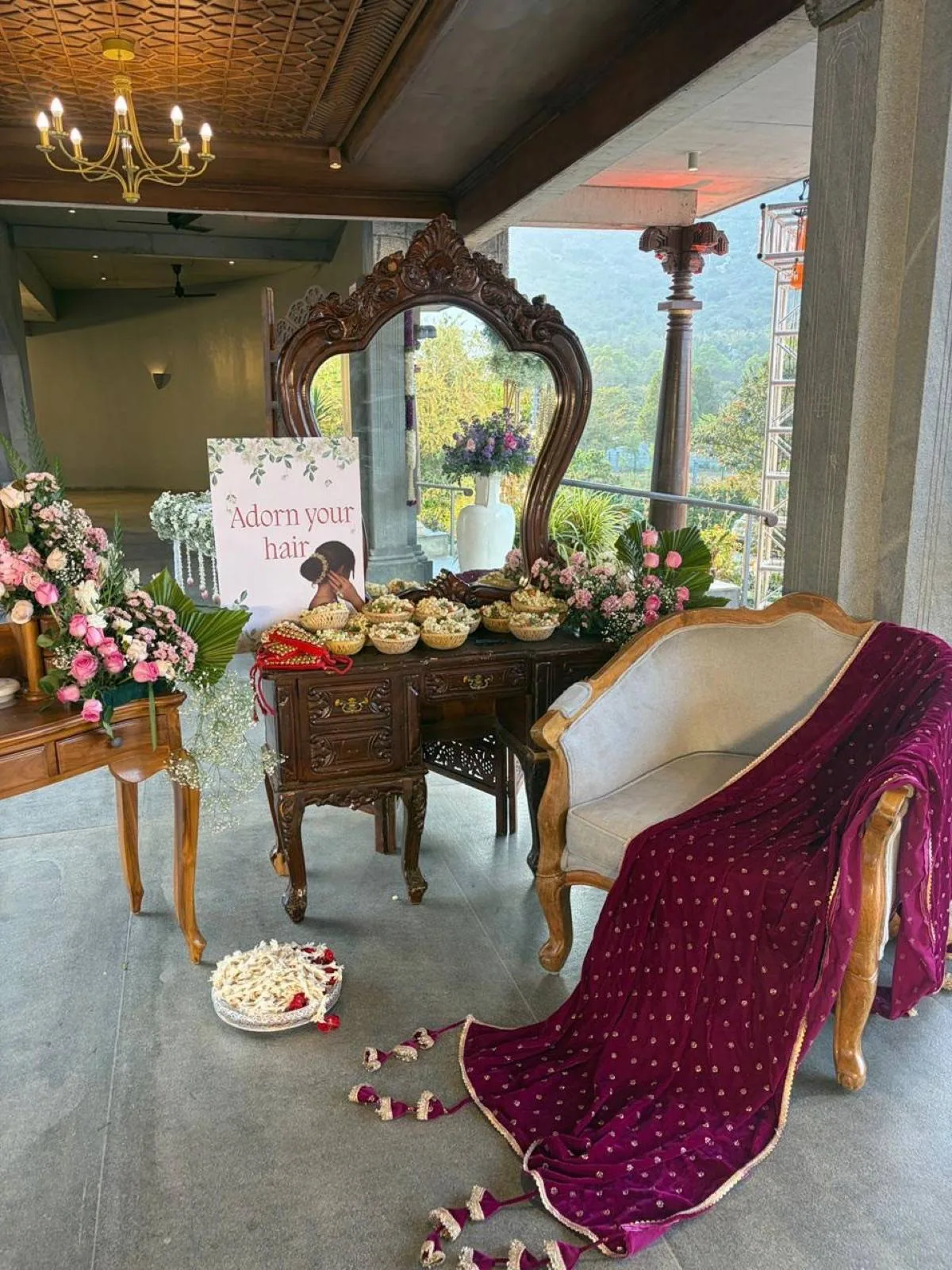
A mehendi runs three to five hours and your guests sit still for two of them, so the decor is a seating brief before it is a backdrop brief. Shade, back support, artist stations at the right light level and a photo wall that works in daylight and after dark are what decide whether the afternoon feels designed. Below are the setups we have built across Bangalore, Goa and Kerala, with what each needs structurally and where couples usually overspend.
Every idea here is one of ours, with the build logic and the failure mode named. If you want the sequence and the hosting side of a mehendi rather than the build, our mehendi ceremony decoration notes and the pre-wedding functions playbook cover that.
Mehendi decor is a seating brief, not a backdrop brief
Work out where 150 people sit for three hours, then design what is behind them. It sounds obvious and almost nobody does it, which is why so many mehendi functions look beautiful in the first ten photographs and tired in the next hundred.
Our working rule: every guest gets a seat with back support within easy reach of the food, and the bride's seat is the only one in the room designed for a fixed pose. We allow about a metre of width per seated guest on a bolstered floor setup and rather less on a sofa, and we plan roughly a third more seats than the guest count, because people move and leave bags.
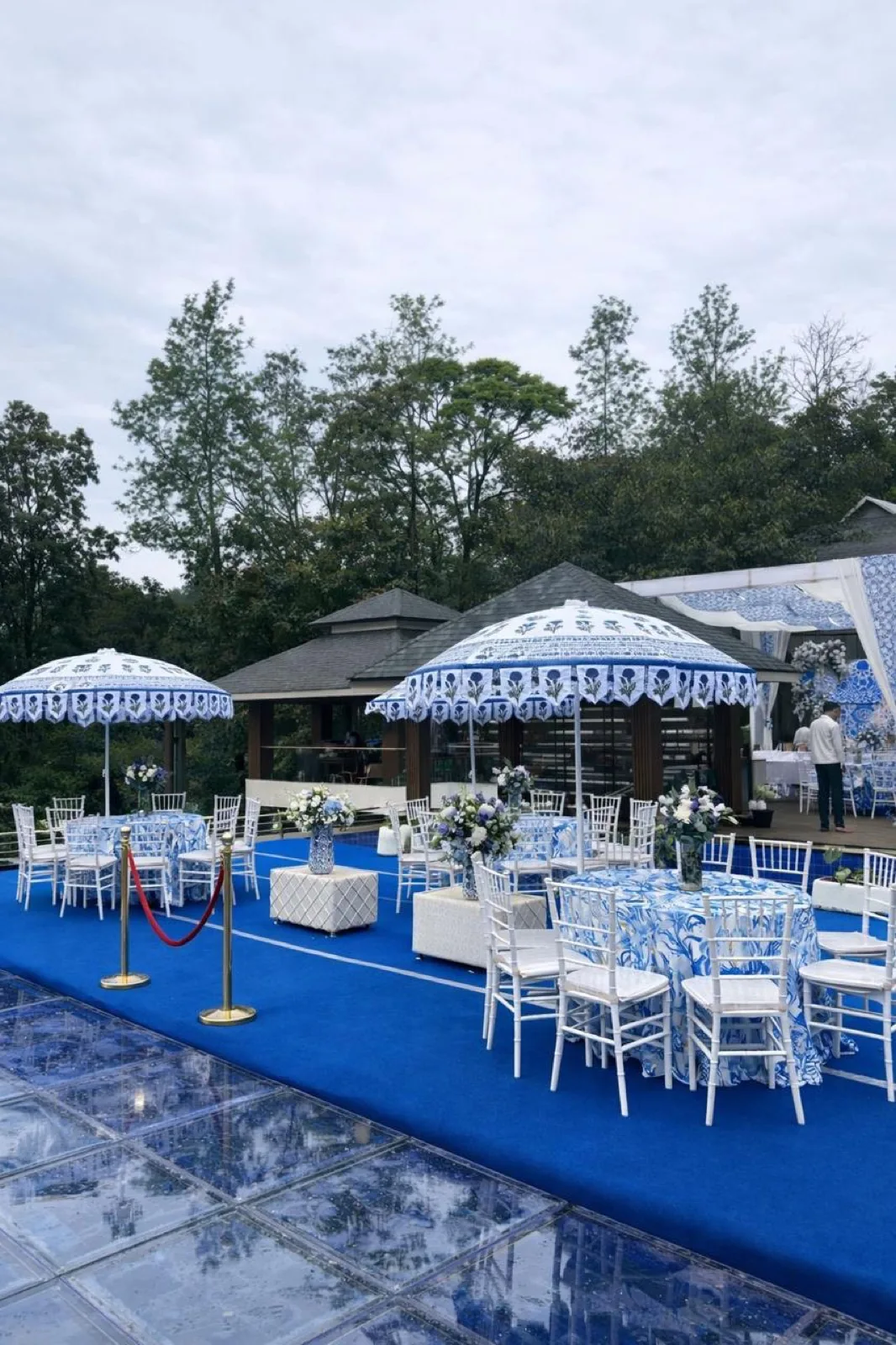
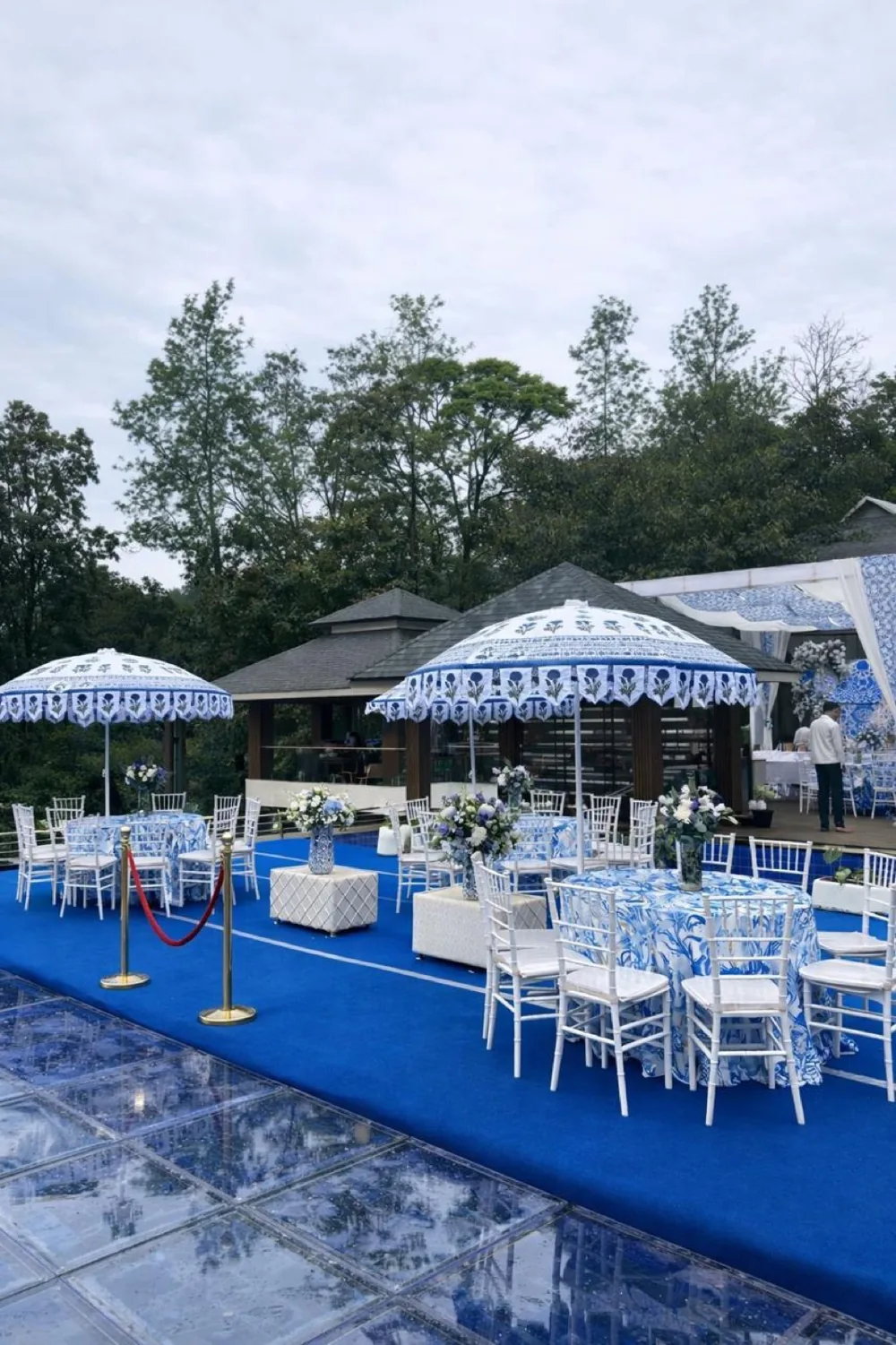
The porcelain-blue poolside setup below is a good example of the priority order. The parasols went in first, as the shade plan; the palette followed; the backdrop was the last decision, not the first.
The jharokha, and why it still wins
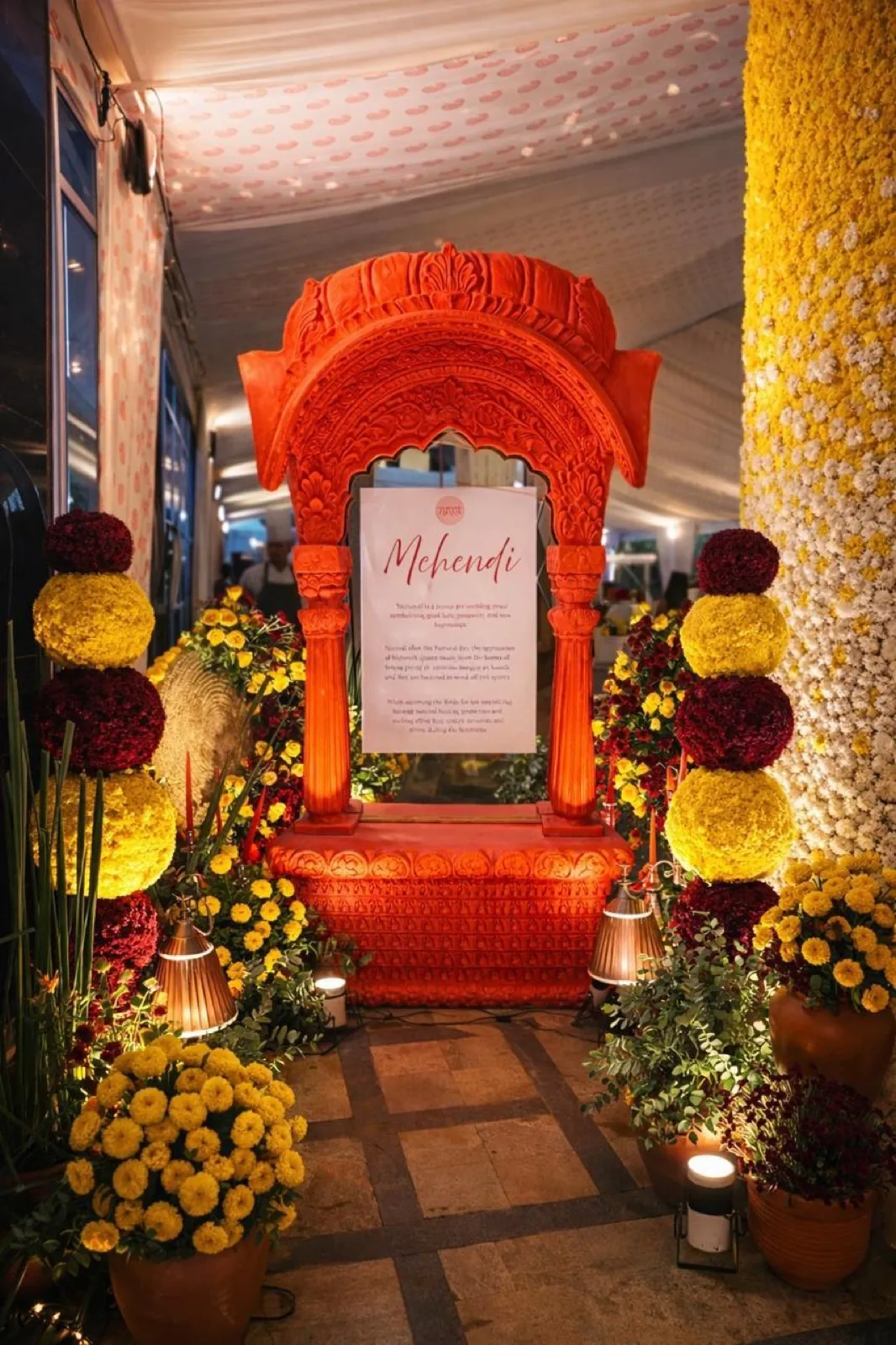
The jharokha, the carved window frame at the top of this page, keeps winning because it does three jobs at once: it seats the bride, it frames her for every photograph from a fixed distance, and it gives the room a focal point that is a built object rather than a flat wall.
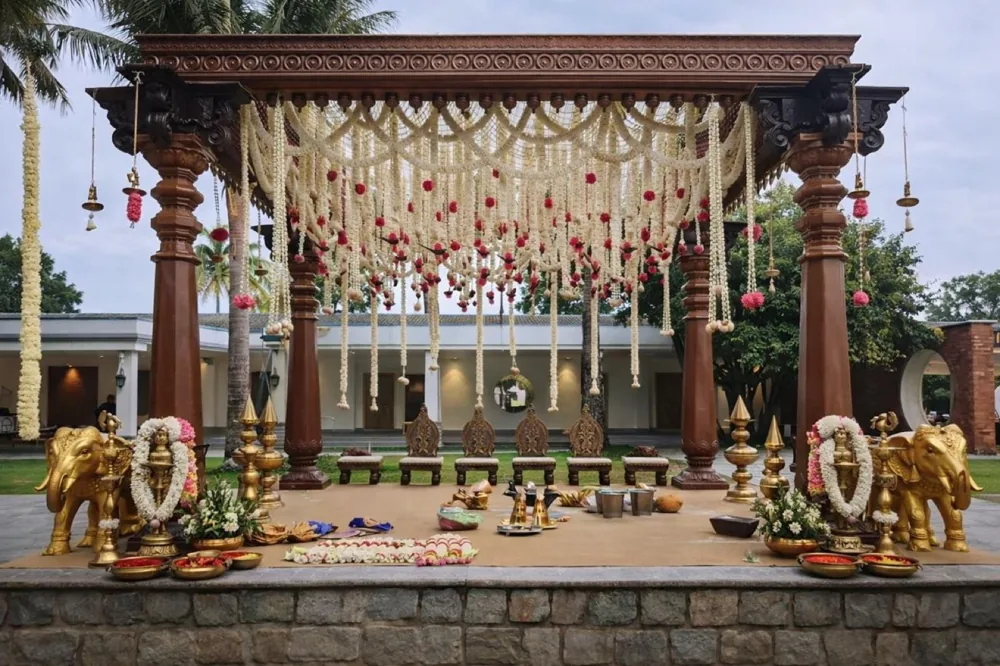
Our South Indian adaptation drops the heavy Rajasthani fretwork and uses a slimmer timber frame, marigold and jasmine strung vertically, and a deeper seat so the bride can sit cross-legged with her hands supported. The frame is built in two halves with a top beam, because a whole one will not turn a hotel corridor.
The failure mode is scale. A jharokha under about two and a half metres tall reads as a prop; the bride's head crowds the top edge and the photograph looks cramped. We build taller than most couples expect and dress the upper third lightly so it does not become a wall.
Artist stations: the detail every Pinterest board misses
Mehendi artists need light at the hand, not light in the room. Overhead fixtures throw the guest's own shadow onto their palm, which is exactly where the artist is working. So we light artist stations from the side at roughly seated shoulder height, with a warm, high-output source, and we check it by sitting in the chair ourselves during the build.
Chair height is the second variable. The artist sits low and works upward, so a standard dining chair for the guest and a lower stool for the artist beats two matching chairs every time. A small side table takes the cone tray off the floor.
The third is the queue. Artist stations pull a standing line, and a line placed against the main photo backdrop ruins both. We put stations on a side elevation with their queue running away from the camera, and we allow a two-metre standing lane in front of them that carries no furniture. Under-provisioning artists is the single most common mehendi mistake we see: a beautiful setup with a long wait reads to guests as a badly planned afternoon.
Poolside and lawn mehendi
Outdoors, three things decide the build: wind, shade and cable routing. Wind is why we keep poolside backdrops low and weighted rather than tall and tied. Anything above about two and a half metres on an exposed deck needs a base weight that will itself become visible, so we design the weight as part of the object rather than hiding it badly.
Shade is a timing problem, not just a heat one. A lawn that is comfortable at four will be in full sun at two, so we map the shadow line across the actual function hours during the site visit, and place seating inside it rather than buying umbrellas to correct a bad position.
Cable routing is the unglamorous one. Poolside power runs must be taped, matted and kept clear of wet edges, and every run should be planned before furniture is placed, not threaded around it afterwards.

Indoor and ballroom mehendi
Indoors the constraint moves to the ceiling. Hotel ballrooms have a finite number of approved rigging points, a stated load per point, and a house rigger who will be the one to hang anything. Drilling into walls or columns is almost never permitted. So an indoor mehendi design either lives on the floor, on freestanding structures, or on rigging that has been approved in writing at booking.
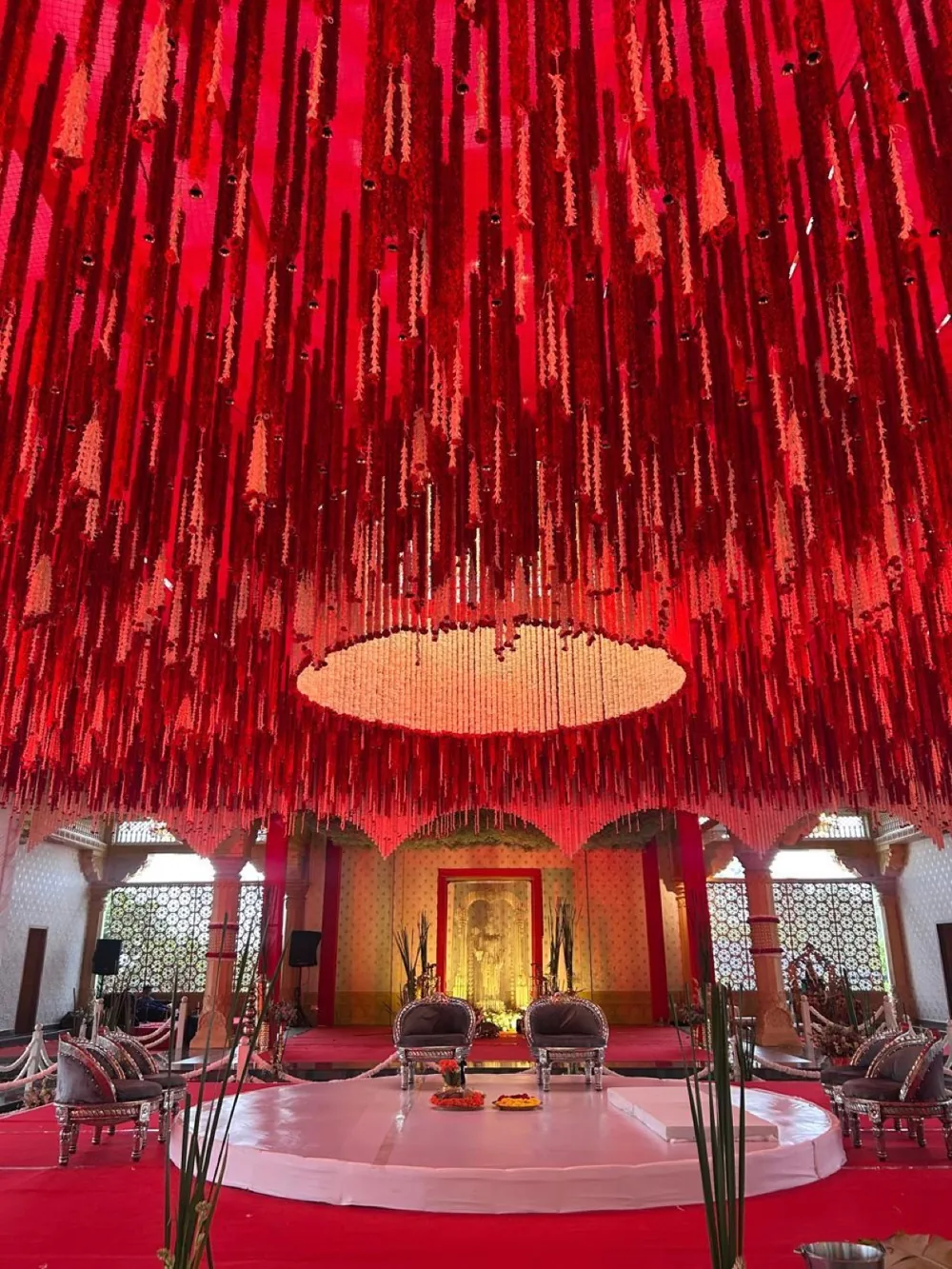
The red arched mehfil below is a floor-supported build: arches standing on their own bases, no ceiling load at all. That is why it could go into a room that would not have approved a hung installation.

The second indoor issue is that ballrooms have no daylight, so the room reads the same at two and at eight. That is easier to light and much harder to make feel like an afternoon. We use warm, low-level sources and leave one wall deliberately underlit so the space has depth.
Floral backdrops that photograph in two light conditions
A mehendi that starts in daylight and ends after dark asks its backdrop to do two different jobs. In daylight, contrast comes from colour; after dark it comes from light. A backdrop with no built-in illumination goes dead the moment the sun drops, and that is when the group photographs happen.
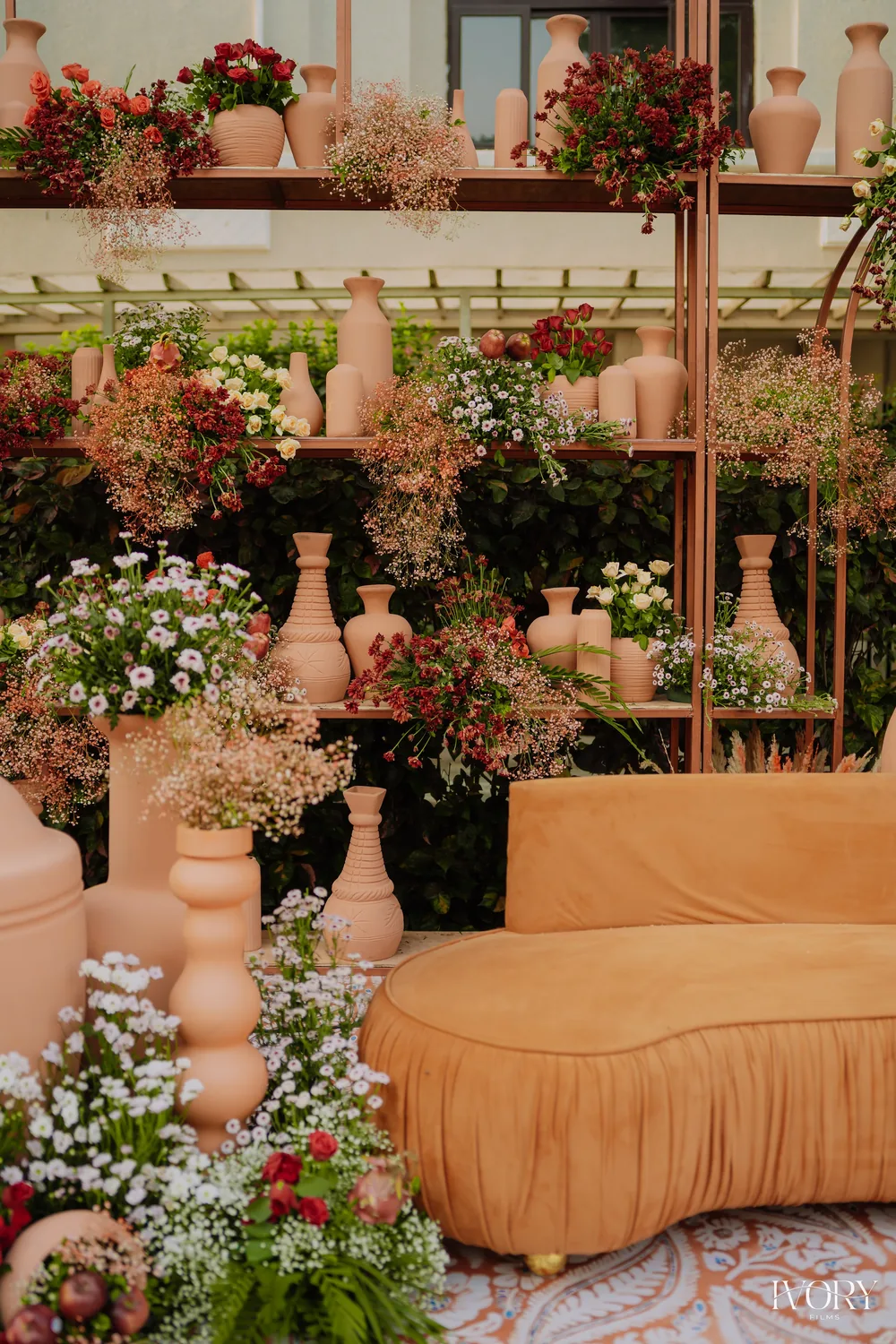
So we build the light into the backdrop. Ochre, terracotta and mango palettes hold up well because they stay warm under tungsten; pale pastels and whites go grey. The ochre-sofa backdrop below was designed around that crossover, and we tested the palette on site before approving it, using the same colour-sample method we use for every function.
Lounge seating: sofas, bolsters, low tables
Lounge clusters are how a mehendi stops being a row of chairs facing a stage. Three to five clusters, each seating six to eight, with a low table each and a clear sightline to the bride, is the layout we build most often.
Two rules. Keep low tables genuinely low, at coffee-table height, so they do not block the seated eye line across the cluster. And put at least one high-back option in every cluster, because a four-hour function on a backless pouffe is punishing for older guests and they will leave early.

Built alcoves, as above, do something a sofa cannot: they give a cluster a back and a sense of enclosure without walling off the room. A garden-patterned scheme does the same job in a softer register.

Colour: ochre, terracotta, porcelain blue, mango
Mehendi palettes have to survive henna. Fresh henna paste is near-black and dries to a deep brown, and it will be on a hundred pairs of hands in every photograph. Palettes that fight it, particularly cool greys and lilacs, look muddy. Palettes that accept it, the ochres, terracottas, mangoes and deep greens, look deliberate.
Porcelain blue is the exception worth knowing: it is cool but high in chroma, so it holds against brown rather than dissolving into it, which is why it works so well poolside. We test every mehendi palette on site under the real light before it is signed off, and the tested combinations from our recent work are in our palette notes and the wedding decor trends report.
What a mehendi setup costs to build
For a Bangalore benchmark, our mehendi decor guide for Bangalore puts a simple garden setup with marigold and floor seating at ₹1 to ₹2 lakh, a designed bohemian or contemporary setup at ₹3 to ₹4 lakh, and a multi-zone mehendi with a cocktail area, bride stage, seating zones and a full lighting design at ₹6 to ₹8 lakh. Where the function sits inside the whole decor envelope is set out in our Bangalore wedding decor cost breakdown, and the India wedding cost calculator will model it against your guest count and season.
| Setup type | Guest count it suits | Shade requirement | Install hours | Main cost drivers |
|---|---|---|---|---|
| Home floor mehendi | 30 to 60 | Existing verandah | 4 to 6, often overnight | Seating, soft furnishing, artist count |
| Lawn with jharokha | 80 to 150 | Mapped shadow line plus umbrellas | 8 to 12 | Jharokha fabrication, seating volume, flooring |
| Poolside lounge | 60 to 120 | Parasols, low weighted structures | 8 to 10 | Furniture hire, ballast, cable matting |
| Ballroom mehfil | 150 to 300 | None; lighting instead | 10 to 14 | Freestanding arches, lighting rig, floor build |
| Multi-zone mehendi | 200 plus | Zone by zone | 14 plus, or two days | Zone count, bar and station builds, lighting |
The pattern across those rows: the structure is rarely the expensive part. Seating volume, artist provision and lighting are.
Venue rules that kill designs
Five rules to establish in writing before the design starts, not after it is drawn. First, drilling: almost no hotel permits it, so every vertical is freestanding and weighted. Second, ceiling rigging: how many approved points, what load each carries, and whether the house rigger must hang it. Third, open flame: many venues allow enclosed candles only, which changes a candle-heavy scheme completely. Fourth, staining, because henna and turmeric both stain and both get billed after the event. Fifth, access hours and the loading route, which decide the largest section you can fabricate.
We ask for these at the site visit and get the answers in the venue agreement. A design approved without them is a design that will be redrawn during the build.
Mehendi decor site check
Twelve things to confirm at the walkthrough. Take this list; the answers change the design, not just the schedule.
- Shadow line across the actual function hours, walked and noted.
- Prevailing wind direction and the exposed edges.
- Rigging points: how many, what load, who hangs.
- Drilling policy for walls, columns and flooring.
- Open flame policy and whether enclosures are required.
- Staining clause for henna and turmeric, in the agreement.
- Loading route and the largest section that will pass it.
- Access hours released, and the overtime rate beyond them.
- Power points, available load and cable-run distances.
- Artist station positions with their queue running away from the camera.
- Seat count against guest count, with a third spare.
- Toilets and water relative to the seating, for a four-hour function.
Reusing the mehendi build for sangeet
If the mehendi is in the afternoon and the sangeet that night, the reuse is worth designing for from the beginning. The jharokha frame, lounge furniture, flooring and a good proportion of the lighting carry over. Florals mostly do not, and the room has to change register from warm daylight to a lit evening.
So we plan one structure with two dressings and a defined changeover window, usually with a crew re-dressing while guests are at a break. Our rules for what transfers and what does not are in reusing wedding decor between functions, and how far the two nights can differ on a shared frame is in theming each function differently. For the evening's own build, see our sangeet planning guide, and for the morning before, our haldi setups.
Regional notes: Bangalore, Goa, Kerala
Bangalore. Lawn and mantapa mehendi works most of the year because evenings are mild, and the design driver is afternoon sun rather than heat. Between June and October we design a covered option in parallel. Hotel lawns here come with strict rigging and drilling rules, which is why so much of our Bangalore decor is freestanding by design. The moongate mehendi at Raghav and Divya's wedding is a build of exactly that kind.
Goa. Villa and poolside mehendi is the default, and wind decides the structure. We keep verticals low, weight them visibly, and treat metal for salt air if it stays out overnight. Late-afternoon light off water is beautiful and merciless: it blows out pale fabric, so we push saturation. Kartik and Manasi's wedding at The Leela Goa ran on that logic.
Kerala. Courtyards and verandahs give shade and architecture for free, so the work is framing rather than covering, and the humidity means adhesives fail while flowers hold. A covered fallback is not optional here; it is the primary plan for much of the year.
If you are working out which of these fits your venue and date, send us the details through our contact page and we will come back with the build logic before the mood board.
Common questions
How much does mehendi decoration cost?
In Bangalore our own guide puts a simple garden setup with marigold and floor seating at one to two lakh rupees, a designed bohemian or contemporary setup at three to four lakh, and a multi-zone mehendi with a cocktail area, bride stage and full lighting design at six to eight lakh. Seating volume, artist provision and lighting move that number far more than the backdrop does.
What is a jharokha and do we need one?
A jharokha is a carved window frame used as the bride's seat and photo frame, and no, you do not need one. It earns its place because it does three jobs at once: seats the bride, frames her at a fixed camera distance, and gives the room a built focal point rather than a flat wall. Below about two and a half metres tall it reads as a prop.
How many mehendi artists do 150 guests need?
Work it out from hours rather than heads. Decide how many guests you want done, how long each design takes, and how many hours the function runs, then divide. Under-provisioning is the most common mehendi mistake we see: a beautiful setup with a long queue reads to guests as a badly planned afternoon, and the queue also lands in your photographs.
Can we do the mehendi outdoors in Bangalore in June?
Yes, with a covered option designed in parallel rather than bought in a panic. June to October we draw the open-air layout and the covered layout at the same time, so the cover can go over the setup rather than replace it. Bangalore evenings stay mild, so the real design driver outdoors is the afternoon shadow line, which we map on site.
What lighting do mehendi artists need?
Light at the hand, from the side, at roughly seated shoulder height. Overhead fixtures throw the guest's own shadow onto their palm, which is exactly where the artist is working. We use a warm, high-output side source at each station and test it by sitting in the chair during the build, because a station that looks fine standing up often fails when seated.
Is poolside mehendi safe?
Yes, if the power and the structures are planned before the furniture. Cable runs must be taped, matted and kept clear of wet edges, and every run should be routed before seating is placed rather than threaded around it afterwards. Verticals stay low and weighted, because wind off water makes a tall backdrop behave like a sail.
Can mehendi decor be reused for the sangeet?
The structure can, most of the flowers cannot. Jharokha frames, lounge furniture, flooring and a good share of the lighting carry over to the same evening, so we design one structure with two dressings and a defined changeover window. The room also has to shift register from warm daylight to a lit evening, which is a lighting job rather than a decor one.
What seating works for a 4-hour mehendi?
Clusters of six to eight with back support, a low table each and a clear sightline to the bride. We allow about a metre of width per guest on a bolstered floor setup, plan roughly a third more seats than guests, and put at least one high-back option in every cluster, because backless pouffes drive older guests home early.
Do hotels allow drilling for a mehendi backdrop?
Almost never, so design every vertical as freestanding and weighted from the start. What varies between hotels is ceiling rigging: the number of approved points, the load each carries, and whether the house rigger must do the hanging. Get all of that in writing in the venue agreement before the design is drawn, not after.
Planning this yourself? Send us your name and a number and we’ll come back the same day with a realistic budget for it — yours to keep, whoever you end up booking.
Panigrahana is an architect-founded studio: 500+ weddings designed since 2018, rated 4.8/5 across 94 Google reviews, on a flat planning fee (quoted for the agreed scope) rather than a percentage of what you spend.