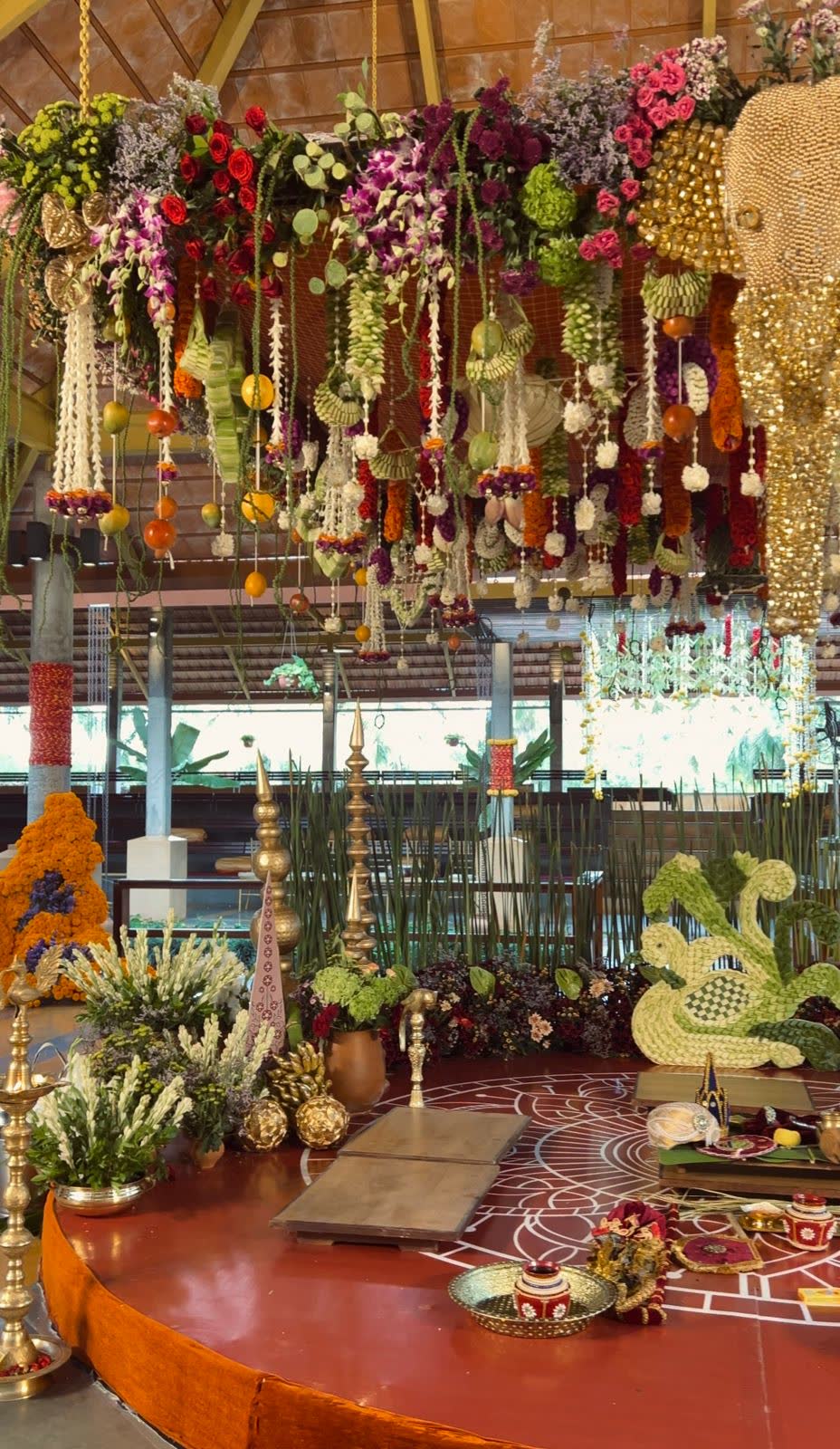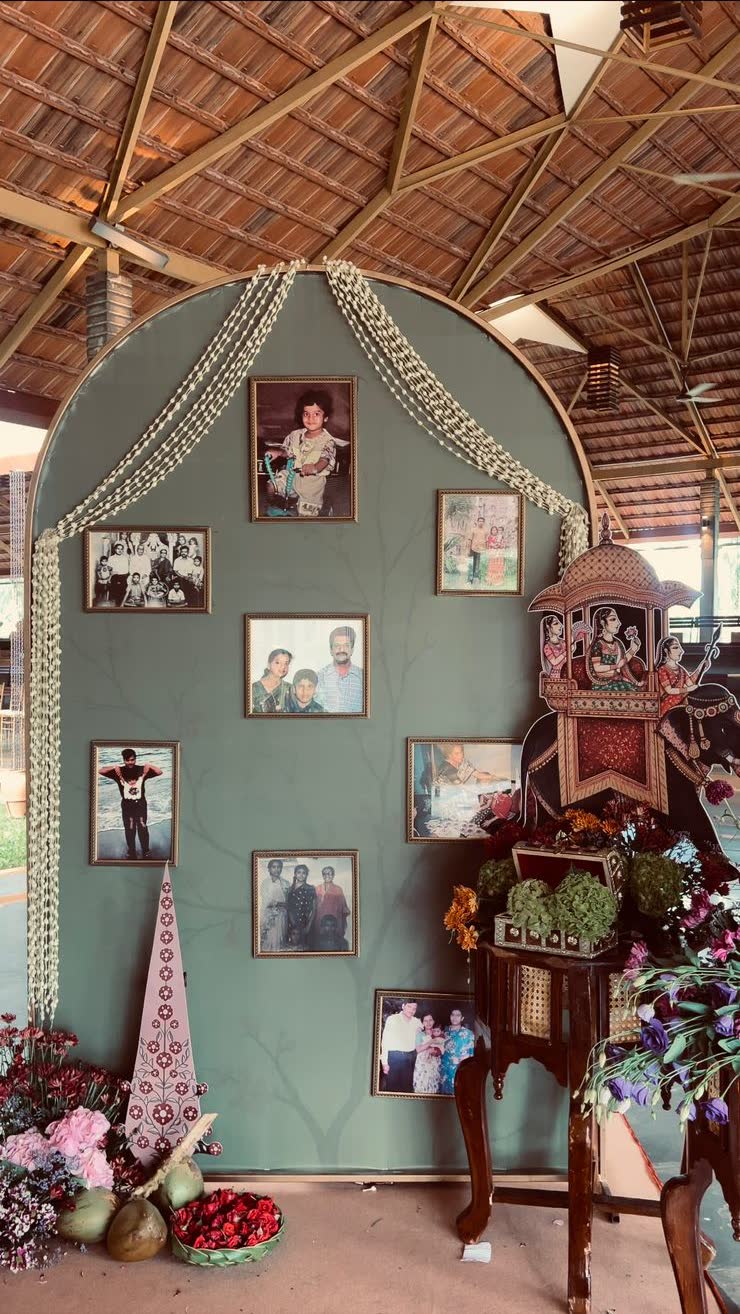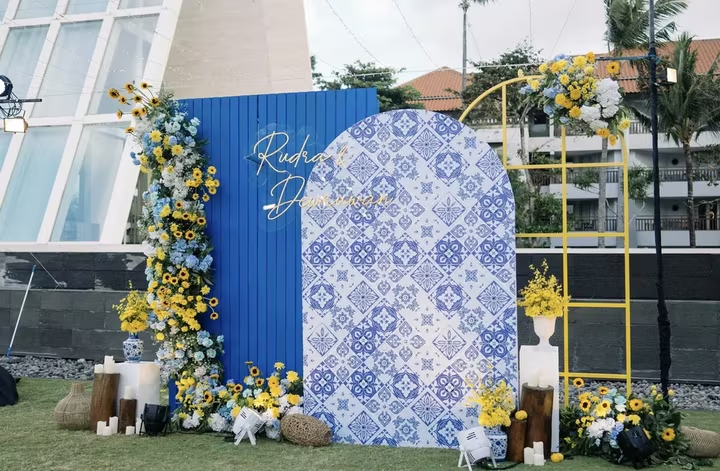
Pinterest's 2026 wedding data says the year belongs to plum, olive, terracotta, fig and iridescence, and to drapery and flower installations over flat backdrops. We have been building most of that for two years, and we can tell you which parts survive contact with an Indian venue and which parts do not. Below is the trend list held against real builds: the palettes that photographed as promised, the ones that collapsed under Indian daylight, and what we would actually recommend for a 2027 wedding in Bangalore, Goa or Kerala.
What the data actually says
Pinterest's 2026 wedding trend report is drawn from roughly 7 billion wedding searches and 16.7 billion wedding ideas saved globally over the preceding year. The colour movement runs clearly toward depth:
| Search term | Year-on-year change | Group |
|---|---|---|
| Opalite aesthetic | +2,710% | Ethereal shimmer |
| Plum and olive wedding | +1,380% | Rooted romance |
| Opalescent | +685% | Ethereal shimmer |
| Plum wedding theme | +630% | Rooted romance |
| Muted terracotta | +545% | Rooted romance |
| Fig wedding | +515% | Rooted romance |
| Midnight teal | +470% | Ethereal shimmer |
| Merlot | +370% | Rooted romance |
| Muted rose | +345% | Rooted romance |
| Dusty olive | +270% | Rooted romance |
On structure, the same report has drapery backdrop up 1,510%, stained-glass wedding arch up 750% and flower installations up 195%. India-specific Pinterest data for December 2025 to February 2026 adds mandap decoration up 980% and Hindu wedding stage decoration up 940%. WeddingWire India's companion list reports purple themes up 1,434%, rococo up 1,000%, soft pink themes up 473%, dark olive green up 58% and editorial wedding photos up 308%.
Taken together: saturated jewel colour, botanical depth, built structure rather than printed backdrop, and photography that looks composed rather than captured. Almost all of it is good news for how we work. Some of it is a trap in Indian conditions.
Planning this yourself? Send us your name and a number and we’ll reply within 24 hours with a realistic budget for it — yours to keep, whoever you end up booking.
Panigrahana is an architect-founded studio: 500+ weddings designed since 2018, rated 4.8/5 across 100 Google reviews (checked 27 September 2026), on a flat planning fee (quoted for the agreed scope) rather than a percentage of what you spend.
What held up: the builds
Plum and mauve — verified, spectacular, and harder than it looks
We built a mauve floral roof over a mantapa at Amita Rasa with pearl swags falling through it, carried through to dusk and then into a purple night sky. It is one of the most photographed things we have made, and it worked because the colour was chosen against the sky at the actual ceremony hour rather than against a moodboard.
Mauve and plum are unforgiving. They read rich at dusk and grey at midday, and they fight red-toned uplighting badly. If your muhurtham is at 11am under an open sky, plum is the wrong answer no matter what the trend data says. If your reception is at 8pm, it is close to the best answer available. Our Amita Rasa build is the dusk version; the purple wisteria reception stage at Utsavaa is the full night version, with a bulb-rain ceiling doing work that flowers alone cannot.
Terracotta and dried botanicals — the most Indian-friendly palette on the list
Muted terracotta at +545% and dusty olive at +270% describe, almost exactly, a palette that holds together in Indian outdoor light. We built a full boho function at Ramada Yelahanka around terracotta urns, dried palm, eucalyptus and sunflower — warm earth tones that hold their character under strong daylight instead of washing out.
This is the trend we would push hardest for a daytime function anywhere in Karnataka. It photographs honestly at noon, it does not fight a beige venue, and dried material survives a nine-hour outdoor build in a way fresh imported stems do not. The Ramada Yelahanka build is the reference.
Olive, moss and botanical depth — yes, if the venue supplies it
Garden themes and deep greens are up across every list. The honest version for India is that it works when the landscape is doing the work and looks thin when it is imported into a ballroom. Our pond mandap at Nature's Knots sits under a fairy-lit banyan with greenery walls; almost none of that is rented material, it is a design that reads the site.
In a hotel ballroom the same palette needs three times the material to achieve half the effect, which is a real budget conversation and one worth having before the palette is chosen rather than after. The Nature's Knots wedding shows what happens when the venue is already green.
Drapery and built structure — the strongest signal on the list
Drapery backdrop up 1,510% and flower installations up 195% point in the same direction: away from flat printed backdrops and toward things with depth you can walk into. We agree completely, and it is the closest thing to a universal recommendation in this piece.
The distinction that matters is between drapery as fabric hung on a frame and drapery as architecture. A ceiling treatment that changes the volume of a room is a different object from a curtain behind a stage, and only one of them survives a wide shot. Our ceiling draping piece covers the theatrical approach, and statement installation design covers how we size an installation to a space.
What we would be careful about
Opalite and iridescence
The single biggest number in the report — opalite aesthetic at +2,710% — and the one we would approach most cautiously in India. Iridescent finishes depend entirely on controlled, directional light. Under an Indian outdoor sky at 4pm they read as grey plastic, and under warm banquet lighting they lose their shift entirely and just look pale.
Used small and lit deliberately, as a beaded curtain, a glass element or a sequinned panel in a controlled corner, it is lovely. Used as a scheme for an outdoor mandap it will not deliver what the board promised, and the couple will not know why.
Rococo
Up 1,000% and genuinely interesting, but it is a European idiom with a specific relationship to gilding, asymmetry and plaster. Dropped onto an Indian ceremonial structure it frequently reads as expensive confusion rather than as a designed hybrid. It can be done, through proportion and ornament logic rather than gold props, but it needs someone who can actually draw. It is not a palette you can order.
Stained glass
Up 750%, and one of the best ideas on the list for an Indian wedding — with one condition. Stained glass is a transmission effect: it needs light behind it. Built as a solid backdrop it is a painted panel. Built as a screen with the sun or a rig behind it, it throws coloured light across a floor and becomes the best thing in the room. The difference is entirely in the engineering, which is why it belongs to studios that fabricate rather than rent.
The trend list, graded for Indian conditions
| Trend | Daytime outdoor | Evening outdoor | Ballroom | Verdict |
|---|---|---|---|---|
| Plum / mauve / merlot | Poor | Excellent | Very good | Time-of-day dependent. Test it in the room. |
| Muted terracotta / dried botanicals | Excellent | Good | Good | The safest strong recommendation on this list |
| Olive / moss / garden | Excellent if the site is green | Good | Expensive | Let the venue decide |
| Soft pink / muted rose | Very good | Good | Very good | Reliable, and forgiving of mixed light |
| Opalite / iridescent | Poor | Fair | Good, if lit | Accents only |
| Midnight teal | Fair | Very good | Excellent | Underrated for receptions |
| Drapery as architecture | Good | Excellent | Excellent | Build it, do not hang it |
| Stained glass | Excellent if backlit | Good | Good | Engineering, not decoration |
| Rococo | Fair | Fair | Good | Only with a designer who can draw it |
The rule that matters more than any trend
Every palette on that list depends on light more than it depends on colour. A colour has no value until you know the hour, the sky, the surrounding material and the artificial light that will be on it. A mauve chosen on a phone at midnight is not the mauve that will be in the room.
So we test: physical samples, in the actual space, at the actual hour, under the actual rig. The method is in the colour and lighting test. It takes an afternoon, and it separates a palette that works from a palette that was fashionable. If you are starting from a board rather than a brief, turning Pinterest saves into a design brief is the step before that one.
For flower-by-flower behaviour — which blooms survive Indian daylight, which are seasonal, which are imported and what that costs — see wedding flowers decoded. For the fuller 2026 picture, our decor trends report and Bangalore colour palettes for 2026.
The part of the data we care about most
Mandap decoration up 980% in India matters more to us than any colour on the list. It says couples have stopped treating the mandap as a rented fixture. It is the structure the whole ceremony happens inside, and the one thing in the room that is genuinely architecture.
That is the work we exist to do. Every mandap, installation and stage set we build is drawn by our own architects and fabricated in our own workshop — a gold mandap cut into a stone amphitheatre, a suspended lotus canopy in a hall, a carved-pillar structure in a bamboo grove, a tiered gopuram on a Goa beach. None of it comes out of a catalogue, and that is the difference the +980% is actually reaching for. What architect-designed decor means sets out the method.
How to put this to your parents
Trend arguments are the hardest to win with parents, because "it's what people are doing this year" is exactly the argument they are suspicious of — and they are right to be.
- Never argue the trend. Argue the room. "This palette holds up at 7pm under the light in that hall" is a technical claim a parent can accept. "Plum is up 630% on Pinterest" is not, and it sounds like spending money to impress strangers.
- Show them one photograph of real work, not a board. Twenty aspirational images read as indecision. One photograph of a comparable build at a comparable venue reads as a plan.
- Concede the traditional palette where it belongs. Red, gold, marigold and jasmine are not outdated for the ceremony — they are ritually correct and photograph beautifully at muhurtham hour. Fight for the reception palette, not the ceremony one. You will get it.
- Use the lighting test as the tie-breaker. Offer to build a physical sample in the actual room and let them see both options. Families settle this in ninety seconds when they can see it, and argue for weeks when they cannot.
Frequently asked questions
What are the 2026 wedding colours?
Pinterest's 2026 report groups the movement into "rooted romance" — plum and olive (+1,380%), plum (+630%), muted terracotta (+545%), fig (+515%), merlot (+370%), muted rose (+345%), dusty olive (+270%) — and "ethereal shimmer", led by opalite aesthetic (+2,710%), opalescent (+685%) and midnight teal (+470%). WeddingWire India adds purple themes at +1,434% and soft pink at +473%.
Which 2026 palette works best for an Indian outdoor wedding?
Muted terracotta with dried botanicals and olive, for daytime; plum, merlot and midnight teal for evening. The deciding factor is the hour of the function, not the venue or the budget. Deep jewel tones photograph poorly under harsh midday Indian light regardless of how well they are executed.
Is purple actually a good choice for an Indian wedding?
For a reception or an evening sangeet, yes — it is one of the strongest options available and we have built several. For a daytime muhurtham, no. It also needs care against warm uplighting, which most Indian banquet rigs default to.
Do you follow trends, or design from scratch?
We read them and mostly ignore them. A trend is useful as evidence of what couples are responding to; it is not a brief. Every structure we build is drawn for the specific venue, hour and family, fabricated in our own workshop, and used once.
How do we decide our palette without guessing?
Bring samples into the actual space at the actual hour of your function and look at them under the light that will be there. It is an afternoon's work and it settles the question definitively. Everything before that is a hypothesis.
Send us the venue and the hour — we will test the palette
Tell us where and when each of your functions happens. We will come back with two palettes tested against that room's real light, and a structure drawn for that specific space rather than pulled from a catalogue.
Start your design