A reception is judged on three things guests actually experience: how long they stand in the receiving line, whether they can find a seat, and what the stage looks like in their photograph. Decor that ignores those three fails even when it is beautiful. Below are the stage designs, tablescapes and entry treatments we have built, with the layout arithmetic that keeps a 400-guest reception moving rather than queuing.
The reception is the function most of your guest list will actually attend, so it is the one where design and logistics are the same problem. We plan the floor before the flowers. If you want the wider guest-experience thinking behind that, our note on designing the guest experience covers it.
The three experiences a reception is judged on
Ask guests about a reception a month later and you get three answers. They remember how long they waited to greet the couple, whether there was somewhere to sit and put a drink down, and the photograph they took on the stage.
Everything else, the drape, the chandeliers, the entrance, sets the tone but does not decide the verdict. So we design in that order: the receiving line and its queue, then seating and circulation, then the stage as a photographic object, and only then the treatments that dress the room. Reversing the order is how a beautiful reception ends up with a forty-minute queue at the door and half the guests standing.
Stage design: proportion before flowers
A reception stage has one job the sangeet stage does not: it has to look right with two people standing on it, from twenty metres away, for three hours. That makes proportion the whole design.
Our working practice is to size the backdrop against the couple rather than against the wall. A backdrop under about three and a half metres wide leaves them looking pinned to it; much beyond seven and they float in the middle of it unless the design has a centre. We set the couple's standing position roughly a third forward of the backdrop so there is depth behind them, and we keep the middle two metres of the backdrop free of any busy detail, because that is where every photograph is framed.
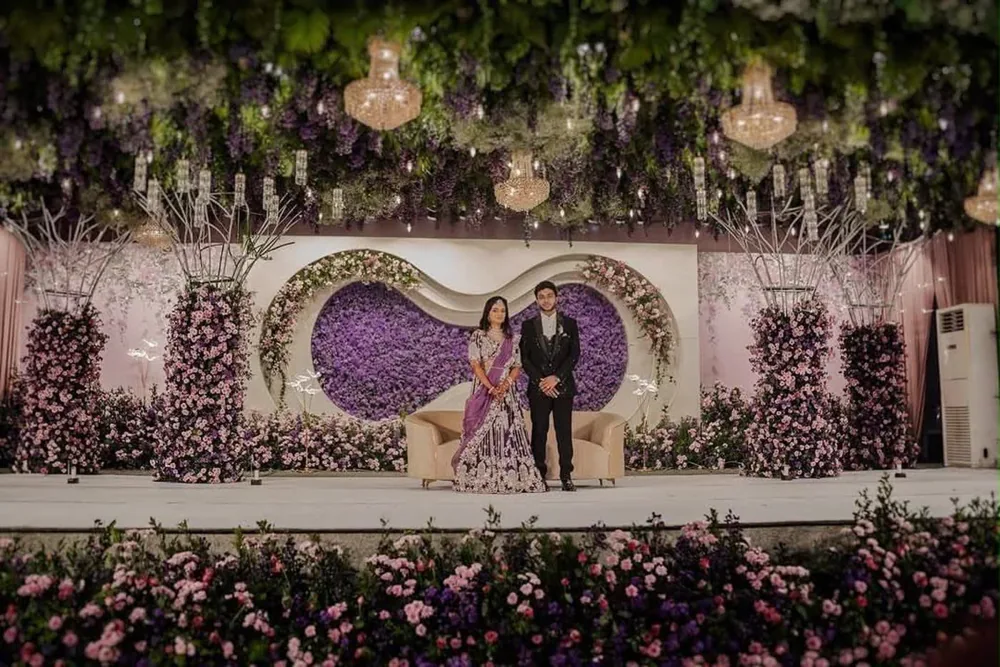
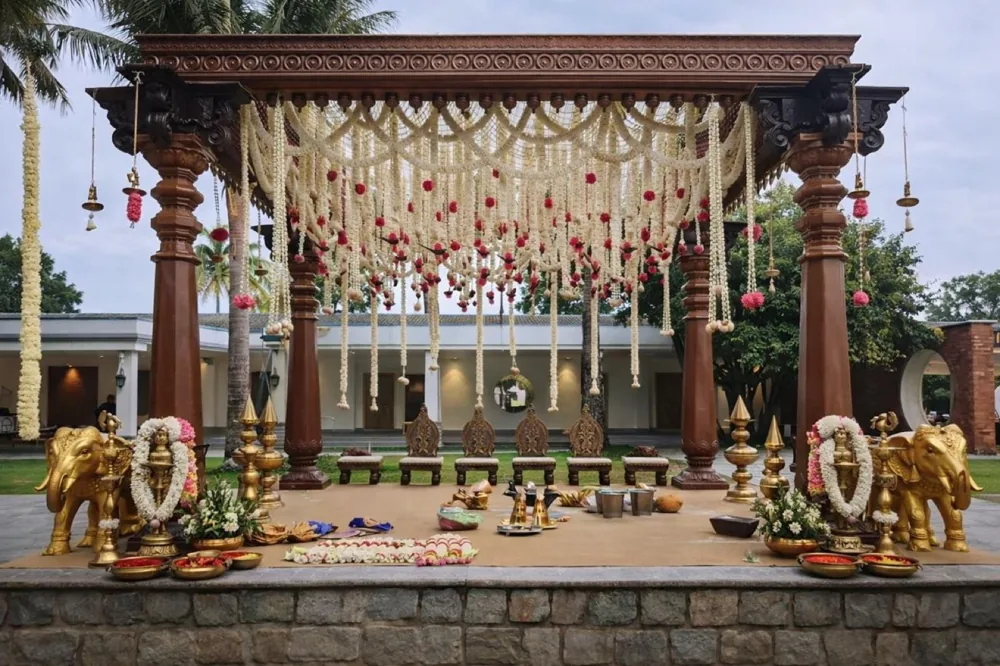
Three forms cover most of what we build. A flat wall, which is the cheapest per metre and the least forgiving of a bad centre. An arch or canopy, which frames the couple and photographs well at height. And a curved or wrapped backdrop, which gives the couple depth on both sides and holds up when guests approach from an angle rather than head on.
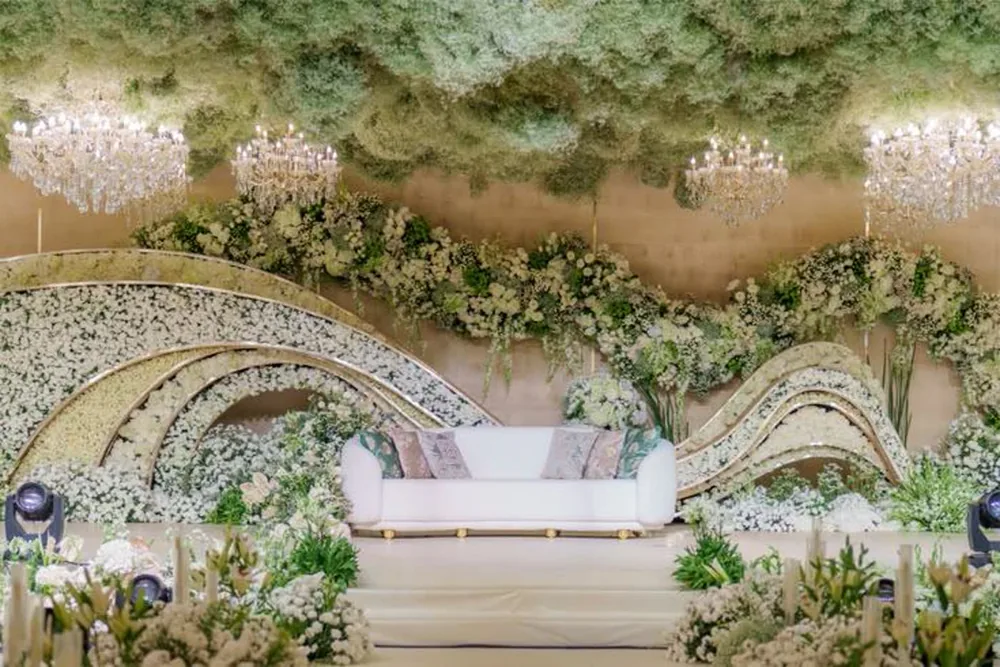
The failure mode is a stage built for a rendering, viewed from the front, at eye level. Nobody sees it that way. We check every reception backdrop from the furthest table, from the entrance, and from the side aisle before it is approved.
The receiving line: throughput arithmetic
This is the number nobody runs. A receiving line moves at a pace set by how many hosts stand in it and how long each greeting takes. In our planning we work on roughly six to eight guests a minute through a line of four hosts when greetings are brief, and closer to three or four a minute when families stop for a photograph with the couple, which they will.
Run that against your guest list and the answer is uncomfortable. Four hundred guests at four a minute is a hundred minutes of queue, and the last guests in it are hungry and standing.
Three fixes, in the order we apply them. Split the line, so two greeting points run in parallel rather than one. Pull the photographer out of the line and give the stage photograph its own station, which is the single biggest speed gain available. And put the queue somewhere with seating, shade and something to drink, so waiting stops being punishment. The queue will exist; it should not be standing in the sun at the door.
Tablescapes: centrepiece height and the sightline rule
One rule governs every centrepiece: nothing sits between about thirty and ninety centimetres above the table surface. Below thirty, guests see over it; above ninety, they see under it. Anything in between blocks the face of the person opposite, and a table where nobody can see across it is a table people leave.
So centrepieces are either low arrangements or tall and thin on a slim stem, and tall ones need to be genuinely tall. A candelabra that is not high enough is the most common and most expensive mistake on a reception table.

The second rule is that the table layout comes before the centrepiece, because table size, shape and spacing decide what will fit and how many pieces you are buying. We write that up in laying out tables before choosing centrepieces. For the costs, our centrepiece guide puts a mid-range production with local premium flowers and quality vessels at ₹5,000 to ₹10,000 a table, which at fifty tables is ₹2.5 to ₹5 lakh for centrepieces alone, and suspended floral centrepieces at ₹12,000 to ₹25,000 a table including rigging.
Entry and welcome: the first thirty seconds
A guest forms their opinion of a reception in the walk from the car to the room. That walk is the cheapest piece of decor you will ever buy and the most consistently underspent.
What it needs is light at eye level, a clear direction of travel, and one object worth stopping at. What it does not need is a photo corner on the main flow route, which reliably creates a queue that blocks the door.

For an outdoor entrance the arrival hour decides the design. An arch that reads beautifully at six in the evening is invisible at eight unless the light is built into it, which is why we specify entrance lighting at the same time as the structure rather than after it.
Hotel ballroom, lawn or poolside reception
Ballroom. Predictable, air-conditioned and rig-ready, with ceiling height as the limiting factor. A low ceiling rules out tall centrepieces and hanging work, and it makes uplighting the only way to give the room scale. Rigging points are finite and booked early, which is why the conversation belongs in the venue shortlist, not the design phase. Our Bangalore ballroom decor guide goes into the specifics.
Lawn. More space and more variables. Outdoor stage backdrops behave like sails, so wind loading decides the structure rather than the rendering does, and a backdrop engineered for a ballroom will fail on a lawn at eight in the evening. Everything needs ground support or ballast, power needs a generator sited out of earshot, and a covered fallback is drawn at the same time as the open layout.
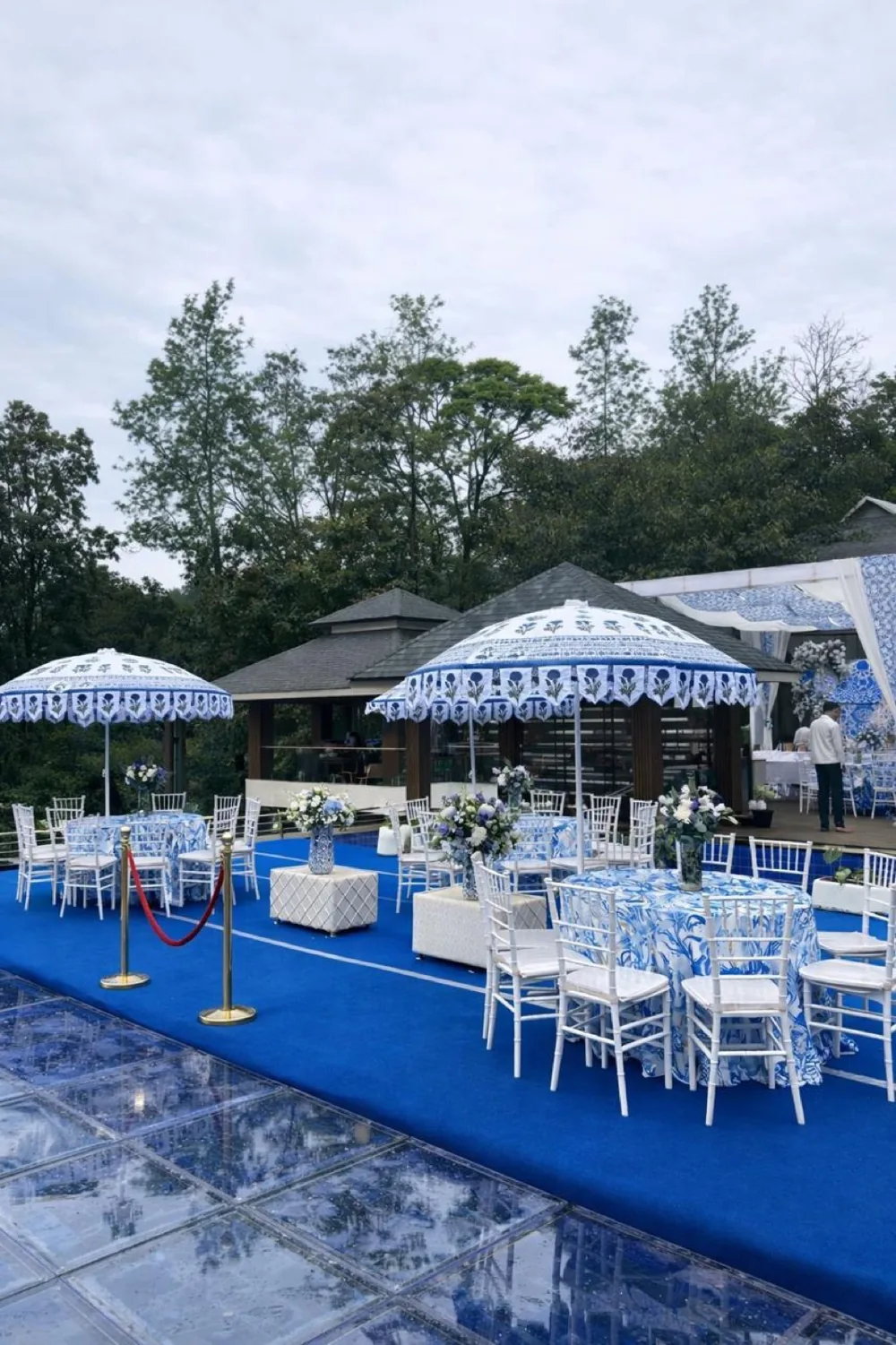
Poolside. The best photographs and the tightest floor. Usable area is small once you keep circulation clear of the water, cable routing governs furniture placement, and reflected light will fight your stage wash unless it is planned in.
Lighting a reception so faces read on camera
Most reception photographs are of people, not decor, so the first job of the lighting is skin tone. That means warm, reasonably soft front light at the stage and at the receiving line, and enough level on the dinner floor that a camera is not fighting for it.
Then the room. Uplighting on walls and columns is what gives a flat ballroom depth; pin spots on tables are what make centrepieces read rather than sink into the gloom. Our Bangalore wedding lighting guide puts basic ambient lighting for a single function at ₹1.5 to ₹2.5 lakh, a full professional design across mehendi, sangeet and wedding at ₹5 to ₹8 lakh, and a monogram gobo on the ballroom floor at roughly ₹25,000 to ₹40,000, which is one of the highest-impact small items in the whole build.
Buffet, live counters or plated, and what the decor must do differently
Service style changes the floor plan more than any decor decision. A buffet concentrates every guest at one line at one moment, so the decor around it has to be robust and the queue needs somewhere to go that is not across the stage sightline. Live counters spread the load, but each counter pulls its own small queue and needs power, extraction and a sensible approach side. Plated service removes the queue entirely and doubles the service staff moving between tables, so the aisles between tables have to be wider.
Our working practice is to keep at least a metre and a half between table edges where service walks, and more where counters face each other. The arithmetic of counters against guest numbers is in our note on live counters and plate maths.
Ceiling and drape: when it is worth it
Ceiling work is worth it when the room is tall and plain, or when the floor is so crowded that the only unused surface is above. It is not worth it in a room with a low ceiling, good architecture or a big floral stage already carrying the design.
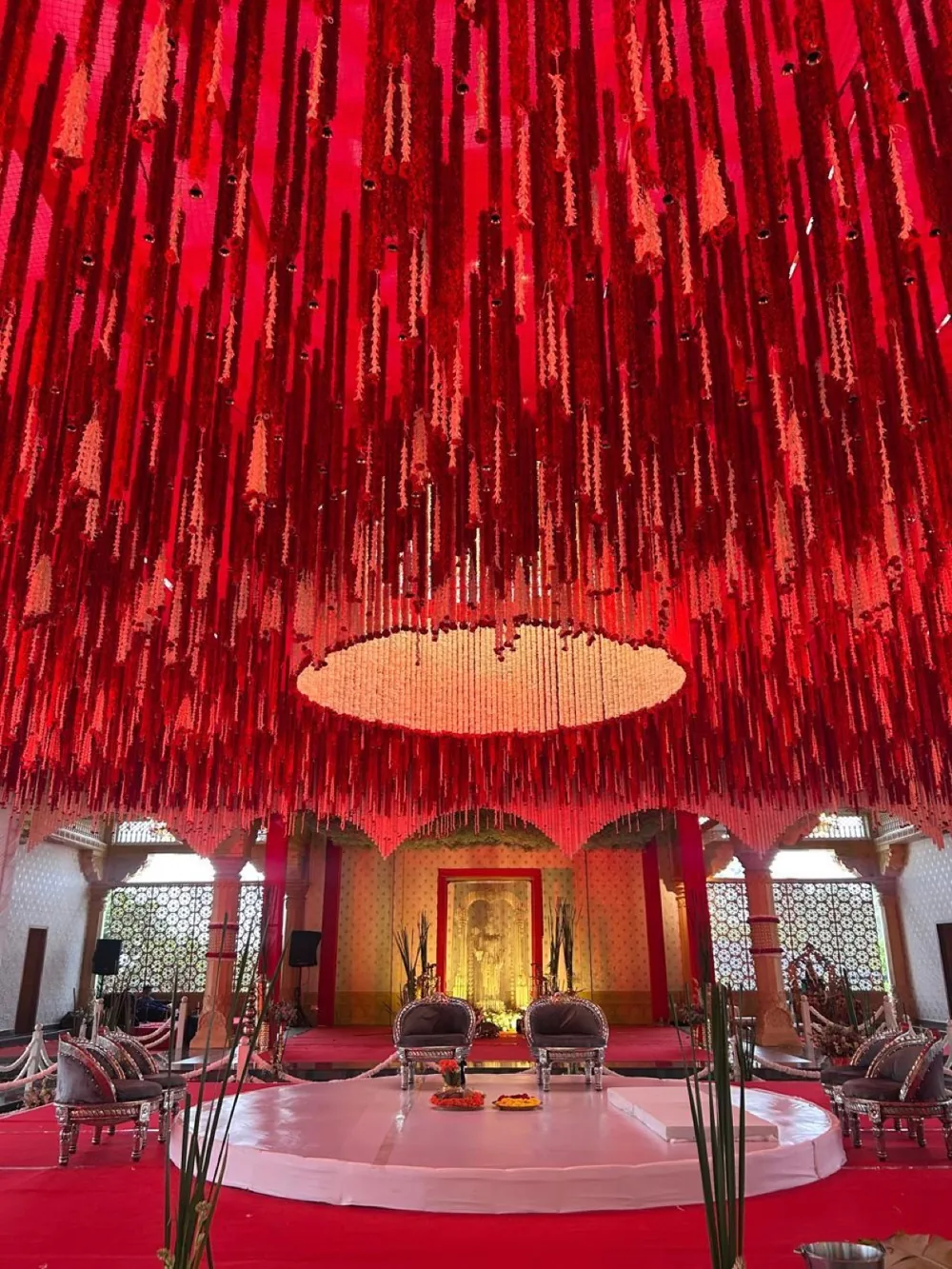
Fabric is the cheaper route and behaves differently: it softens and lowers a room, where a floral or chandelier install adds drama without changing the perceived height. Both depend entirely on approved rigging points and stated loads, which is why we settle them at booking. The thinking is in our note on theatre-inspired ceiling draping.

What drives a reception decor quote
For a Bangalore benchmark, our reception decor guide for Bangalore hotels puts a beautifully simple dinner setup for 100 guests at ₹4 to ₹6 lakh and a fully designed reception for 200 to 300 guests at ₹10 to ₹15 lakh. The India wedding cost calculator will model your own guest count and season, and our wedding data pages and decor trends report show how the shares move.
Before you compare quotes, run your own numbers through this. Everything below is layout, not taste, and it is what a quote is really sizing.
| Guest count | Receiving line, single vs split | Stage backdrop width | Round tables of ten | Buffet counters |
|---|---|---|---|---|
| 150 | About 40 minutes single, 20 split | 4 to 5 metres | 15 | 2 double-sided |
| 250 | About 65 minutes single, 35 split | 5 to 6 metres | 25 | 3 double-sided |
| 400 | About 100 minutes single, 50 split | 6 to 7 metres | 40 | 4 to 5, or live counters |
| 600 | Split line and a separate photo station, always | 7 metres with a defined centre | 60 | 6 plus, spread across two zones |
Those line times assume four hosts and families pausing for photographs. Pull the photograph out of the line and they drop sharply, which is the cheapest improvement on the list.
Reception layout sign-off
- Receiving line position and whether it is split.
- Photo station separated from the greeting line.
- Queue holding area with seating, shade and drinks.
- Stage backdrop width checked against the couple, not the wall.
- Couple's standing mark set forward of the backdrop.
- Backdrop centre kept clear of busy detail.
- Sightline check from the furthest table, entrance and side aisle.
- Table count and spacing, with service aisles measured.
- Centrepiece heights outside the thirty to ninety centimetre band.
- Buffet or counter positions clear of the stage sightline.
- Entrance lighting specified for the actual arrival hour.
- Rigging points approved in writing, with loads.
- Uplighting and pin spots in the lighting plan.
- Weather fallback drawn, not described.
- Strike plan and the venue's clearance deadline.
Reception in India after a wedding held abroad
When the wedding happened elsewhere and the reception is the family's event in India, the brief changes in a specific way: this is the function where the wider circle is received, so the receiving line is longer, the guest list is older, and the stage carries more weight because for most of the room it is the wedding.
We design these with a longer greeting window, more seating than a standard reception, and a stage treatment that stands alone rather than referring back to a ceremony nobody in the room attended. Our guide to holding a reception in India after marrying abroad covers the planning side.
Regional notes
Bangalore. Five-star ballrooms dominate, and their limits are ceiling height, rigging policy and a strict clearance deadline after the event. The lawns are excellent from November to February and need a drawn fallback the rest of the year. That is the discipline behind our Bangalore decor work, and it shaped both Vikram and Ananya's reception at The Leela Palace and Sandeep and Meghana's at The Ritz-Carlton.
Goa. Resort lawns and poolside decks, where salt air, wind and a dusk arrival hour drive the design. We build lower and weight structures visibly, treat anything metal that stays out overnight, and light the entrance for the hour guests actually arrive. Details in our Goa reception decor guide.
Kerala. Backwater and clifftop settings give you a view worth not covering, so the stage often sits with the landscape as the backdrop and the built element kept low. Humidity is the constraint: adhesives fail, electrics need weather-rated fittings, and a covered option stays live for most of the year.
If you want us to run the layout arithmetic against your own venue and guest list, send the details through our contact page and we will come back with the floor plan before the mood board.
Common questions
How much does reception decoration cost?
In Bangalore hotels our own guide puts a beautifully simple dinner setup for 100 guests at four to six lakh rupees, and a fully designed reception for 200 to 300 guests at ten to fifteen lakh. Centrepieces are a bigger share than couples expect: a mid-range production runs five to ten thousand a table, which at fifty tables is two and a half to five lakh on its own.
How wide should a reception stage be?
Size the backdrop against the couple, not against the wall. Under about three and a half metres wide they look pinned to it; much past seven and they float in the middle unless the design has a defined centre. We set their standing mark roughly a third forward of the backdrop for depth, and keep the middle two metres free of busy detail.
How long does a receiving line take for 400 guests?
On our planning figures, around a hundred minutes with a single line of four hosts when families stop for photographs, and roughly half that if you split the line into two parallel greeting points. The biggest single gain is pulling the photograph out of the line and giving it its own station, because that is what slows each greeting down.
What centrepiece height blocks conversation?
Anything between about thirty and ninety centimetres above the table surface. Below thirty guests see over it, above ninety they see under it, and in between it sits exactly in the face of the person opposite. So centrepieces are either low arrangements or genuinely tall on a slim stem; a candelabra that is not tall enough is the most expensive table mistake we see.
Ballroom or lawn for a Bangalore reception?
Ballrooms for predictability, lawns for scale and only with a drawn fallback. Ballroom limits are ceiling height, finite rigging points and a strict clearance deadline. Lawns are excellent from November to February; the rest of the year we draw the covered layout alongside the open one, because an outdoor backdrop behaves like a sail and wind loading decides the structure.
Do we need ceiling draping?
Only when the room is tall and plain, or when the floor is so crowded that the ceiling is the only unused surface. In a low room, or one with good architecture, or one where a large floral stage already carries the design, it is money better spent elsewhere. Either way it depends on approved rigging points and stated loads, settled at booking.
How many buffet counters for 300 guests?
We plan on three to four double-sided counters at that scale, or a switch to live counters which spread the load across the room. What matters as much as the count is where the queues go: they must not form across the stage sightline, and each live counter needs power, extraction and a sensible approach side of its own.
What lighting makes reception photos look good?
Warm, reasonably soft front light at the stage and the receiving line, because most reception photographs are of people rather than decor. Then uplighting on walls and columns to give a flat room depth, and pin spots on tables so centrepieces read instead of sinking into the gloom. A monogram gobo is a small line with a large effect.
Can we hold a reception in India after marrying abroad?
Yes, and it is a different brief rather than a smaller one. This is the function where the wider family circle is received, so the greeting window is longer, the guest list skews older and the stage has to stand alone, because for most of the room this is the wedding. We plan more seating and a longer receiving line than a standard reception.
Planning this yourself? Send us your name and a number and we’ll come back the same day with a realistic budget for it — yours to keep, whoever you end up booking.
Panigrahana is an architect-founded studio: 500+ weddings designed since 2018, rated 4.8/5 across 94 Google reviews, on a flat planning fee (quoted for the agreed scope) rather than a percentage of what you spend.