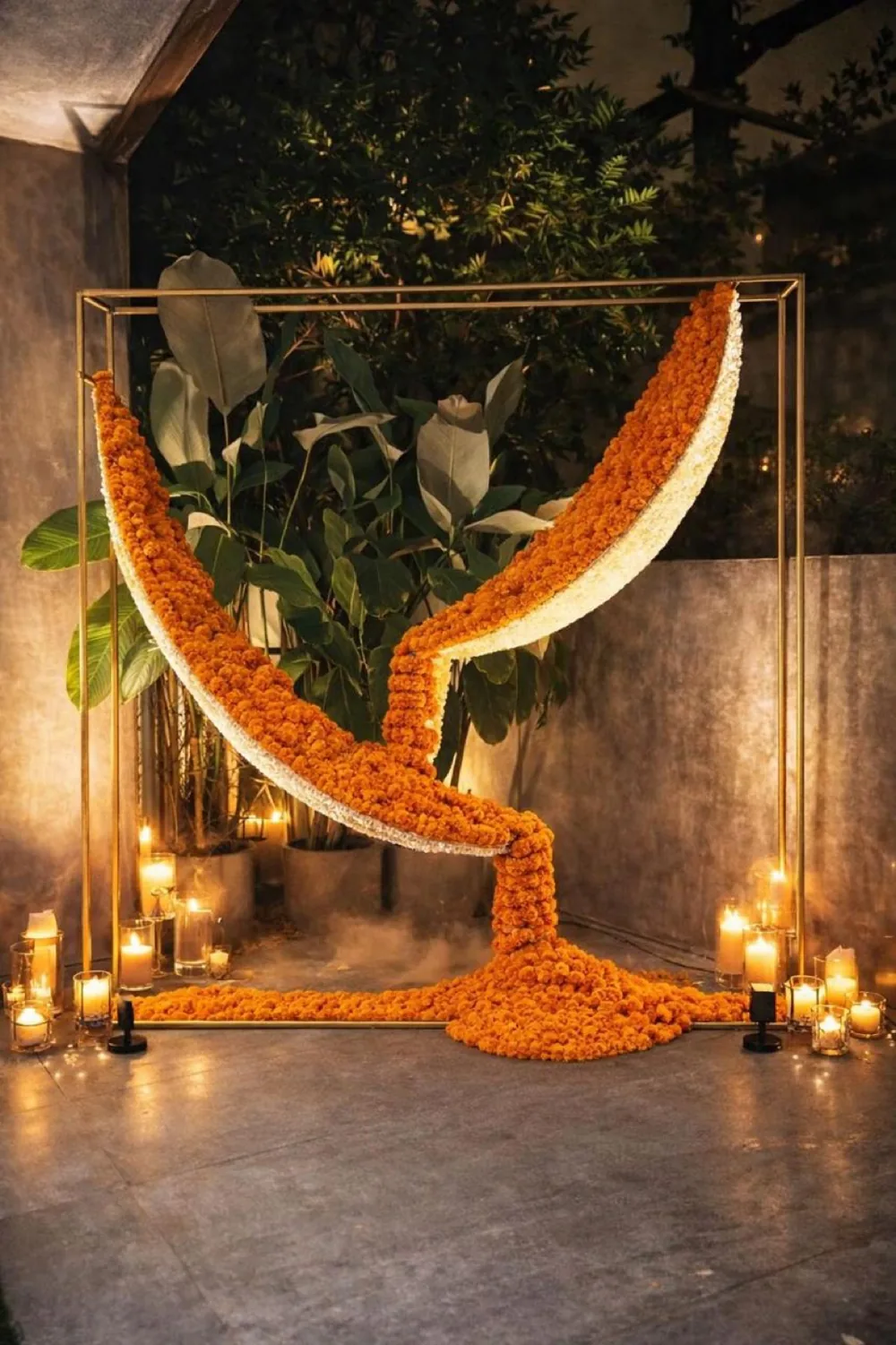
A haldi setup is built from four parts: a seating platform for the couple, a backdrop behind it, a floral and prop layer around it, and a guest-flow zone in front. Three levers move the cost: the span of the backdrop, whether the flowers are market-bought marigold and sunflower or imported stems, and whether the setup sits in open sun or under cover. Every idea below is one we have built, with the build logic and the failure mode named.
Twenty-four setups from our archive: eight backdrops, four seating formats, four settings, four prop zones, four regional variants, ordered the way we design one, structure first and flowers last. For the ritual sequence instead, see our haldi ceremony planning guide and the pre-wedding functions playbook.
What a haldi setup is actually made of
Four components, in the order we draw them. The seating platform decides everything above it: floor level, low riser, swing or built stage. The backdrop is sized to that platform and to the camera distance the room allows. The floral and prop layer is the only part most couples are ever shown. The guest-flow zone, the standing and turmeric-throwing area in front, is the part nobody draws and everybody stands in.
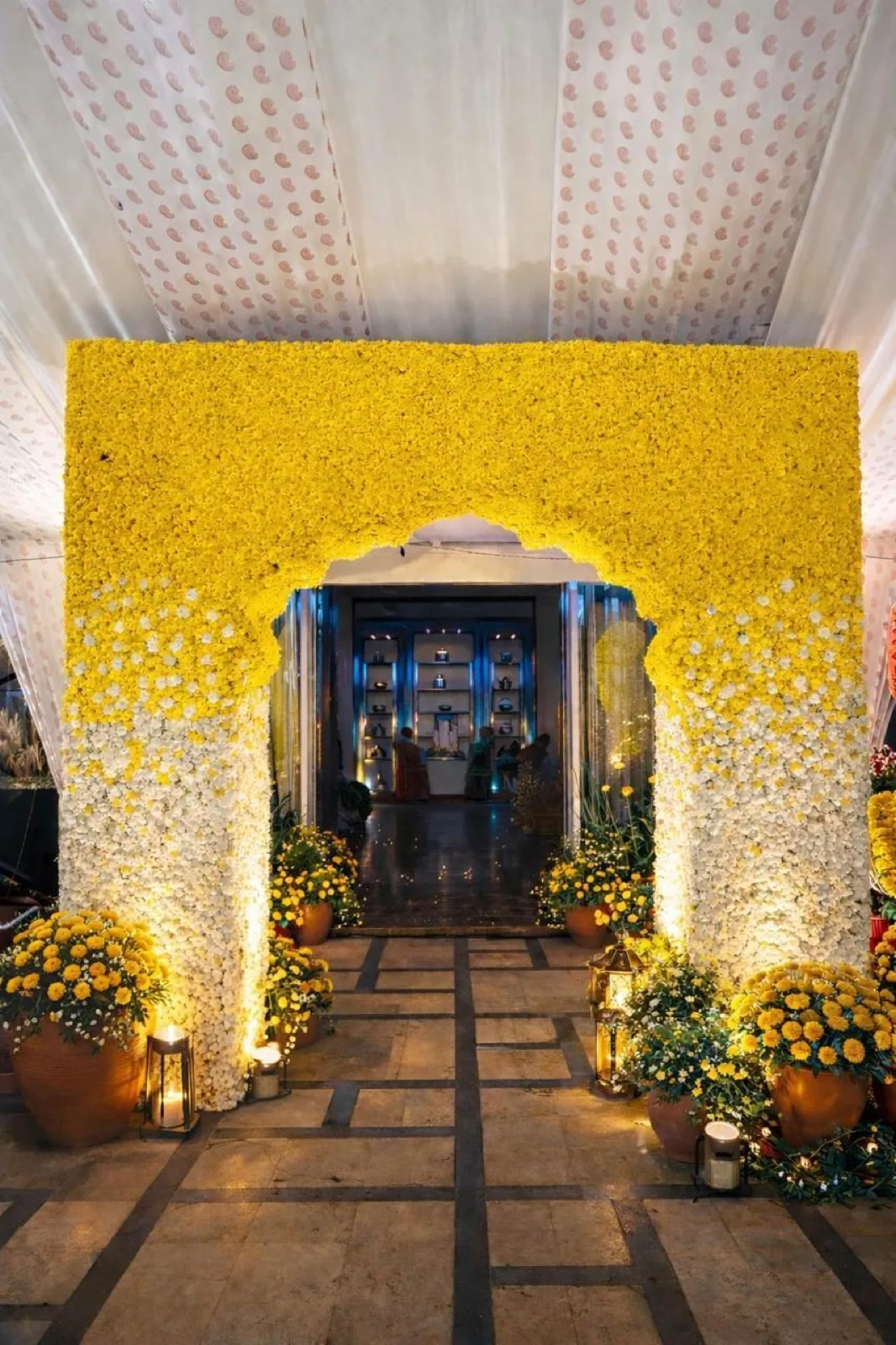
Take the ombre arch at the top of this page. It reads as one object, but it is a welded frame in three sections with a mesh skin, flowers worked outside in so the colour shifts across the span. It is sectional because a single-piece arch will not pass a house door or a hotel service corridor. That is a build decision, not a styling one, and it is why the same design prices differently at a home and at a venue.
The failure mode when those four parts are designed separately is always the same: a beautiful backdrop with no room to stand in front of it.
Morning light is the whole design decision
Haldi is a daylight function, usually between eight and eleven, and daylight at that hour changes faster than any other design variable. At nine, Bangalore light is low, warm and directional, and yellow marigold reads golden against skin. By eleven it is high and close to white, the same marigold reads flat and slightly green, and white fabric in the backdrop blows out on camera.
So we do not approve colour on a screen. We shoot samples on site, at the hour the function will run, against the actual wall or lawn, and view them on a phone, because that is where the photographs will be seen. The method is in our note on testing wedding colours under the real light.
Two consequences. If the function starts after ten, we push saturation up and drop the whites. If the setting faces east, we seat the couple so the sun is behind the camera, not behind their heads.
Marigold and sunflower: the workhorse palette
Marigold and sunflower carry haldi for reasons that have nothing to do with tradition: they are dense, they hold shape out of water for hours, and they grow near where we work. In Bangalore we buy them fresh from the city flower market on the morning of the build, which is why a marigold-led backdrop can be briefed late and still delivered. In Kerala the same holds for marigold and jasmine, with tuberose from local growers.
The substitution rule we write into every haldi brief is simple: name the look, not the stem. If sunflower is short or poor on the day, we move to another dense yellow head of similar diameter and tell you before we do it, rather than quietly thinning the coverage. Coverage density is what you see in a photograph; the species is what you see on an invoice. Imported stems are ordered days ahead and cannot be re-cut on the morning, so on a haldi we almost never recommend them.

Eight backdrop designs we have built
Each of these is a frame plus a skin plus a flower treatment. The frame is what you are really buying.
- Ombre floral arch. Sectional welded frame, mesh skin, colour graded across the span. Needs a level base.
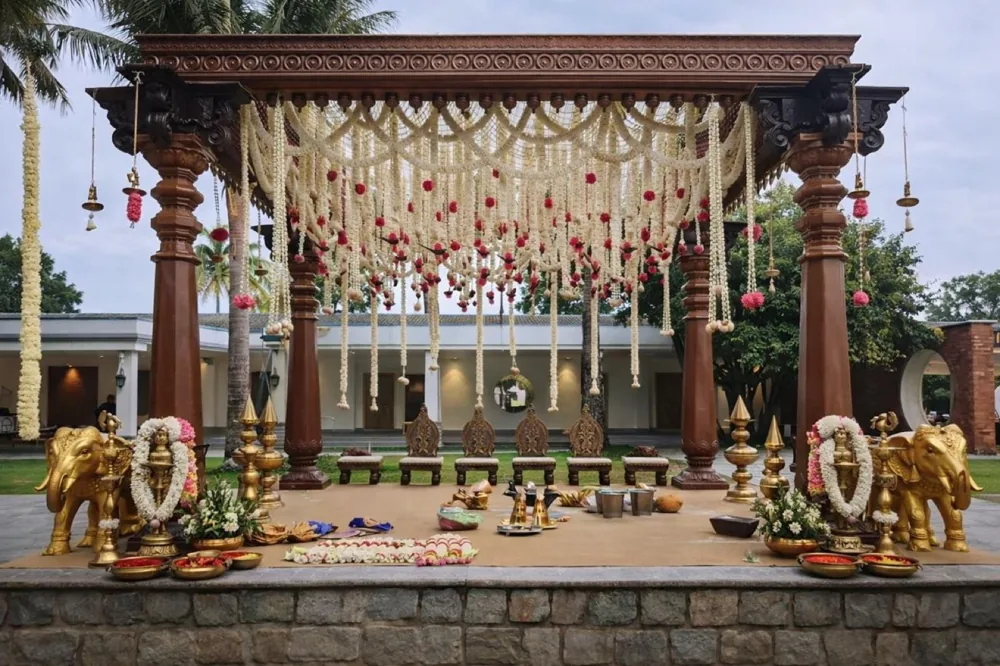
- Marigold curtain wall. Strings on a top rail at a fixed pitch. Cheapest large backdrop per square metre, and the one that moves most in wind.
- Mango-leaf and sunflower panel. Rigid board, foliage in bands, heads set proud. Strong close up, weak at distance.
- Banana-stem frame. Four green stems and a cross-member, dressed with garlands. Traditional, heavy, needs anchoring at the base.
- Floral basket cluster. No wall: grouped baskets build depth, not height. Our default where the existing wall is worth showing.
- Yellow floral stage backdrop. A built stage with a matched backdrop, for couples seated above guest level.
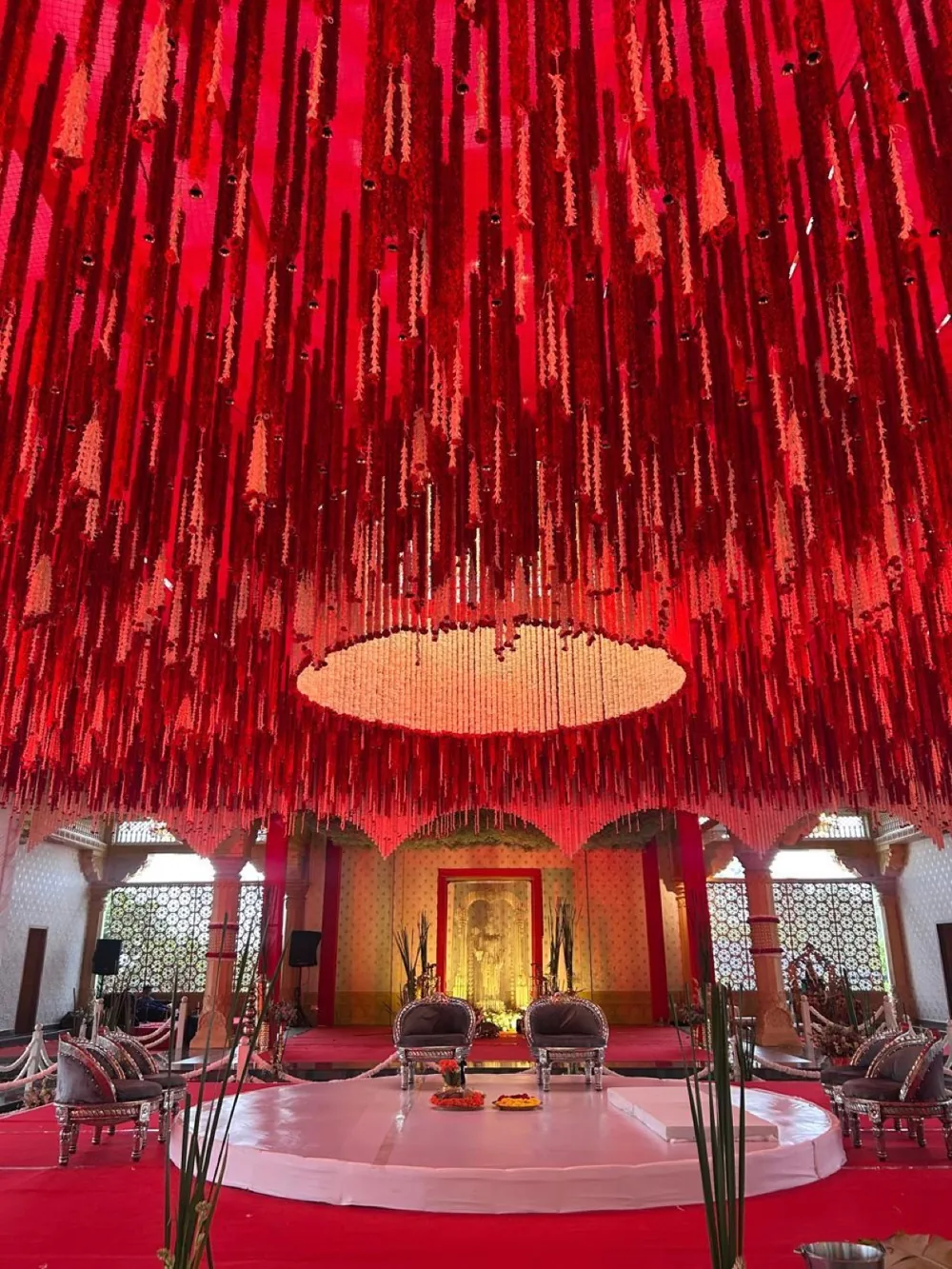
- Garland rain. Overhead garlands from a beam or truss, no vertical backdrop. Only where an overhead load is permitted.
- Open-sky frame. A bare rectangle dressed at the corners, using sky or water as the backdrop. Hardest to sell on a drawing, best in photographs.

The marigold curtain above is a Kerala haldi. On a Bangalore lawn it needs a heavier top rail and ground weights, because the strings behave like a sail.
Seating: platform, swing, jharokha, floor
Four formats, chosen by how long the couple sit and who needs to reach them. A floor dhurrie photographs most naturally and is hardest on anyone over sixty. A low platform, which we build most often, lifts the couple just enough to be seen over a standing crowd. A swing is the strongest single object in a haldi, but it swings, so it needs a fixed overhead span and a clear arc behind. A jharokha frame earns its keep when haldi and mehendi share a day, because the same carved frame is re-dressed that evening: more on that vocabulary in our mehendi decor ideas for Bangalore.
Whatever the format, we dress haldi seating in washable fabric by default. Turmeric does not come out of rented upholstery.

Haldi at home vs at a venue vs at a resort
The setting changes the build far more than the design. How the three compare on what actually decides a quote:
| Consideration | At home | At a venue or mantapa | At a resort |
|---|---|---|---|
| Access | Doors and stairs cap section size | Service corridor, shared loading window | Good vehicle access, longest crew travel |
| Install window | Usually the previous night | Whatever is released, often four to six hours | Evening before; the calmest of the three |
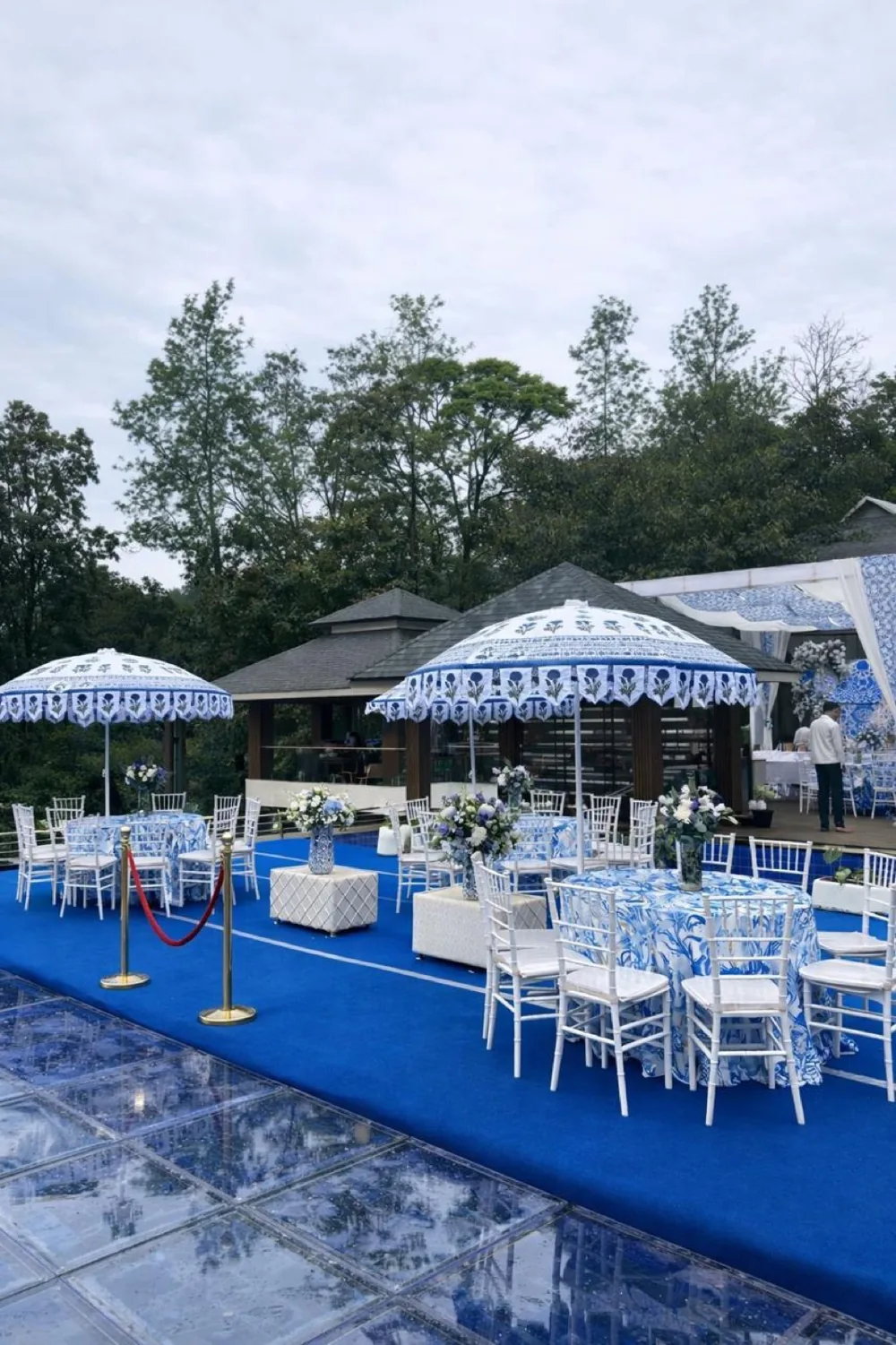
| Surface protection | Your own floors; we sheet the throw radius | Turmeric clauses are common | Pool decks and timber, not the lawn |
| Structure allowed | Nothing drilled; freestanding and weighted | Overhead loads need written approval | Rigging exists but is booked early |
| Guest capacity | Forty to eighty | Flow problems above 150 | Large but spread out |
The clause worth reading twice is turmeric on surfaces. Several Bangalore venues bill for staining on stone, timber and pale upholstery, and the bill arrives after the wedding. We ask for the wording in writing at the site visit and design the throw zone around it.
Outdoor haldi and the rain and heat problem
An open-lawn haldi in Bangalore is a heat problem from March to May and a rain problem from June to October. We plan for both with one tool: a cover that goes up in forty-five minutes without dismantling the backdrop.
In practice the backdrop is freestanding and independent of the shade structure, so cover goes over it rather than being built into it, the seating sits where a canopy can reach, and we hold a decision point ninety minutes before guest arrival with one named person to call it.
Heat is the quieter risk. Marigold holds, roses do not, and anything glued rather than tied lets go in direct sun by mid-morning. We tie, wire and net outdoors.
At a resort the indoor fallback has to be a designed room, not a corridor. At Ajay and Mythili's wedding at Kumarakom Lake Resort the covered option was drawn at the same time as the open one, which is the only way it looks intentional.
Props that earn their place, and the ones that do not
Props are where haldi budgets leak. Our test: does a guest touch it, or does a camera stop on it. Water pistols and turmeric pots pass; printed hashtag signage fails.
A gajra station passes on both counts. Guests queue at it, wear what they take, and it gives the forty people not currently applying turmeric something to do.
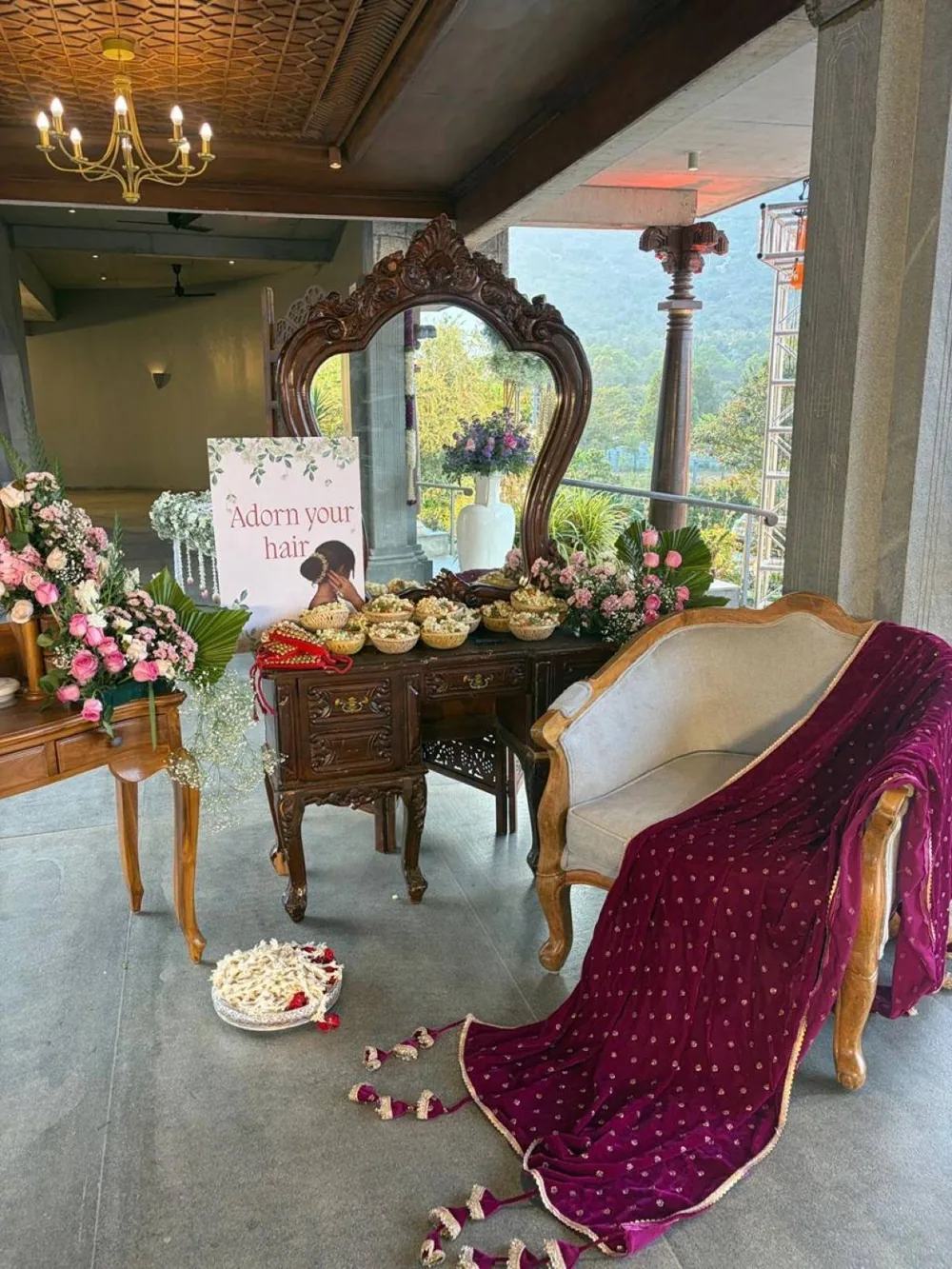
Crate and fruit styling works for the same reason, and fills the low horizontal band flowers alone leave empty.

Guest flow: where sixty people actually stand
Sixty haldi guests do not spread evenly. Around forty stand within four metres of the couple at any moment, because that is where the turmeric is. So we plan a throw zone roughly three metres deep across the full seating width and keep it clear of furniture entirely.
Behind it we allow a circulation band of about a metre and a half so people move without crossing the photograph. Food and the gajra station sit outside that band, or the queue forms in the frame.
Then the wash-up: a water point at the exit of the throw zone, on every haldi, or sixty pairs of turmeric hands reach the buffet first.
What drives the price up or down
Published ranges are a sanity check before you brief anyone. Our haldi decoration guide for Bangalore puts a home setup at ₹80,000 to ₹1.2 lakh, a mid-scale venue haldi at ₹1.5 to ₹2.5 lakh, and a full designer haldi at ₹2.5 to ₹4 lakh. Those are decor-only, and the haldi normally sits inside a whole-wedding envelope rather than being bought alone; that tier structure is in our Bangalore wedding decor cost breakdown.
What moves the number is below. Use it to change the brief, not to argue about the total.
| Driver | Lower end | Typical | Higher end | What to ask for instead |
|---|---|---|---|---|
| Backdrop span | Under three metres | Four to six metres | Eight metres or curved | Keep the span, drop the height; cameras read width |
| Flower type | Marigold and local foliage | Marigold, sunflower, tuberose | Imported heads | Spend on density, not species |
| Seating build | Floor dhurrie | Low platform, dressed edge | Built stage with steps | A low platform buys most of the photograph |
| Shade structure | Existing verandah or tree | Umbrellas, partial canopy | Full-span canopy | Site the setup where cover exists |
| Prop and station count | Pots and pistols | Plus one interactive station | Three or more zones | One station guests use beats three they photograph |
| Labour window | Overnight access | Four to six hours | Two hours before guests | Negotiate access at booking |
To model it inside the whole budget, the India wedding cost calculator takes guest count, functions and season, while our South India wedding cost index and wedding data pages show how those inputs move by region.
Reusing haldi decor for mehendi
If the haldi and mehendi share a day, the reuse is real and worth designing for from the start. Frames, platforms, seating and lighting transfer; flowers do not, because turmeric-splashed marigold cannot go into an evening photograph.
So we design one structure and two skins, and a crew of four re-dresses it between functions. The rules and limits are in reusing wedding decor between functions, and theming each function differently covers how far the colour can move on a shared frame.
How to brief a decorator for haldi
Copy this, fill it in, send it. A decorator who cannot answer these fourteen lines is guessing.
- Date and start time, and the muhurtham it must clear.
- Setting: home, venue, mantapa or resort, space named.
- Guest count, and how many stand in the throw zone.
- Install window the venue will release, in hours, in writing.
- Seating format: floor, low platform, swing or stage.
- Backdrop span and height, plus the camera distance available.
- Flower brief by look, substitution rule agreed in advance.
- Shade plan and the cut-off time for calling it.
- Surface protection and the venue's turmeric clause.
- Water point for guests to rinse.
- Power: points, load, who supplies cable.
- Reuse: what carries to the mehendi, and who re-dresses it.
- Strike time and who clears the site.
- Named person on site through the function, not just install.
Our wedding brief builder assembles the same fields into something you can send to more than one studio and compare like for like.

Bangalore, Goa and Kerala differences
Bangalore. Mornings are cool and the light is kind, which is why haldi here runs at home or at a kalyana mantapa more often than at a hotel. The constraints are access and the install window: houses cap section size, mantapas hand over a hall a few hours before. Flowers are the easy part. That is the logic behind our Bangalore wedding decor work and it carried through at Karthik and Sneha's wedding at Amita Rasa.
Goa. Poolside and beach haldi is driven by wind, not sun. Curtain backdrops become sails, petals travel, and salt air is unkind to anything untreated overnight. We build lower, weight the bases, install the same morning. Specifics in our Goa haldi decoration guide.
Kerala. Courtyards and backwater properties supply the architecture, so the backdrop frames rather than covers. Humidity is the variable: flowers hold, adhesives do not, and a shower is plausible most of the year. We design the covered option first here and treat open air as the upgrade.
Send us the date, the setting and the guest count through our contact page and we will come back with the build logic before the mood board.
Common questions
What time of day should a haldi be held?
Between eight and eleven in the morning, and earlier is better. Light at nine is low, warm and directional, which flatters both skin and marigold; by eleven it is high and close to white, and yellows read flat while white fabric blows out on camera. An early start also gives the couple time to wash and change before the next function.
How much does haldi decoration cost in Bangalore?
Our Bangalore haldi guide puts a home setup at roughly eighty thousand to one point two lakh rupees, a mid-scale venue haldi at one and a half to two and a half lakh, and a full designer haldi with custom installations and multiple zones at two and a half to four lakh. These are decor-only figures, and most couples buy the haldi inside a whole-wedding decor budget rather than on its own.
Can we do haldi at home instead of the venue?
Yes, and it is the setting we build most often in Bangalore. The trade-offs are access and capacity: doors and stairs cap how large a single section can be, so the structure is pre-fabricated small and assembled inside, and forty to eighty guests is the realistic ceiling. Nothing gets drilled, so every element is freestanding and weighted.
What flowers are used for haldi decoration?
Marigold and sunflower do most of the work, with tuberose, jasmine and local foliage filling in. They are chosen for performance rather than symbolism: the heads are dense, they hold shape out of water for hours in morning heat, and they are grown near where we work, so they can be bought fresh on the morning of the build.
How do we stop turmeric staining the venue?
Sheet everything inside the throw radius and get the venue's turmeric clause in writing before you book. Several venues bill for staining on stone, timber and pale upholstery, and the bill arrives after the wedding. We also dress haldi seating in washable fabric by default and put a water point at the exit of the throw zone so guests rinse before touching anything else.
How long does a haldi setup take to install?
Four to six hours for a typical venue setup, and we prefer to work the previous night wherever access allows. A home haldi almost always installs overnight, because mornings are crowded with family. If the venue will only release the space two hours before guests arrive, that constraint should change the design, not just the schedule.
Can haldi decor be reused for mehendi?
The structure can, the flowers cannot. Frames, platforms, seating and lighting transfer cleanly to an evening mehendi, so we design one structure with two skins and send a small crew to re-dress it between functions. Turmeric-splashed marigold does not survive into an evening photograph, so the floral layer is always budgeted twice.
What do we do if it rains on the haldi morning?
Put the cover up, which takes about forty-five minutes if the design allowed for it. That means the backdrop is freestanding and independent of the shade structure, and the seating is sited where a canopy can actually reach. We hold a decision point roughly ninety minutes before guest arrival with one named person whose only job is to call it.
How many guests does a haldi usually have?
Forty to eighty is the common range, and the number that matters more is how many stand inside the throw zone. At sixty guests, around forty will be within four metres of the couple at any moment, so we keep roughly three metres of depth across the full seating width clear of furniture, with a circulation band behind it.
What is the difference between haldi and pithi decor?
They are the same ceremony under different regional names, and the decor differs mainly in palette and seating. Pithi setups in the western Indian tradition lean towards mirrors, bandhani and layered fabric, while South Indian haldi work leans on marigold, banana stem, mango leaf and floor or low-platform seating. The build logic underneath is identical.
Planning this yourself? Send us your name and a number and we’ll come back the same day with a realistic budget for it — yours to keep, whoever you end up booking.
Panigrahana is an architect-founded studio: 500+ weddings designed since 2018, rated 4.8/5 across 94 Google reviews, on a flat planning fee (quoted for the agreed scope) rather than a percentage of what you spend.