What is the difference between a Nair wedding and a Namboodiri wedding in Kerala?
Nair weddings are characteristically grand — elaborate decor, large Sadya meals, multi-community celebrations, the full expression of Kerala's traditional hospitality culture. Namboodiri weddings are characteristically austere and ritually precise — the Vedic strictness, the precise muhurtham, the absence of maximalist decor, and the primacy of the ritual itself. Both share the white-and-gold Kerala aesthetic and Sadya meal tradition, but Namboodiri ceremonies have a quality of concentrated spiritual focus that Nair weddings balance with greater festivity.
What is the Sadya meal at a Kerala wedding?
The Sadya is Kerala's grand ceremonial feast — a vegetarian meal served on a banana leaf comprising 26 or more dishes, including rice, parippu, sambar, rasam, avial, thoran, pickles, pappadam, and payasam. At a Kerala wedding, the Sadya is served to all guests following the ceremony and is considered as important a ceremonial element as the wedding rituals themselves. Panigrahana works with Kerala's finest Sadya caterers to produce this meal at your chosen venue.
What is the Pudavakodukkal ritual in a Nair wedding?
Pudavakodukkal is the formal presentation of the bridal silk Kasavu saree to the bride by the groom's family. The saree is carried to the ceremony mandap and presented ceremonially, after which the bride changes into it. The ritual signifies the groom's family's formal acceptance and welcome of the bride. It is followed by the Tali-tying ceremony, which is the formal moment of marriage in the Nair tradition.
What are the best Kerala venues for traditional Nair and Brahmin weddings?
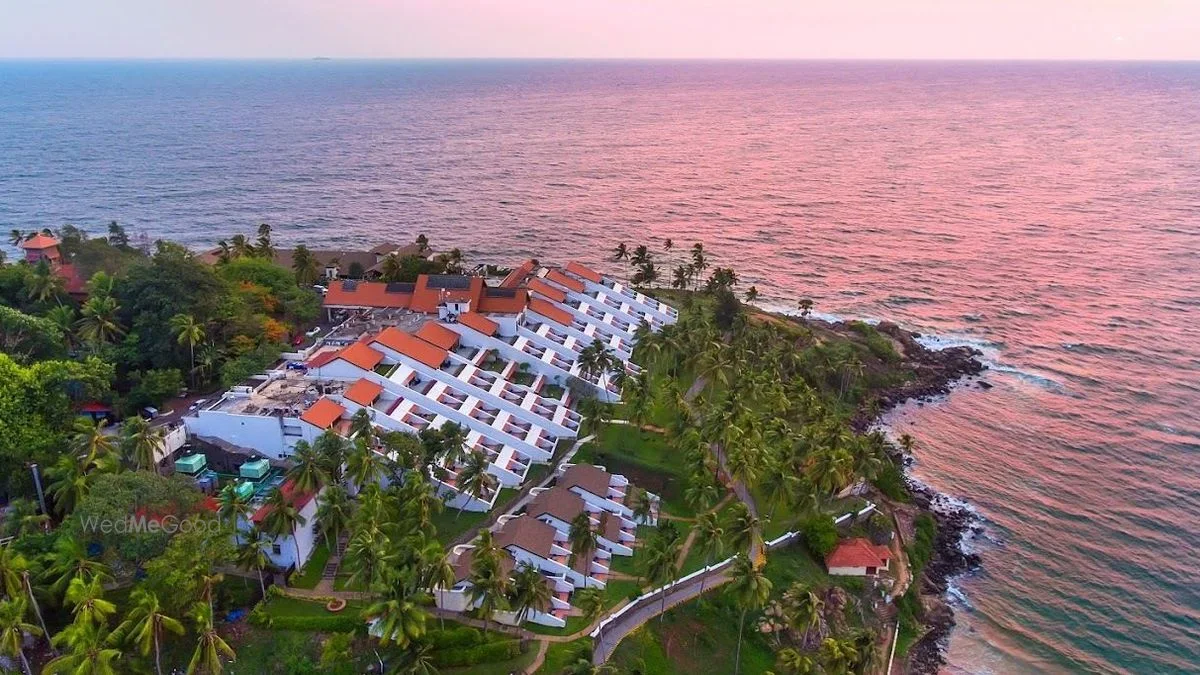
For large Nair weddings of 200–500 guests, Taj Bekal Resort & Spa is our top recommendation. For intimate Namboodiri-appropriate weddings of 50–150 guests, Taj Kumarakom offers the most serene backwater setting with appropriate privacy and atmosphere. Leela Kovalam is the choice for beachfront settings with larger capacity. Backwater houseboats are available for the most intimate ceremonies of 20–50 guests.
How does the Kerala Brahmin (Namboodiri) muhurtham work?
The Namboodiri muhurtham is set with greater precision than most other Hindu wedding communities — the Vedic priest calculates the exact time window using the couple's janma nakshatra and traditional astrological frameworks. The ceremony window can be as narrow as 45 minutes. Panigrahana works with the officiant priest from the earliest planning stage to ensure all logistics are complete before the muhurtham begins, so the ceremony is never delayed by a planning failure.
How long is a Kerala Hindu wedding ceremony?
The core ceremony can be over in under an hour, which regularly surprises guests from other parts of India. It does not make the day shorter, it makes it differently shaped: more time is given to the Sadya, to the arrival and departure sequences and to family gathering than to the ritual itself.
What is thali kettu?
The tying of the thali, the sacred chain often called the minnu in Kerala, around the bride's neck. It is the central moment of the ceremony and the point around which the muhurtham is calculated, so the entire schedule is arranged forwards and backwards from it.
What do the bride and groom wear at a Kerala Hindu wedding?
The convention is built around the kasavu: off-white cotton with a gold border, worn as a set-mundu or saree by the bride and a mundu by the groom, with gold jewellery against it. For design and photography this is unusually important, because a near-white, gold-edged palette sets the colour direction of the whole ceremony space.
What is panchavadyam?
A traditional Kerala percussion and wind ensemble, performed live and entirely acoustically. Along with chenda melam it is the strongest cultural moment available at a Kerala wedding and one of the least expensive, and what it needs from production is space for the ensemble and a processional route with a workable width and surface.
Do Kerala weddings have a fire ceremony?
Practice varies by community and by family. Many Kerala Hindu ceremonies are built around the nilavilakku, the lamp, as the central witness rather than a large fire, while others include a fire and circumambulation around it. Settle the specifics with the family priest early, because the answer changes the venue's ventilation and clearance requirements.
How is a Kerala wedding different from a Tamil one?
Length and emphasis, mainly. A Tamil ceremony runs a longer sequence with several distinctive staged moments such as the kashi yatra and the oonjal; a Kerala Hindu ceremony concentrates into fewer, shorter acts with the thali kettu at the centre. The dress convention, the music traditions and the meal are also quite different.