The Month-by-Month Wedding Checklist
for Couples Planning From Abroad
Thirty points set out by month, from twelve months out to the week after — plus the papers, the cash and the jewellery you carry in and out of India. Built from the roughly 300 weddings we have planned for couples living abroad.
Wedding Planning From Abroad Guide
Last updated: September 2026 · Next review: December 2026

Thirty things to do
before your India wedding
The Complete Checklist
The wedding from abroad checklist for India is a 30-point list organised by timeline — from foundation decisions at 18+ months out through bookings, vendor briefs, and the wedding week itself — built from 300 weddings for families abroad. Every item is actionable. Items marked with context notes tell you what only you can decide — and what Panigrahana can own on your behalf.
Quick answer · Planning from abroad
Start twelve months out and work backwards: venue and planner by month twelve, guest leave and visas by month nine, outfits and payments by month six, and the documents that must travel with you — apostille, affidavits, jewellery invoices — by month three. The month you land is for fittings, tastings and the walk-through.
The wedding, month by month
Work backwards from the wedding month in six bands. Months 12–18 settle the date, the planner and the venue. Months 6–12 settle guest travel and the brief. Months 3–6 settle outfits, money and the run of show. The last three months are paperwork and arrivals. The table below maps every one of the thirty points to the month it belongs in, so you can read only the band you are standing in.
Two bands are consistently under-run. Guest travel, because anyone flying from the United States, the United Kingdom, Canada, the Gulf or Australia for a three-day wedding is committing a week of leave and needs a year of notice. And documents, which move at the speed of appointment slots in your city rather than the speed of your planning.
| Months out | What has to be settled in this band | Points |
|---|---|---|
| 18+ | The date agreed across both families and both calendars, the planner appointed, the venue shortlist walked on video, the decision-makers named | 01–04 |
| 12–18 | Venue contracted, photographer briefed, family warned about leave, guest visa guidance issued, room blocks held | 05–09, 23 |
| 6–12 | Outfit route decided, caterer and music briefed, RSVPs opened, the affidavit and legalisation route confirmed for your country | 10–13, 24–25 |
| 3–6 | Fittings trip, the payment schedule and transfer route, guest guide, WhatsApp structure, run of show | 14–18, 26 |
| 1–3 | Venue walk-through, registration paperwork lodged, what you carry decided, guest visas actually applied for | 19–20, 27–28 |
| Wedding week & after | Welcome kits, emergency contacts, the family proxy pack in one folder, registration completed and the certificate legalised before you fly home | 21–22, 29–30 |
If you are deciding how many times you need to be in India for all of this, we have set the trips out separately in how many India trips wedding planning actually needs.
Tell us the month. We will build the rest around it.
Plan this from abroad
Send your wedding month and roughly how many people will travel. We will come back with the band you are actually in, what is already late, and which venues are worth a video walkthrough for those dates.
The thirty points in full
How do you handle guest health and hygiene at an Indian wedding for guests flying in?
Guest health at an Indian wedding with 50-150 guests flying in comes down to five arrangements we build into every wedding from abroad. Sealed bottled water at every function and in every room, with no ice from unknown sources at the bar. A written food-safety brief to the caterer: cooked-to-order live counters, no pre-cut fruit standing in the sun, salads washed in filtered water, and a labelled vegetarian, vegan and nut-free line. A first-aid desk with ORS sachets, paracetamol, antacids and a doctor on call, which most 5-star hotels provide on request and which costs about ₹10,000-25,000 for a wedding week through an agency (indicative). Travel insurance for every overseas guest, stated on the wedding website as a request rather than a rule. And a neutral pointer to the traveller's own doctor for vaccination advice 6-8 weeks before travel; we make no medical claims ourselves.
Can we carry gold and jewellery into India for the wedding, and take it back out?
Yes, and the wedding jewellery of a family living abroad crosses the border every season — but the duty-free allowance is set by a customs notification that changes, so we do not publish a figure for it. What we do publish is the preparation that keeps the conversation at the counter short, whichever allowance is in force in the month you fly.
The allowance for jewellery carried by a passenger who has been residing abroad turns on two things: how long you have lived outside India, and whether the pieces are jewellery rather than bars or coins. Both are fixed by the Baggage Rules and amended by notification, and the figures circulating on travel blogs and forums disagree with each other. The only authority is the Central Board of Indirect Taxes and Customs. We could not read the current notification directly when this page was reviewed, so we are not going to state a gram limit or a duty rate and have you plan around a number we have not verified. Check the current rules on the CBIC site, or with a customs broker, in the month you travel — not the month you are reading this.
What we ask every couple to do, regardless of the allowance:
Photograph every piece against a plain background and keep the purchase invoice or a written valuation with it. For heirlooms with no invoice, a dated family declaration and a jeweller’s valuation are what an officer can actually work with. Carry the pieces in cabin baggage, not in the hold, and carry the paperwork with the pieces rather than in a folder at home. Declare where declaration is required and use the red channel if you are unsure — the cost of declaring is known, and the cost of not declaring is not. Never carry bars or coins on behalf of another family, however the request is framed. And tell your insurer: most household policies do not cover jewellery in transit without an endorsement.
Coming back out is a second country’s question, not India’s. The United States, the United Kingdom and Canada each have their own rules on declaring goods and on carrying currency or monetary instruments, and those rules sit with the customs authority of your own country of residence. Read them there. If you are buying in India, keep every invoice in one envelope from the first day of shopping — our Bangalore wedding shopping guide sets out how we sequence the shopping trip so that the invoices exist in the first place.
How much cash can we bring in without a declaration?
India’s Currency Declaration Form is not required below two thresholds, and above either one you declare on arrival. The Reserve Bank of India’s February 2026 amendment to the export and import of currency regulations sets them out in a single sentence.
The notification says the Currency Declaration Form “need not be completed in cases where the aggregate value of the foreign exchange brought in by the passenger in the form of currency notes, bank notes, or travellers’ cheques does not exceed U.S.$ 10,000/- … and/or the value of foreign currency notes does not exceed U.S.$ 5,000”. Read the two limits as separate tests: the total of notes, bank notes and travellers’ cheques against the first figure, and physical foreign currency notes alone against the second. Cross either, and the form is completed on arrival.
In practice this matters less than couples expect, because carrying a wedding’s worth of cash across a border is the worst way to pay for it. Vendor deposits, venue instalments and the final settlements should move through a banking route with a record attached to each one, for the ordinary reason that a payment you cannot evidence is a payment you cannot dispute. Your departure country will also have its own outbound declaration rules; check them with your own customs authority rather than assuming they mirror India’s.
Which documents must come from abroad, and by when?
Two things routinely have to be produced outside India: a sworn statement that you are free to marry, and the legalisation of any certificate that will be used in the other country. Both run on appointment queues, so both belong in the six-to-twelve month band rather than the last one.
The no-objection statement. The US Embassy and Consulates in India state that “if the government asks you for a ‘no objection letter’, you can satisfy this request by making an affidavit at your local U.S. Embassy/Consulate regarding your marital status and eligibility to marry”, and that “affidavit fees and appointments are required”. The same page notes that a registrar may also ask for proof that any prior marriage has been terminated, and that the Embassy does not itself register marriages in India. The Government of Canada issues what it calls a “statement in lieu of certificate of non-impediment to marriage abroad” for a fee, and says that marriages legally performed in a foreign country are usually valid in Canada without being registered there.
Apostille or attestation. India has been a party to the Hague Apostille Convention since it came into force for the country on 14 July 2005, following accession on 26 October 2004. The United States, the United Kingdom, Australia and Singapore are parties; Canada became one on 11 January 2024. The United Arab Emirates is not on that list, which is the practical point for Gulf families: a certificate destined for the UAE goes through consular attestation, not an apostille, and the two chains are not interchangeable.
On the Indian side, the Ministry of External Affairs runs apostille through e-Sanad, which states plainly that the Ministry “is not accepting documents directly from the applicant/individual” — documents are submitted and collected through four designated outsourced agencies. The published fees are ₹50 for the apostille of each document, ₹22 per personal document to the agency and ₹40 postal; normal attestation is free of charge. None of those numbers is the constraint. The appointment slot is.
Order the chain so nothing waits on anything else: the affidavit and any divorce or death certificate from your country of residence in the six-to-twelve month band, the Indian certificates gathered in the three-to-six band, the registration lodged in the one-to-three band, and the legalisation of the marriage certificate begun the week after the wedding while someone is still in the country.
Which items can only be done on the India trips?
Five things need a body in the room: final outfit fittings, the caterer’s tasting, a walk of the venue at the hour your ceremony actually starts, any appearance the registration requires, and the wedding itself. Everything else on this list can be done from where you live, and most of it is done better that way.
The fittings are the immovable one: a blouse or a sherwani cut from emailed measurements will need adjustments, and adjustments need you standing still in a shop. The tasting matters because a menu reads identically on paper whether or not the kitchen can hold it for four hundred people. The walk-through matters because you are checking where the sun sits at your ceremony hour, where the sound carries and what the last row can see. The registration appearance is set by the office, not by you.
Grouping those five into as few trips as possible is a planning decision worth making deliberately rather than by accident, and it is the whole subject of how many India trips wedding planning needs. The broader remote workflow — what we send you, what you approve, and what happens between visits — is set out in how to plan an Indian wedding from abroad.
What do we hand to the family proxy at each stage?
One named relative, one folder, and a written list of what they may and may not approve. The failure mode is never a dishonest proxy; it is a well-meaning one who says yes to a vendor because nobody told them they were not supposed to.
At booking stage, hand over the signed scope and the payment schedule, the venue and vendor contact list, and a one-page note naming who may approve what. At design stage, add the approved drawings and the material list, so that a substitution offered on site can be recognised as a substitution. In the month before, add the document folder with a clear marking of which papers are originals and which are copies, the rooming and arrival list, and the emergency contact card. In the wedding week, the proxy holds the run of show and nothing more — decisions at that point belong with the on-ground coordinator, not with a relative who is also a guest.
Write down the limits as explicitly as the permissions. One of them is set by regulation rather than by you: the Reserve Bank of India’s master direction on deposits and accounts provides that a resident power-of-attorney holder may operate an account held by a person resident outside India only for “withdrawals for local payments or remittance to the account holder himself”, and may not “make payment by way of gift to a resident on behalf of the account holder”. A relative holding your power of attorney is not a way to route wedding gifting, and assuming otherwise is a problem discovered at the worst possible moment.
Wedding From Abroad
Planning Questions
FAQ
Yes, and families living abroad do it every season. We do not publish a gram allowance or a duty rate, because both are set by a customs notification that is amended from time to time and the figures circulating online disagree. Check the current Baggage Rules with the Central Board of Indirect Taxes and Customs in the month you fly. Photograph every piece, carry the invoice or a written valuation with it, keep it in cabin baggage, and declare where declaration is required.
The Reserve Bank of India's February 2026 amendment to the export and import of currency regulations says the Currency Declaration Form need not be completed where the aggregate foreign exchange brought in as currency notes, bank notes or travellers' cheques does not exceed US$10,000, and the value of foreign currency notes alone does not exceed US$5,000. Above either threshold, the form is completed on arrival.
It depends on the country the certificate is going to. India has been a party to the Hague Apostille Convention since 14 July 2005, and the United States, the United Kingdom, Australia, Singapore and, since 11 January 2024, Canada are parties, so an apostille is the route for those countries. The United Arab Emirates is not a party, so a certificate destined for the UAE needs consular attestation instead.
The US Embassy and Consulates in India say a request for a no objection letter can be satisfied by making an affidavit at your local U.S. Embassy or Consulate about your marital status and eligibility to marry, with fees and an appointment required. The Government of Canada issues a statement in lieu of certificate of non-impediment to marriage abroad for a fee. Book the appointment months ahead, not weeks.
Five: final outfit fittings, the caterer's tasting, a venue walk-through at the hour your ceremony begins, any appearance the marriage registration requires, and the wedding itself. Everything else on this checklist can be run from where you live. Grouping those five into as few trips as possible is a decision worth making deliberately.
A signed scope and payment schedule, the vendor contact list, the approved drawings and material list, the document folder marked for originals against copies, and a one-page note naming who may approve what. Write the limits down as explicitly as the permissions. A resident power-of-attorney holder cannot, under the Reserve Bank's master direction, make a gift payment to a resident on your behalf from your account.
Start 18–24 months out. Premium venues in Goa, Bangalore, and Kerala book up 18 months in advance for peak season dates (October–February). couples living abroad who start 12 months out often find their preferred venues already blocked. The date must be agreed across two family time zones before any booking begins.
Most of it, yes — venue shortlisting, vendor briefing, design approvals, payments and contract review are all run remotely. Five things still need you in the room: final outfit fittings, the caterer’s tasting, a venue walk-through at your ceremony hour, any appearance the registration requires, and the wedding itself. We work between your visits over WhatsApp, video calls and documented approvals.
You need someone on the ground who can be held to a written scope. Without one, you are project-managing several dozen vendors in a country you do not live in, across a time difference, while every family member has a view. What a planner does for a couple abroad is different in kind: on-ground representation, family coordination and vendor verification against documents rather than photographs.
Foreign passport holders need an Indian visa; cardholders under the Overseas Citizen of India scheme do not. The Indian e-Tourist Visa portal names a casual visit to meet friends and relatives as a valid purpose, asks for applications a minimum of four days before arrival and no more than 120 days ahead, and offers 30-day, one-year and five-year options. The fee is country-specific and non-refundable. Give your overseas guest list the guidance at least three to four months out.
Your Indian ceremony needs to be registered with the Sub-Registrar's office to produce a legal marriage certificate. For use abroad, this certificate requires an Apostille stamp from India's Ministry of External Affairs (UAE requires attestation instead of Apostille). See our complete legal guide for country-by-country details.
Keep planning
How many India trips wedding planning needs · How to plan an Indian wedding from abroad · Registering your India marriage when you live abroad · Sending wedding money to India · The Bangalore wedding shopping trip · Wedding guests flying in from abroad
Last updated: September 2026 · Next review: December 2026 · Government sources checked 12 September 2026. Nothing here is legal, tax or customs advice; confirm the current rules with the issuing authority for your dates.
Talk to the studio.
Plan this from abroad.
Plan this from abroad
Around 300 of the weddings we have planned since 2018 have been for couples living abroad. Send us the month and we will tell you which band you are in and what is already late.
Send Your Wedding MonthSee the design details in our work
Use one shared approval record for the layout, materials, inclusions and open questions. A remote walkthrough should show access, rooms, guest routes and the weather alternative as well as the venue’s most attractive view.
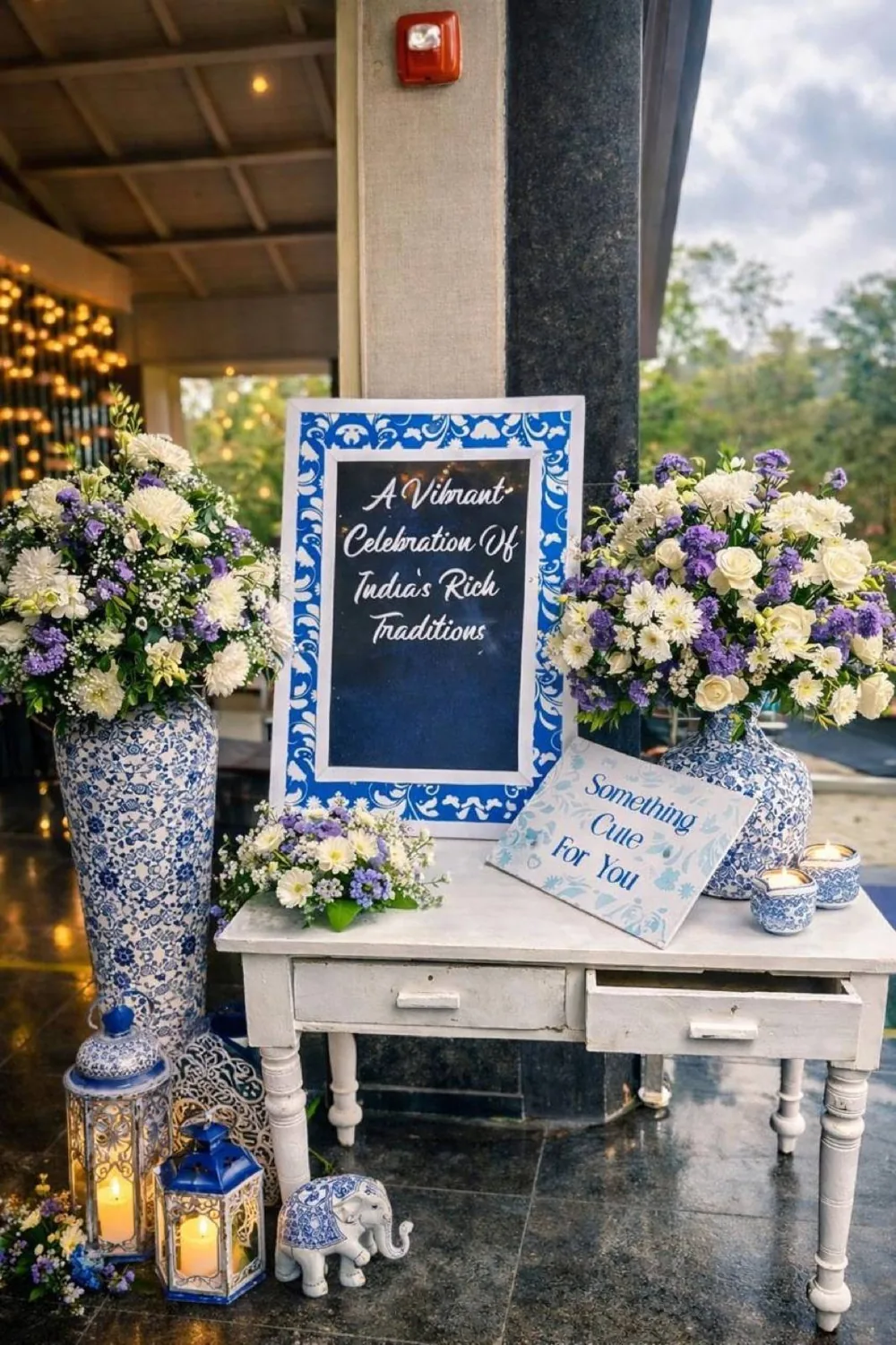


Make the next decision with the details in front of you.
What should we decide before booking a wedding in India?
Agree your date flexibility, guests at each event, overnight guests, overall spending limit and essential family requirements before comparing venues. Give each decision an approver. Then check venue suitability, a complete quotation and the dependencies that a deposit would create.
A venue shortlist can be prepared remotely. Before a visit, ask which spaces and room types you can inspect and arrange tastings or supplier meetings separately. Keep unconfirmed details in an open-questions list. A booking should follow the written scope and terms you have reviewed, rather than a photograph or an assumed capacity.
Check venues against our briefWhat should we resolve before paying a venue deposit?
Obtain the dates, booked spaces, room allocation, payment schedule, inclusions and change or cancellation terms in writing. Check what is still provisional and which other decisions depend on the booking. Review the actual supplier terms rather than assuming a refund or date-change policy.
List the decisions a deposit would trigger: invitations, flights, accommodation, supplier bookings and design. Identify who can authorise changes and what needs reconfirmation if guest numbers or event timings change. Ask the provider to explain unclear clauses; seek qualified advice for a legal interpretation of your contract.
Explore the effect of a changeWhat should be agreed for after the wedding?
List outstanding deliveries, their owners and agreed dates before the event. Keep approved changes, payments, invoices and any deposits to reconcile together. Confirm the process for reporting missing items or following up on photography, video and other promised deliverables.
Check each supplier's agreed scope and delivery dates. Record what has been received and what remains open. A final expense review should distinguish approved additions from items needing clarification. Refunds and other remedies depend on the actual agreement and circumstances; do not assume a standard policy.
Review outstanding decisions