In eight years and more than five hundred weddings we had never run an entire ceremony scheme in marigold orange. Couples ask for blush, for ivory, for green. Vikram and Kaamya's wedding morning at The Tamarind Tree was the first time we committed the whole thing to the cheapest flower in the Bangalore market, and it is now one of our favourite things the studio has made.
Marigold is the cheapest flower in the market and the one every Indian guest has seen at every function since they were a child. That is exactly the problem. Used lazily it reads as budget, and it reads as generic, and no amount of it fixes either.
So the studio's instinct for eight years has been to reach for blush, ivory, sage, dusty pink — palettes that announce themselves as considered. Vikram and Kaamya's families wanted the wedding morning to look like a wedding morning in Karnataka. We agreed to build the whole thing in marigold on one condition: that every piece of it had to be constructed rather than draped.
Marigold only reads as luxury when the craft is visible.
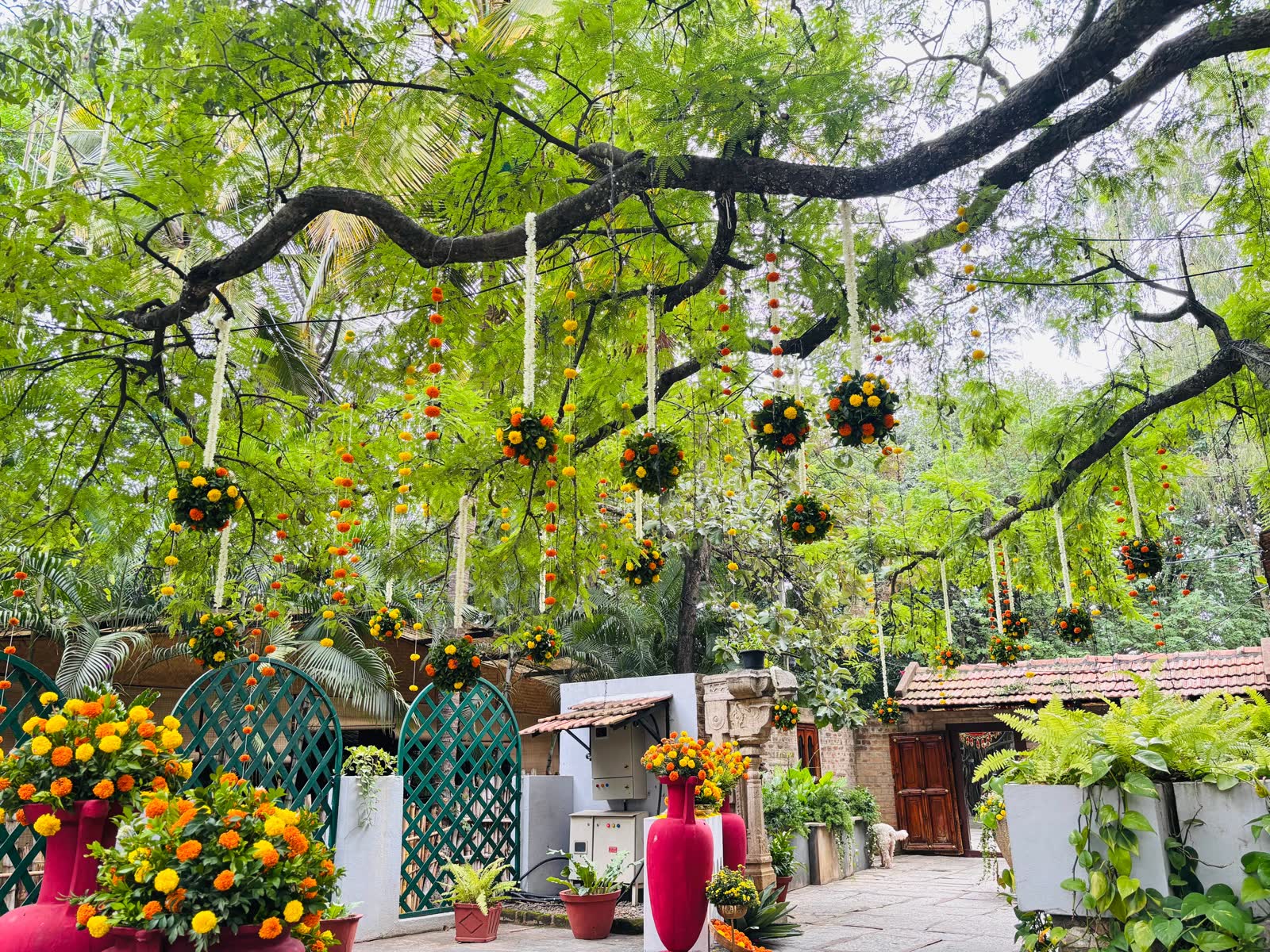
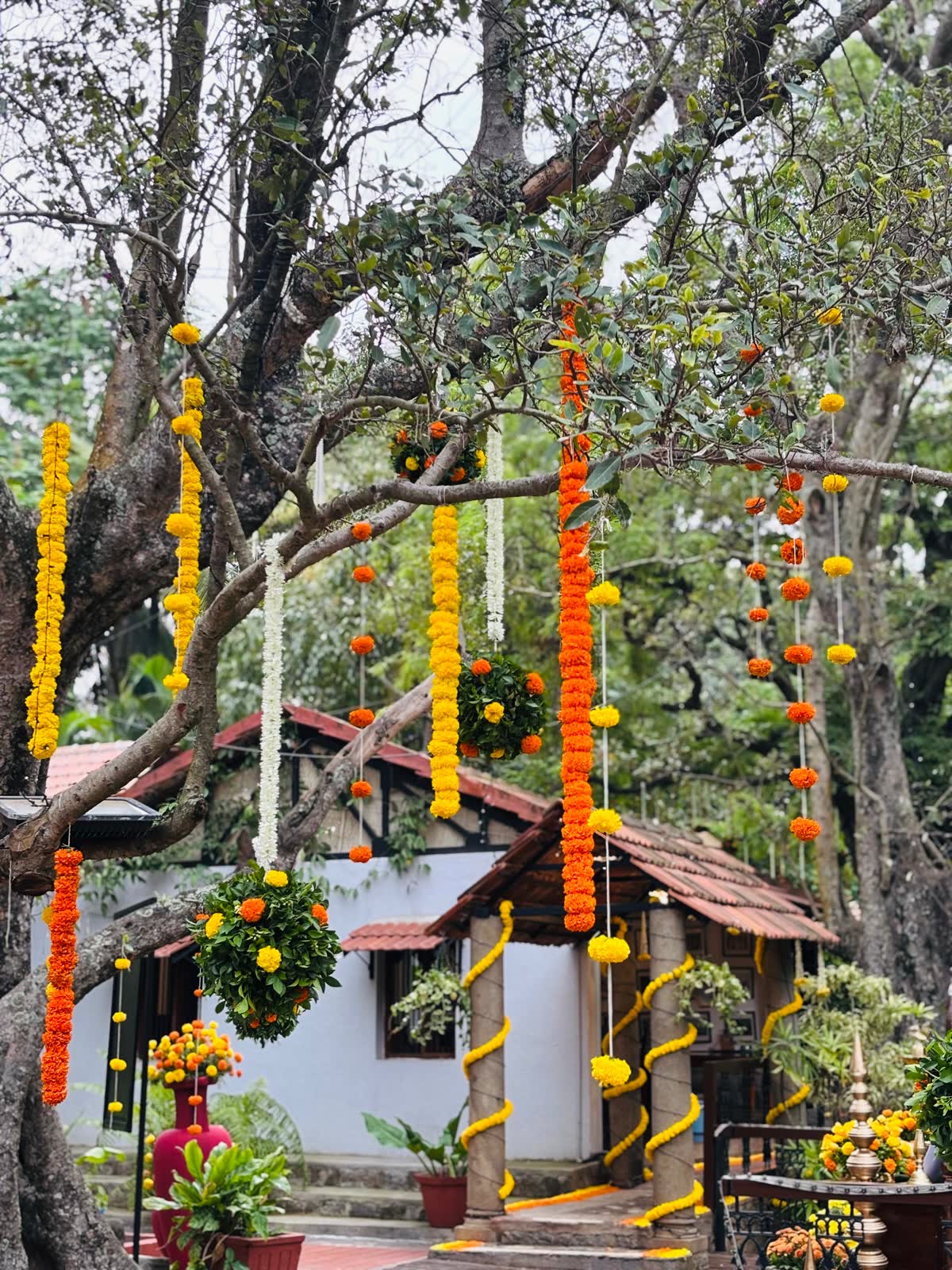
That is the whole rule. A marigold rope thrown over a branch is decoration. A marigold rope that runs the full drop of a four-hundred-year-old tamarind limb, graded against six others, ending clear of a guest's head, is architecture. The flower did not change. The build did.
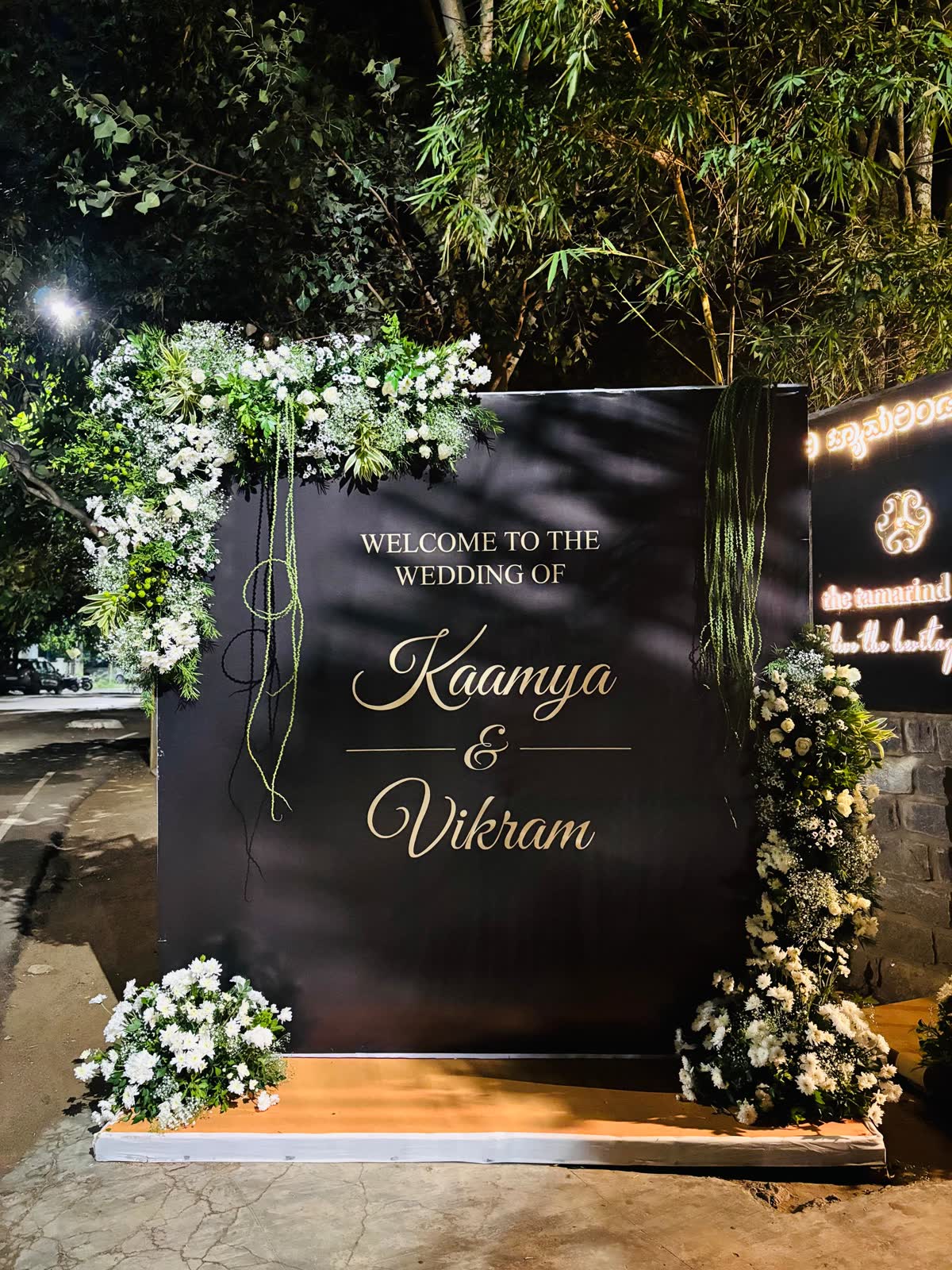
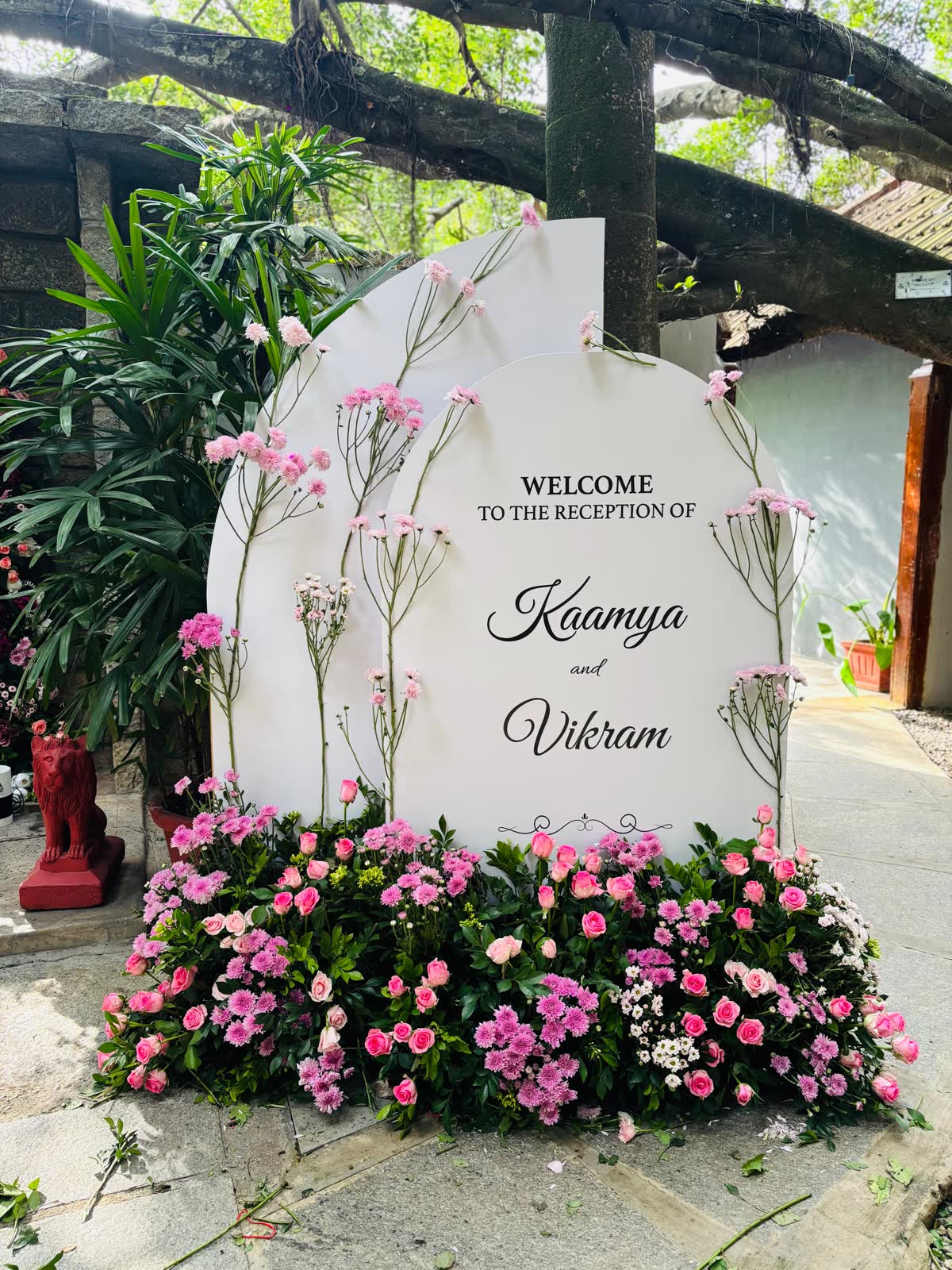
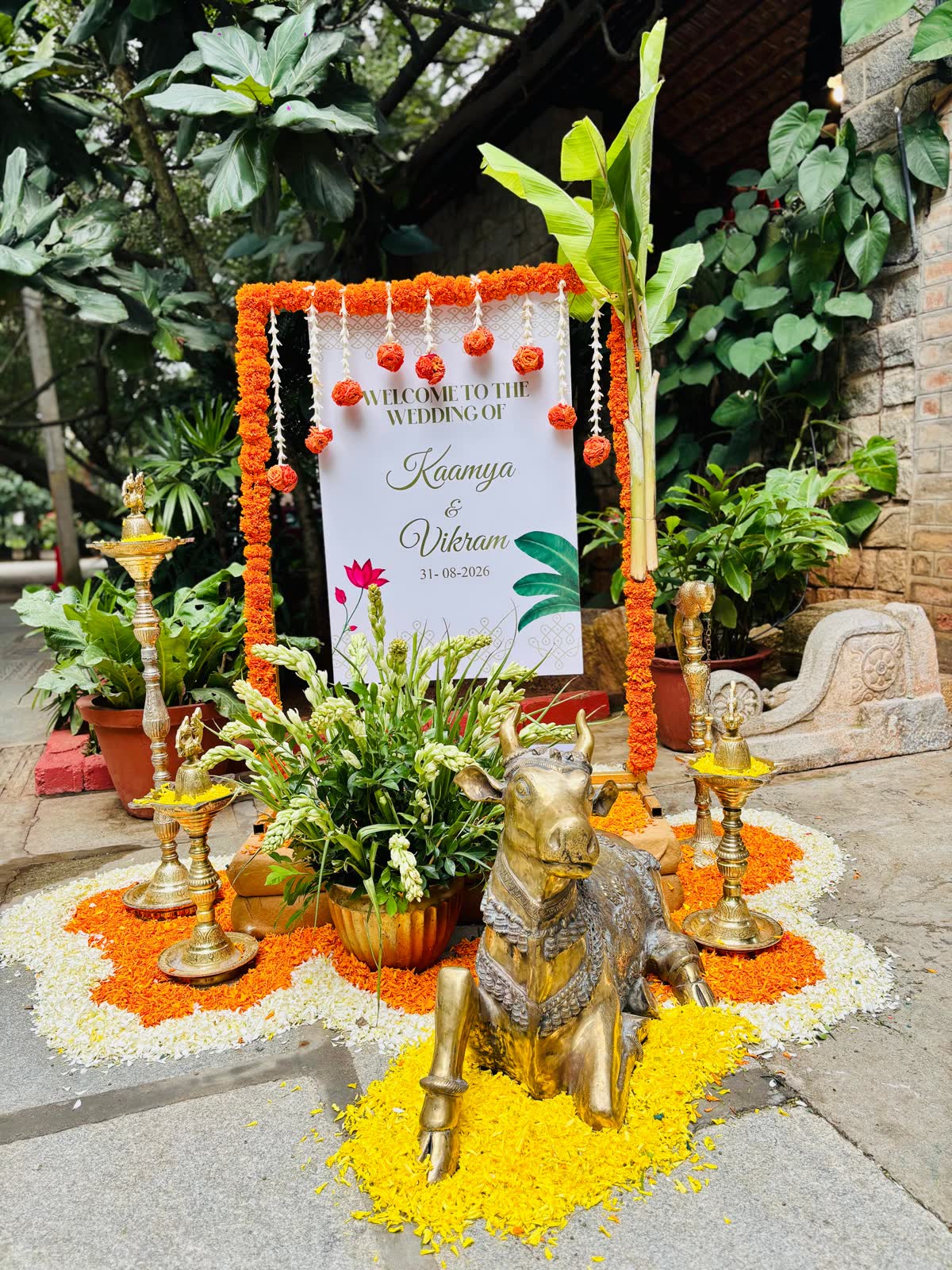
Guests arrived after dark. At night The Tamarind Tree's estate lighting does most of the work, so the welcome evening was built to be lit rather than coloured — a black board in gold script, white bloom clusters at two corners, and the venue's own signage left visible behind it.
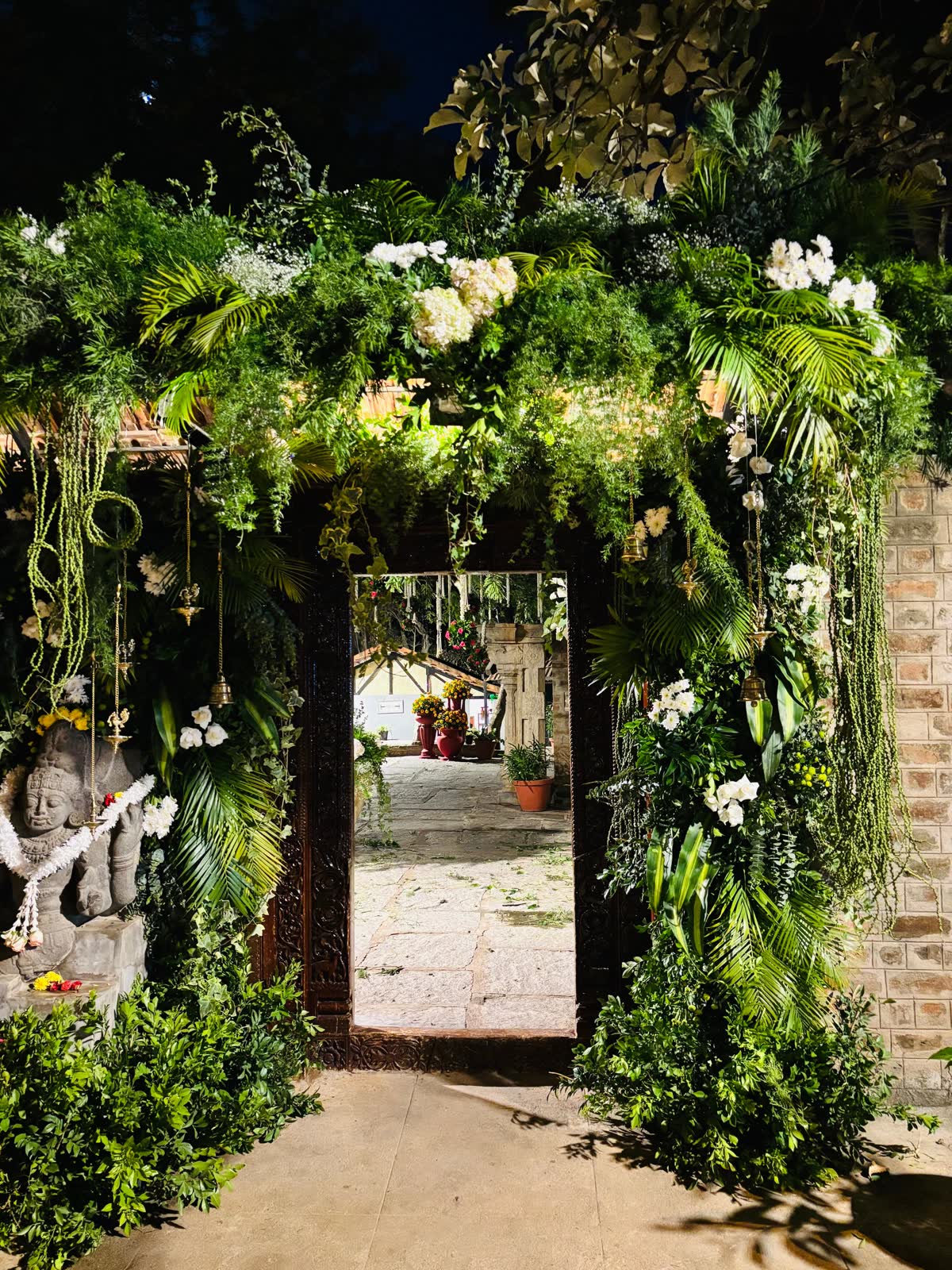
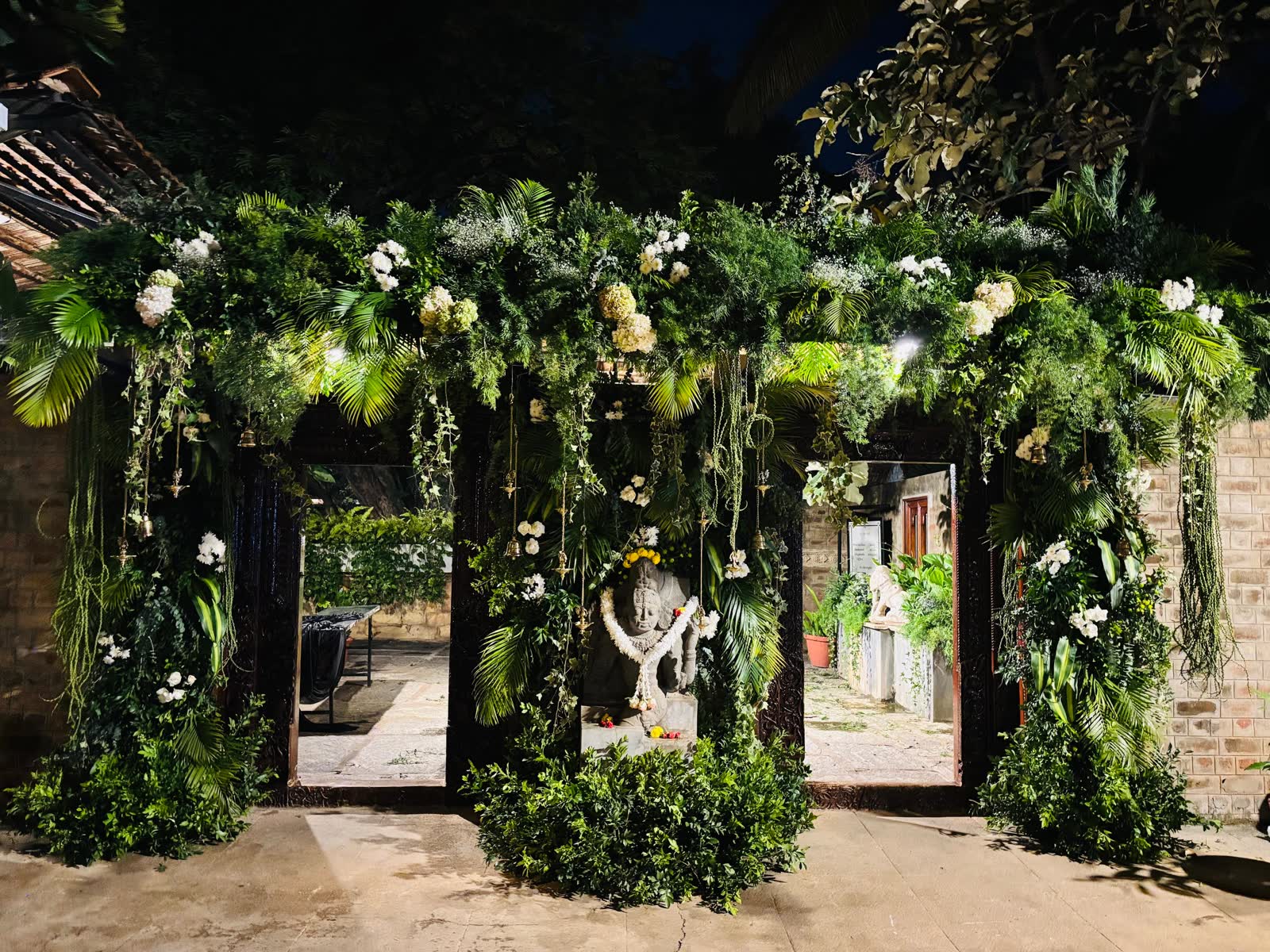
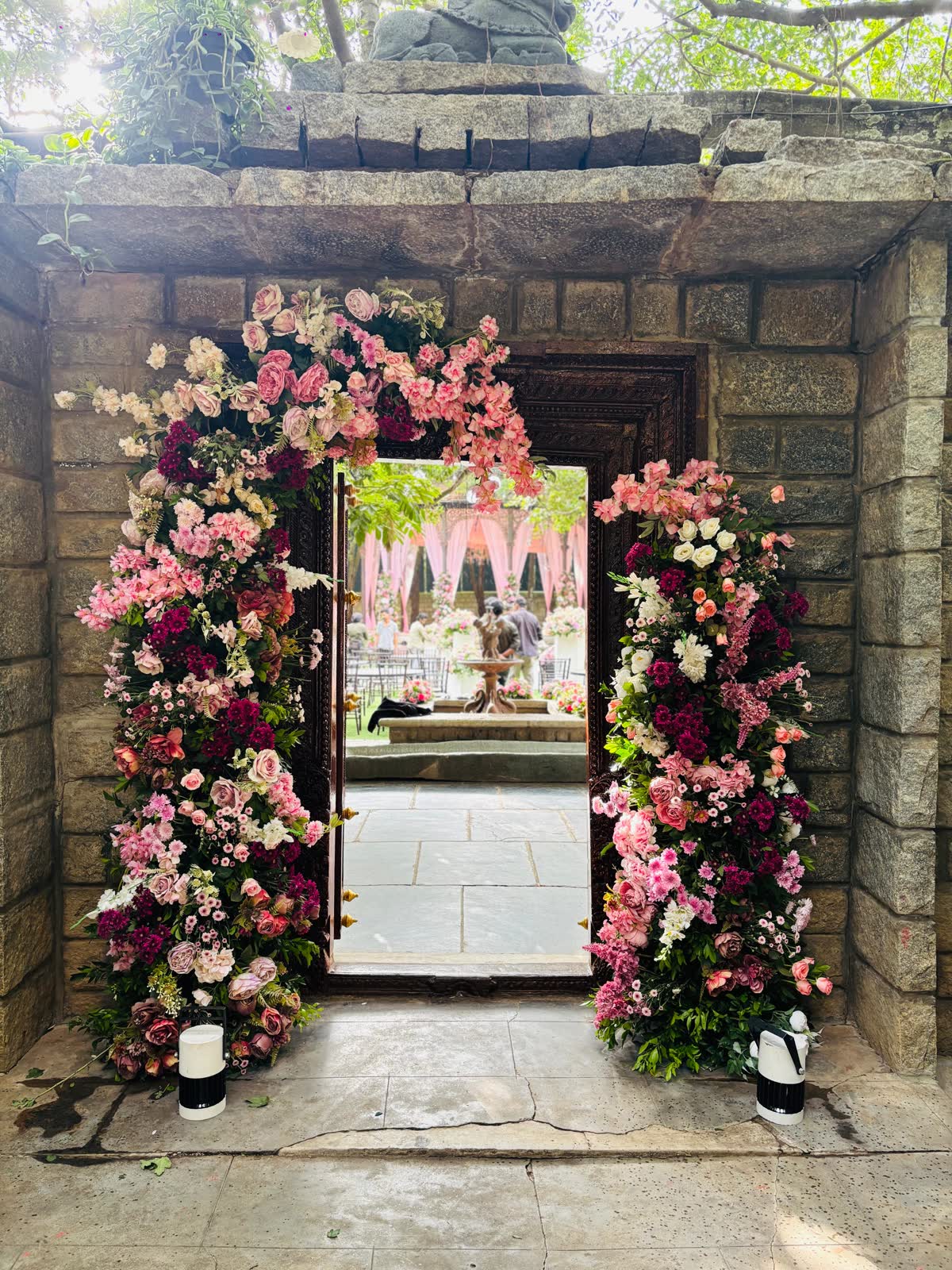
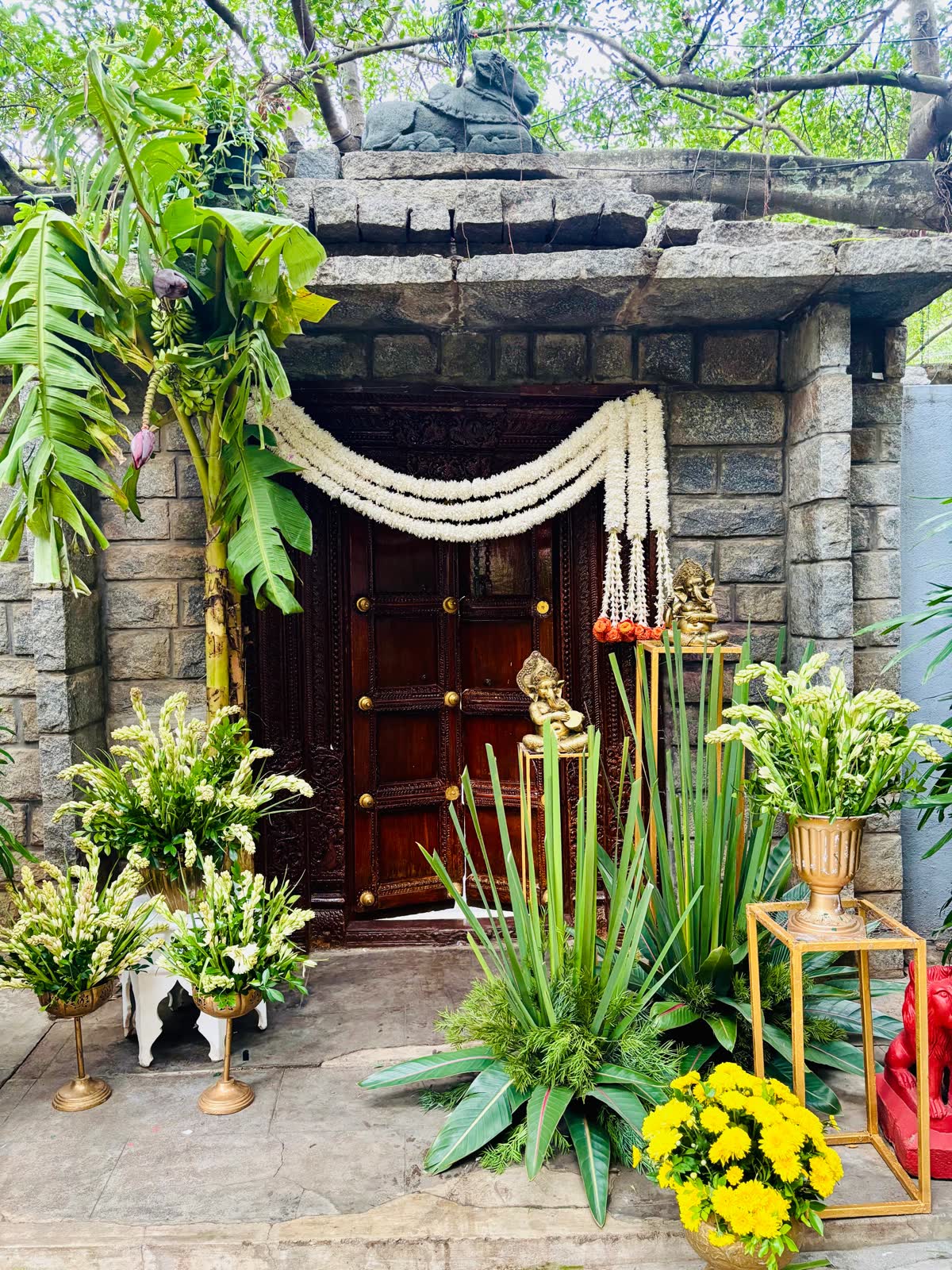
The two portals are the piece we would build again. The estate's carved teak door frames and its stone deities were wrapped in dense fern, palm, ivy and hanging amaranthus, punctured with white orchid and hydrangea, and hung with brass bells and oil lamps on chain. Lit from inside, a doorway stops being a doorway and becomes a tunnel with something glowing at the end of it.
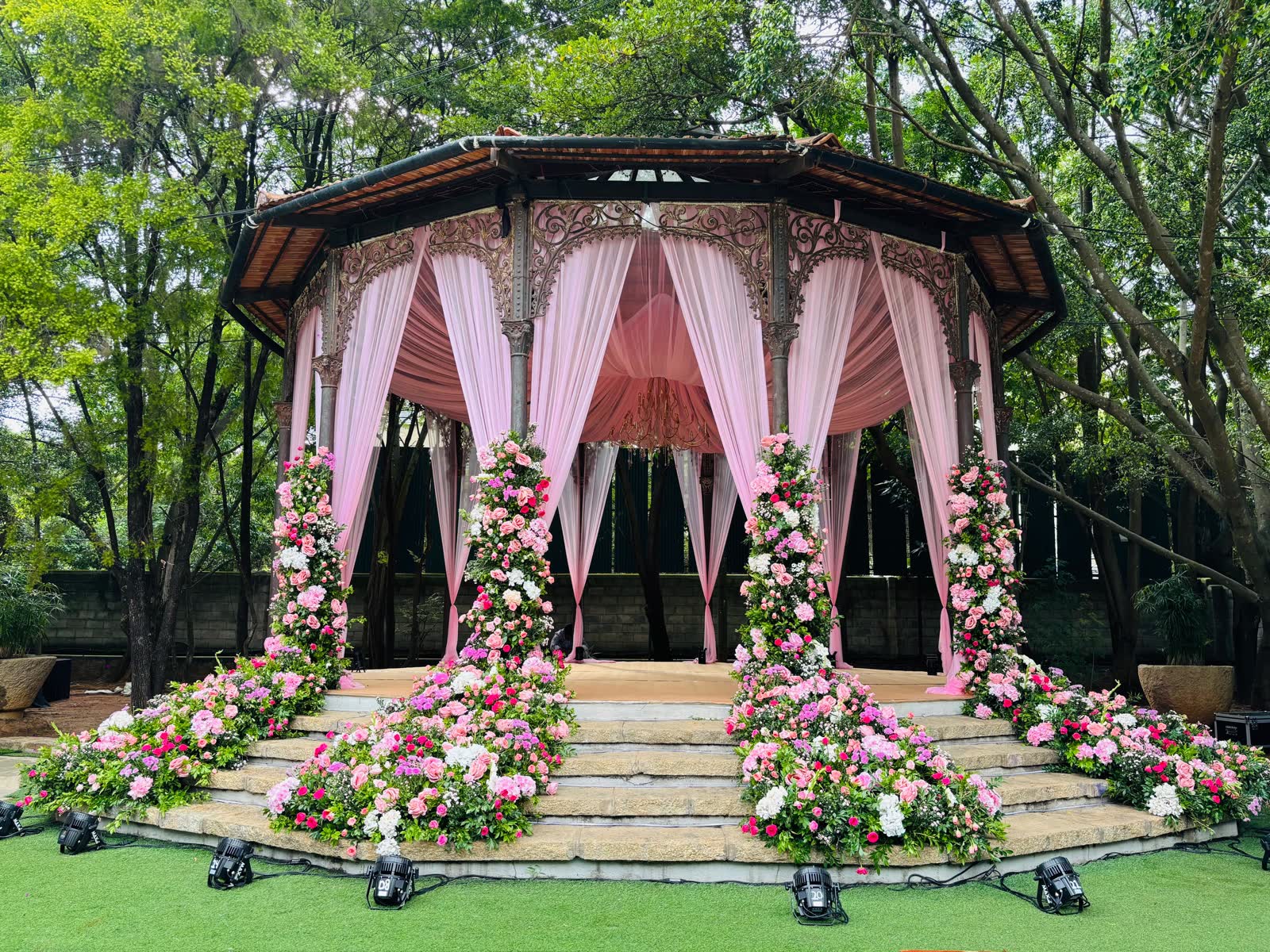
The Gazebo is a cast-iron octagon with a tiled roof and fretwork spandrels, standing free on the lawn. It is the most decorated object on the estate before anyone touches it, so the decor had to work with its geometry instead of hiding it.
Blush drape was hung from the inner ring and swept out to each column, which turns the roof into a soft ceiling and keeps every one of the eight bays open. Floral columns in pink, blush and fuchsia climb four of the piers and then break — deliberately — spilling down the stone steps in irregular banks rather than stopping in a neat line at the base. A structure this symmetrical needs one thing on it that is not symmetrical.
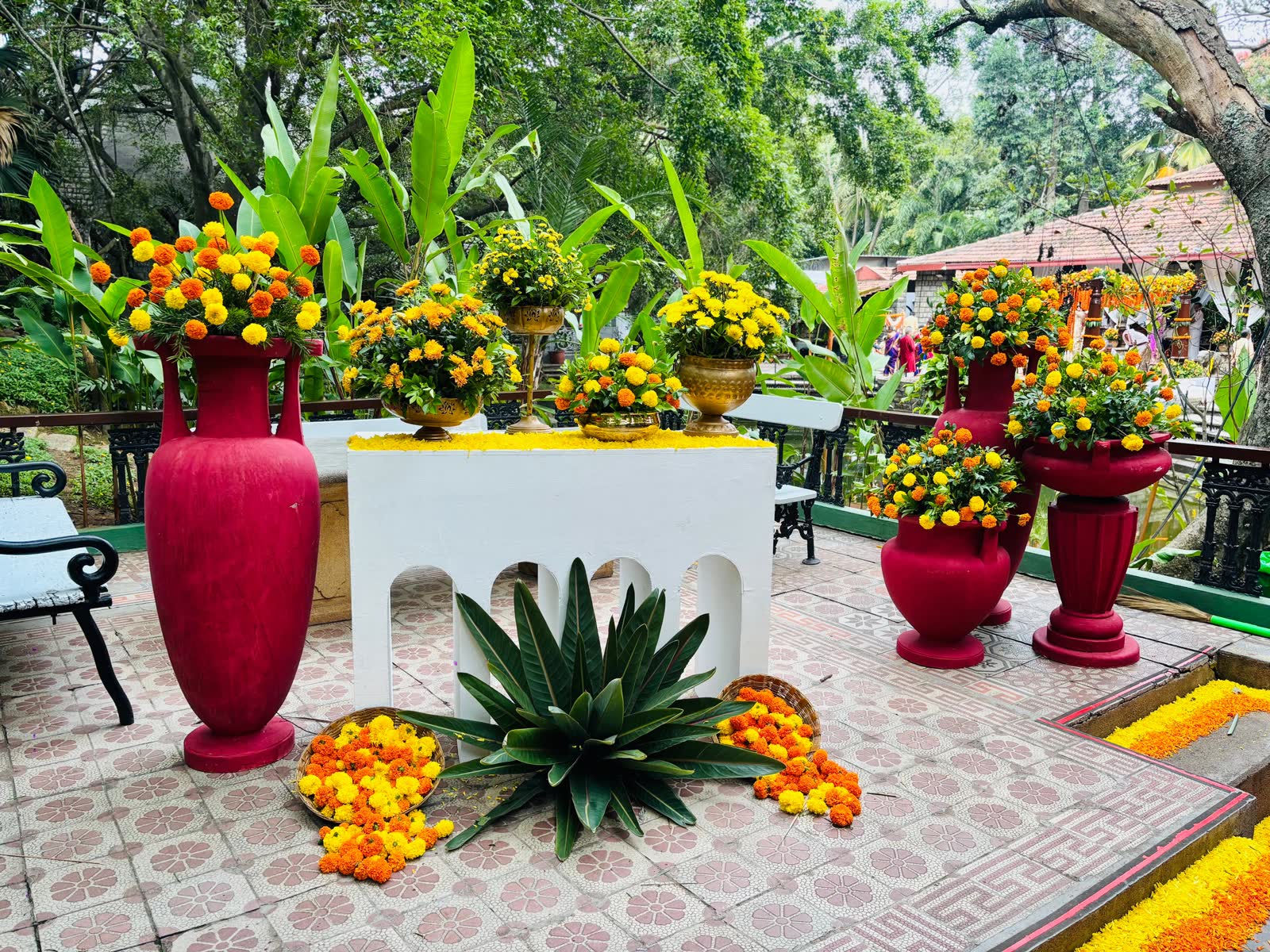
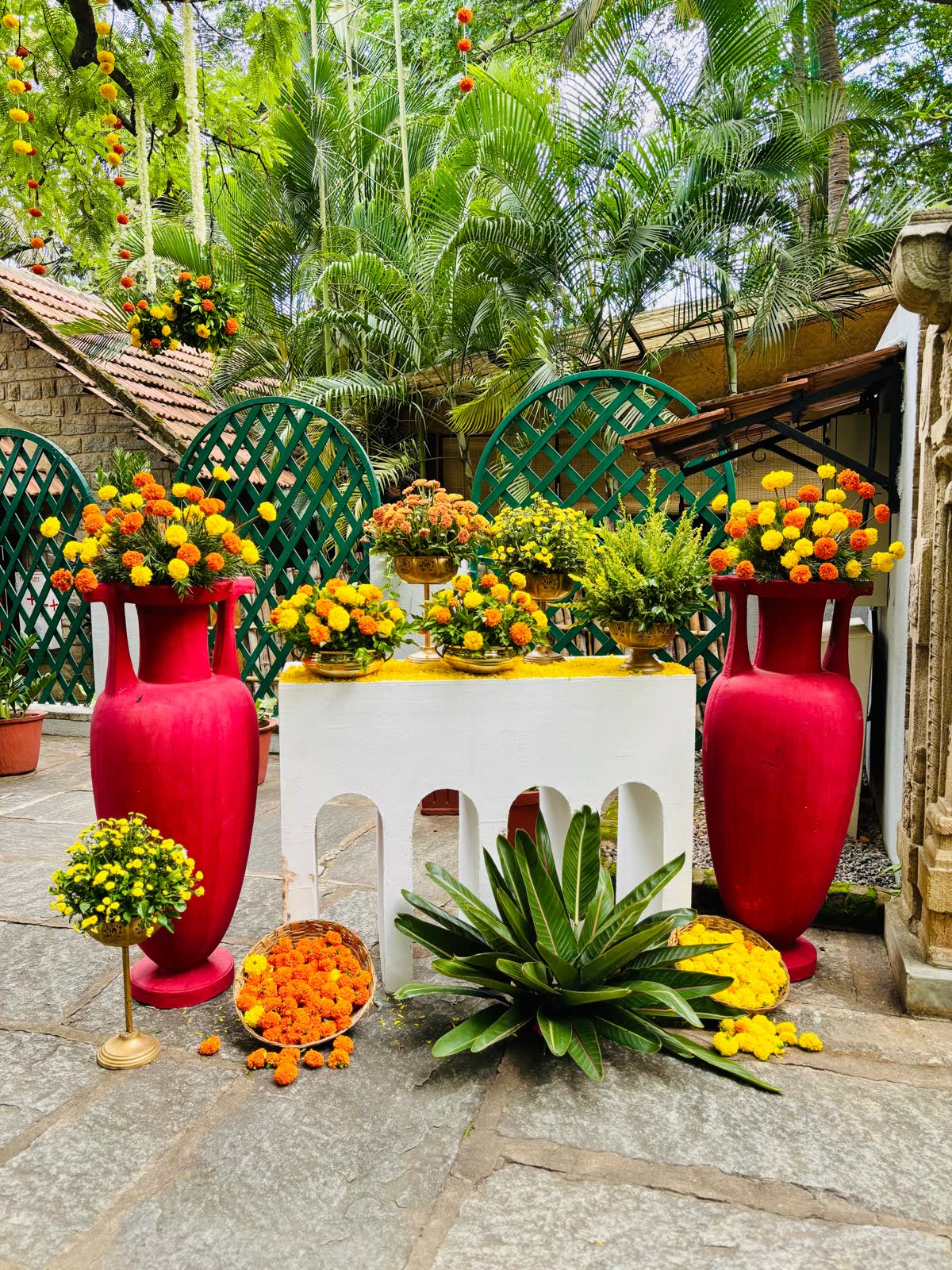
Three colours and one metal for the entire morning. Marigold orange and yellow for mass, white jasmine and tuberose for the line work, brass for everything that holds light. No fabric anywhere in the ceremony zone except the drape already on the Heritage Pavilion.
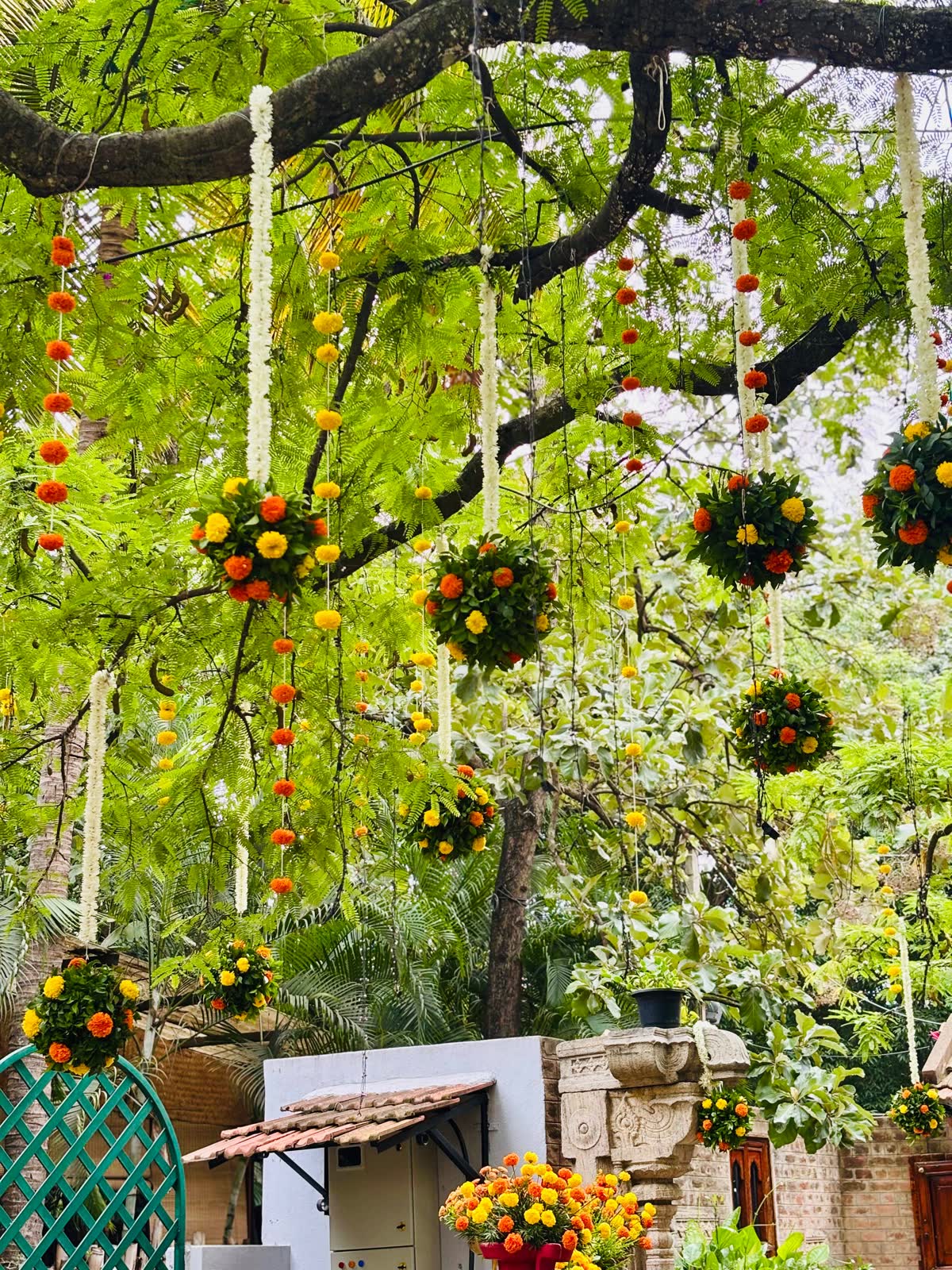
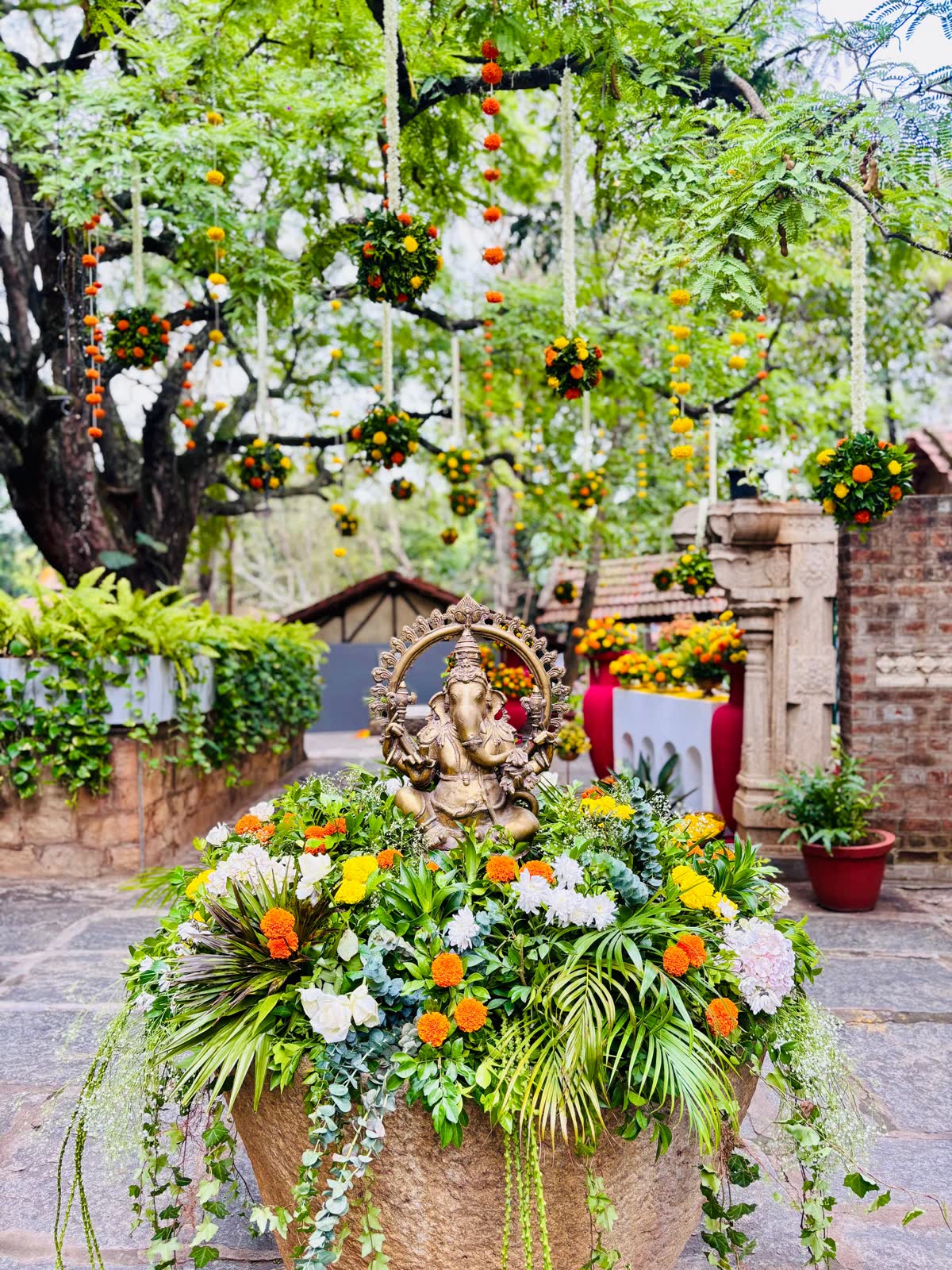
The estate is named for a four-hundred-year-old tamarind, and its limbs run right across the arrival court. We hung the whole canopy: marigold ropes in alternating orange and yellow at graded drops, white jasmine ropes between them for contrast, and moss-and-marigold spheres suspended at three different heights so the eye reads depth rather than a flat curtain. From underneath it is a ceiling. From the path it is a screen. It is the same eight rupees a metre of flower either way.
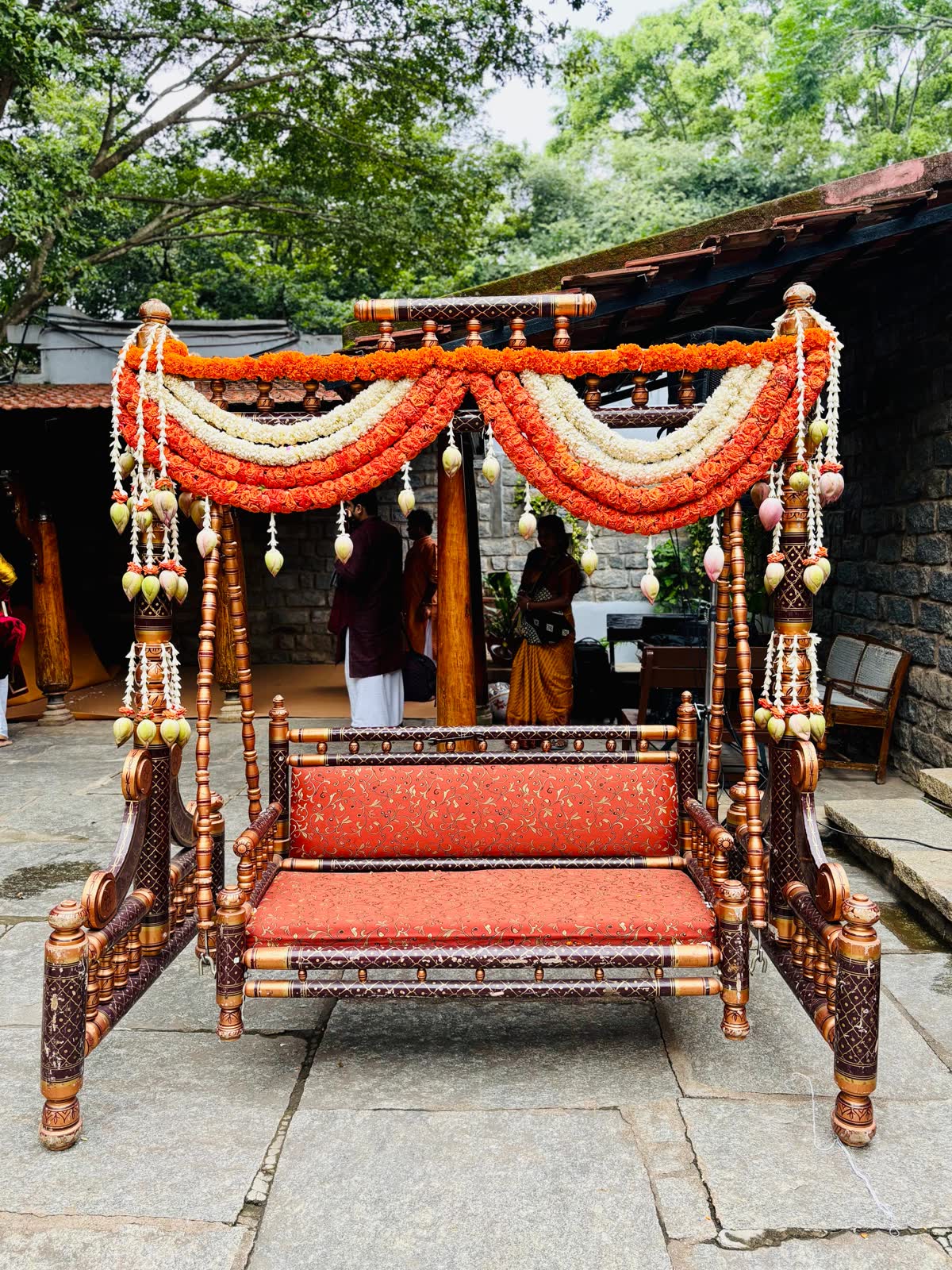
Two swings were built, and they answer different questions. The jhoola on the paving is a turned-and-lacquered frame carrying layered swags — orange rose over white jasmine over orange rose again — with lotus-bud tassels dropping from every junction. It is an object to sit in and be photographed on.
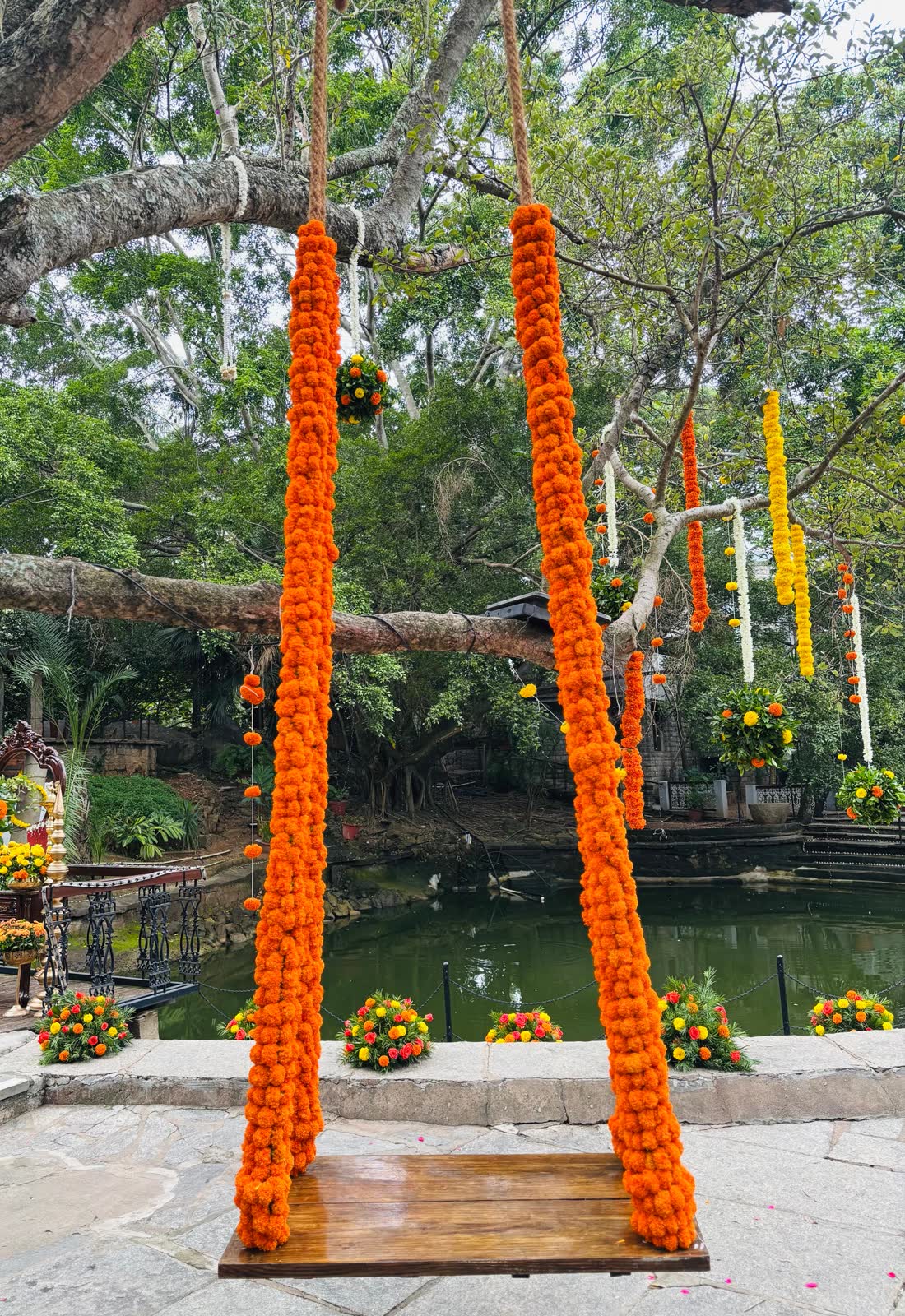
The second one is barely a swing at all: a plain teak plank on rope, hung from the tamarind branch out over the pond, with both ropes wrapped their entire length in marigold. Nothing else. It became the most photographed thing at the wedding, and it cost less than any other installation on the estate.
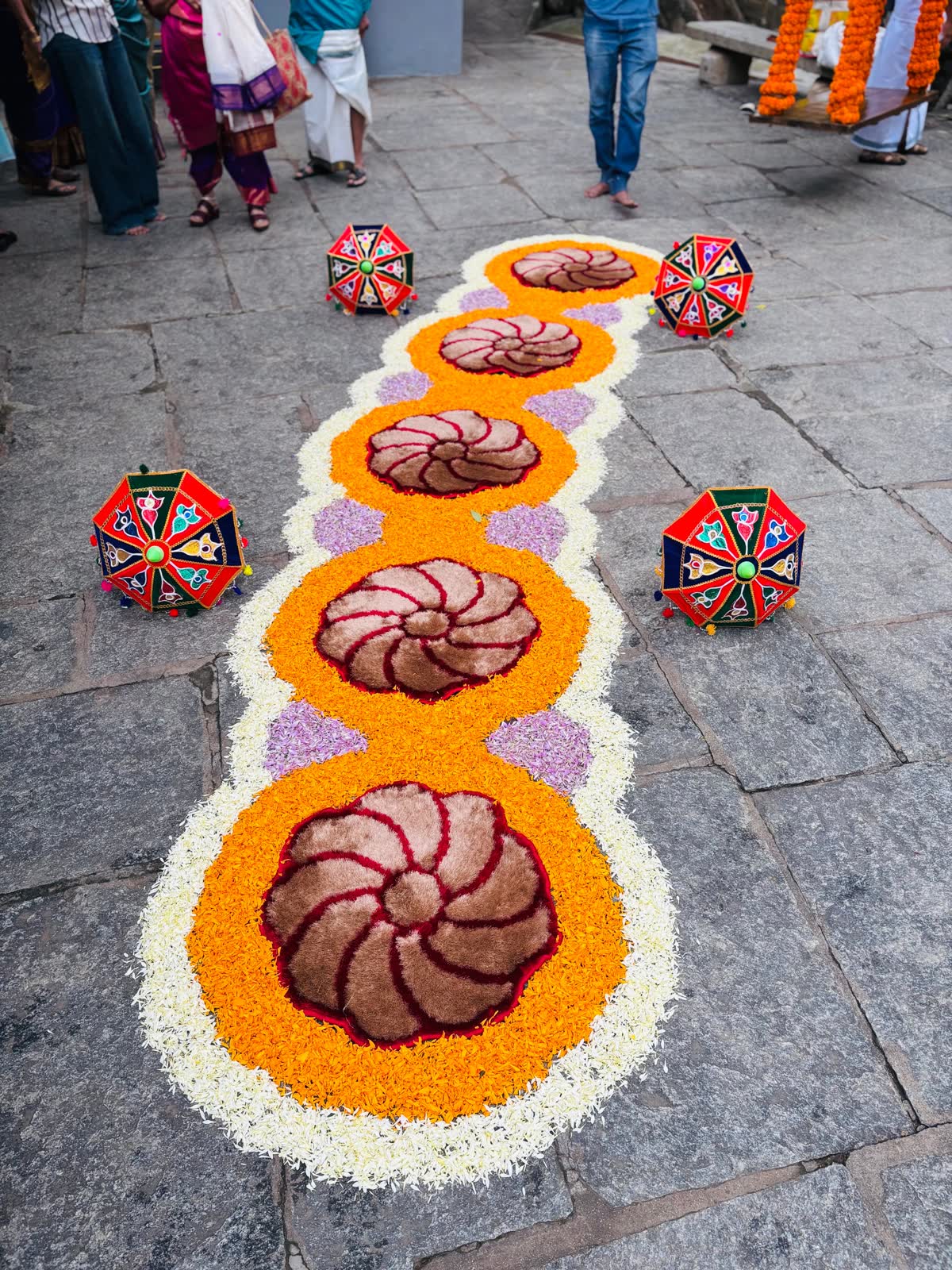
The aisle was laid in loose petal — a white border, an orange field, five maroon-and-cream spiral medallions down the centre, and purple corner lozenges to stop the run reading as a stripe. It is hand-laid, it takes hours, and it survives roughly one procession. Painted kolam umbrellas were set on either side to mark the width.
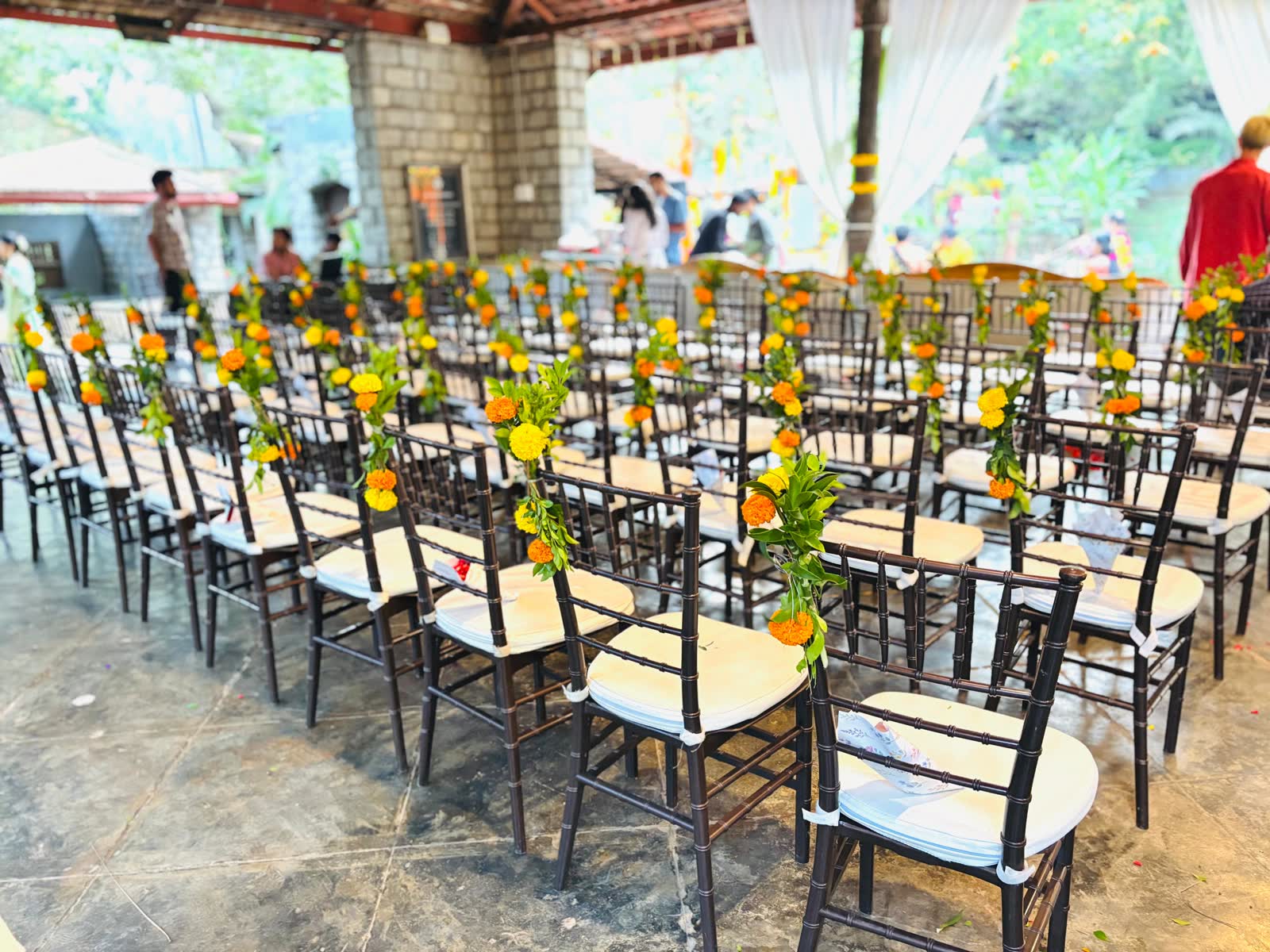
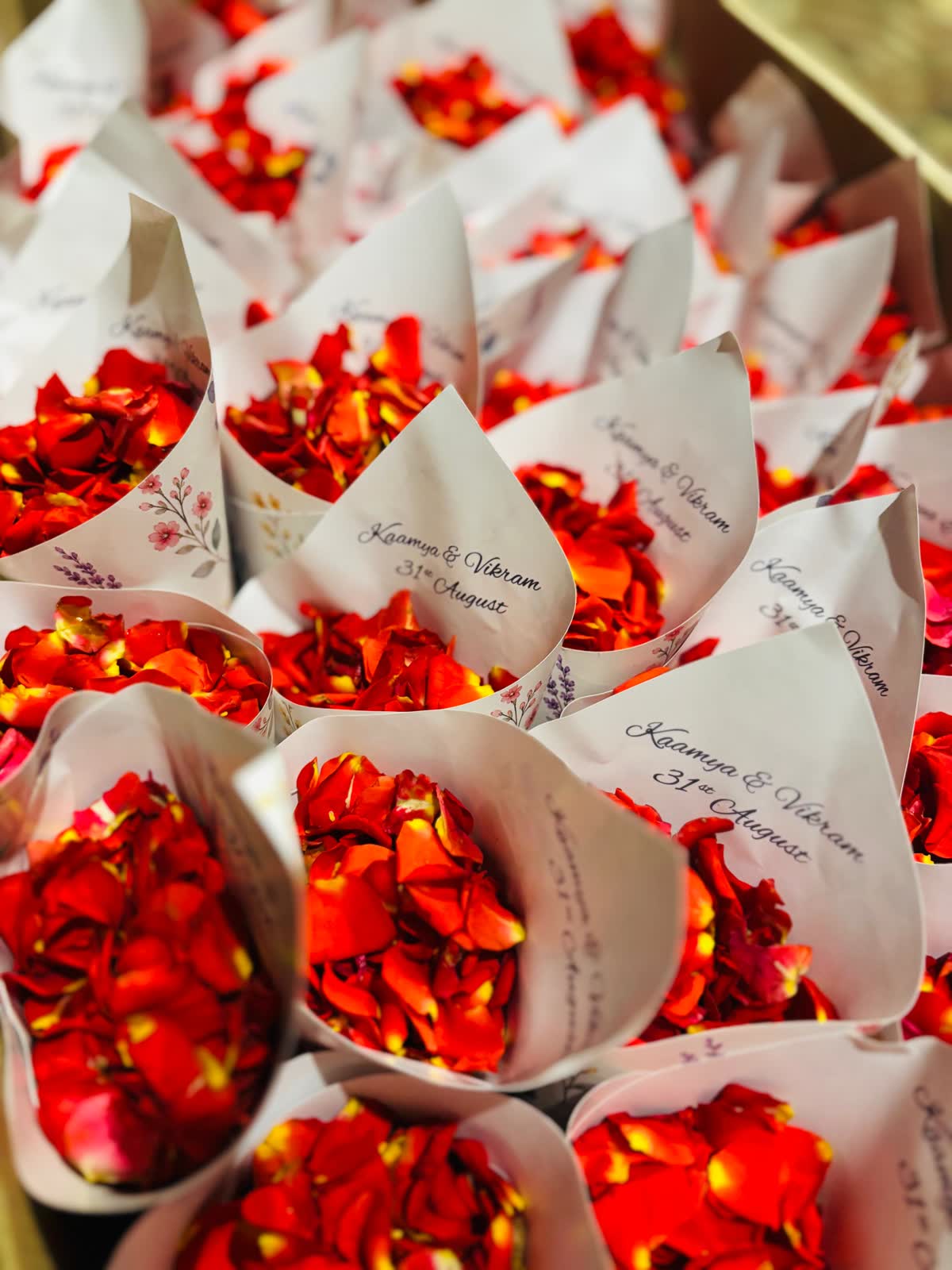
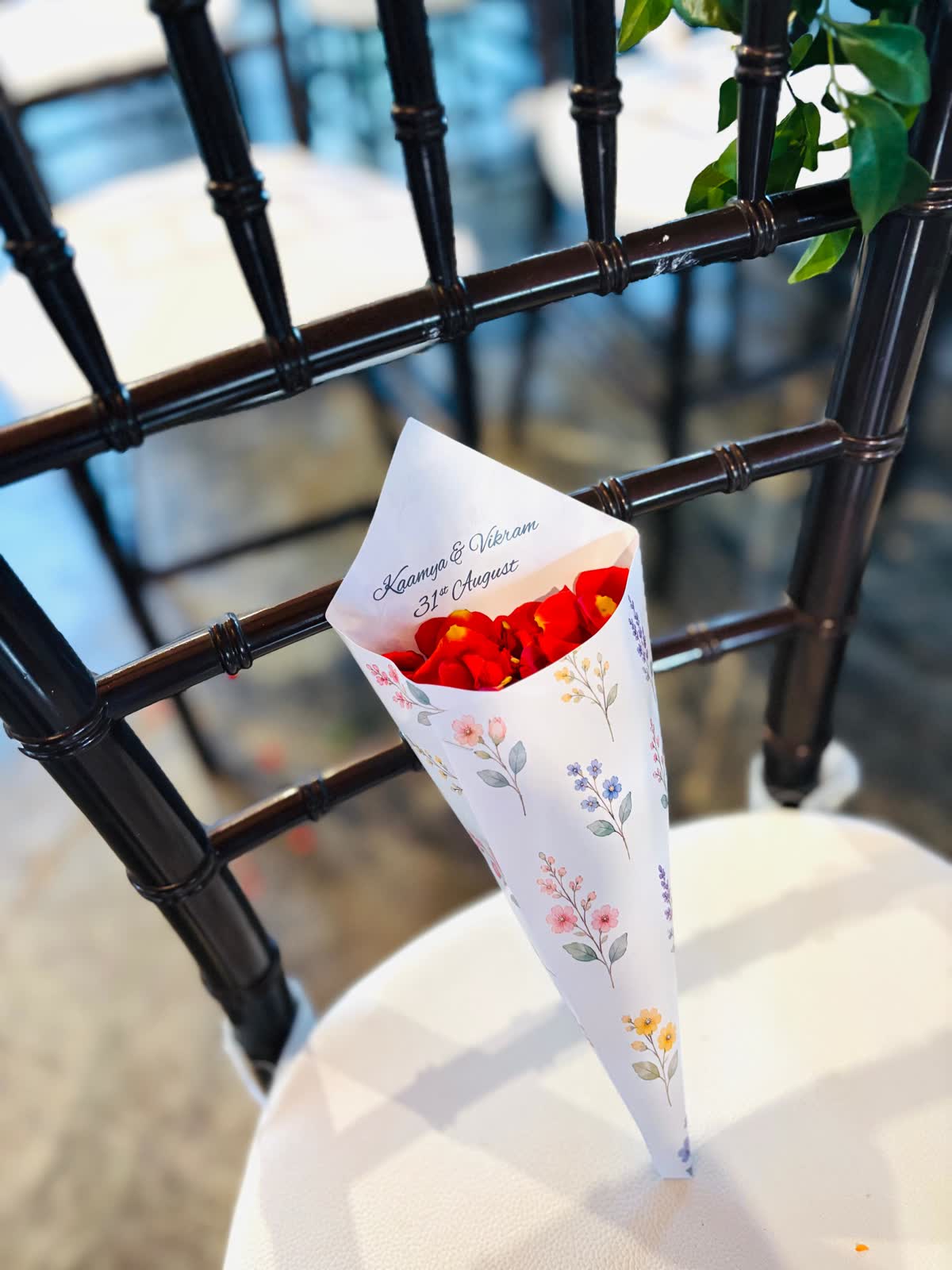
The seating is the opposite kind of decision. Every chiavari chair got one thing: a single marigold-and-green sprig wired to the back post, and a printed petal cone on the seat. Four hundred identical small gestures do more for a room than four large installations, and the guest who picks up the cone with their own names printed on it takes the wedding home.
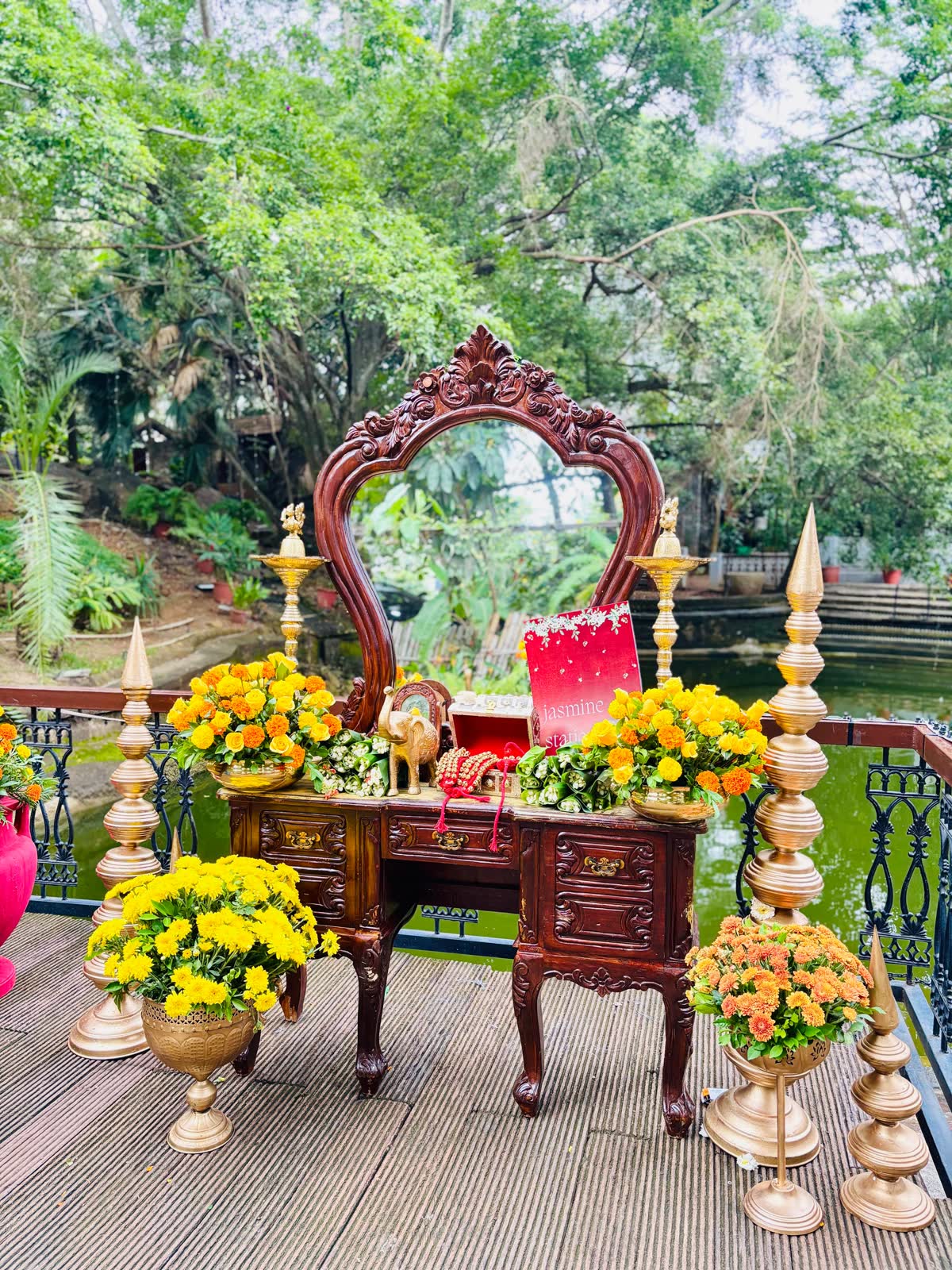
An antique carved vanity was set on the pond deck with brass finials rising on either side, urns of marigold and chrysanthemum, and trays of strung jasmine for guests to take and wear. Because it sits on the deck rather than the lawn, the mirror carries the pond and the trees behind whoever is standing at it.
Last week of August in Bangalore, on a five-acre open estate, with fresh flower already hung. This is not an unusual event and it is not a disaster; it is the thing you plan the sequence around.
What gets re-ordered: work already hung is left alone rather than taken down and re-hung. Work not yet started moves under cover — the portals, the carved doors, the pavilion seating — so the covered zones finish while the open lawn waits out the shower. Petal work is always the last thing laid, because it is the most vulnerable and, being loose petal, the fastest thing on site to rebuild.
Suraj and Vivek ran that call on the ground and the wedding started on time. The reason a build can be re-sequenced in the middle of it is that we produce in-house: there is no rental supplier's delivery slot to wait on, and no third party to argue with about who eats the cost of a wet morning.
“We have attended Vikram & Kaamya's wedding and loved the decor that has matched the aesthetics of the heritage property. All the rituals were handled smoothly, scheduled on time and immediate response to all the RSVPs. Great team to work with!”
Alakananda A · Google review, the day afterThree unedited clips recorded after the wedding, by the groom's parents and by two guests. Full transcripts are printed below each one.
“Tamarind Tree was the most beautiful venue for our son's wedding. Sakshi and her team worked very hard to meet all our requirements, and dealt with many different personalities and stressful times, and made this event a very joyous and memorable occasion for us. Thank you so much. We love Tamarind Tree and the planning team.”The groom's parents
“I had the privilege of attending the South Indian wedding in Bangalore at Tamarind Tree, and what an amazing experience it was. The ambience is wonderful, the food was amazing. To top it all — the decoration, I can't say anything more about it. The decoration was awesome. And not only that, the whole organisation was perfect. No delays, nothing. Greatly organised by Panigrahana.”A wedding guest
“The weddings had great decor. They thought about everything, including the walkways to the actual events themselves, and everything was very thoughtfully decorated.”A wedding guest
We work at The Tamarind Tree regularly, and on a heritage estate that is worth more than it sounds. Knowing the property means knowing which limbs of the tamarind will take a rigging load and which will not; that nothing can be fixed into the heritage tile so every eaves run has to hang off timber fascia; where the estate's own lighting already does the job so you do not pay to light it twice; how long the walk is from the kitchen to the Pond & Lawn; and which of the five spaces stays usable when the sky opens.
A studio seeing a venue for the first time spends its first day learning those things. We spent ours building.
| Space used | What we put in it |
|---|---|
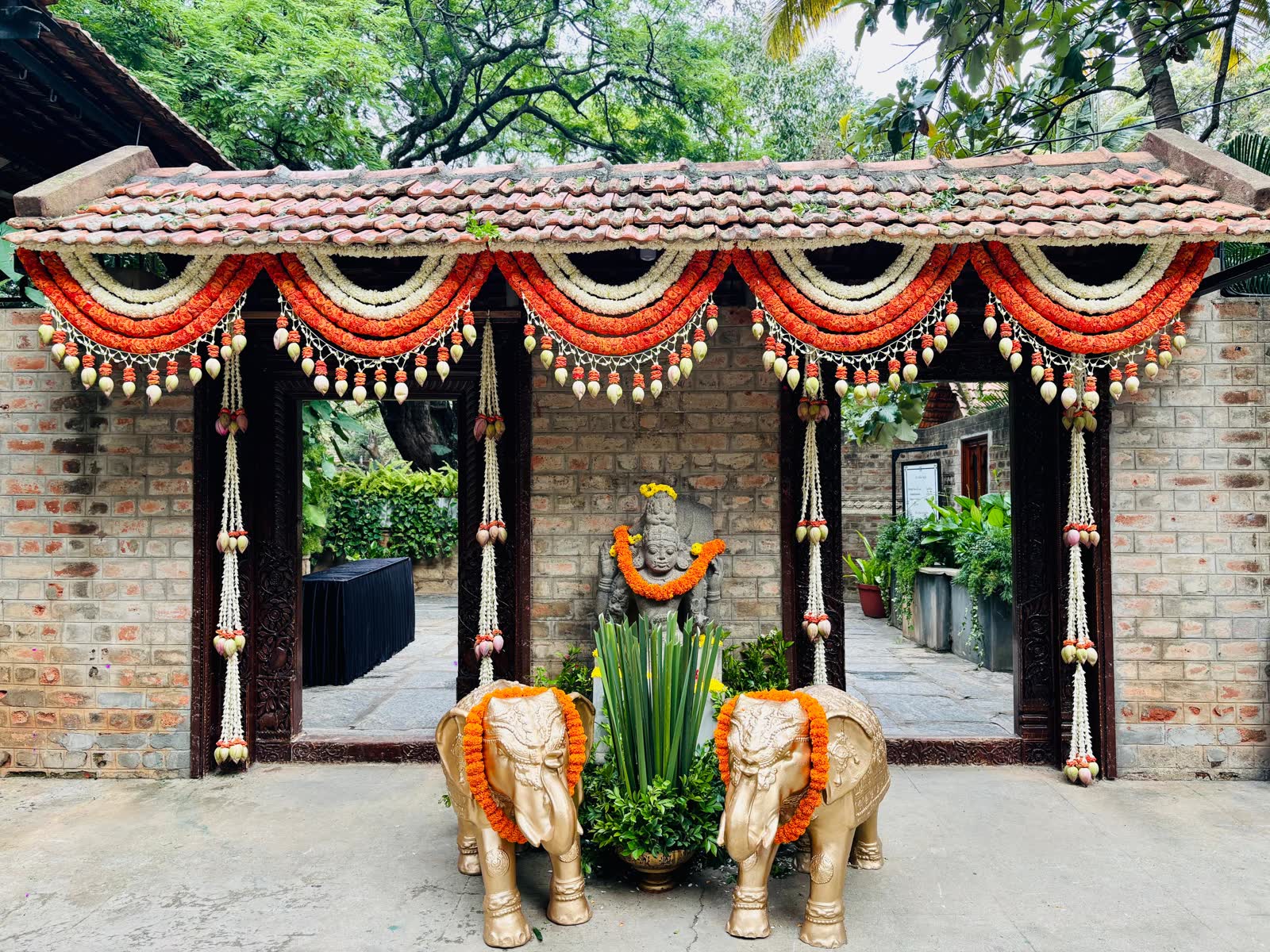
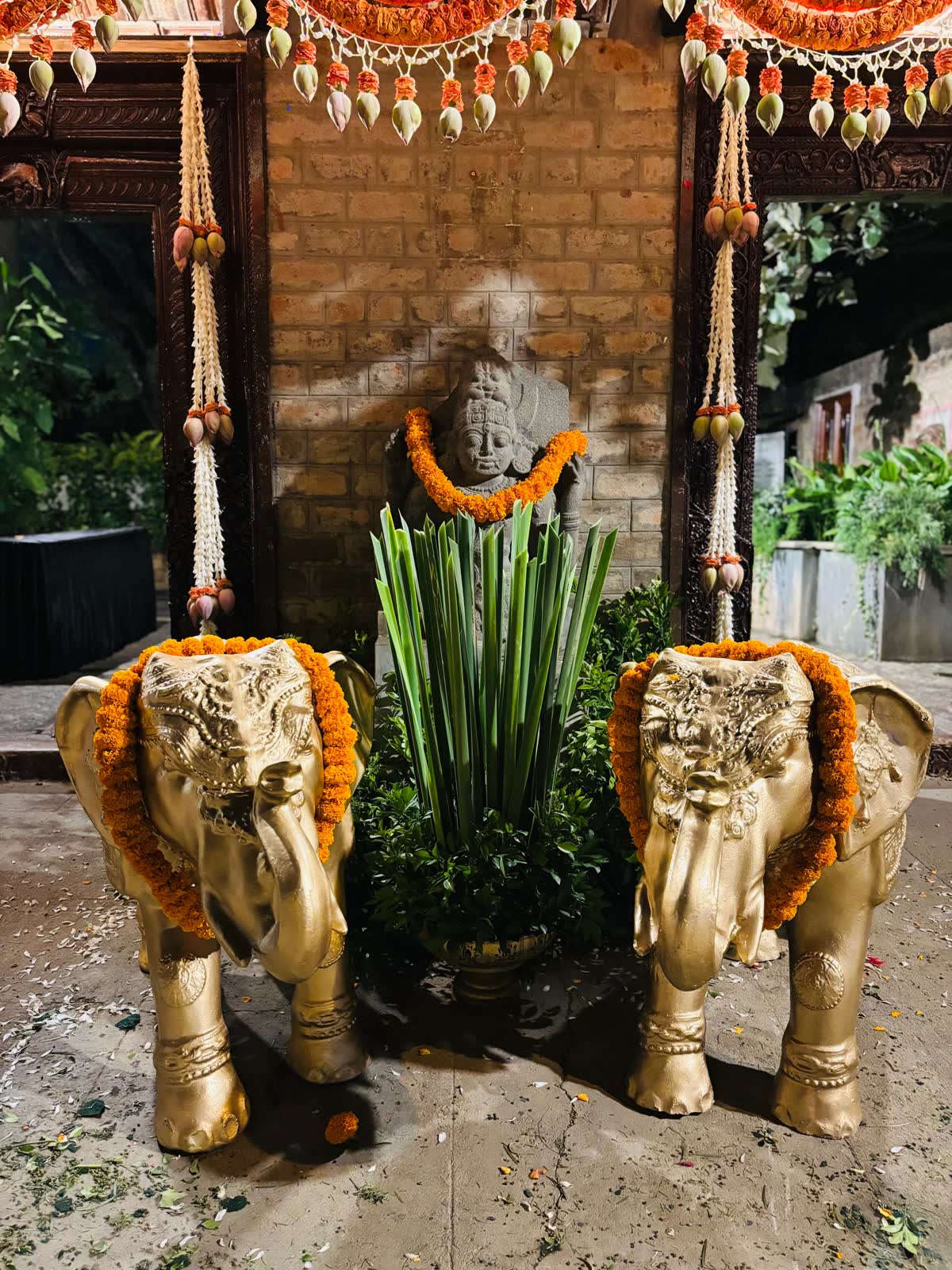
| Vishnu Mantapa | Ceremony threshold — five-bay scalloped toran in orange rose and white jasmine, lotus-bud tassels, gold elephants garlanded in marigold, stone deity garlanded and left as the centre |
| Heritage Pavilion | Guest seating — chiavari chairs with a single marigold-and-green sprig wired to each back post, printed petal cone on every seat |
| Pond & Lawn | Marigold-wrapped rope swing off the tamarind limb over the water; jasmine station on the deck; crimson urn consoles |
| Colonial Gazebo | Reception — blush drape swept to the columns, floral columns in pink, blush and fuchsia breaking down the stone steps |
| Arrival court | Hung canopy off the tamarind limbs — graded marigold and jasmine ropes, moss-and-marigold spheres at three heights, spiral garlands on the cottage columns |
Designed and produced by the studio's own team on site. Nothing hired from a rental catalogue.
| Element | Built from |
|---|---|
| Hung canopy | Orange and yellow marigold rope at graded drops; white jasmine rope between; moss-and-marigold spheres at three heights; spiral garlands on columns |
| Scalloped toran | Three layers at three depths — orange rose, white jasmine, orange rose — hung off timber fascia, closed with lotus-bud tassels alternating long and short |
| Jhoola | Turned and lacquered frame; layered rose and jasmine swags; lotus-bud tassels at every junction |
| Pond swing | Teak plank, rope wrapped full-length in marigold, rigged off a load-tested tamarind limb |
| Aisle | Loose petal, hand-laid — white border, orange field, maroon-and-cream spiral medallions, purple corner lozenges; painted kolam umbrellas |
| Seating | Chiavari chairs, one wired marigold-and-green sprig per back post; printed petal cones filled the same morning |
| Jasmine station | Antique carved vanity on the pond deck; brass finials; marigold and chrysanthemum urns; trays of strung jasmine |
| Night portals | Fern, palm, ivy and hanging amaranthus over carved teak frames; white orchid and hydrangea; brass bells and oil lamps on chain |
| Reception | Blush drape to the Gazebo columns; floral columns in pink, blush and fuchsia; arched welcome board with tall chrysanthemum stems over a dense rose bank |
No, but it is unforgiving. Marigold is the cheapest flower in the Bangalore market and the one every guest has seen since childhood, so a marigold scheme only reads as luxury if the craft is visible. Here the difference was made by construction rather than spend: ropes running the full drop of a 400-year-old tamarind limb, scalloped swags layered three deep, hand-laid petal medallions, and a single sprig wired to every chair. This was the first time in eight years we ran an entire ceremony scheme in marigold orange.
It rained partway through this build. Work already hung is left alone; work not yet started is re-ordered so covered zones finish while the open lawn waits; petal work is laid last because it is the most vulnerable and the fastest to rebuild. Suraj and Vivek ran that call on the ground and the wedding started on time. Being able to re-sequence a build mid-way is a function of producing in-house rather than waiting on a rental supplier's delivery slot.
The Tamarind Tree is a 5-acre heritage estate on Kanakapura Road with five distinct spaces — the Pond & Lawn, the Heritage Pavilion, the colonial Gazebo, the Heritage Villa and the Vishnu Mantapa — plus 28 rooms on site, at its best for 200 to 600 guests. This wedding used four of them across three events. Full venue details, capacity and rental are here.
Give each event its own palette and let the venue stay constant. The welcome evening was black, gold and white against dense green; the reception was pink, blush and fuchsia; the wedding morning was marigold, jasmine and brass. No single element was reused between events. The one thread across all three is that the estate's own architecture stayed visible in every frame.
It is priced by what gets fabricated and by labour-days on site, not by square footage. On this wedding the cost drivers were the volume of fresh flower in the hung canopy, the hand-laid petal work, and the fact that three events meant three separate builds with no shared elements. The Tamarind Tree's own rental is quoted around ₹16 lakh per day, separate from decor. We charge a flat design-and-production fee rather than a percentage, so our fee does not rise when the flower order does. Our decor cost breakdown is here.
Send us your dates. We will tell you which of the five spaces suits your guest count and your ceremony, what the estate can and cannot take structurally, and what a build like this actually involves.
Begin your design WhatsApp the studio