Panchavati Pavilion seats two thousand guests in the round. There is no back wall to decorate and nowhere to hide a frame, so we stopped designing a backdrop and designed a ceiling instead — a suspended floral raft, a life-size squirrel woven from tender coconut frond, and a wall of the family's own photographs. This is how it was drawn and how it was built.
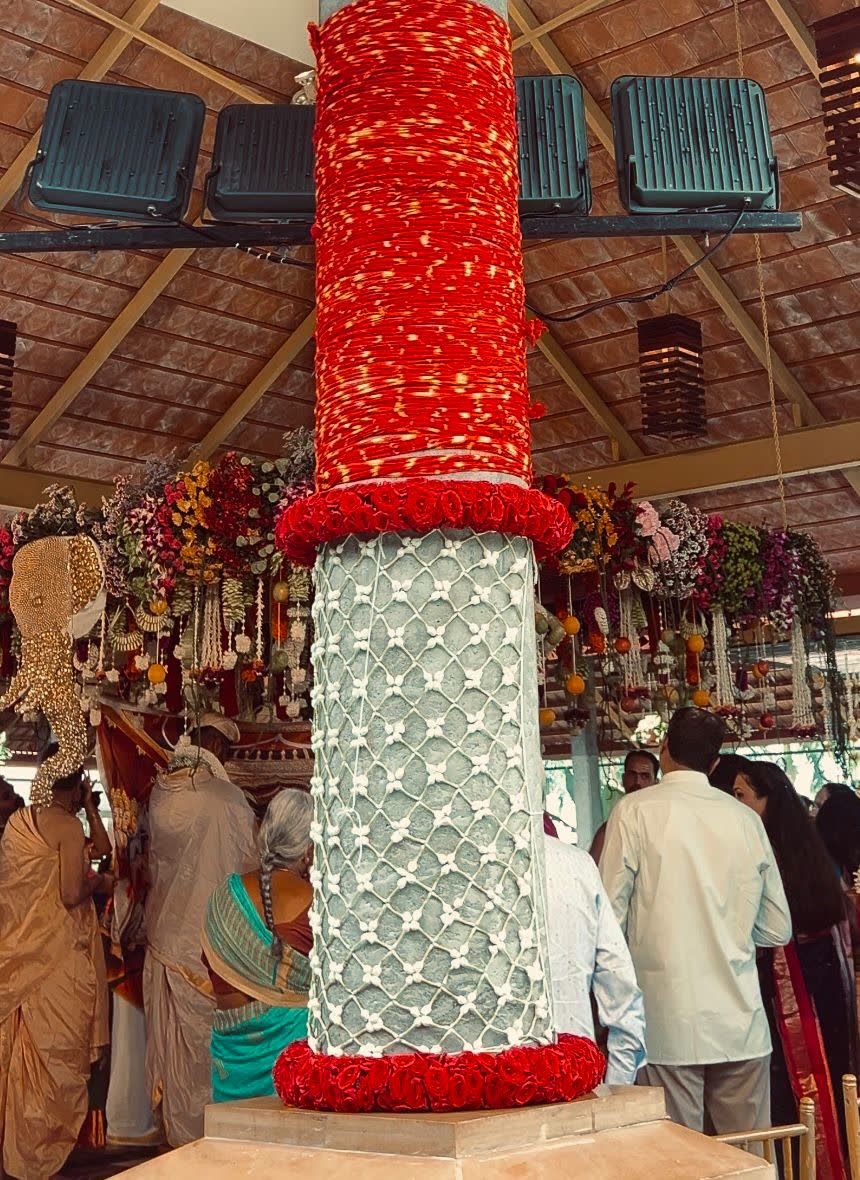
Most Indian wedding decor is built like a stage set. There is a front, there is a back, and everything structural — the frame, the ply, the zip ties, the cable — lives in the back where the camera does not go. Panchavati Pavilion's central mantap does not allow that arrangement. It is a covered pavilion with seating on all sides, and the ritual platform sits in the middle of it. Every guest has a different front. There is no back.
That single fact reorganises the whole design. A tall structure behind the couple blocks a third of the room. A floral wall reads as a plywood wall to whoever is sitting behind it. Anything at eye level becomes an obstruction for somebody who has travelled to watch a ceremony.
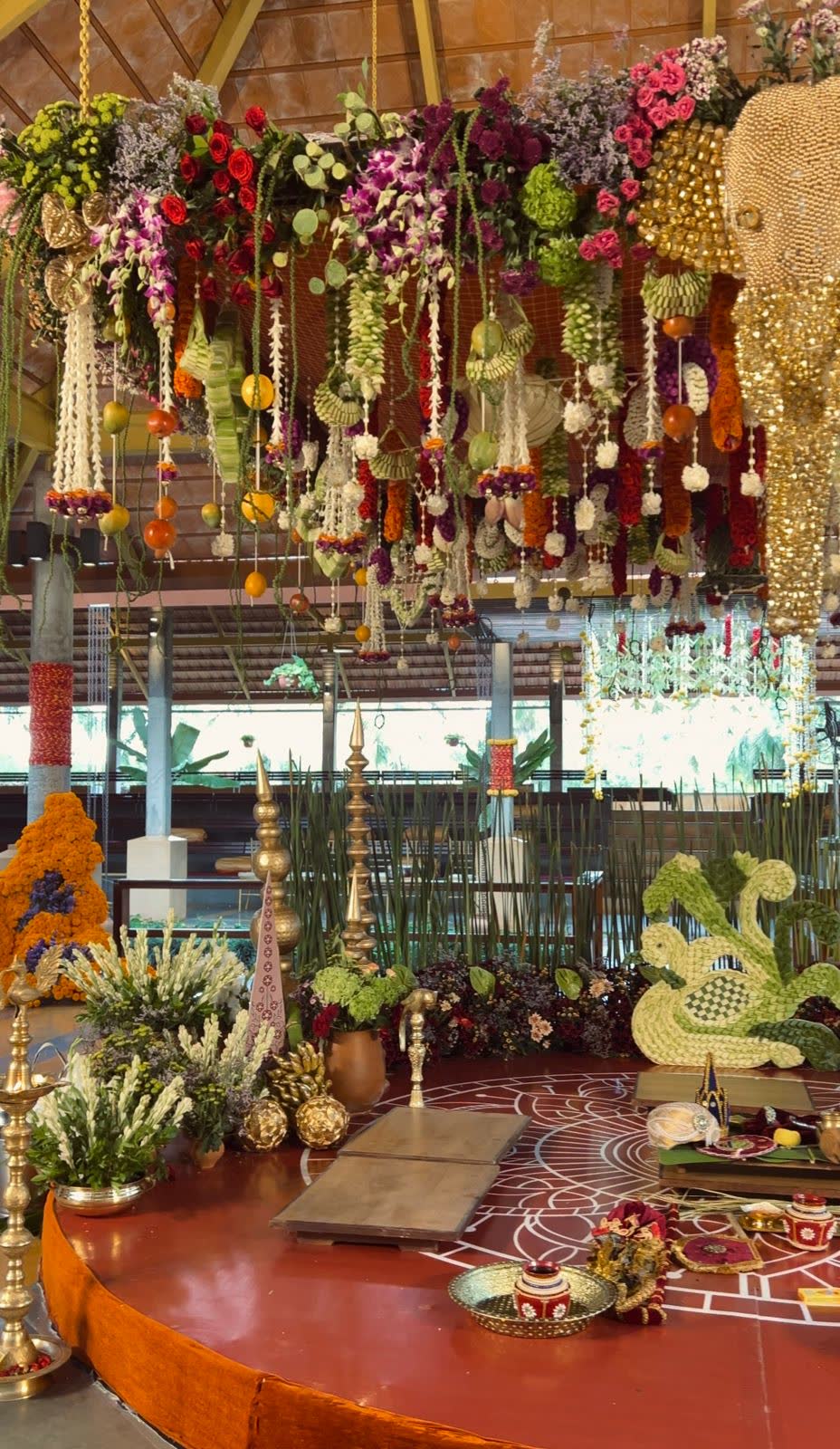
So the design moved to the two planes nobody sits in: the air above head height, and the floor. The overhead plane got a raft of flowers dense enough to become the room's ceiling. The floor plane got low, fully resolved objects — a woven sculpture, brass finials, pots, gilded fruit — each of which is finished on every side because each of them is seen from every side.
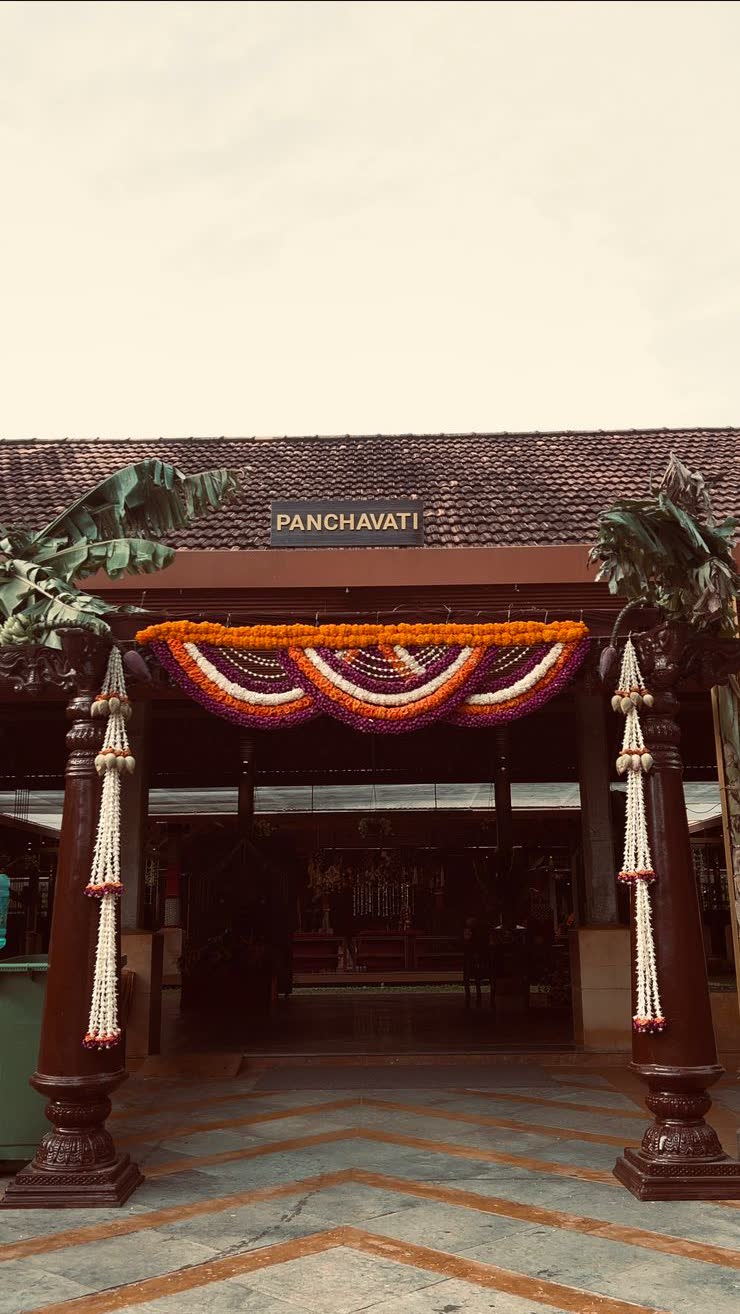
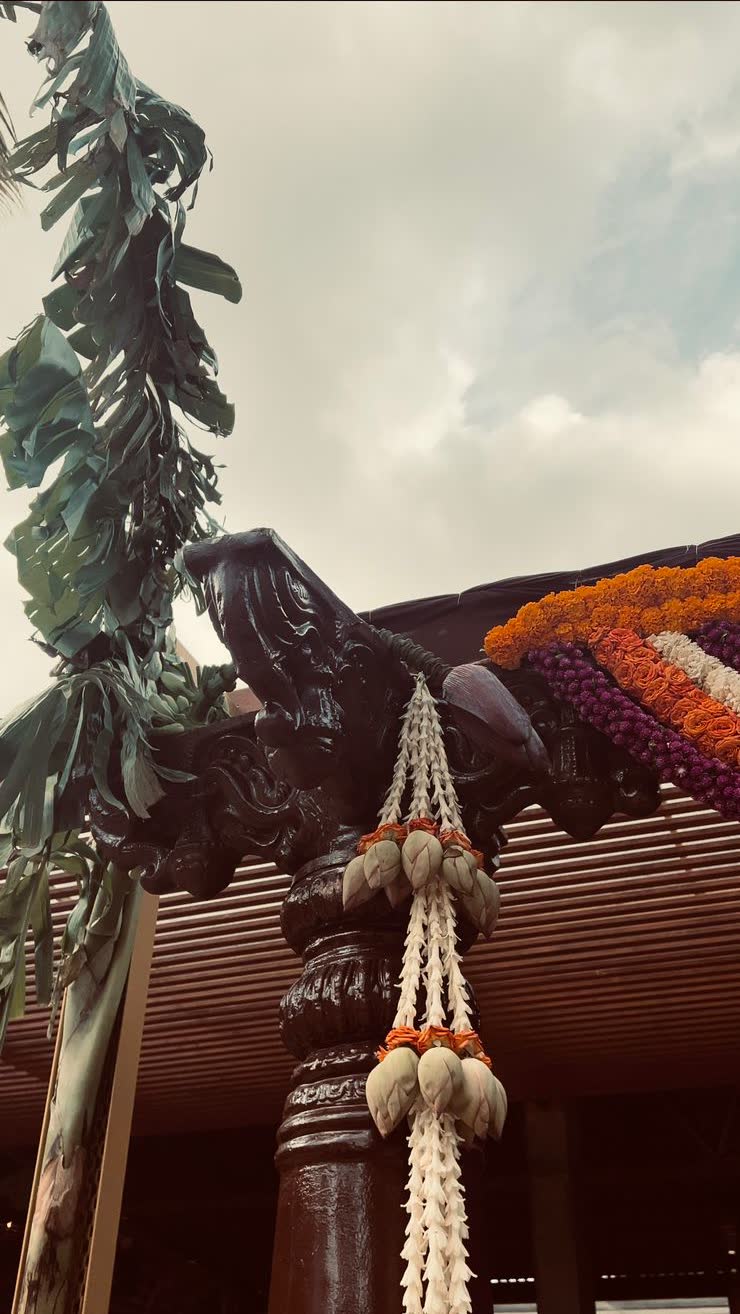
Guests arrive under the venue's own name board, so the entrance decor had to sit with an existing sign rather than compete with it. A scalloped swag of marigold, purple and white was hung as a single deep curve across the opening, and the two carved columns were dressed with jasmine ropes tipped in rose and closed with a banana bud. Fresh banana stems went in on either side because in a Kannada household the banana stem at the door is not decoration, it is the signal that a wedding is happening inside.
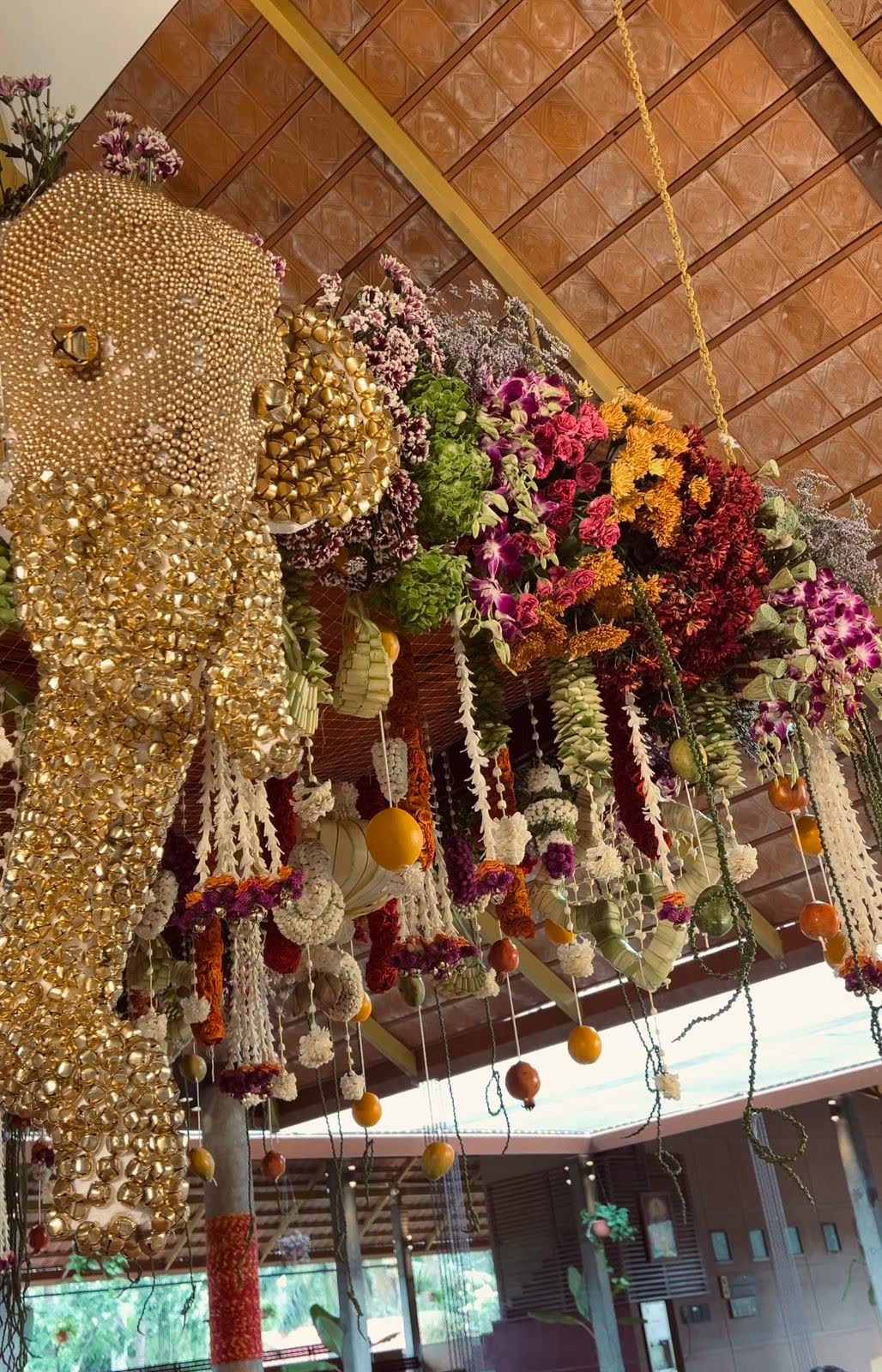
The raft is not a flower arrangement scaled up. It is assembled in defined layers on a framed matrix, and each layer has a job. Foliage first, to give the underside something to be dense against — without it you see the frame. Then mass flower for volume, then focal flower for the colour that photographs, then texture to break the edges, and only then the drops.
The drops are where the ceiling stops being florist work and starts being craft. Woven-frond pendants, tuberose and jasmine strings, folded-leaf cones, hanging citrus, pomegranate and mango. Fruit is the part guests notice last and remember longest, and it is also the part that makes the ceiling read as a harvest rather than as a florist's order.
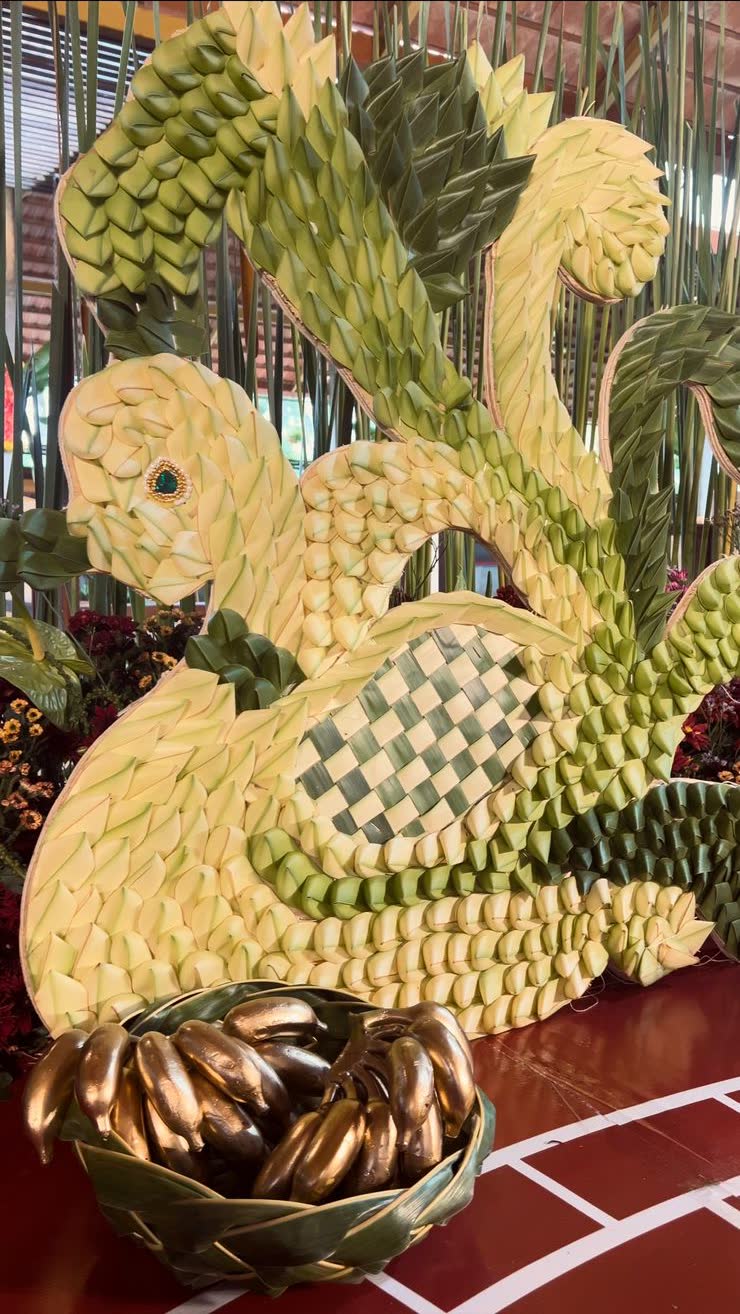
The piece that stops people is not floral. It is a life-size squirrel built entirely from split coconut frond, standing beside the platform with a woven basket of gilded bananas at its feet.
The craft is temple-festival work — the same folding and pinning that produces thoranam and festival canopies across Karnataka, Kerala and Tamil Nadu — used here for volume rather than trim. A silhouette is cut in ply to the drawn outline. Leaflets are split from the spine and pinned in overlapping courses, and the direction of the course changes at every plane of the body, so the light catches each plane differently and the form reads as a body rather than a flat cut-out. Tender frond is pale and mature frond is deep green, and the two are used as two different materials: pale for the belly, chest and face; deep green for the tail, the ears and the folded outer courses. Across the flank sits a flat chequer weave in alternating tones. The eye is a single set stone and the only element in the whole piece that is not leaf.
None of this can be bought or hired. The frond pales within a day or two of cutting, so the entire piece has to be woven on site in the days immediately before the wedding, and then it composts.
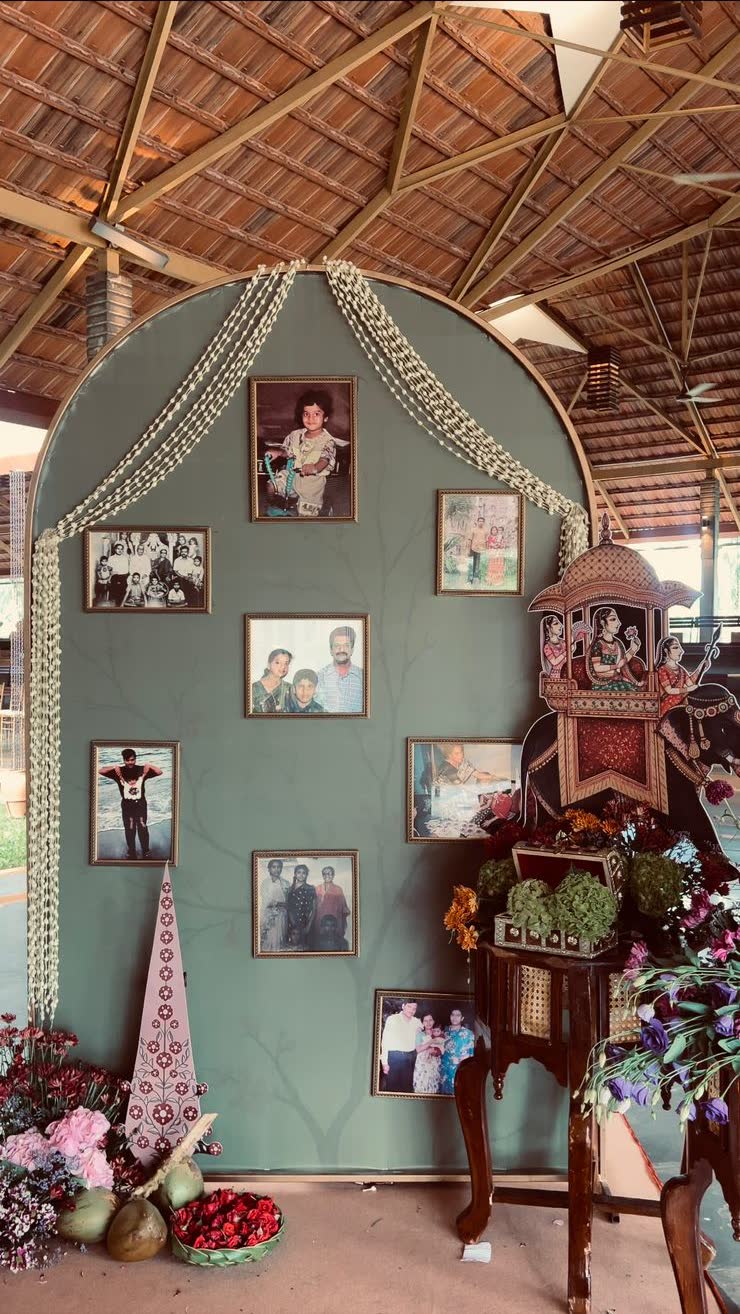
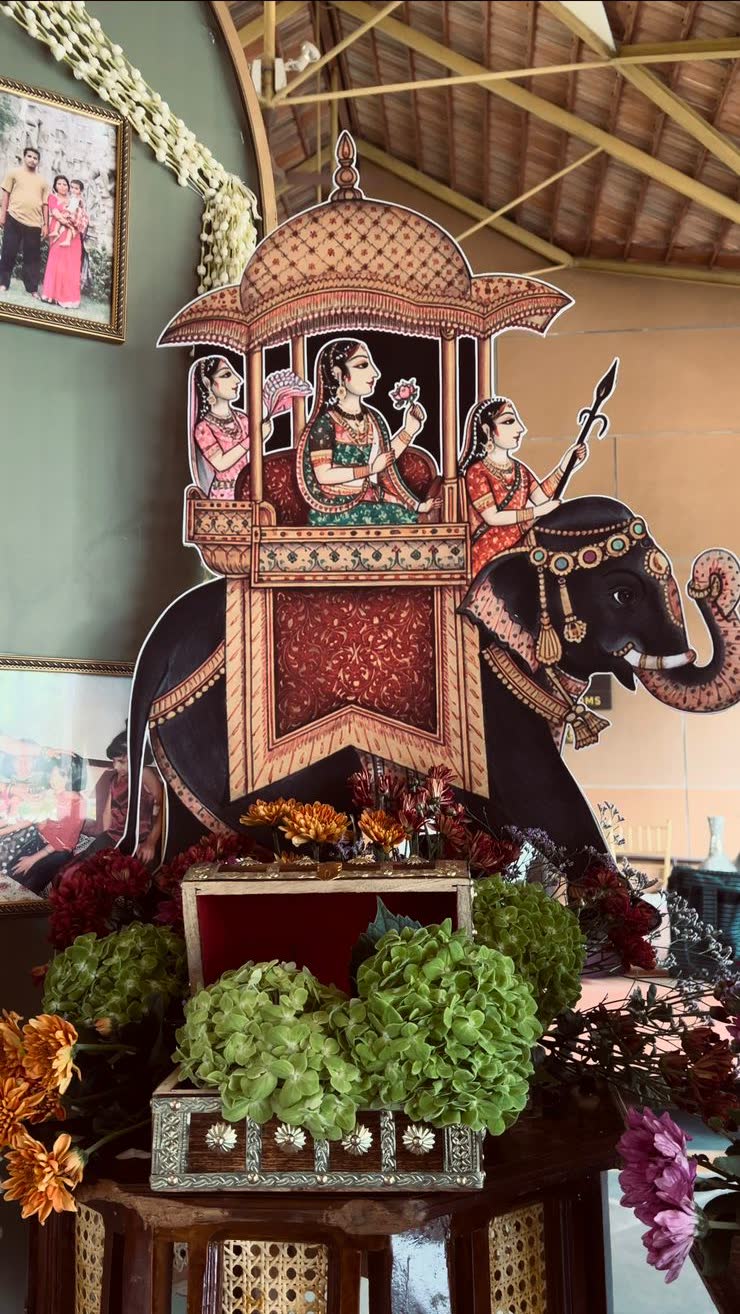
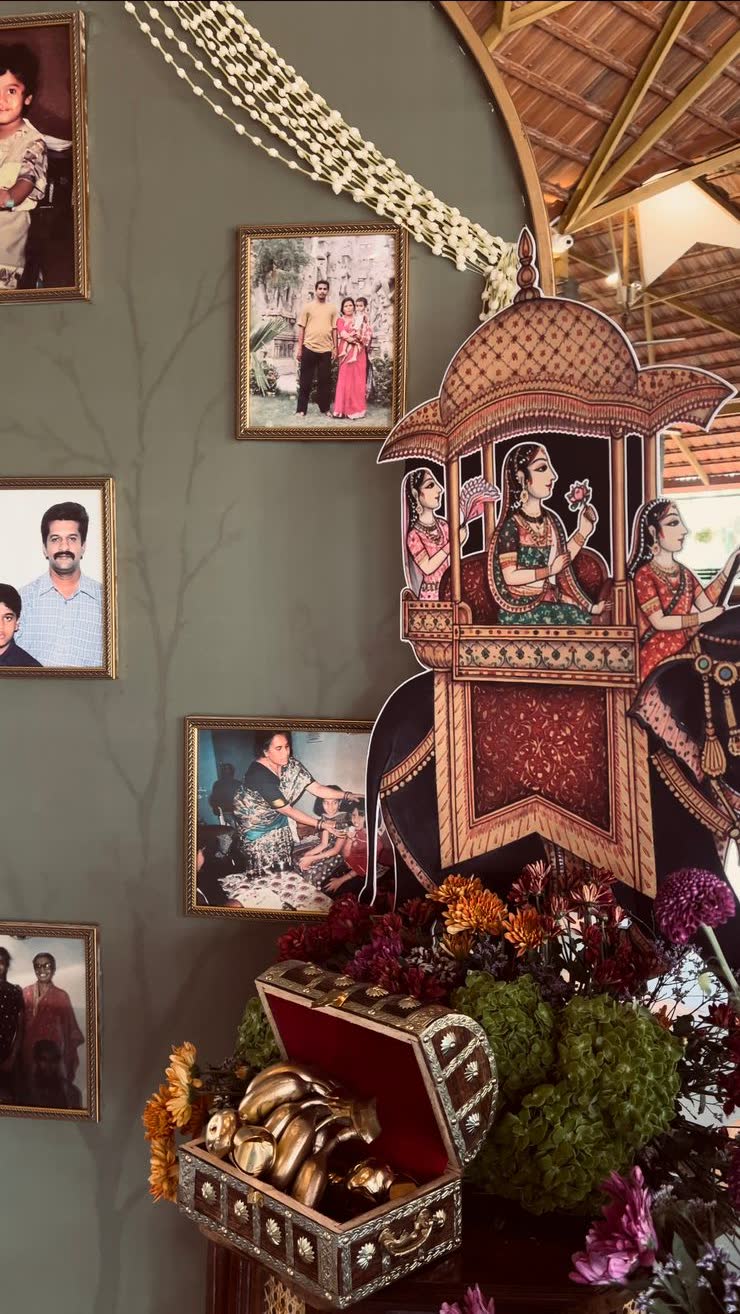
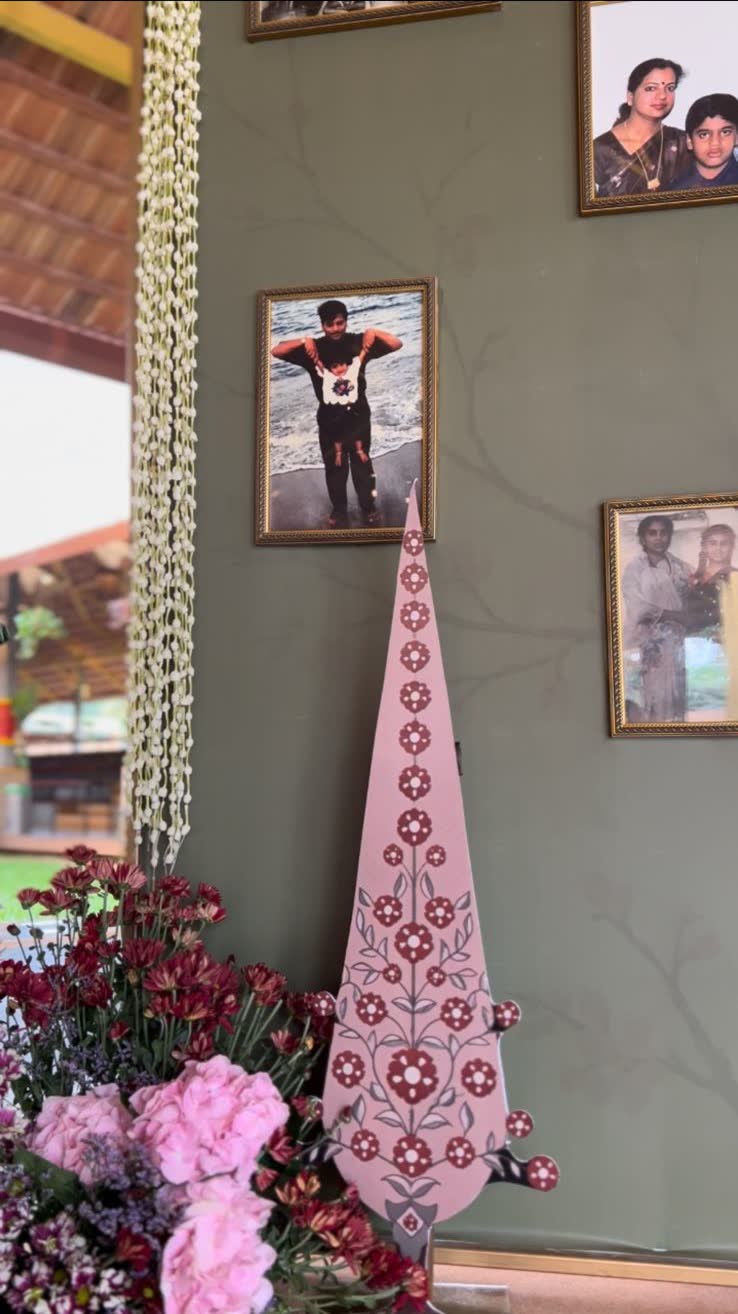
A sage-green arch was painted with a bare branch motif and hung with the family's framed photographs — childhood pictures, grandparents, weddings from two generations back. Jasmine ropes fall from the crown of the arch on both sides. It is the one element at the wedding that no other couple could use.
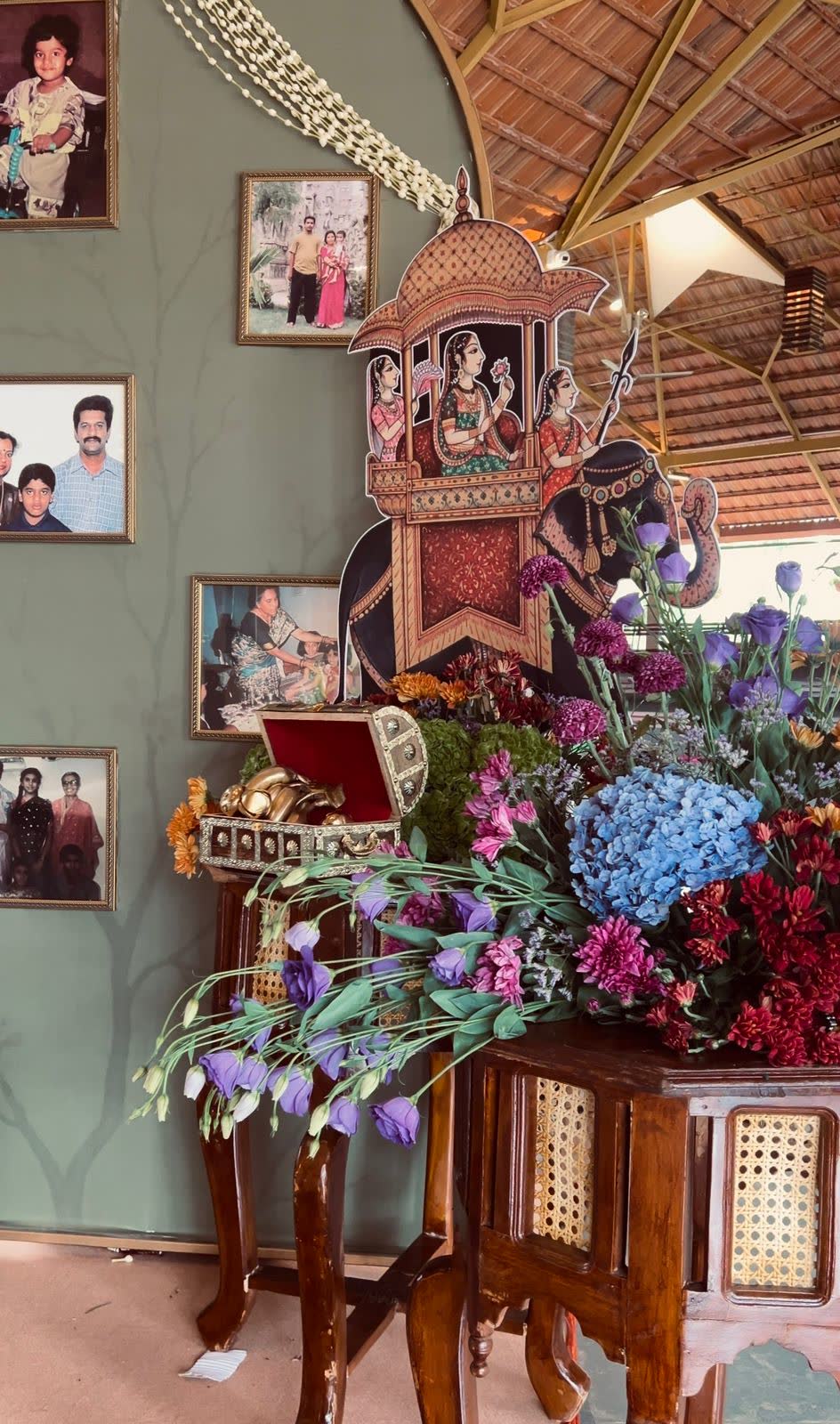
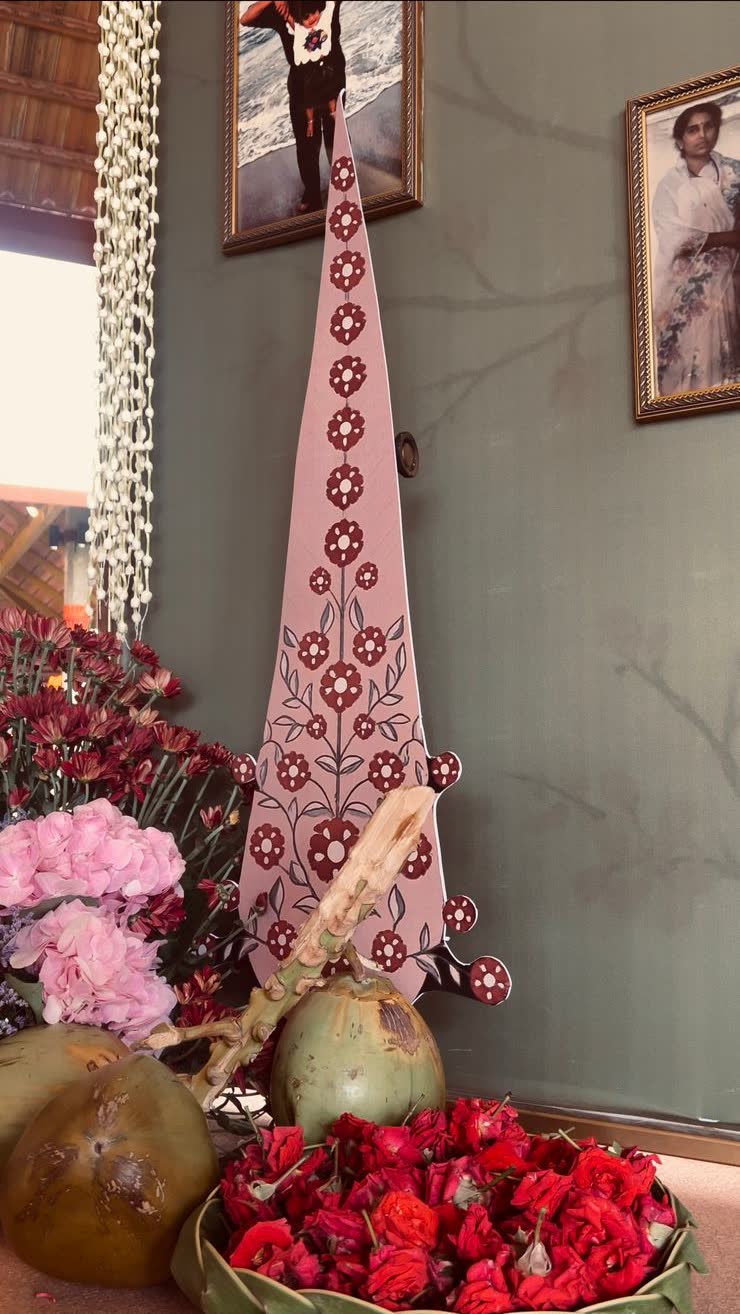
Beside it stands a hand-painted Pichwai elephant and howdah, cut and mounted, with an inlaid heirloom chest open at its base holding gilded fruit. Painted kalash cutouts in dusty pink and oxblood lean into the composition, and the floor is finished with tender coconuts and a woven leaf plate of loose red roses. The whole zone is assembled the way a home is assembled — old things, kept things, and one new painted thing — rather than the way a stall is dressed.
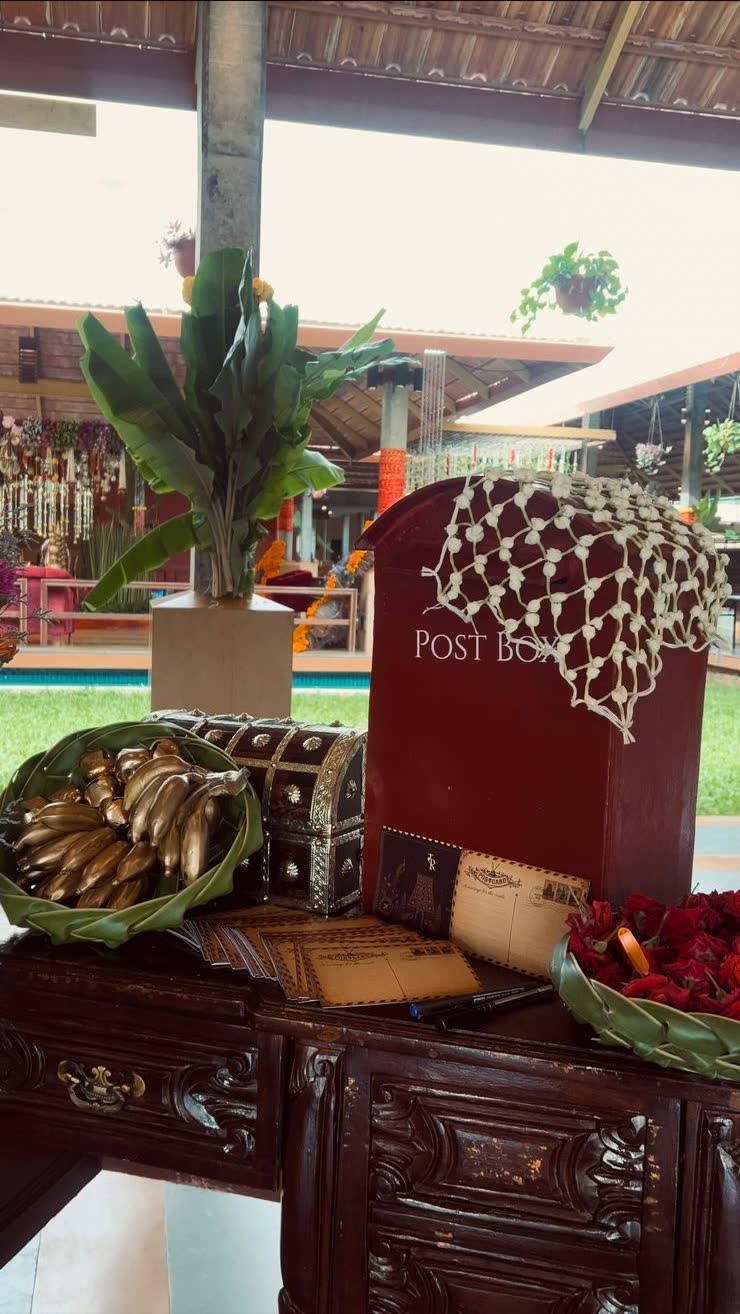
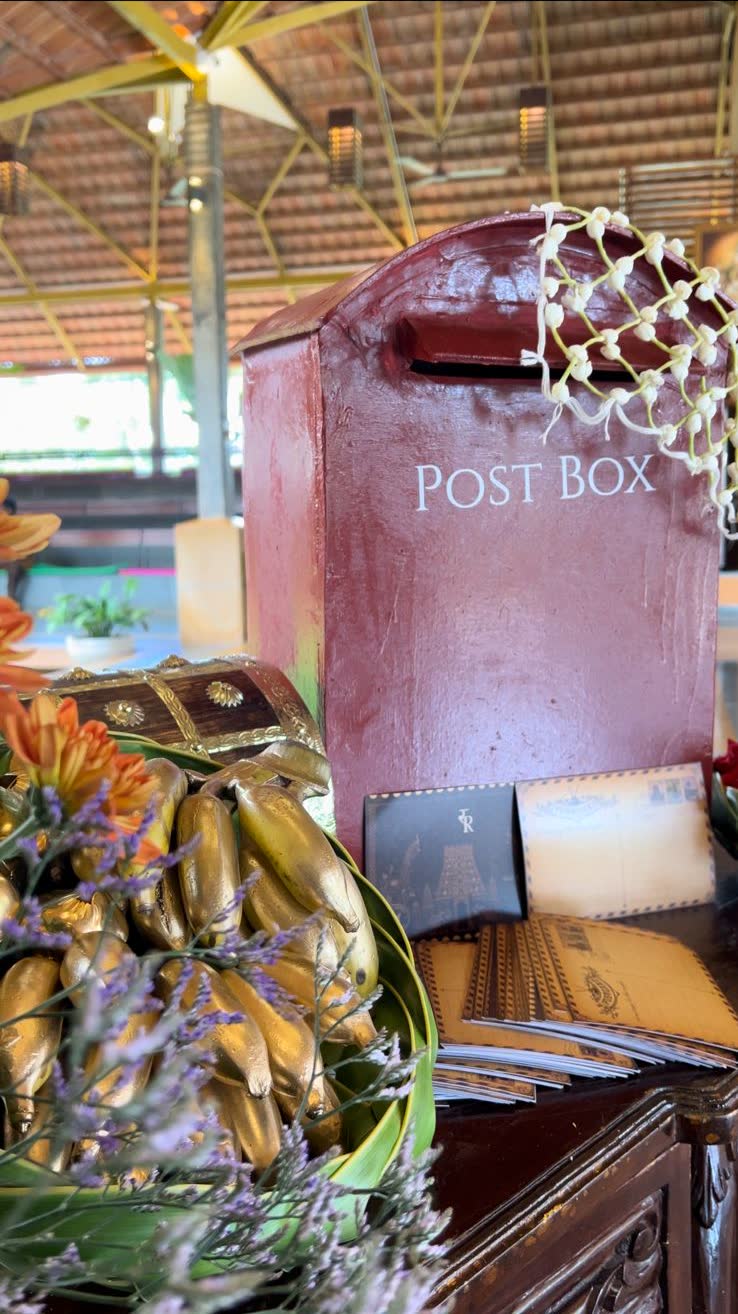
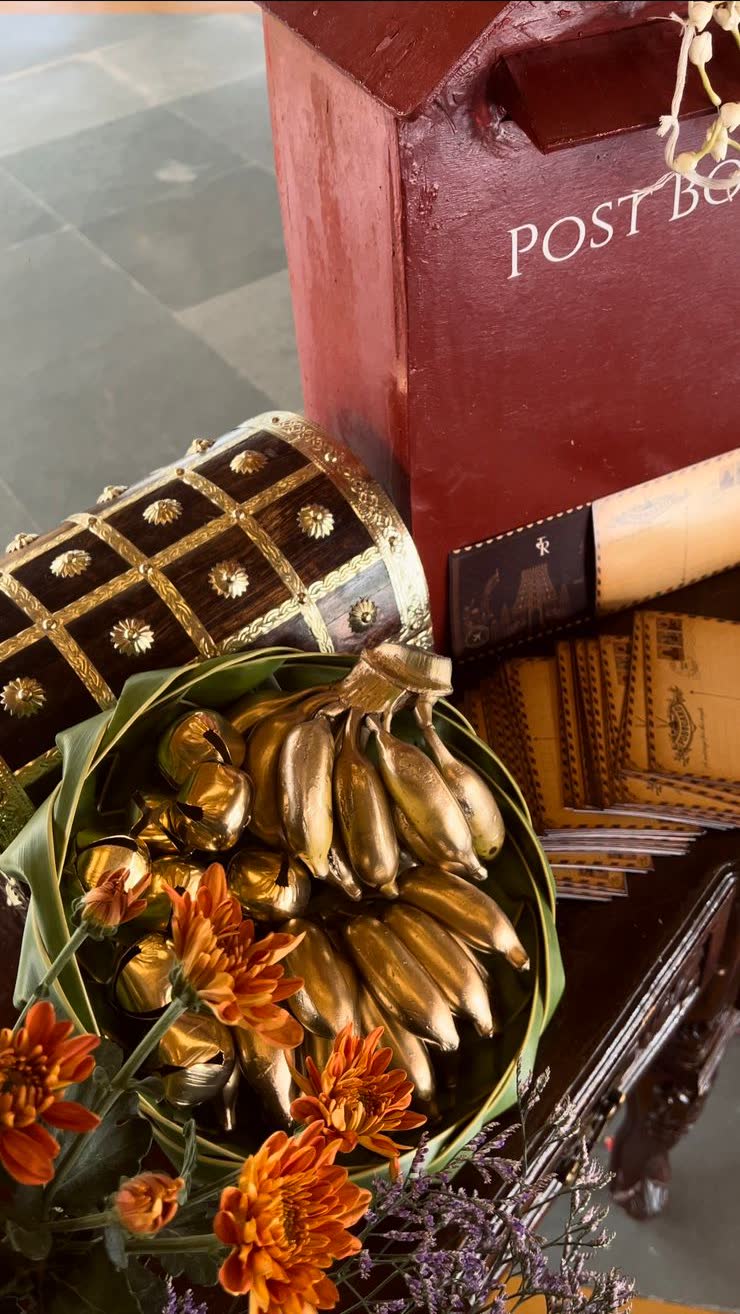
An Indian Post letterbox was built and painted, set on a carved teak desk with postcards, pens and a wax-sealed box, under a hand-knotted jasmine net. Guests write to the couple instead of signing a line in a book. The couple opens the box afterwards.
Around it: gilded bananas on a folded banana-leaf plate, a leaf tray of loose roses, and an inlaid chest. Gold-painting the fruit is a small idea that does a lot of work — it takes an object every South Indian guest has seen a thousand times at every ceremony and makes them look at it again.
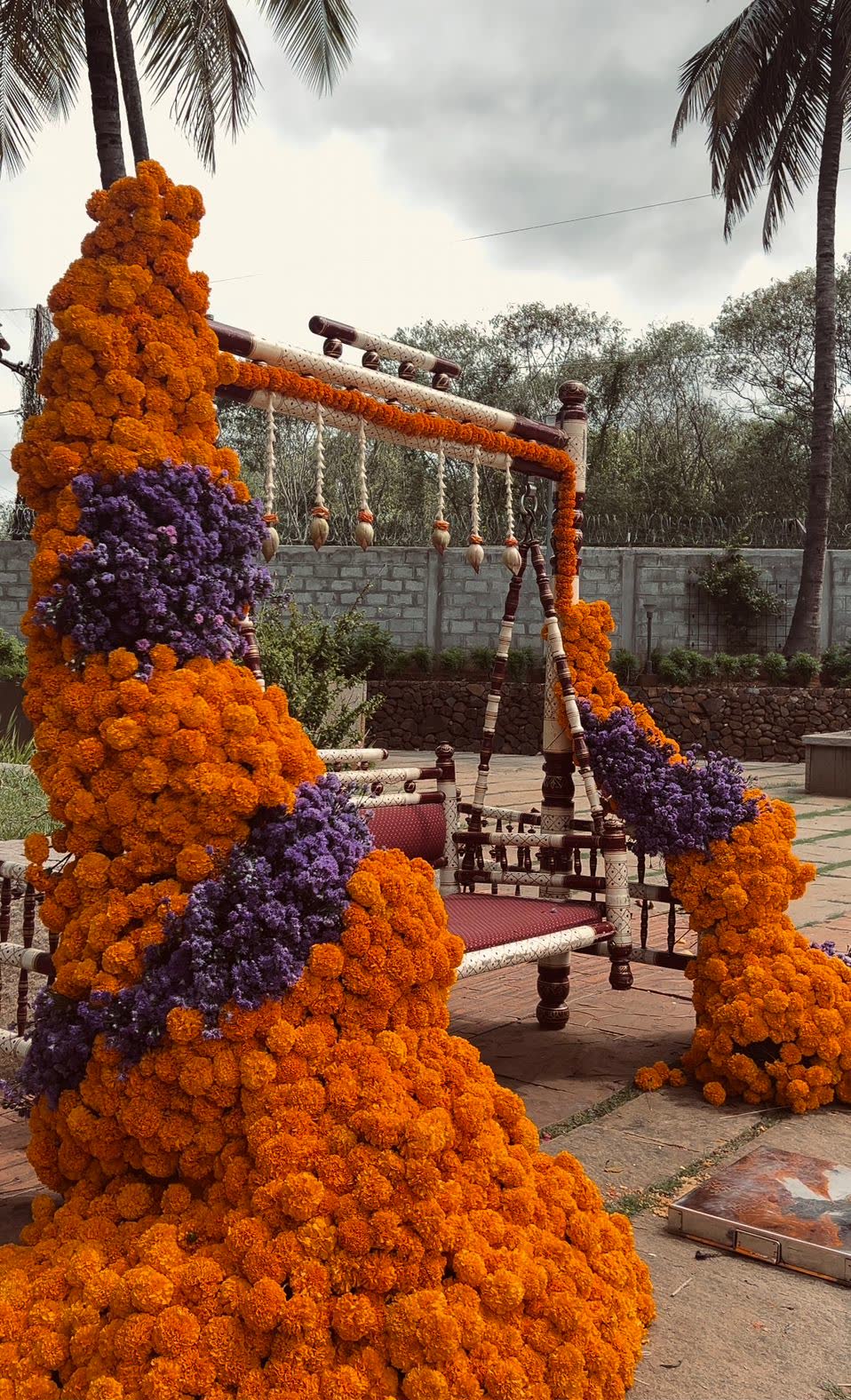
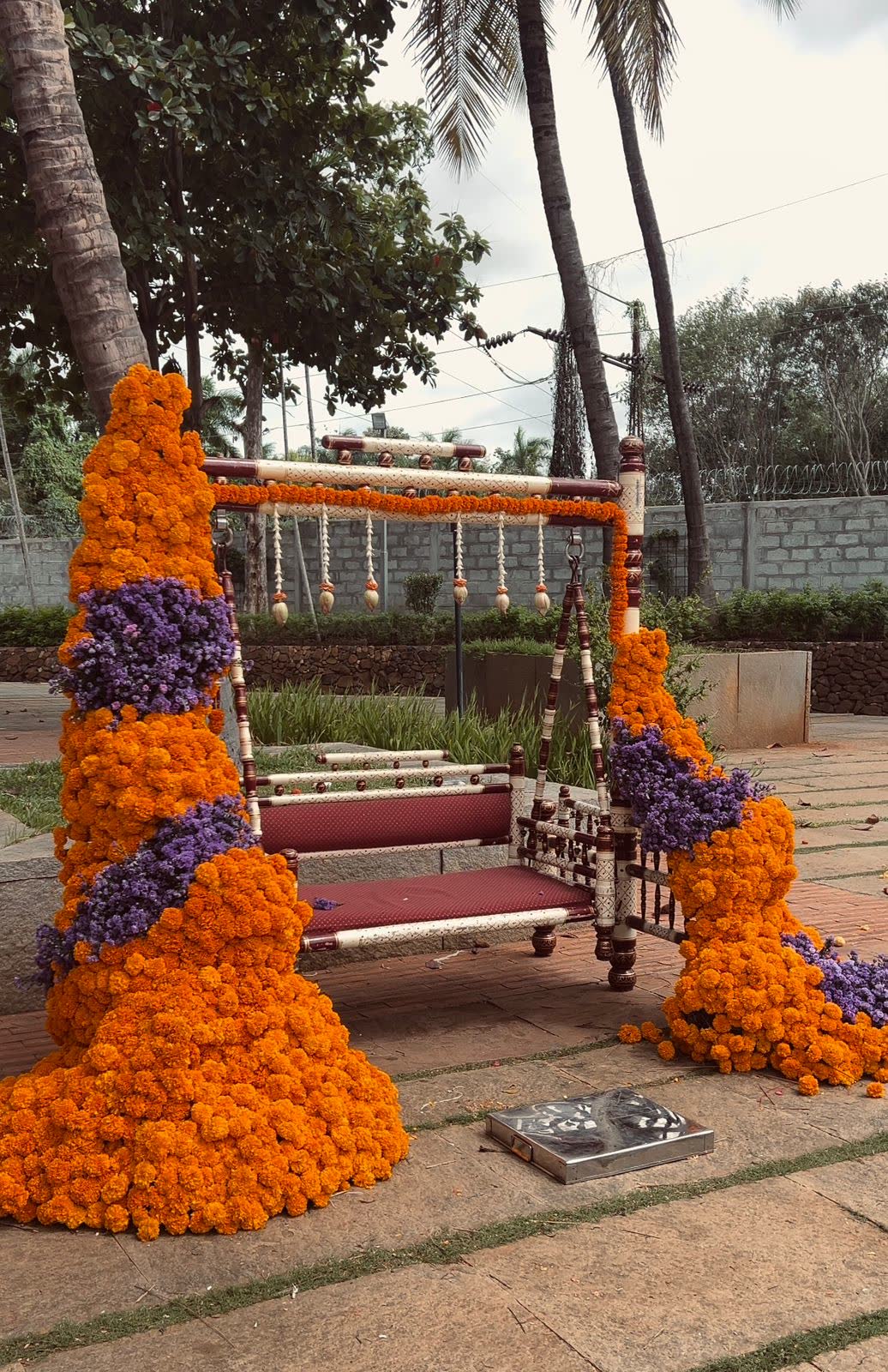
Panchavati's lawn runs to just under twenty thousand square feet, and the light out there is nothing like the light under the pavilion. Colour that reads as rich indoors goes flat under an open Bangalore sky, so the outdoor pieces were built in saturated marigold with purple statice cut through it on the diagonal — two colours, high contrast, no subtlety, because subtlety loses outdoors.
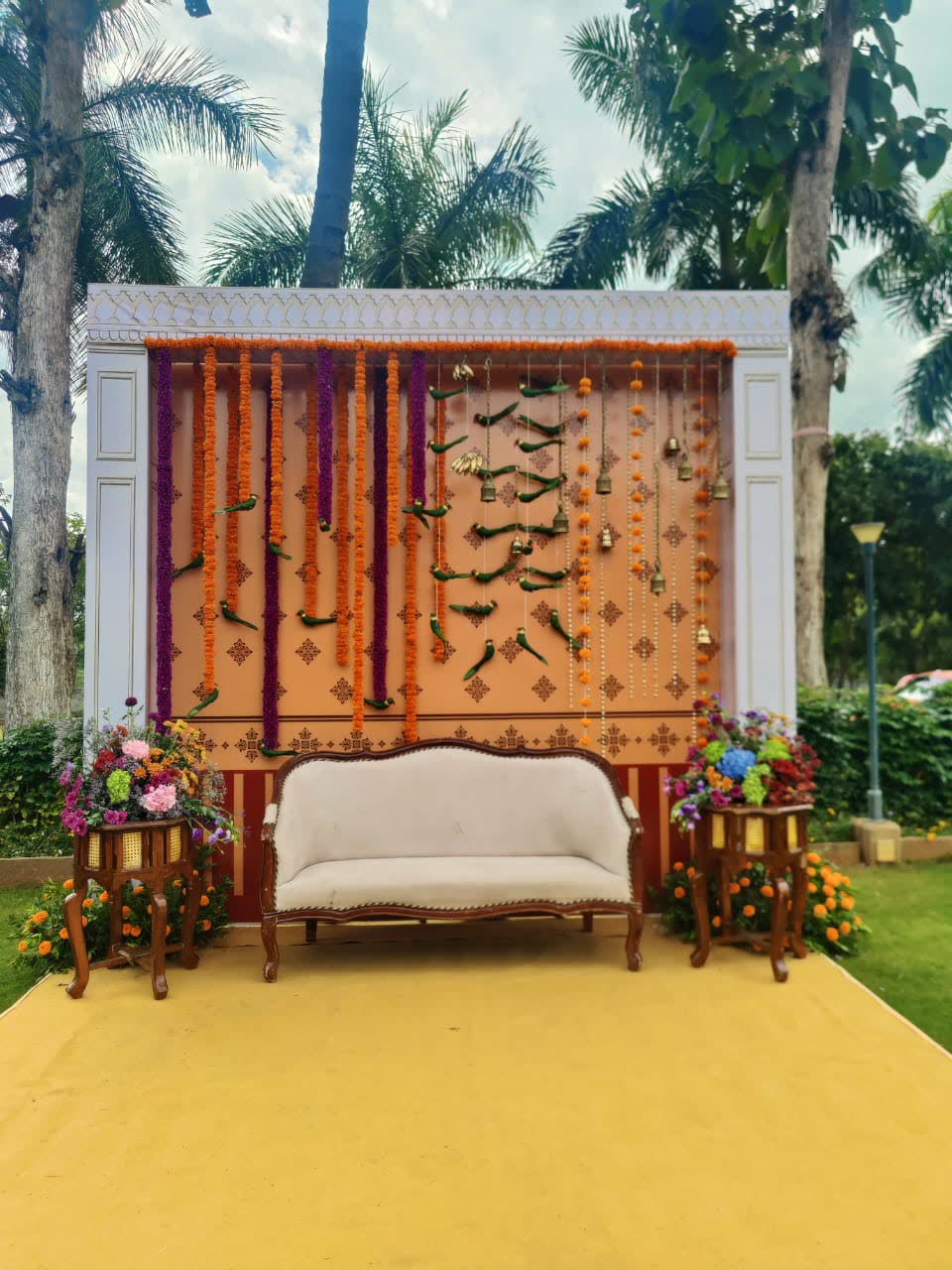
A traditional turned-wood swing was banked in marigold that spills onto the paving, and the haldi backdrop was built as a flat terracotta panel with printed motif, hung with marigold and purple ropes, brass bells, green chillies and lemon on thread. The chilli-and-lemon string is the drishti charm every South Indian household hangs at the door; here it is enlarged into a graphic element and it is the detail that grandmothers photograph.
Everything on this page was produced by the studio's own team on site. Nothing was hired from a rental catalogue.
| Element | Built from |
|---|---|
| Suspended raft | Framed matrix rigged to the pavilion structure; palm and philodendron foliage; hydrangea, chrysanthemum, marigold; orchid, rose, carnation; statice and amaranthus; woven-frond pendants, jasmine and tuberose strings, hanging citrus, pomegranate and mango |
| Ghungroo panels | Brass bells and pearl work, panel-wired into an elephant head and trunk at the corner of the raft |
| Woven sculpture | Split tender and mature coconut frond over a cut ply silhouette; flat chequer weave panel; single set stone for the eye; woven leaf basket of gilded bananas |
| Memory wall | Painted arch in sage with a drawn branch motif; the family's own framed photographs; jasmine ropes; hand-painted kalash cutouts; painted Pichwai elephant and howdah |
| Letter station | Fabricated and painted post box; carved teak desk; printed postcards and wax-seal box; hand-knotted jasmine net |
| Offerings | Gold-painted bananas and mangoes on folded banana-leaf plates; inlaid chests; tender coconut; sugarcane; loose rose in woven leaf trays |
| Columns | Rose garland banding above, open jaali net over bare stone below; lotus-bud garlands and shredded banana-leaf toran on the carved columns |
| Lawn | Marigold banked to ground with purple statice on the diagonal; turned-wood swing; terracotta printed haldi panel; brass bells, green chilli and lemon on thread |
Three short clips from the morning of the ceremony, before guests were seated.
Unedited, from the studio's Google reviews in the days after this wedding.
“Great decor in panchavati the pavillion for a dear friends wedding”
Paaritosh S · Google reviewYou stop designing a backdrop and start designing a ceiling. Panchavati Pavilion's central mantap seats guests on all sides, so any vertical structure blocks somebody's view and every element is read from behind by half the room. Here we suspended a horizontal floral raft above head height instead — a framed matrix of foliage, mass flowers, woven-frond pendants and hanging fruit, with drop lengths graded so sightlines stayed open to the platform from every seat. The stage itself carries only low, fully resolved objects that look finished from all sides.
It is temple-festival craft: tender coconut fronds are split along the spine and the leaflets are folded and pinned in overlapping courses, the way thoranam and festival canopies are made across Karnataka, Kerala and Tamil Nadu. Here it was used structurally rather than as trim — a life-size squirrel built up in graded courses over a cut ply silhouette, with a flat chequer weave of mature and tender leaf across the flank. It is entirely biodegradable and cannot be bought; it has to be woven on site in the days before the wedding, because the frond pales as it dries.
Both, and the decor has to answer both. Panchavati Pavilion at the 25th km on Kanakapura Road runs a central 360-degree pavilion seating up to 2,000 under a tiled roof, a 15,305 sq ft air-conditioned banquet hall, a second smaller hall, and a 19,305 sq ft outdoor lawn. In this wedding the ceremony sat under the pavilion roof, the memory wall and letter station used the covered walkways, and the swing and haldi backdrop went out onto the lawn — which is also the sequence that keeps a monsoon-season date safe. Full venue details are here.
Decor of this class is priced by what is fabricated, not by square footage. The variables that move the number here are the suspended raft (rigging plus fresh flower volume), the hand-woven frond sculpture (labour-days on site), and the number of separately designed zones. Panchavati Pavilion's own venue rental is quoted around ₹7.25 lakh per function, separate from decor. We work on a flat design-and-production fee rather than a percentage, so our fee does not rise when the flower order does. Our full decor cost breakdown is here.
The thinking transfers; the objects do not. A suspended raft is the right answer wherever seating is in the round or the venue has a ceiling worth using, and the layered build-up applies anywhere. But the memory wall was made from one family's photographs, and the frond sculpture was woven for this room. We draw every wedding from the venue up rather than re-staging a previous one, which is the reason there is no rental catalogue behind any of this.
Send us your dates and the venues you are considering. You will get a designer's read on what each one can and cannot hold — before anyone quotes you.
Begin your design WhatsApp the studio