An Indian wedding theme is not one themed event. It is four or five events across three days that have to feel like one family story without repeating themselves. The method that works is a spine: one palette logic, one material logic, one motif, held constant, with deliberate variation in scale, light and density per function. Pick six unrelated themes and you get six weddings. Pick one spine and vary it, and each function surprises people while still reading as yours.
We are an architect-founded studio and we design every function of a wedding as one drawing set, not as six separate briefs. Below are six theme families we have built end to end, and the grid we use to vary a theme across functions without repeating it.
Why one theme per function fails, and what to do instead
The instinct is understandable. Nobody wants the reception to look like the sangeet, so couples ask for a different theme each day. What arrives is a wedding with no through-line: six sets of props, six palettes, nothing reused, and photographs that could belong to six different families.
The opposite failure is worse. One theme repeated identically across five functions reads as a budget decision even when it was not, and by the third function guests have stopped looking. Parents notice this faster than couples do, because they are the ones standing in the room while the same backdrop goes up again.
The spine sits between them. Hold three things constant and change everything else. We have written the function-level version of this in our guide to theming each wedding function differently; this page is about the layer above it, the decision that makes those differences add up.
Choosing the spine: palette, material, motif
The palette logic is not a set of colours, it is a rule about them. Warm earth with one metal. Cool neutrals with one saturated accent. Two adjacent hues and white. A rule survives changes of scale and light; a fixed swatch list does not, because the same swatch behaves differently on a lawn at noon and in a ballroom at nine.
The material logic is the honest part of a theme, and the part guests feel without naming. Brass, stone, raw cotton and terracotta is one world. Lacquer, porcelain, silk and mirror is another. You can change the flowers completely and, if the materials hold, the wedding still reads as one thing.
The motif is the smallest element and the one that does the most work: a lotus, an arch profile, a jaali pattern, a stripe. It appears at every function at a different size, from a stationery corner to a full mandap profile. Our record of which palette rules held up in practice is in the palettes we tested, and the colour detail sits on our Bangalore wedding colour palettes page.
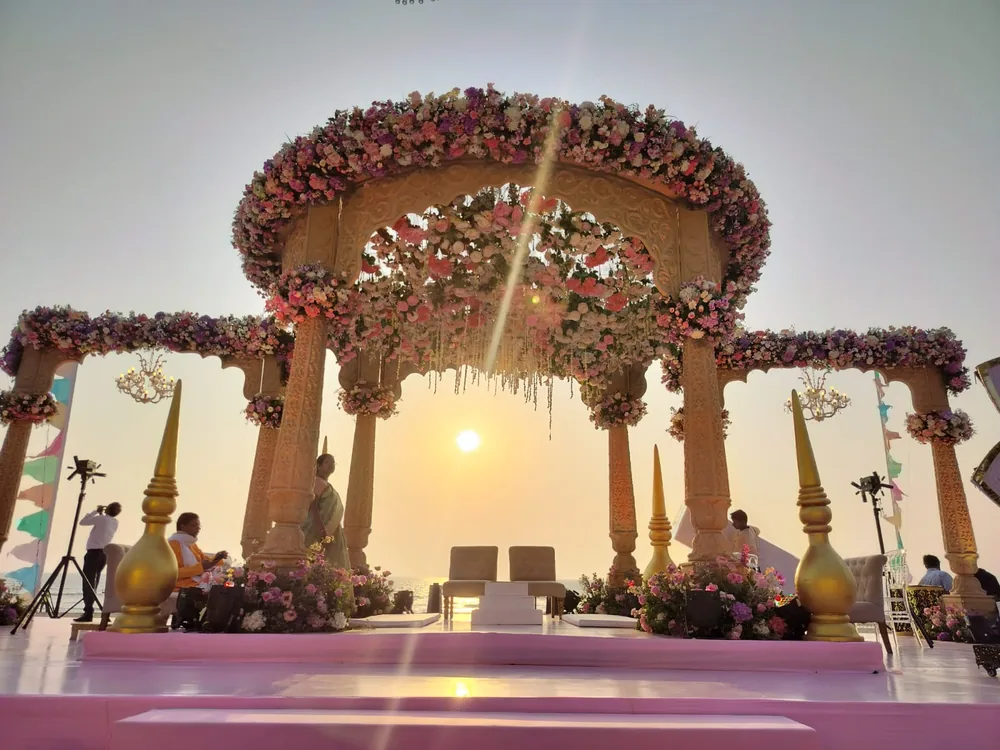
Theme family 1: temple and heritage
This family takes its geometry from temple architecture: tiered profiles, carved or cut screens, stone and brass, deity vignettes, oil lamps and dense garland work. It is the most emotionally direct theme we build in South India, because families recognise it before they analyse it.

Its risk is weight. Carried at full intensity across five functions it becomes solemn, and a sangeet does not want solemn. The variation that works is to keep the motif and the metal but drop the density: a gopuram profile at the ceremony becomes a single carved screen at the mehendi and a brass lamp run at the sangeet.
Heritage work is also the family with the most ritual content, which means the priest brief and the design brief have to be reconciled early. A tiered mandap that cannot take a homa kunda in the position the priest needs it is a beautiful drawing and a bad design.
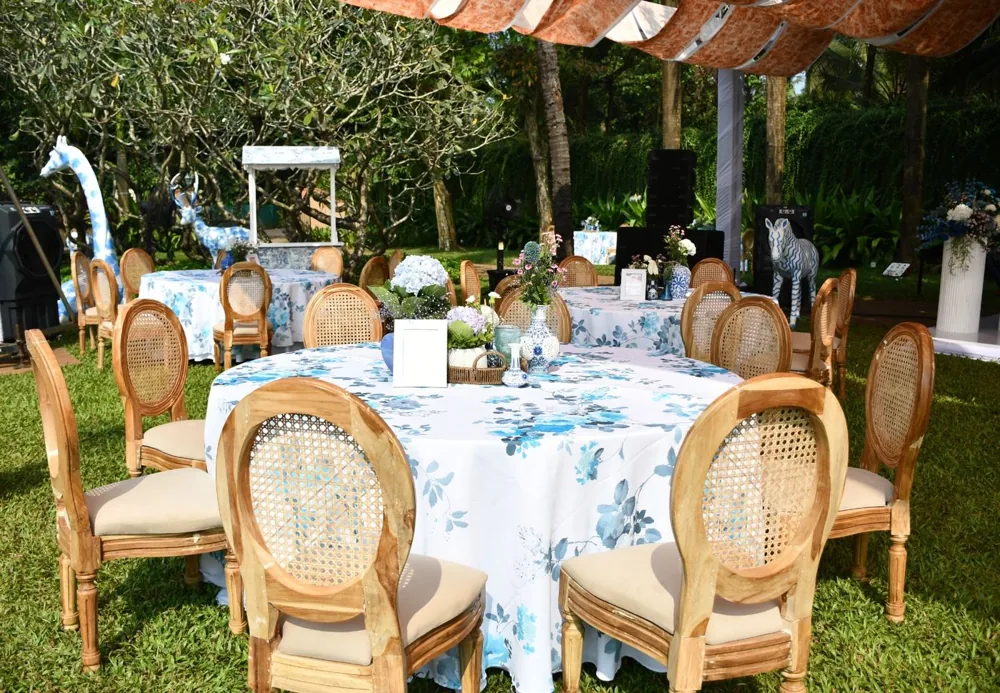
Theme family 2: garden and English country
Garden themes are the most forgiving in Bangalore because the city gives you real greenery to build against. The material logic is cane, painted timber, printed cotton and soft upholstery; the palette rule is usually two soft hues with white and a green that is already on site.

The failure mode is pale colour in hard afternoon light. A Bangalore lawn at three in the afternoon will bleach a soft palette to white, so we either push the saturation up a step for daytime functions or move the pale version to dusk. The other Bangalore factor is that the greenery you are designing against is not neutral: an existing hedge line reads as a colour in every photograph, and a palette approved indoors can fight it.
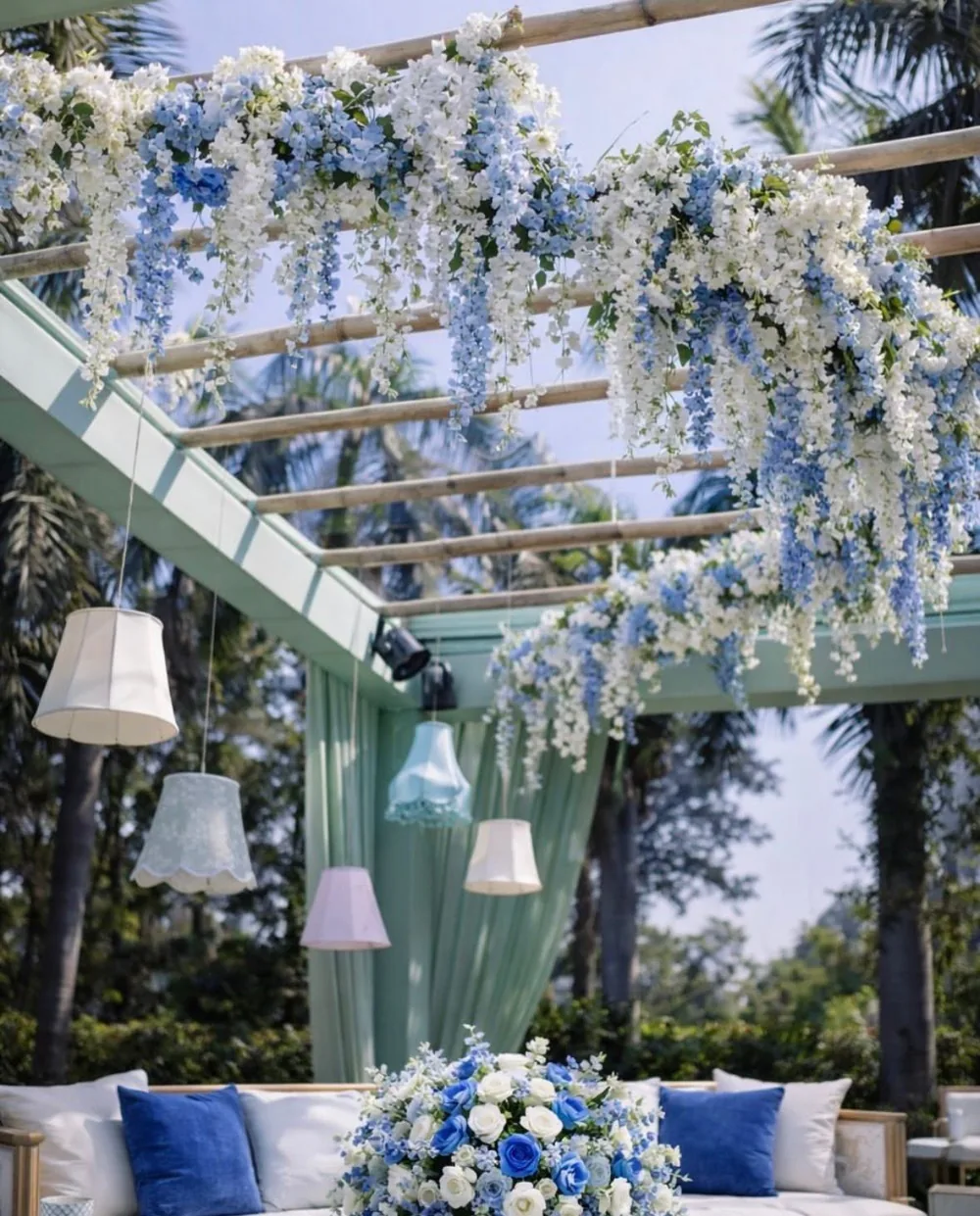
Theme family 3: chinoiserie and porcelain
Chinoiserie is a graphic theme, which makes it unusually disciplined. The motif is the pattern itself, the palette rule is two colours and white, and the materials are lacquer, porcelain, mirror and painted panel. Because the pattern carries the theme, the flowers can be modest without the design looking thin.

It is also the family that varies most easily across functions, because pattern can be dialled up or down without changing the palette. A full painted backdrop at the reception becomes vessels and a table pattern at the mehendi, and nothing has to be rebuilt to say the same thing quietly.
Theme family 4: tropical and coastal
Tropical themes belong to geography more than to taste. Palm, woven fibre, unfinished timber, shell and rope read as correct in Goa and in coastal Kerala and read as costume in a Bangalore ballroom, which is the honest reason we steer couples towards it only where the setting supports it.
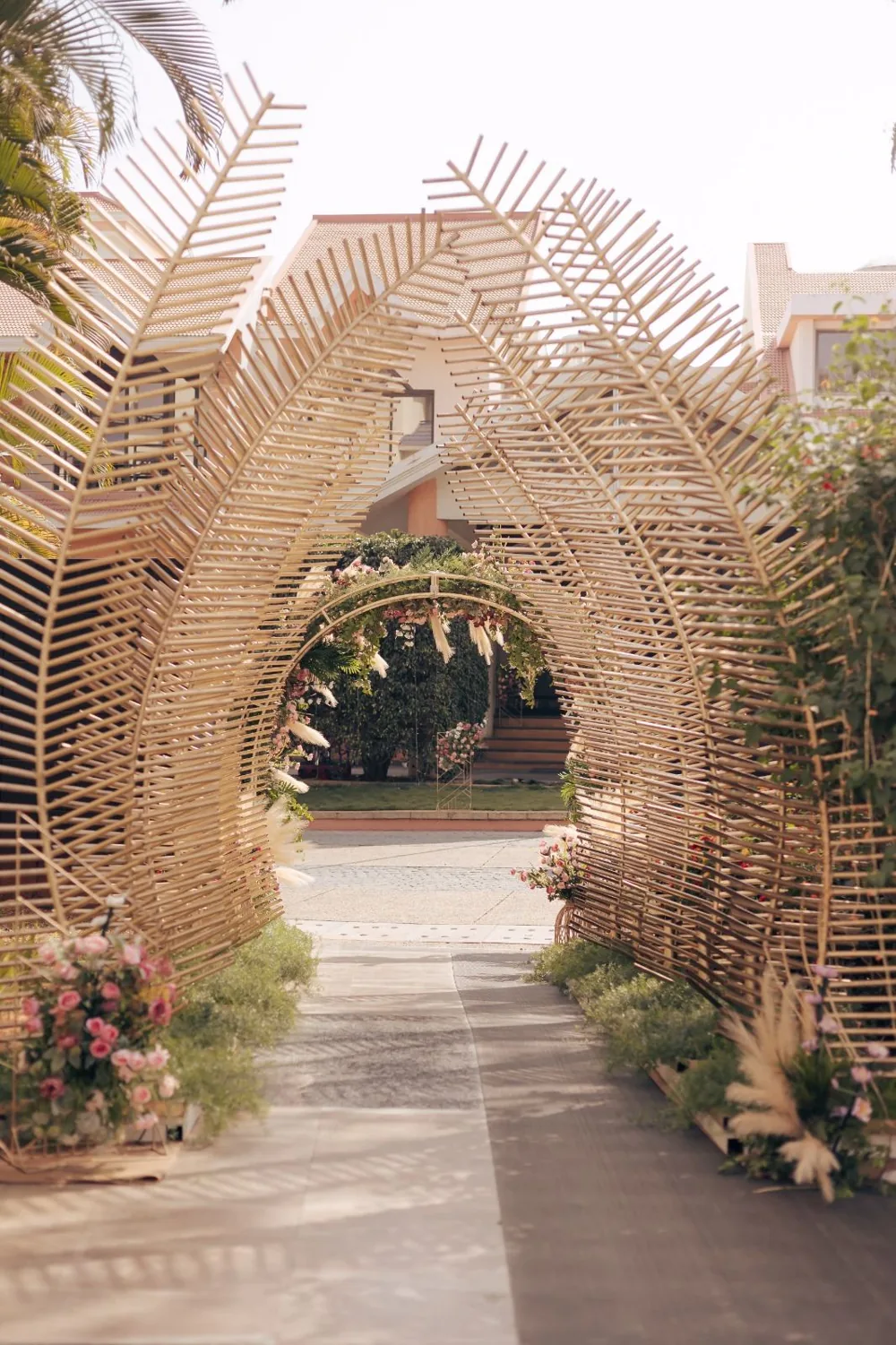
The constraints are physical. Salt air, sea wind and open decks mean tall flat surfaces are out, natural fibre needs treating, and anything not ballasted moves. We size coastal structures for wind first.
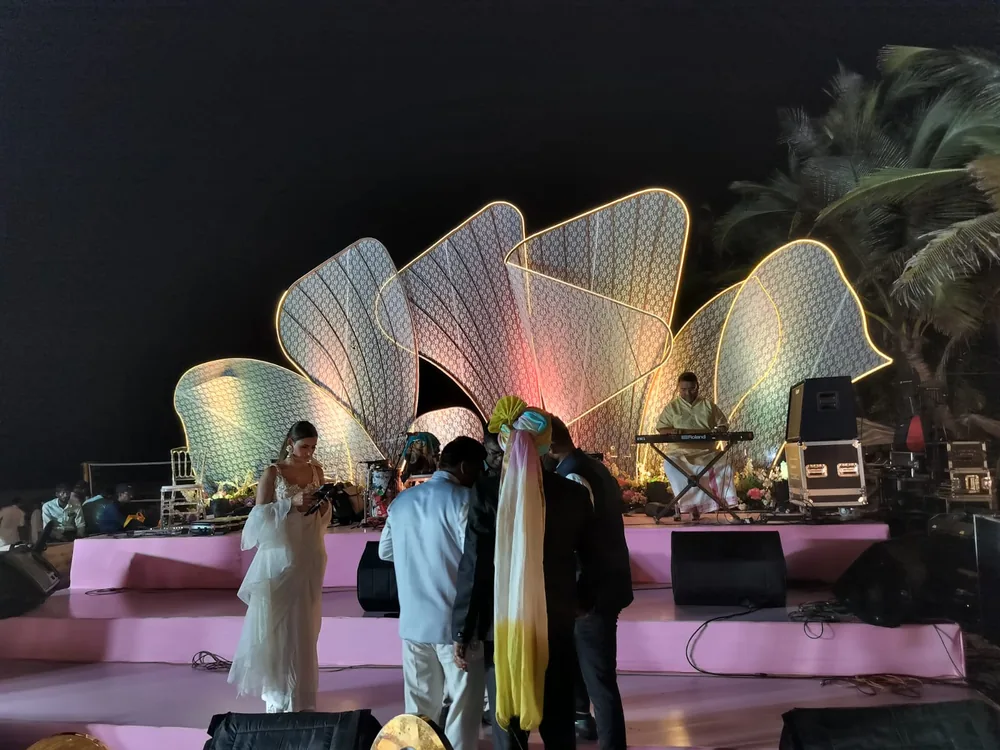
Theme family 5: theatrical and carnival
A theatrical theme is the hardest to do without embarrassment, because the line between designed and dressed-up is thin and it is crossed by half-commitment. The rule we work to is that a theatrical theme must be built at full scale or not attempted: painted murals, real structure, a proper lighting state.

At Caravela Beach Resort in Goa we built a circus function that way. The murals were hand-painted at architectural size, the palette rule was saturated primaries against black, and the theme stopped at the edge of that one function rather than bleeding into the ceremony. That is the second rule: a theatrical theme is a single-function guest, not the spine of the wedding. It works because the spine underneath it, the palette rule and the material logic, carried on unchanged the next morning.
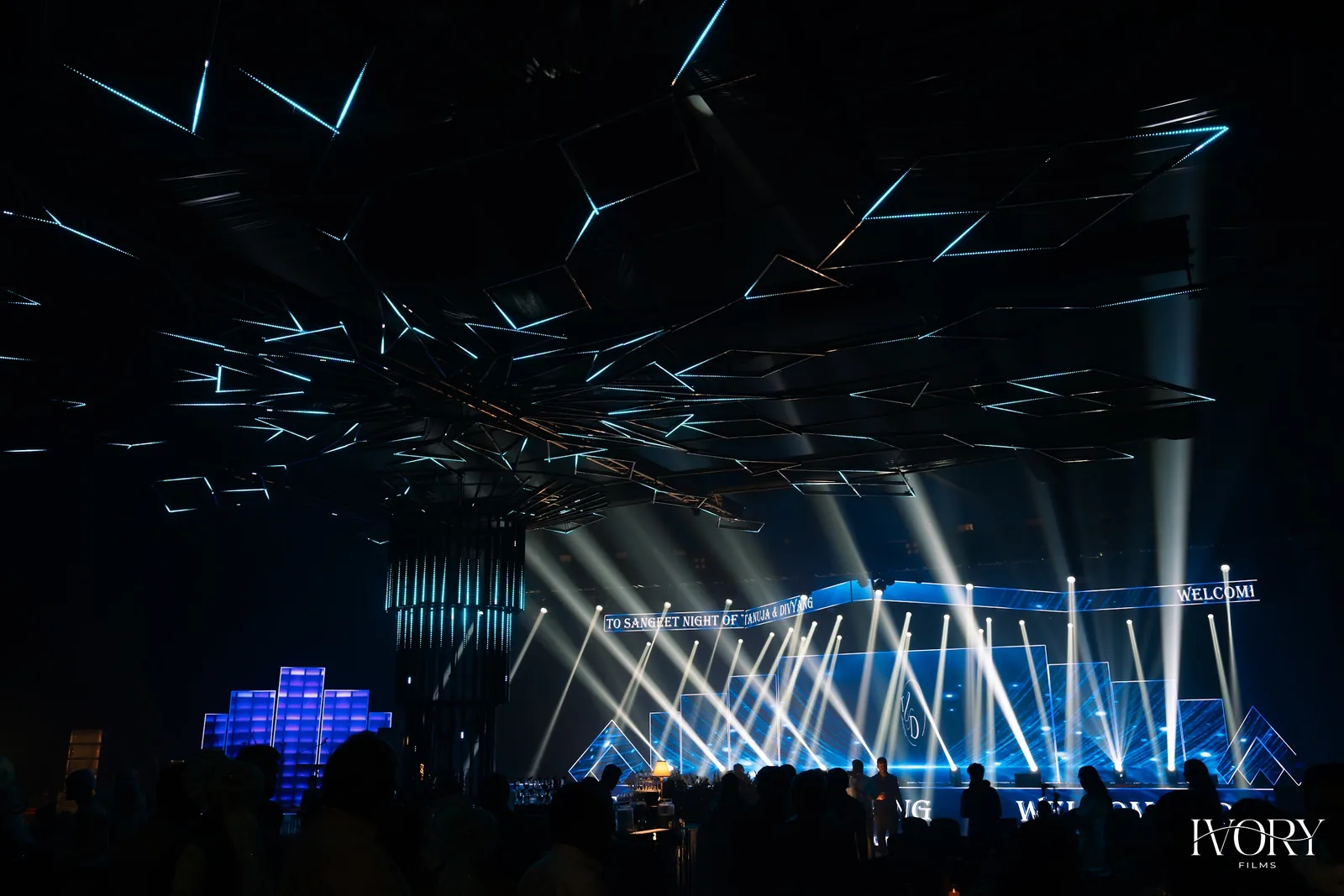
Theme family 6: minimal and contemporary
Minimal is the most misunderstood family, because it is not the cheap option. Removing decoration removes the things that hide bad proportion, poor finish and visible cable, so every remaining element has to be right. It is the family where architect-drawn geometry earns its keep, and where we spend on fabrication rather than on flower volume.
The spine here is usually one material and one gesture: a single curve, a single colour shift, one light source doing all the work. Our minimalist wedding decor page covers what it takes to do it properly, and the opposite instinct, where abundance is the point, is on our maximalist wedding decor page. Both are legitimate; what is not legitimate is a minimal design that is really just an under-resourced one.
Varying without repeating: the function-by-function grid
This is the grid we fill in before any decorator is briefed. The spine stays in the left column, and the job of each function column is to say what changes. Most variation comes from three levers: scale, density and light. Change any two and the function feels different without leaving the family.
| Theme family | Haldi | Mehendi | Sangeet | Ceremony | Reception | Reuse potential |
|---|---|---|---|---|---|---|
| Temple and heritage | Lamps and raw flower, low | Carved screen, seated | Brass runs, dark and lit | Full tiered mandap | Motif at panel scale | Medium |
| Garden and country | Print and cane, open sun | Lounge clusters, shade | Pergola and lamps at dusk | Arch of real planting | Tall stems, warm light | High |
| Chinoiserie and porcelain | Pattern on cloth only | Vessels and table pattern | Lacquer and mirror, lit | Painted panel behind | Full painted backdrop | High |
| Tropical and coastal | Palm and fruit, daylight | Woven shade and rope | Fire and low light | Palm structure on sand | Timber and shell, warm | Medium |
| Theatrical and carnival | Not used | Not used | Full build, one function | Not used | Motif echo only | Low |
| Minimal and contemporary | One colour, one form | Furniture as the design | Light as the decor | Single curved structure | One gesture, at scale | High |
Read the rows across and you can see the discipline: the theatrical row is deliberately mostly empty, because a theme that heavy belongs to one night. At W Goa for Tarun and Anushka the spine was modernist geometry with cascading marigold, and the same geometry read as clean at the ceremony and as energetic on the pool deck simply by changing density and light.
Turning a Pinterest board into a brief
A board of saved images is evidence, not a brief. It tells a designer what you respond to and nothing about why, and two hundred saves usually contain three different weddings. The work is to extract the rule underneath the images.
We do it by asking what is constant across the saves: is it always warm metal, always a low horizon, always one flower repeated, always dark. That constant becomes the spine. Our method for reading a board that way is written up in turning Pinterest saves into a design brief.
- The palette rule: a rule, not a swatch list.
- The dominant material: one, named.
- The metal: brass, gold, chrome or none.
- The motif: one shape that can scale from stationery to mandap.
- The light temperature: warm, neutral or mixed, across the whole wedding.
- The one non-negotiable ritual element: and what it must look like.
- The function that gets the biggest build: only one can.
- The function that is deliberately quiet: at least one should be.
- What must be reused: decided before anything is fabricated.
What a theme costs to sustain across five functions
The cost of a theme is not the theme, it is the number of times you rebuild it. A spine held across five functions is cheaper than five themes, because the structures, furniture and vessels carry and only the finish changes. Five unrelated themes means five fabrications, five install cycles and nothing that can move.
The drivers worth knowing are structure count, install and strike cycles, how much of the design is fresh flower, and whether pieces were built to be re-dressed. That last one is a design decision, not a budgeting one, and it has to be made before fabrication. The questions to settle are in our note on reusing wedding decor between functions.
At The Leela Palace Bangalore for Vikram and Ananya, a 400-guest wedding across two days, the discipline was exactly this: one material and colour logic held while the scale changed. What we are seeing across the market this year is in our wedding decor trends report, with the underlying patterns in our wedding data pages, and the longer form of this argument in our guide to luxury wedding decor in India and our luxury decor page.
Regional fit: Bangalore, Goa, Kerala
Bangalore. Heritage and garden families sit most naturally here, because the city supplies both palace-scale interiors and real gardens, and its evenings are usable outdoors for most of the year. The constraints are hard afternoon light on lawns, which bleaches pale palettes, and ballroom ceilings that decide whether an overhead gesture is possible at all. For Karthik and Sneha at Amita Rasa, a stone estate at the foot of the Nandi Hills, the estate own material palette became the spine, which is almost always the stronger decision at a property with character. Our Bangalore wedding decor page has the venue-level detail.
Goa. Tropical and theatrical both belong here, for different reasons. Tropical is supported by the setting; theatrical works because resort properties have the space, the power and the late licences that a full build needs. Salt air, wind and seaward setbacks are the design constraints, and they are physical rather than negotiable.
Kerala. Temple and backwater families fit the architecture: courtyards, tiled roofs, water edges and timber already frame the event, so the work is additive and low rather than structural. Humidity shortens fresh flower life and rain is a scheduling assumption, which pushes the design towards materials that do not wilt and towards covered circulation between functions.
If you want a spine drawn for your own venues and dates rather than a theme picked from a list, that is what architect-designed wedding decor means here, and you can tell us about the wedding to start it.
Common questions
How do we pick a wedding theme?
Pick a spine rather than a theme: one palette rule, one dominant material and one motif that can scale from stationery to a mandap. A rule survives changes of light and scale where a fixed swatch list does not. Everything else, density, flowers and lighting, then becomes a per-function decision instead of a whole new theme to invent.
Should every function have a different theme?
No. Different themes for every function produce a wedding with no through-line, six sets of props and nothing that can be reused. Hold the palette rule, the material logic and the motif constant, then vary scale, density and light per function. Each event will feel distinct while the whole wedding still reads as one family story.
What is a theme spine?
A spine is the three things that stay the same across every function: a palette rule, a material logic and a motif. It is not a list of colours but a rule about them, such as warm earth with one metal, or two adjacent hues plus white. Fix the spine first and each function can then be designed to look different without drifting.
Which themes work for a Goa beach wedding?
Tropical and coastal themes work because the setting supports them, and theatrical builds work because resort properties have the space, power and late licences a full build needs. The constraints are physical: salt air corrodes untreated metal, sea wind takes anything tall and flat, and seaward setbacks decide where a structure can stand at all.
How much extra does a strong theme cost?
A strong theme held across functions usually costs less than several weak ones, because the structures, furniture and vessels carry through and only the finish changes. The real drivers are how many separate structures you build, how many install and strike cycles they need, how much of the design is fresh flower, and whether pieces were built to be re-dressed.
Can decor be reused between themed functions?
Yes, if reuse is designed in before fabrication rather than requested afterwards. A piece built to be re-dressed has accessible fixings and a finish that survives stripping. Reuse also depends on the schedule: the move only starts when the first space is released, so overlapping functions usually make a second piece cheaper than a rushed transfer.
What theme suits a South Indian wedding?
The temple and heritage family sits most naturally, built on tiered profiles, carved or cut screens, stone and brass, oil lamps and dense garland work. Its risk is that carried at full intensity across every function it becomes solemn, so keep the motif and the metal at the lighter functions and drop the density instead of changing theme.
How do we turn a Pinterest board into a brief?
Look for what is constant across the saves rather than for individual images to copy. If the board always shows warm metal, or a low horizon, or one flower repeated, that constant is your spine. Write down the palette rule, the dominant material, the metal, the motif and the light temperature, and brief those rather than the pictures.
Planning this yourself? Send us your name and a number and we’ll come back the same day with a realistic budget for it — yours to keep, whoever you end up booking.
Panigrahana is an architect-founded studio: 500+ weddings designed since 2018, rated 4.8/5 across 94 Google reviews, on a flat planning fee (quoted for the agreed scope) rather than a percentage of what you spend.