One Statement Wedding Installation: How to Make It Work in the Whole Space
Choose a focal installation by its role, sightlines, venue setting and production requirements, then let the surrounding decor support it.
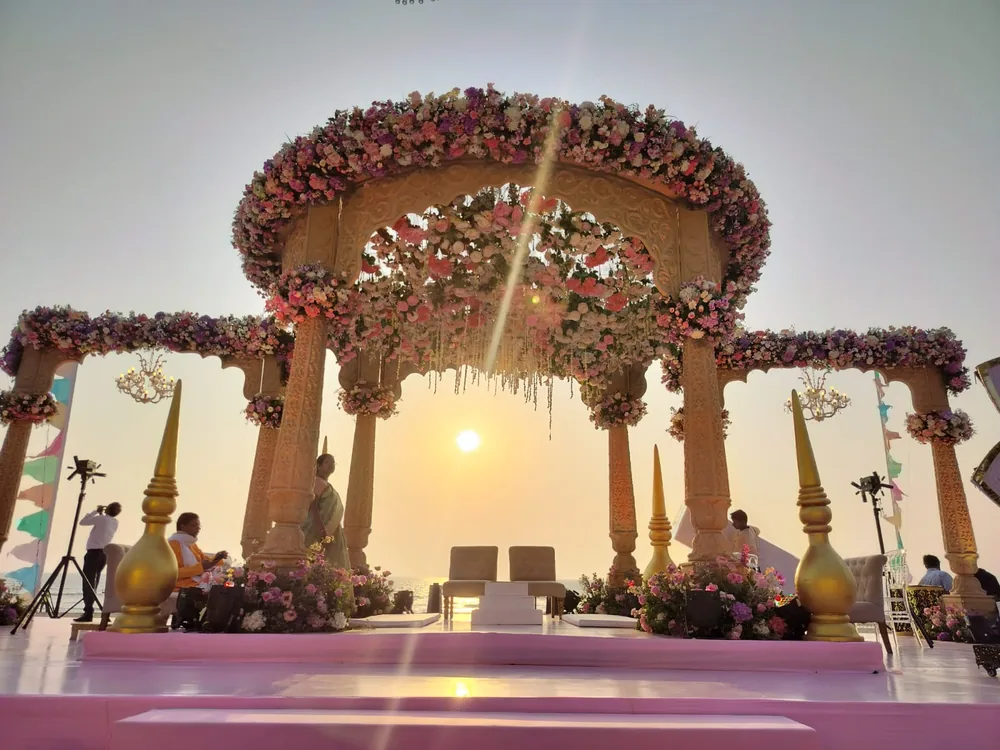
Choose a statement wedding installation around the moment it serves and the viewpoints from which guests will see it. Check scale, circulation, lighting and the complete production scope before reducing the rest of the decor. A strong focal piece still needs a coherent setting.
Choose the moment before the object
Decide whether the focal installation belongs to the ceremony, the arrival or the party. A mandap needs to support the ceremony and its participants. An entrance needs to welcome guests without blocking them. A stage needs to work with the performance and the camera. The same sculptural idea can require a different form in each location.
WedMeGood’s 2026 editorial forecast includes statement installations among its design themes. That is useful inspiration, rather than a reason every wedding should adopt one. Choose the idea because it suits your venue and the way you want to celebrate. If guests will barely pass the proposed location, a dramatic object there may not deserve the largest share of the design budget.
Check the focal point from three distances
From the entrance, look at its overall silhouette and relationship to the venue. From the main guest area, check whether people can see the important action around it. Up close, examine the materials, joints, floral detail and surfaces guests can reach. A design can work at one distance and feel unresolved at another.
Use the measured plan to check the surrounding space. Guests, photographers and staff need routes that do not force everyone through the same narrow opening. Discuss structural feasibility and venue acceptance with the appropriate production specialists; the decorative image is only one part of the review.
Keep the rest of the space intentional
| Around the focal piece | Design question |
|---|---|
| Seating | Does the arrangement support the view and the occasion? |
| Aisle or approach | Does it lead naturally toward the moment? |
| Lighting | Can the feature and the people around it be seen well? |
| Background | What unwanted equipment or service activity is visible? |
| Nearby decor | Does it support the main idea or compete for attention? |
Understand what simplicity still requires
A visually simple structure can still involve custom fabrication, transport, specialist installation and careful finishing. Ask for those elements in the priced scope. Removing small decorative details does not automatically make the main feature inexpensive, particularly when its size or installation method is unusual.
Decide where detail matters most. A surface behind the couple may appear in many photographs, while another face may rarely be seen. Explain that priority rather than asking the supplier to reduce every line by the same amount. Keep technical and access requirements intact when discussing savings.
Use completed work to ask better questions
The accompanying photograph shows a circular floral mandap from Panigrahana’s work at The St. Regis Goa Resort. Notice the relationship between the structure, the open setting and the ceremony approach. It is evidence of a completed design, not a price reference or a promise that the same setup suits every beachfront location.
When reviewing your own proposal, ask the designer to show how the focal piece sits within the entire event. Panigrahana develops the idea through drawings, layouts and mockups, with line-item costing. Approve the surrounding plan as carefully as the main image so the finished installation works for the people using it.