By Chaithanya Ganesha · Founder & Creative Director, Panigrahana Weddings · Updated July 2026
Wedding decor in Bangalore runs in four tiers — Essential ₹3–5 lakh, Signature ₹5–12 lakh, Luxury ₹12–20 lakh, and Ultra-luxury ₹20 lakh+ (grand multi-day productions can reach ₹50 lakh). The most common spend for a 150–250 guest wedding across three functions is ₹12–20 lakh; the sweet spot for a single function at a premium hotel is ₹10–12 lakh.
Planning numbers for your own wedding — guest count, functions, season — take about a minute in the wedding cost calculator, built on figures from weddings we have actually planned.
| Decor Tier | Guests & Functions | Venue Type | Total Decor Cost |
|---|---|---|---|
| Tier 1 (Essential) | 80–120 guests, 1 function | Hotel ballroom | ₹3–5 lakh |
| Tier 2 (Signature) | 150–200 guests, 1 major function | Premium hotel | ₹5–12 lakh |
| Tier 3 (Luxury) | 200–300 guests, 2–3 functions | 5-star hotel | ₹12–20 lakh |
| Tier 4 (Ultra-luxury) | 300+ guests, full production | Leela / Taj West End | ₹20 lakh+ |
Looking for the decorator itself, not just the numbers? See Wedding Decorators Bangalore — Panigrahana's in-house decor studio page, with venue-by-venue design guidance.
Panigrahana is an architect-founded in-house decor studio — rated 4.8/5 across 79 Google reviews. Across 500+ weddings our production records show decor lands within ~5% of quote. Every design is created in-house by a dedicated design team — Harshitha on florals, Nishitha on floral detailing, Chandru on AV, Dhanush on structures, designers Shivani and Hemanth — directed personally by founders Ajit and Chaithanya. See the production-records data in our 2026 India Wedding Cost Report · 79 Google reviews
Wedding decor in Bangalore in 2026 costs ₹3–5 lakh at the Essential tier (a single function of 80–120 guests), ₹5–12 lakh at the Signature tier where most couples land (150–200 guests, one major function), ₹12–20 lakh at the Luxury tier for a 2–3 function celebration of 200–300 guests, and ₹20 lakh and above at the Ultra-luxury tier — grand multi-day productions can reach ₹50 lakh. These numbers come from over 500 weddings Panigrahana has produced across Bangalore, Goa, Kerala, and abroad; ₹10–12 lakh is the sweet spot for a single function at a premium Bangalore hotel. Below is the full breakdown by budget tier and category. For the full Bangalore context, read our complete Bangalore weddings guide; for the most popular Bangalore format, our garden wedding decor guide for Bangalore.
What Drives Wedding Decor Cost in Bangalore
Five variables set decor cost in Bangalore. Once you know what they are, every quote you receive will make sense, because the numbers below are all responding to them. Read this list before you read the tiers.
- Guest count. More guests means more tables, which means more centrepieces, more rental chairs, more linens — and a larger mandap to hold proportional visual weight in the space. A 100-guest wedding costs far less to decorate than a 300-guest one, even if you use the same style.
- Venue size and architecture. A high-ceiling ballroom at the Four Seasons or Ritz-Carlton requires taller floral arrangements and more dramatic overhead elements to fill the visual field. A garden at Taj West End requires weather-proofed lighting structures. Venue type shapes your decor spend significantly.
- Number of functions. A mehendi, sangeet, and wedding ceremony on three separate days each need their own decor brief. Many couples double-book venue spaces, which means full strip-down and reset overnight — a labour and logistics cost that adds 20–30% to the total.
- Flowers: local vs imported. Bangalore has excellent local flower availability — marigolds, mogra, tuberose, roses, gerberas. If you want imported flowers — anthuriums, king proteas, ranunculus, peonies, hydrangea — expect to add ₹1–4 lakh per function depending on volumes. Our quotes itemise flowers at the wholesale rates we buy at daily.
- Season and wedding date. November through February is peak wedding season in Bangalore, and this is the variable couples most often overestimate. Peak wedding dates carry roughly 15% higher flower costs, which moves the total decor line by only about 5% — flower rates track the festival calendar and daily market supply far more than they track the wedding calendar. What genuinely moves on a peak date is the venue: off-peak discounts of about 5% sit almost entirely on the venue and room-block lines, not on decor. Vendors are in demand, rental items are limited, and last-minute additions cost more, so booking 10–14 months out still locks in better rates overall.
Budget Tier 1 · Essential — ₹3 to ₹5 Lakh

This is an entry-level decor budget for a single function of 80–120 guests in Bangalore, and it can look genuinely beautiful if you spend it with discipline. Pick one focal point, usually the mandap or the stage, put most of the money there, and keep everything else clean and simple.
What ₹3–5L covers:
- A fabric-draped mandap with local flowers (marigold, roses, tuberose) — no structural frame, pre-made iron arch with cladding
- Basic entrance gate or corridor decoration
- Simple table centrepieces — bud vases, floating candles, or small florals
- Warm string lights or fairy lights for ambient fill
- Stage backdrop with printed or fabric panels
This budget works best in hotel ballrooms, at Sheraton Grand, Marriott Whitefield, or the smaller halls at JW Marriott, where the venue's own interior does some of the heavy lifting. A large open garden will stretch it thin.
Budget Tier 2 · Signature — ₹5 to ₹12 Lakh
This is where most Bangalore couples end up for a single major function (typically the wedding ceremony or reception) with 150–200 guests. At ₹10–12 lakh you have real creative room, enough to carry one cohesive design across mandap, entrance, stage, and tables without compromise.
What ₹5–12L covers:
- A structured mandap with original floral design — fresh flowers throughout, custom fabric draping, canopy or dome element
- Statement entrance installation (floral arch, hanging garlands, or light tunnel)
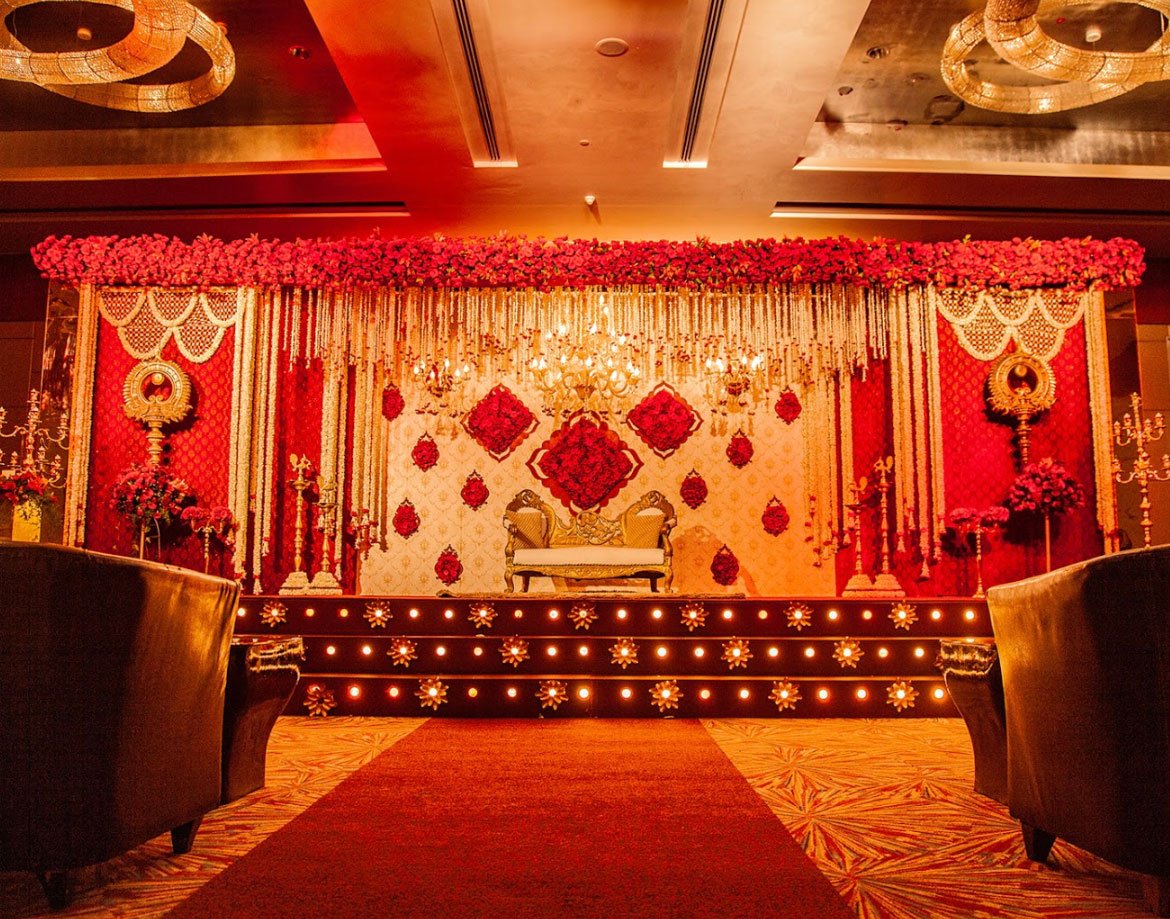
- Designed stage with backdrop, bridal seating, and flanking arrangements
- Consistent table decor — proper florals, candles, linens, and glassware upgrade
- Professional lighting: uplighting, fairy lights, spot illumination on key elements
- Some imported flower accents possible without blowing the budget
For a single-function wedding at a premium Bangalore hotel, we consider ₹10–12 lakh the sweet spot: it is the budget where the design starts showing in every detail, and the range where Panigrahana's in-house decor studio does its best work.
Budget Tier 3 · Luxury — ₹12 to ₹20 Lakh

This is the luxury tier for Bangalore weddings. For most couples with 200–300 guests planning a 2–3 function celebration, this is the total decor spend, and at ₹18–20 lakh you can carry a fully original design across the whole celebration.
What ₹12–20L covers:
- A fully custom mandap — original structural concept, premium imported florals, bespoke fabric, lighting integrated into the structure
- Dramatic entrance experience (full corridor of flowers, chandelier installation, projection on entry walls)
- Stage with architectural backdrop — not a printed banner but a designed, built element
- Premium table decor with stem-heavy centrepieces, candelabras, linen coordination
- Full lighting design by a dedicated lighting consultant — not just fairy lights
- Mehendi and sangeet decor as distinct functions with their own design language
- Branded stationery elements — menus, escort cards, place cards, custom signage
At this tier you are working with an in-house design team rather than a vendor marketplace, and the difference shows. The concept is original and the execution stays in one set of hands, down to the welcome garland and the farewell petal shower.
Budget Tier 4 · Ultra-Luxury — ₹20 Lakh and Above
This is production-house territory. At ₹20L+, and especially as grand multi-day productions climb toward ₹50 lakh, the wedding decor becomes architectural: the kind of work that ends up on magazine covers and in brand partnerships, with installations guests are still describing ten years later.
What ₹20L+ unlocks:
- Original structural mandap — custom-fabricated metal or wooden frame, not off-the-shelf rental pieces
- Full floral ceiling canopy spanning 2,000+ square feet
- Programmable LED lighting rig with moving heads and colour wash capability
- Custom props and furniture — no catalogue pieces, everything bespoke
- Bridal suite decor, getting-ready suite florals, custom gifting installations
- Multiple concept-separated functions, each with its own art direction
- A dedicated Panigrahana design director assigned to your wedding
Cost Breakdown by Category

Across all budget tiers, decor cost splits roughly as follows; keep this table next to any quote you are evaluating:
| Category | % of Total Budget | ₹ at ₹15L Total | ₹ at ₹30L Total |
|---|---|---|---|
| Mandap (structure + florals) | 25–30% | ₹3.75–4.5L | ₹7.5–9L |
| Stage / couple seating | 15–20% | ₹2.25–3L | ₹4.5–6L |
| Entrance installation | 10–15% | ₹1.5–2.25L | ₹3–4.5L |
| Table decor and centrepieces | 15–20% | ₹2.25–3L | ₹4.5–6L |
| Lighting design and equipment | 15–20% | ₹2.25–3L | ₹4.5–6L |
| Fabric draping and linen | 5–8% | ₹75K–1.2L | ₹1.5–2.4L |
| Props, signage, stationery | 5–8% | ₹75K–1.2L | ₹1.5–2.4L |
| Setup labour and logistics | 8–12% | ₹1.2–1.8L | ₹2.4–3.6L |
Mandap Decoration Cost in Bangalore
The mandap is the largest single line in a Bangalore decor budget — 25–30% of the total, as the category table above shows. Applied to the four tiers, that gives you the mandap band for each budget:
| Decor Tier | Total Decor Budget | Mandap Share (25–30%) |
|---|---|---|
| Tier 1 (Essential) | ₹3–5 lakh | ~₹0.9–1.5 lakh |
| Tier 2 (Signature) | ₹5–12 lakh | ~₹1.5–3.6 lakh |
| Tier 3 (Luxury) | ₹12–20 lakh | ~₹3–6 lakh |
| Tier 4 (Ultra-luxury) | ₹20 lakh+ | ₹6 lakh+ |
On a ₹15 lakh total decor budget the mandap line works out to ₹3.75–4.5 lakh; at ₹30 lakh it is ₹7.5–9 lakh. What that money buys changes by tier: a fabric-draped iron arch with local flowers at Essential, a structured mandap with original floral design at Signature, and a fully custom structural build with integrated lighting from Luxury upward.
What to Prioritise — and Where to Cut
Our advice after producing hundreds of Bangalore weddings: never cut on lighting and never cut on the mandap. Both are in every photograph, and between them they set the mood of the day and how guests remember it. If you must reduce, bring the table centrepieces down in height before you touch the mandap florals.
- Prioritise: Mandap florals and structure, lighting design (especially for evening functions), entrance experience (first impression is everything)
- Cut thoughtfully: Number of imported flower varieties, prop count, stationery embellishment, back-of-room table decor (guests don't sit there long anyway)
- Never cut: Labour budget — underestimating setup time and crew size is the most common cause of decor disasters
Why In-House Decor Studios Cost More — and Deliver More
You will find two types of decor providers in Bangalore: marketplace vendors who aggregate subcontractors, and in-house studios (like Panigrahana) where the designers who create the concept are the same team that executes it. On paper, an in-house studio typically costs 15–25% more. What that buys is accountability and quality control, and a design that cannot be copied out of a catalogue because it never came from one.
Book a marketplace vendor and you will often get the same mandap frames, flower suppliers, and installation crew as a dozen other weddings happening that weekend in Bangalore. An in-house studio starts from your wedding instead: the concept is drawn for your venue, in your colour story, at your proportions.
Planning a specific budget? Read our deep dives: What ₹10 Lakhs Gets You, What ₹25 Lakhs Gets You, and What ₹50 Lakhs Gets You. Browse Bangalore wedding venues to match your budget to the right venue, or speak to a The complete Bangalore weddings guide — which venues define each cost tier. Garden wedding decor for Bangalore — costs for the most popular format. Bangalore wedding planner about what is realistic at your budget.
Frequently Asked Questions
How much does wedding decor cost in Bangalore?
Wedding decor in Bangalore falls into four tiers: Essential ₹3–5 lakh, Signature ₹5–12 lakh, Luxury ₹12–20 lakh, and Ultra-luxury ₹20 lakh+ — grand multi-day productions can reach ₹50 lakh. The most common spend for a 150–250 guest wedding across three functions is ₹12–20 lakh total.
What is included in wedding decor cost?
Wedding decor cost typically covers the mandap structure and florals, stage backdrop and bridal seating, table centrepieces, entrance decoration, lighting design, fabric draping, and on-day setup and takedown labour. Floral imports, custom fabrication, and lighting rigs are usually itemised separately — ask for a fully inclusive quote so you can compare accurately.
Can I do a Bangalore wedding with ₹5 lakh decor?
Yes — ₹5 lakh is workable for a single-function wedding of 80–120 guests at a venue with existing infrastructure (like a hotel ballroom). It covers a fabric-and-flower mandap, basic table arrangements, entrance decoration, and ambient lighting. A full three-day celebration at this budget will require significant prioritisation — we would focus entirely on the ceremony mandap and use venue lighting for everything else.
Does decor cost include GST?
Most professional decor studios in Bangalore quote exclusive of GST, which is 18% on services. Always confirm whether the figure you are comparing includes or excludes GST — it is a significant variable when comparing quotes.
How far in advance should I book my decor team?
For peak season (October–February) weddings at premier Bangalore venues, book your decor studio 10–14 months in advance. Dates at Leela Palace, Ritz-Carlton, Four Seasons, and Taj West End fill very early, and your decor team needs to be booked before the venue so they can plan around the site.
How much does mandap decoration cost in Bangalore?
Mandap decoration takes 25–30% of the total decor budget in Bangalore. By tier that means roughly ₹0.9–1.5 lakh at the Essential tier (₹3–5 lakh total decor), ₹1.5–3.6 lakh at Signature (₹5–12 lakh), ₹3–6 lakh at Luxury (₹12–20 lakh) and ₹6 lakh+ at Ultra-luxury (₹20 lakh+). On a ₹15 lakh decor budget the mandap line is ₹3.75–4.5 lakh; at ₹30 lakh it is ₹7.5–9 lakh. See the mandap cost table above.
Do decorators provide furniture and prop rentals?
Yes. Most Bangalore decor quotes include rented furniture and props — lounge seating, tables, backdrops, signage stands — either from the decorator's own inventory or a rental partner. Panigrahana maintains its own in-house decor and furniture inventory, so every piece comes from the same house that designs the wedding. Confirm in the quote which items are rented, which are fabricated for you, and who carries damage liability.
Is it true that a bigger venue makes decor more expensive?
Yes, and not in a straight line. People who have watched many wedding budgets fail put it plainly: overdecorating a large space is where money disappears fastest, because a bigger venue multiplies decor cost exponentially, not linearly. A vast lawn or convention hall demands more coverage everywhere — longer aisles, taller structures so the mandap doesn't look lost, more lighting to kill the empty corners. A smaller, tighter venue almost always photographs better and costs less to make beautiful. If you are choosing between venues, put the decor question to your decorator before you sign the venue contract, not after.
Should the money go into a better venue or better decor?
Venue first, in most cases. Couples who have been through it say the same thing: good decor is expensive, custom decor more so, and even "minimal" costs more than expected — but a venue that already fits your aesthetic needs far less of it. A heritage courtyard or a well-designed ballroom arrives half-decorated. The exception is the sangeet, where decor and lighting create the energy no venue provides on its own. Our working rule: buy the venue that needs the least correction, then spend the decor budget on the two or three frames every photograph will show.
Begin Your Story
Let's Design Your Wedding Together
Share your date, venue, and vision. We'll come back with a detailed decor proposal and honest budget guidance.
Start the Conversation