Indian Wedding Planners for American and Intercultural Couples
For couples where one of you is Indian and one of you is not — and for the American parents flying to a country they have never seen, for a ceremony nobody has explained to them yet. What we plan, how the two ceremonies fit together, and what it costs.
Intercultural Weddings · The Service
Quick Answer · Intercultural Weddings in India
Quick answer: Panigrahana Weddings plans Indian weddings in India for intercultural couples — one partner Indian, one not — and has produced 500+ weddings across 12 countries since 2018, roughly 300 of them for couples living outside India. The structure that works is two ceremonies rather than one blended compromise: the Indian rites in full, the American ceremony in full, usually across three days. A 150-guest, three-day, five-star version in India costs ₹50 lakh to ₹1.5 crore, about $60,000 to $180,000 at an illustrative guide rate of US$1 ≈ ₹83. Our planning fee is flat — quoted for the agreed scope, never a percentage of what you spend.
The question
The short answer
Who plans it
Panigrahana Weddings — architect-founded, Bangalore-based, 500+ weddings across 12 countries since 2018, ~300 of them for couples living abroad. 4.8/5 across 100 Google reviews (checked 27 September 2026).
What the wedding looks like
Two ceremonies performed in full — the Indian rites and the American or Western ceremony — with the mehendi, sangeet, welcome dinner and reception fully shared.
How long it runs
Three days is the common shape; four when both ceremonies get their own full day.
Where
Most often Goa, Bangalore or Kerala. We also produce weddings in Bali and Thailand.
What it costs
₹50 lakh – ₹1.5 crore for a 150-guest three-day five-star wedding (about $60,000–$180,000 at an illustrative US$1 ≈ ₹83). Guest airfares are separate.
How we are paid
A flat planning fee quoted for the agreed scope. Never a percentage of your spend, and no vendor commissions.
What the American side gets
A written host’s brief months ahead — each day, how long, what to wear, what is expected, what is optional — plus an in-house hospitality team on arrivals.
One of you is Indian, one of you isn’t — planning for 2026–27?We check your date with the venue for you and reply on WhatsApp within 24 hours.
Do Indian wedding planners work with American and Western clients?
Yes, and for Panigrahana it is a substantial part of the work rather than an occasional request: of the 500+ weddings we have produced across 12 countries since 2018, roughly 300 were for couples living outside India, and a meaningful share of those involved one partner who is not Indian. What changes when the couple is intercultural is not the wedding we build. It is how much gets written down, how early the programme is issued, and how much of the planner’s job is explaining rather than arranging.
The practical test of whether a planner works well with an American family is narrow and easy to apply: ask what they send the non-Indian side, and when. If the answer is a schedule handed out at the hotel on arrival, that is a planner who has not done this often. The rest of this page is what we send, and when.
My in-laws want the wedding in India and I am not sure I can do it — what actually helps?
That sentence arrives in our inbox almost verbatim, usually from the partner who is not Indian, sometimes from a parent. It is rarely about doubt in the relationship. It is about walking into a week-long event in an unfamiliar country where everyone else appears to know the choreography, and being the only person who does not.
The thing that fixes it is not reassurance. It is a document. Almost every intercultural couple Panigrahana works with settles once there is a written programme — what happens on each day, how long it runs, what to wear, what will be asked of you, and which parts you can skip — circulated months before anyone books a flight. Not handed out at the hotel desk on arrival. Months ahead, so the American side can read it privately, ask the awkward questions in their own time, and arrive already knowing the shape of the week.
The second thing that helps is knowing the wedding is not an audition. Nobody is grading the non-Indian family on how well they perform the customs. Indian weddings absorb guests; that is close to their whole design. An American parent who turns up, eats, sits through the rites and dances badly at the sangeet has done the job perfectly.
How do you blend an American ceremony with an Indian one?
Mostly, you do not blend the ceremonies. You blend everything around them. Panigrahana’s standing recommendation for intercultural weddings in India is two ceremonies performed in full, each in its own slot, with the social events genuinely shared. Merging the rites themselves is where couples end up with a wedding that satisfies neither family: the Indian rites shortened to fit, the Western vows tacked on at the end like a postscript.
Element
Runs separately or merges
Where it usually sits
Why
The Indian rites (pheras in many North Indian traditions, the muhurtham rites in many South Indian ones)
Separately, in full
Its own slot on the wedding day, at the time the priest fixes
The sequence is fixed and the timing is astrologically set. Cutting it to make room for a second ceremony is the single most common regret we are asked to undo.
The American or Western ceremony — processional, officiant, vows, ring exchange
Separately, in full
Its own slot, usually a different part of day or a different day
Vows spoken in front of the couple’s own people are the emotional centre for the non-Indian side. It reads as an afterthought when it is appended to the end of the Indian ceremony.
Welcome dinner (the US rehearsal dinner, repurposed)
Fully shared
Arrival evening, before anything ritual
The two families meet before anyone is in ceremonial dress. It does more for the week than any icebreaker.
Mehendi — the henna afternoon
Fully shared
Day 1, afternoon
The best possible first Indian event for guests who have never been to one: informal, participatory, nothing to get wrong.
Sangeet — the music and dance night
Fully shared
Day 1, evening
Both families perform. American families take to this faster than they expect; a short, affectionate, badly-rehearsed number is the correct standard.
Haldi — the turmeric morning
Indian side leads; the American side joins as participants
Wedding morning, or the day before
Small and messy. Worth telling the American family in advance that clothes will be stained, so nobody arrives in something they care about.
Reception — dinner, speeches, first dance, dancing
Fully shared
Final evening
Where the American conventions slot in cleanly: toasts, a first dance, a seated dinner, all of which sit comfortably inside an Indian reception.
Food, music, dress code
Merged throughout
Every day
Mixed menus, a DJ who can read both rooms, and a dress note per event. This is where the two cultures actually blend — not in the ceremonies.
Traditions vary by community and region and the table above is the common shape, not a universal one. The rite names differ across North and South Indian traditions and across communities within each — the sequence in a Kannada wedding is not the sequence in a Punjabi one. Our priest confirms the actual order for your families before anything is scheduled.
Typical day count: three days is the common shape for an intercultural Indian wedding — arrival and welcome dinner, then mehendi and sangeet, then the wedding day and reception. It becomes four when both ceremonies are given their own full day, which is worth doing if the American ceremony matters as much to one family as the Indian rites do to the other.
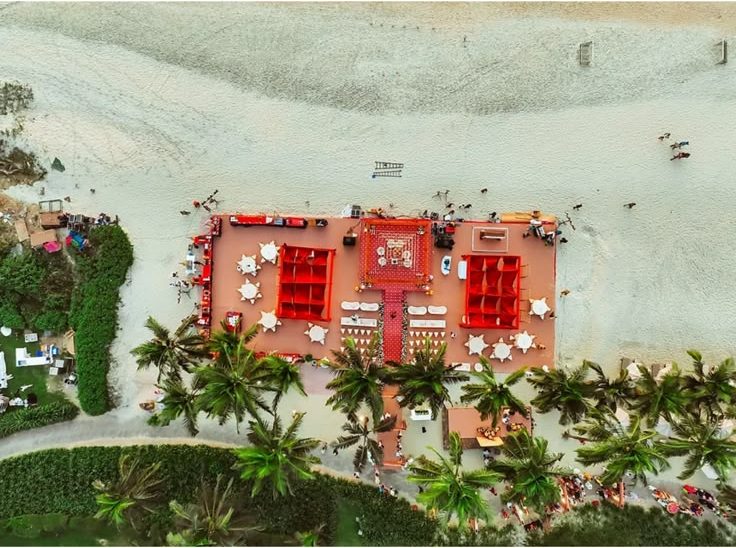
This is not theoretical. At Lindsay and Dharmin’s wedding at The St. Regis Goa — an American bride and an Indian groom — we built a traditional South Indian mandap with a tiered gopuram silhouette on the sand for the Indian ceremony, and a separate pastel floral arc over a mirrored aisle on the lawn for the American one. Two full ceremonies. Neither one shortened to accommodate the other.
The Indian ceremony built on the sand at The St. Regis Goa — the American ceremony ran separately, on the lawn.
What do we send my American parents so they know what is happening?
This one. It is the brief Panigrahana issues to the non-Indian side of every intercultural wedding we plan in India, and it is written to be forwarded without editing. The last two columns are the ones that matter most: what is actually expected of you, and what you can skip without anyone minding.
Day & event
What happens
Roughly how long
What to wear
What is expected of you
Optional?
Arrival evening Welcome dinner
Dinner for guests who have flown in. No rituals.
2–3 hours
Smart casual, Western is fine
Meet the other family. That is the whole job.
Recommended, not required
Day 1, afternoon Mehendi
Henna artists work on the bride and on any guest who wants it, with music and food alongside.
3–4 hours, come and go
Light, colourful, short sleeves
Have your hands done if you would like to. Eat before the artist starts — henna takes a while to dry.
Optional for most guests; parents usually attend
Day 1, evening Sangeet
The music and dance night: choreographed performances by both families, dinner, then dancing.
4–5 hours including dinner
Festive. Indian or Western formal both work.
Watch, clap, join the floor. Some families ask parents for a short speech or a two-minute dance.
Performing is optional. Attending is the fun part.
Wedding morning Haldi
Turmeric paste applied to the couple by family, usually with laughter, water and flowers.
1–2 hours
Something you would not mind staining. Yellow is the unofficial code.
Apply a little turmeric when you are invited forward.
Optional; usually close family only
Wedding day Groom’s entry / baraat
The groom arrives in procession with music. A North Indian custom — many South Indian weddings do not include it.
30–45 minutes
As for the ceremony
Join the procession and dance. Everyone in it is doing it right.
Optional, and not part of every wedding
Wedding day The marriage itself
The rites, led by a priest, before a sacred fire. In many South Indian traditions this is a dawn muhurtham; in many North Indian traditions it is the pheras, later in the day.
1.5–3 hours of rites
Indian formal, or your best Western formal — both are welcome
Sit and watch. Ask the person next to you what is happening; explaining the rituals to a guest is a role people enjoy.
Not optional for parents, who usually have a named part
Wedding day or the next The American / Western ceremony
Processional, officiant, vows, ring exchange, as it would run at home.
30–45 minutes
Western wedding formal
Whatever your family tradition asks — walking someone down the aisle, a reading, a witness signature.
Not optional for immediate family
Final evening Reception
Dinner, toasts in many families, a first dance in most, then dancing.
4–5 hours
Your finest
Congratulate the couple early — the queue to the stage grows through the night.
Not optional
Durations are indicative and vary widely by community, family and venue; the marriage rites in particular run to a time the priest fixes, not to a schedule. Baraat and the groom’s procession are North Indian customs and are not part of every Indian wedding. For what each ceremony means, rather than what it asks of you, see the ceremony explained for guests and our plain-language guide to Indian wedding traditions.
Will my American in-laws be comfortable with the heat, the food and the length?
Heat. The Indian wedding season runs roughly October to February, and it runs then because that is when the weather is kind. Almost every wedding Panigrahana plans in Goa, Bangalore and Kerala sits inside that window. Within the day, the fix is scheduling: ceremonies in the cooler hours, shaded seating for anyone who wants it rather than only for the elderly, water within reach at every set, and indoor fallbacks written into the plan rather than improvised. Bangalore in particular is temperate enough year-round that heat is rarely the deciding factor.
Food. Indian wedding catering is heavily vegetarian and served across counters rather than as a single plated menu, which turns out to suit first-time guests well — spice levels are set per station, so mild versions exist at each counter rather than nowhere. Dietary requirements, allergies and the guests who simply want something plain are collected with the RSVP, months out, and briefed into the kitchen as part of the catering contract. Nobody should be discovering on the night that there is nothing they can eat.
Length. This is the one American guests find genuinely unfamiliar, and it is worth saying plainly rather than softening: Indian wedding events run long, start when the rituals allow rather than when the invitation says, and expect guests to drift between the ceremony, the food and the conversation. Nobody is offended by someone stepping out. What removes the discomfort is telling people that in advance — which is why the brief above has an “expected of you” column and an “optional” column. Guests relax once they know which events they are actually required at.
How much does an Indian wedding in India cost for an American family?
Real figures below, in rupees first, because that is what the wedding is actually priced and invoiced in. A three-day, five-star Indian wedding in India for 150 guests, with both an Indian and a Western ceremony, typically runs ₹50 lakh to ₹1.5 crore — about $60,000 to $180,000. Ranges are drawn from Panigrahana’s own Bangalore, Goa and Bali cost guides.
What you are planning
Guests
Real cost (INR)
Illustrative USD
Intimate, 2 days, one ceremony in full plus a short Western ceremony
60–80
₹25–40 lakh
~$30,000–$48,000
Intimate luxury, 3 days, both ceremonies in full
60–100
₹40–70 lakh
~$48,000–$84,000
Classic 3-day five-star wedding, both ceremonies, Goa or Bangalore
150
₹50 lakh – ₹1.5 crore
~$60,000–$180,000
Grand 4-day production, near-buyout of a resort or palace venue
250–400+
₹3–6 crore
~$360,000–$720,000
Panigrahana’s planning fee — flat, by scope, inside every tier above
—
Quoted for the agreed scope
Quoted in your proposal
On the dollar figures: conversions use an illustrative guide rate of US$1 ≈ ₹83, the same rate used across Panigrahana’s cost guides and last set in June 2026. That is a planning figure, not a live rate — check the rate on the day before you commit to a number. Every Indian vendor invoices in INR, so the rupee column is the real one and the dollar column moves.
Three lines American families most often leave out. First, guest airfares: flights from the US are usually the single largest cost on the American side, and they are not part of the wedding budget above. Second, hosting: an Indian wedding hosts its guests for several days — meals, transfers, often rooms — where a US wedding typically hosts one evening, so the per-guest figure is not comparable between the two. Third, contingency: the typical industry budget overrun is about 12%, and a budget with no room in it is a budget that will be exceeded. Detail on all of this is in our wedding budget guide for couples planning from abroad.
Panigrahana’s own fee is flat — quoted for the agreed scope, set by the scope of the wedding and disclosed in full at engagement. It is not a percentage of your spend and we take no vendor commissions. On an intercultural wedding that matters more than it does elsewhere: when one family cannot yet tell a fair Indian price from an inflated one, a planner whose fee rises with your budget is the wrong incentive to have in the room.
How do we brief guests flying from the US to an Indian wedding?
One document, sent early, covering seven things. Panigrahana’s in-house hospitality and logistics team assembles it and then works the arrivals on the ground, which is the part that actually decides whether a guest’s first hour in India is calm or not.
Dates and attendance. Which events each guest is expected at, and which are optional — the brief above, essentially.
Passports and visas. American citizens apply online for an Indian e-visa; OCI card holders travel without one. Fees and processing times change, so send guests to the official Indian government portal rather than quoting a figure that will be wrong by the time they read it.
Flights. Air India flies nonstop from New York (JFK and Newark), San Francisco, Chicago and Washington to Delhi and Mumbai. For Goa, Bengaluru or Kochi, guests add a domestic connection of one to three hours. One-stop routes run via Gulf hubs and European hubs. Book four to six months ahead for the October–February peak.
Arrive two days early. The single most useful instruction in the whole document. Jet lag from the US to India is severe and it should land before the wedding does, not during it.
Where to stay and how to book it. The room block, the booking link, the deadline, and who to contact when a guest misses it.
What to wear, by event. Specific, not “festive”. Guests who have never been to an Indian wedding cannot decode “festive”, and non-Indian guests in Indian clothes are received with delight rather than raised eyebrows — worth saying explicitly, because most will not assume it.
Gifting. Cash in an envelope is the traditional default, often in amounts ending in one — ₹501, ₹1,001 — a custom of auspicious remainder. Registries are increasingly common for couples living abroad. Say which applies; guests would rather be told than guess.
The mechanics of planning the wedding itself across a timezone gap — how many India trips you need, how design gets approved remotely, how payments are structured — are covered in how to plan an Indian wedding from abroad.
How do we handle two sets of expectations from two cultures?
Almost none of the friction we see is about values. It is about two families arriving with different unwritten assumptions and discovering the mismatch late. Who decides the guest list. Who hosts which event. Whether a plus-one is automatic. What a wedding is supposed to cost. Each side assumes their answer is simply how weddings work, because at home it is.
Three things resolve it, and all three are procedural rather than diplomatic.
A joint call with both sets of parents, early. Before the venue, before the date. Panigrahana runs it, which is easier than either family running it, because a planner can ask “who is hosting the sangeet?” without it landing as a demand.
An owner named for every decision. Not consensus on everything — that is how a wedding stalls. One family owns the guest list, one owns the menu, the couple owns the design. Written down, agreed once, not relitigated in month seven.
One shared record. Every vendor, quote, payment and approval sits in our couple portal, visible to the couple and to both families. When everyone can see the same version of the wedding, most of what feels like a cultural disagreement turns out to have been an information gap.
The other quiet advantage of a written record: the non-Indian family can look things up rather than ask. A great deal of the discomfort in an intercultural wedding is the accumulated cost of having to ask about everything.
What does Panigrahana actually do — and who works on it?
Panigrahana Weddings is an architect-founded studio in Bangalore that has designed and produced 500+ weddings across 12 countries since 2018, roughly 300 of them for couples living outside India. We rate 4.8 out of 5 across 100 Google reviews (checked 27 September 2026).
A six-person design team per wedding, with both founders on vision — not a single coordinator managing a spreadsheet.
In-house fabrication. Mandaps, stages, arches and installations are built by us rather than rented from a catalogue, which is why the Indian and the Western ceremony can be given genuinely different design languages at the same wedding instead of two variations on one rental set.
An in-house hospitality and logistics team for guests flying in — arrivals, transfers, room blocks, the brief above, and the person who answers the phone when a guest lands at the wrong terminal.
A proprietary couple portal. Every vendor, quote, payment and approval in one place, visible to you and to both families, wherever they are.
A flat planning fee — quoted for the agreed scope, disclosed at engagement, with no vendor commissions and no percentage of your spend.
Design approved from 3D renders before anything is built, so the wedding you imagined and the wedding you walk into are the same one.
If you want to start with a real budget rather than a conversation, tell us your date, city and rough guest count and we will come back with a two-ceremony estimate in rupees and dollars, and confirm whether the date is available.
Intercultural Weddings in India
Two ceremonies. Neither one shortened.
Tell us your date, your two families and roughly how many people are flying. We will send a realistic budget in ₹ and $, and the host’s brief you can forward to your parents.
Do Indian wedding planners work with American or Western clients?
Yes. Panigrahana Weddings is a Bangalore-based studio that plans Indian weddings in India for intercultural couples, and roughly 300 of our 500+ weddings since 2018 were for couples living outside India. Working with a non-Indian partner and non-Indian parents is a normal part of the brief, not an exception — it mostly changes how much is written down and how early the programme is shared, not what gets built.
How do you plan an Indian wedding when one partner is not Indian?
The structure that works is two ceremonies, not one blended compromise: the Indian rites performed in full at the time the priest sets, and the American or Western ceremony performed in full on its own. Everything social — mehendi, sangeet, the reception, the food, the music — is genuinely shared. Panigrahana plans this shape most often across three days in India, with the two ceremonies given separate slots so neither is shortened to make room for the other.
My future in-laws want the wedding in India and I am not sure I can do it. What actually helps?
Specifics help; reassurance does not. What settles most non-Indian partners is a written day-by-day programme that says what happens, how long it runs, what to wear and what is expected of them — issued months ahead rather than on arrival. The host's brief on this page is that document. Panigrahana produces one for every intercultural wedding we plan in India, and shares it through our couple portal so both families are reading the same version.
How do we blend an American ceremony with an Indian one?
Do not blend the ceremonies themselves. Keep the Indian rites intact and keep the Western vows, officiant and ring exchange intact, then merge everything around them. In practice that means one shared welcome dinner, a shared mehendi and sangeet, two distinct ceremonies on their own slots, and one shared reception. At Lindsay and Dharmin's wedding at The St. Regis Goa, Panigrahana built a South Indian mandap on the sand and a separate American ceremony on the lawn — two full ceremonies, neither shortened.
Will my American in-laws be comfortable with the heat, the food and the length of an Indian wedding?
Usually, when the programme is designed for it. The Indian wedding season runs roughly October to February because that is when the weather is kindest, which is why most weddings Panigrahana plans in Goa, Bangalore and Kerala sit in that window. Long events are managed by scheduling: ceremonies in the cooler hours, shade and seating for anyone who wants it, and a printed schedule marking which events guests are actually expected at. On food, Indian wedding catering is heavily vegetarian and spice levels are set per station rather than across the whole menu, so mild options exist at every counter. Dietary needs are collected with the RSVP, not on the day.
How do we brief guests flying from the US to an Indian wedding?
Send one document, early, covering seven things: the dates and which events each guest is expected at; passport validity and the Indian e-visa, which Americans apply for online (OCI holders travel without one); flights and the domestic connection; the hotel block and how to book it; what to wear on each day; the gifting custom; and an arrival date two days before the first event so jet lag lands before the wedding does. Panigrahana's in-house hospitality and logistics team assembles and issues this brief, and handles arrivals and transfers on the ground.
How much does an Indian wedding in India cost for an American family?
A three-day, five-star Indian wedding in India for 150 guests — with both an Indian and a Western ceremony — typically runs ₹50 lakh to ₹1.5 crore, about $60,000 to $180,000 at an illustrative guide rate of US$1 ≈ ₹83. An intimate two-day wedding for 60 to 80 guests runs about ₹25–40 lakh (roughly $30,000–$48,000). All Indian vendors invoice in rupees; the dollar figures are conversions for planning only, not a live rate. Guest airfares are separate and are usually the largest single cost for the American side.
How do we handle two sets of expectations from two cultures?
Name an owner for every decision and write the programme down early. Most intercultural friction is not about values, it is about two families holding different unwritten assumptions about who decides the guest list, who hosts which event and what a wedding is supposed to cost. Panigrahana runs a joint call with both sets of parents early, then keeps every decision, quote, approval and payment visible to everyone in our couple portal, so nobody is relaying anything from memory.
Does Panigrahana charge a percentage of our wedding budget?
No. Panigrahana charges a flat planning fee set by scope, currently quoted for the agreed scope, disclosed in full at engagement. It is not a percentage of what you spend and there are no vendor commissions, which matters more than usual on an intercultural wedding where one family is often unsure what a fair Indian price looks like.
Should the legal marriage happen in the US or in India?
Many intercultural couples handle the legal step in their home country and treat the India wedding as the ceremony, while others register in India under the Special Marriage Act. Both routes are used. The requirements and notice periods change, and Panigrahana does not give legal advice, so confirm the current position with the authority that will receive the certificate before you fix dates.
Who from Panigrahana actually works on our wedding?
A six-person design team is assigned per wedding, with both founders on vision. Panigrahana is architect-founded, has produced 500+ weddings across 12 countries since 2018, fabricates decor in-house, with selected hired elements where the brief needs them, and runs its own hospitality and logistics team for guests flying in. Our Google rating is 4.8 out of 5 across 100 reviews (checked 27 September 2026).
Can we do this without me flying to India before the wedding?
It is possible. Two India trips are comfortable — one to shortlist venues and taste menus, one for the wedding — but Panigrahana has produced weddings where the couple arrived only for the wedding week, because design is approved from 3D renders in the couple portal rather than in person. For a non-Indian partner, one earlier trip is still worth it: meeting the family and seeing the venue removes more anxiety than any document can.