You are not asking your parents for permission. You are asking them to fund and co-host something they cannot yet picture — and the reason the conversation keeps going badly is that you are presenting inspiration when they need a document. One page, seven sections, no adjectives. We ask couples to write it before the family meeting. It works because it answers the four questions parents are actually asking underneath the ones they say out loud.
What your parents are actually asking
In ten years of sitting in these meetings, the objection is almost never the one stated. "It's too expensive" is usually one of four other things:
- "Is this open-ended?" — The fear is not the number. It is that there is no number, and that the number will keep moving. A parent who has funded a wedding before knows exactly how this goes.
- "Are these people legitimate?" — Their generation verified vendors through people they knew. You found yours on Instagram. That gap is real and it is not unreasonable.
- "What will the family think?" — Weddings are social contracts, not private parties. Your parents are protecting relationships with people you have met four times.
- "Are we still hosting?" — The unspoken one, and the one that sinks the most conversations. A wedding is one of the few things a parent still gets to give you. A plan that makes them a spectator will be resisted for reasons nobody in the room will name.
A brief that answers those four questions gets a yes at a number that would have been refused without it. A mood board does not, however beautiful it is.
Planning this yourself? Send us your name and a number, and a planner will reply within 24 hours to talk it through with you, whoever you end up booking.
Panigrahana is a wedding design and planning studio with 500+ weddings since 2018, rated 4.8/5 on Google (checked 27 September 2026). Planning starts at ₹2 lakh per day for two events + GST and decor at ₹5 lakh + GST, quoted for the agreed scope rather than as a percentage of what you spend.
The one-page brief
One page, printed rather than sent as a link. That matters more than it should. Seven sections, in this order, because the order is doing work: certainty first, cost second, credibility third, and only then the part you actually care about.
1. The proposal, in three lines
Date, place, guest count, number of functions. No adjectives. "14 February 2027. Muhurtham at [venue], Bangalore. Three functions across two days. Approximately 280 guests." That is the whole section. A parent who reads four sentences of atmosphere before reaching a date has already decided this is a fantasy.
2. What it costs, with the range named
A single total with a stated range, "₹34–38 lakh, all in", and then the five or six lines underneath it. Do not present a best case. Present the top of the range, because the fastest way to lose a budget conversation permanently is to come back in March asking for more.
Include the line most couples omit: what is not included. Jewellery, trousseau, travel for relatives, gifting. Naming the exclusions is what makes the inclusions believable, and a parent who spots an omission you did not flag will discount everything else on the page. Run your own version on the cost calculator before you write this section.
3. Who pays for what
The single most-skipped section and the one that prevents the most damage. Set out plainly what you are contributing, what you are asking them to contribute, and what the other family is expected to carry. If that has not been discussed with the other family, say so: "to be agreed with [family] by [date]". A silence in this section gets filled with an assumption.
Indian wedding cost-sharing has changed considerably and varies enormously by community and family. Get it explicit early; who pays for what, and gifting covers the conventions and the modern variations.
4. Who is planning it, verified
Three or four lines of checkable fact about whoever you are proposing to hire — registered company name, years in operation, weddings delivered, review profile with a link, a named contact. Not a paragraph about their aesthetic. Facts a parent can verify in five minutes, because that is exactly what they will do.
For us: Panigrahana Weddings is the consumer brand of Wedvitez Planners Private Limited, a Bengaluru-registered private limited company verifiable on India's MCA portal; the brand has operated since 2018; 500+ weddings delivered; 4.8 out of 5 across 100 Google reviews (checked 27 September 2026), sourced and linked. We wrote an entire page for parents to read without you in the room, because that is how this verification actually happens.
5. How the money is controlled
This is the section that answers "is this open-ended", and it is worth more than any three others. Explain the fee structure in one sentence, name what triggers an extra cost, and state who has to approve a change.
Ours: a flat planning and design fee quoted for the agreed scope — not a percentage of what you spend — with every external vendor invoice passed through at cost and shown to you, and nothing added to a vendor's price. We set the mechanics out on the zero-markup page, and the fee bands on wedding planner cost in Bangalore. If you are being quoted a percentage by anyone, make sure your parents understand what that means: the planner's income rises with your spending, and they are the one advising you on how much to spend.
6. What it will look like — one image, not twenty
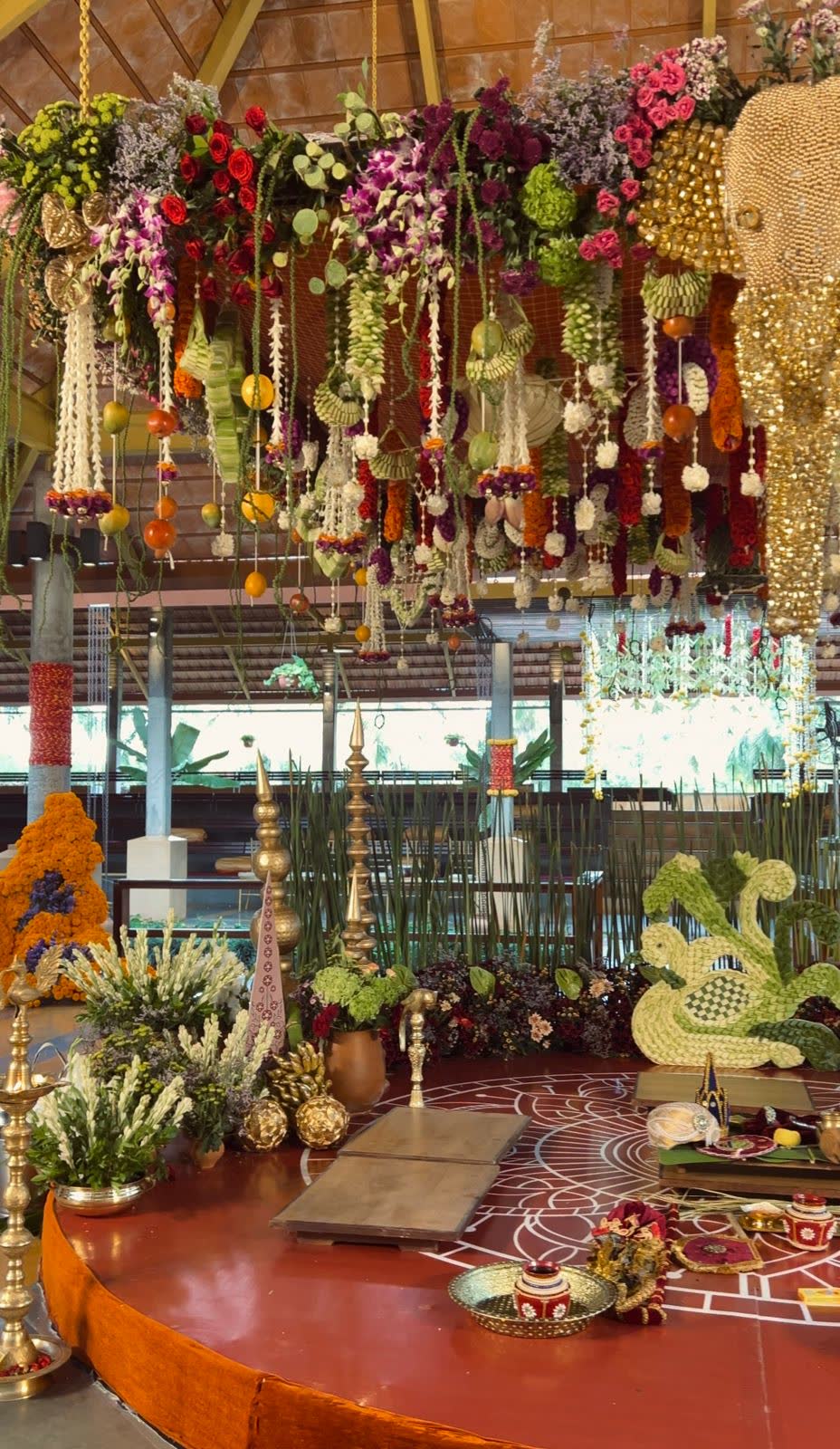
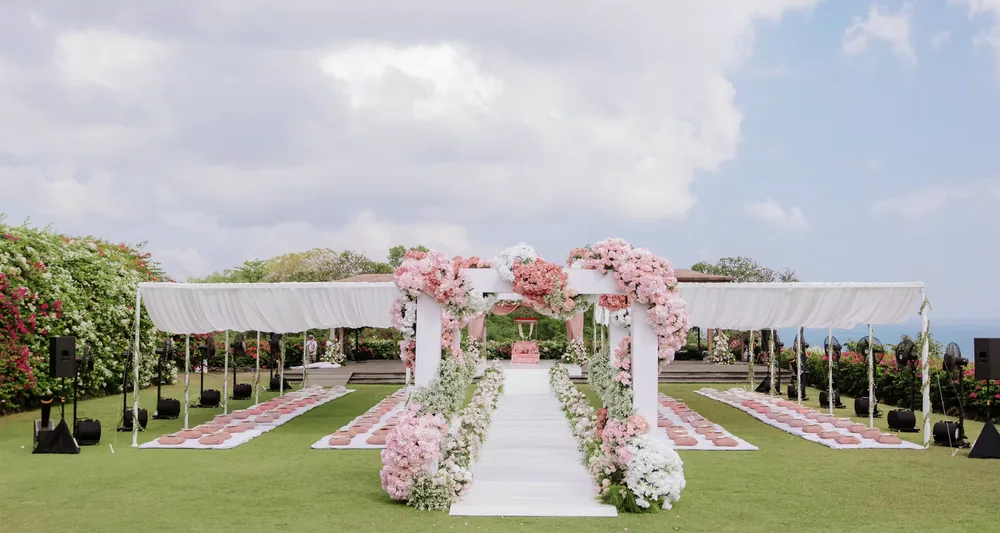
Now, and only now, the design. One image, ideally of real work at a comparable venue rather than an aspirational board. Twenty images read as indecision; one reads as a decision already made well.
Pick something that shows scale and setting rather than a close-up of a centrepiece — parents are trying to picture four hundred relatives in a space, not a table. Our work archive and real weddings are organised by venue for exactly this.
7. What you need from them, and by when
End with a request and a date. "We need a decision on the venue by 20 October, because the date releases after that." A brief without an ask is a presentation, and presentations get thought about indefinitely. A real deadline converts a discussion into a decision. It has to be a real one; an invented deadline gets found out.
The seven sections, and what each defuses
| # | Section | The objection it answers before it is raised |
|---|---|---|
| 1 | Proposal in three lines | "You haven't thought this through" |
| 2 | Cost, with range and exclusions | "How much is this really going to be?" |
| 3 | Who pays for what | "What is the other family doing?" |
| 4 | Who is planning it, verified | "Who are these people?" |
| 5 | How the money is controlled | "This will keep growing" |
| 6 | One image | "I can't picture it" |
| 7 | The ask and the date | "Let's discuss it later" |
Five rules for the meeting itself
- Print it. A page on a table can be picked up, annotated and taken away. A phone screen belongs to you and they have to lean over to read it, which is subtly the wrong posture for asking someone to fund something.
- Send it before, discuss it after. Give them a day. Parents asked to react in real time react defensively; parents who have read something overnight arrive with questions, which is a far better meeting.
- Lead with the constraint, not the dream. "We have worked to a budget of ₹35 lakh and here is what fits inside it" is a fundamentally different opening from "here is what we want". The first makes you the person defending the budget. That position is worth an enormous amount and you can only take it once.
- Name one thing you have already given up. A brief where the couple has conceded nothing reads as an opening bid and will be negotiated as one. A brief that says "we have dropped the second reception" reads as a settled plan.
- Let them change something. Leave one genuinely open decision — the caterer, the invitation, the guest list for one function. A plan a parent has amended is a plan they co-own, and co-owned plans get defended to relatives instead of apologised for.
How to put this to your parents
Stop trying to make them excited, and start making them certain. Excitement is your job and it does not transfer. Certainty does, and it is what they are actually withholding.
- Give them something to verify. A registered company name, an MCA record, a review page with real links. Verification is how their generation grants trust, and handing them the means to do it is a sign of respect, not a defensive move.
- Put the top of the range on the page. Every rupee you shave off the presented number today costs you ten in credibility in March.
- Make them a host, not an approver. Ask which function they would like to shape. The resistance you are feeling is often not about money at all; it is about being written out of an occasion they have been imagining longer than you have.
- Bring a third party into the room. A planner who will sit with your parents and answer the money question directly is worth more than any amount of you arguing. We do this routinely, and about half our first meetings include a parent who arrived sceptical.
- If it is a destination wedding, address the imposition on relatives first. Not your budget — the ₹25,000 trip you are asking cousins to fund. It is a legitimate objection and the whole argument turns on it. The destination-wedding version of this conversation goes through it properly.
- If there are two families disagreeing rather than one, the brief still works but the sequencing changes — managing joint-family opinions covers that case.
Why we ask couples to do this
Selfishly, it makes our job possible. A couple who has written this page has already made the hard decisions — the guest count, the budget ceiling, who is paying — and we can start designing instead of mediating. A couple who has not spends the first two months renegotiating scope with their family while we hold dates we cannot confirm.
Less selfishly: the wedding is better. Every hour spent arguing about whether to have the wedding is an hour not spent deciding what it should look like. The brief is how you end the first conversation quickly and spend the year on the second.
Frequently asked questions
How do I convince my parents to let me hire a wedding planner?
Do not argue that a planner is worth it in the abstract. Show the fee structure and what it controls: a flat fee with vendor invoices passed through at cost means the planner has no incentive to inflate your spending, which is the exact objection most parents hold. Then show verifiable credentials — registered entity, years, weddings delivered, linked reviews.
What should I include in a wedding proposal for my parents?
Seven things, in this order: the proposal in three lines; total cost with the range and the exclusions named; who pays for what; who is planning it with verifiable facts; how the money is controlled; one image; and a specific ask with a real deadline. One page.
My parents think a wedding planner is an unnecessary expense. What do I say?
Ask what they expect to spend on the wedding overall, then ask who is going to negotiate forty vendor contracts, hold the production schedule and be responsible when something fails at 6am on the morning of the muhurtham. The honest answer is usually "an uncle", and the honest follow-up is what that has cost families they know. Then show the fee as a percentage of the total, and the markup policy.
Should I tell my parents the full budget upfront?
Yes, and the top of the range rather than the bottom. Budgets that grow after approval destroy trust permanently, and you will need that trust for every decision over the following year. Under-promising once is far cheaper than being right and appearing to have misled them.
Can we meet you together with our parents?
Yes, and we would encourage it. A large share of our first meetings include a parent who came to test whether we are real. We would rather answer the registration, insurance and money questions directly than have you relay them.
We will help you write the page, and sit in the meeting
Send us your guest count, your date and your ceiling. We will come back with the cost structure, the verification facts your parents will ask for, and one image of comparable work — the page, ready to print.
Start your design