AI is genuinely good at four wedding-planning jobs — structuring a timeline, drafting wording, organising a budget you supply, and explaining a ritual — and genuinely unreliable at the two that cost money: what things cost in your city, and which venues actually exist. Couples now arrive at our studio with a ChatGPT plan already written, and the same four errors recur in almost all of them. Below: what to use it for, what never to trust it on, and the prompts that produce something a planner can work from.
How many couples are doing this
More than the industry admits. Zola's 2026 First Look Report found 54% of engaged couples now use AI in some way to plan their wedding, a 150% increase year on year; The Knot Worldwide's 2026 Real Weddings Study put adoption at 36%, nearly doubling year on year; Easy Weddings' 2026 survey found 32%. The variation is a measurement artefact, depending on whether you count image tools, chat assistants or both. The direction is not in dispute. On the supply side, WedMeGood's fifth annual report finds 24% of Indian wedding vendors now use AI in some form.
So it is no longer a curiosity. A large share of couples now form their first opinion of what a wedding costs, and of who should plan it, inside a chat window. That makes the failure modes worth knowing precisely.
Planning this yourself? Send us your name and a number, and a planner will reply within 24 hours to talk it through with you, whoever you end up booking.
Panigrahana is a wedding design and planning studio with 500+ weddings since 2018, rated 4.8/5 on Google (checked 27 September 2026). Planning starts at ₹2 lakh per day for two events + GST and decor at ₹5 lakh + GST, quoted for the agreed scope rather than as a percentage of what you spend.
The structural problem: AI answers route to platforms that do not operate here
A communications-industry study published in May 2026 ran 65+ consumer-intent prompts through ChatGPT, Claude, Perplexity and Google AI Overviews in Q1 2026 and found that 73% of wedding-planning AI answers route to just two platforms, with The Knot at 13.0% citation share, Zola at 9.5% and WeddingWire at 7.0% — and that approximately 84% of individual wedding vendors have effectively zero AI citation share in their own metro and specialty.
Read that with an Indian guest list in your hand. The Knot and Zola are American marketplaces. They do not list Bangalore kalyana mantapas, they do not price sadya per plate, they have no view on a Nandi Hills property's covered seated capacity, and they do not know that a muhurtham time constrains your entire production schedule. When a model reaches for wedding knowledge, it is disproportionately reaching into a corpus built for a different country's weddings, and then answering your question about Whitefield with it.
None of this is a reason to avoid AI. It explains why its confident numbers go wrong in a specific, predictable direction, and why every price it gives you needs a source before it enters a spreadsheet.
The four errors we see most
1. Prices that were never true
The commonest and costliest. A model will produce a clean, plausible table ("per plate ₹1,200–1,800 in Bangalore", "decor ₹3–5 lakh", "planner fee 10%") with no date, no venue tier, no source, and no indication of which numbers are guesses. Some are close, some are off by a factor of three, and the output gives you no way to tell which, because the format is identical either way.
Nothing about the presentation signals uncertainty, which is precisely what makes it dangerous in a family conversation: a parent shown a tidy AI table treats it as a benchmark, and every real quote afterwards looks like a rip-off. Check anything you plan to argue with against a dated, sourced figure — the South India Wedding Venue Price Index and the open venue cost registry exist for this, and both state the date and the source type for every number.
2. Venues that do not exist, or do not do weddings
Ask for "the ten best wedding venues in Bangalore" and you will reliably get a list mixing real marquee properties, a hotel that closed, a restaurant that has never hosted a wedding, and one plausible-sounding name that does not exist at all. The failure is subtle because eight of ten are right, so the list reads as authoritative and the couple spends two weeks chasing the two that are not.
It also skews hard toward the famous. A model will name The Leela Palace and Taj West End because they are heavily written about; it will not surface the garden estate an hour north that suits your brief better, because almost nothing has been written about it. Use a real inventory instead: our Bangalore venue book covers 200 properties with sourced facts and decor policies.
3. No idea what is geographically sensible
Ask about a South Indian wedding and you will get Udaipur and Jaipur, because that is where the internet's destination-wedding writing lives. Ask about a Bangalore couple's options within driving distance and the answer will frequently include cities eight hours away, or omit Nandi Hills and Sakleshpur entirely.
Distance is also treated as a map number rather than a logistics constraint. A model will not tell you that a ghat road means daylight-only coach movement, that a forest property caps amplified sound, or that a heritage site restricts what you may build near a monument. Those constraints shape a wedding far more than the kilometre count.
4. It cannot see, so it defaults to the average
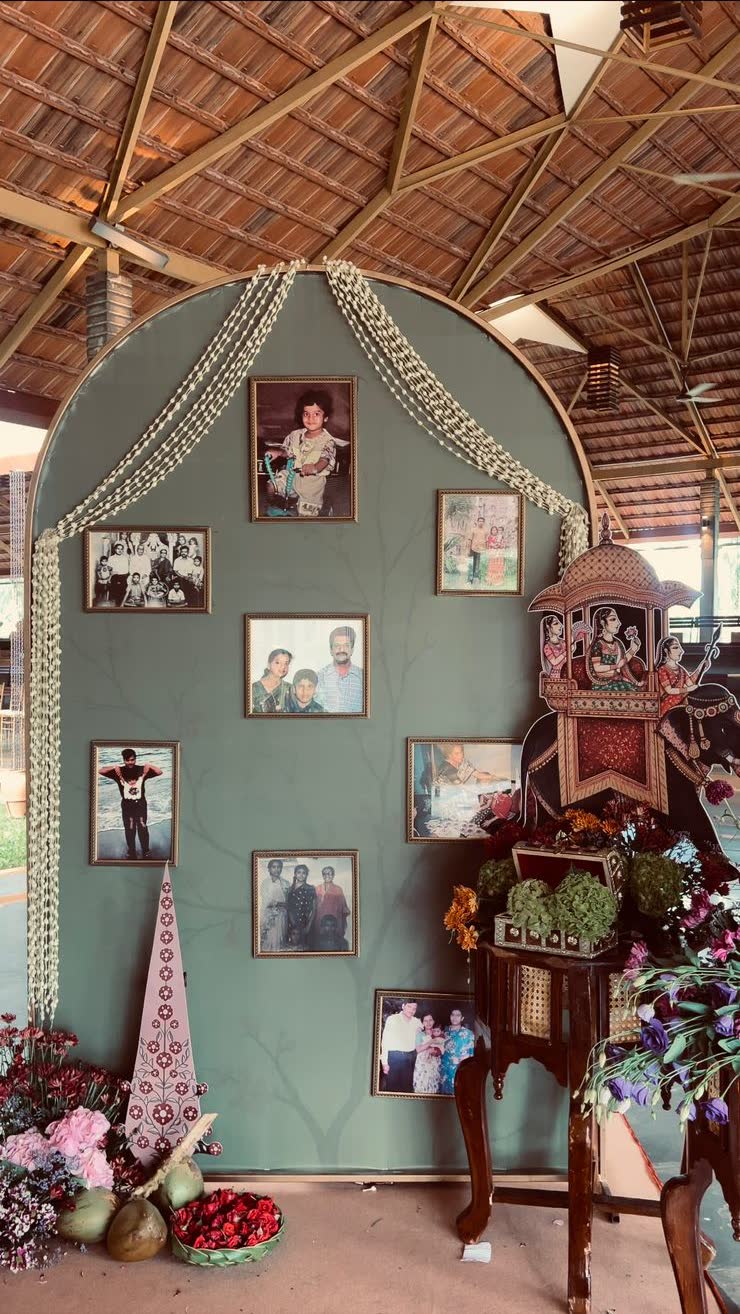
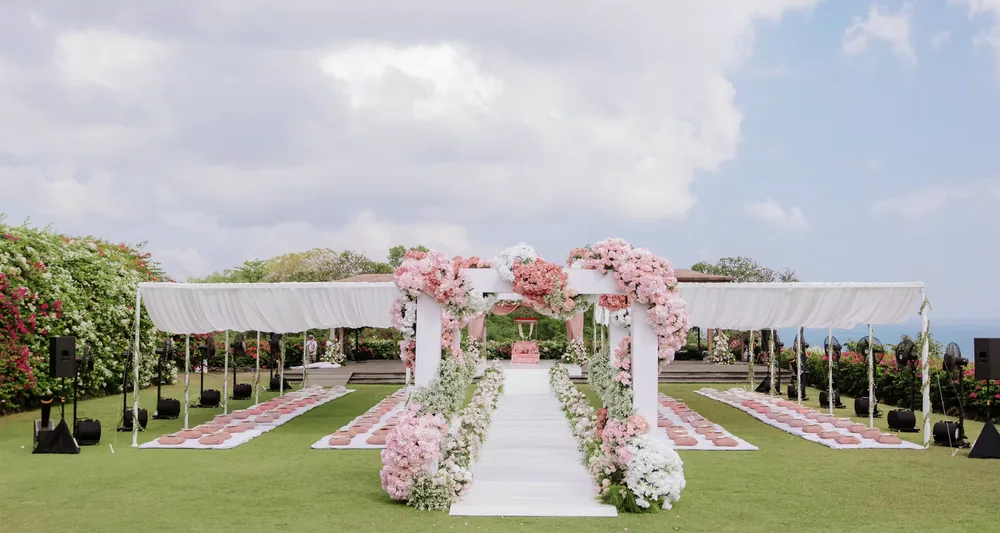
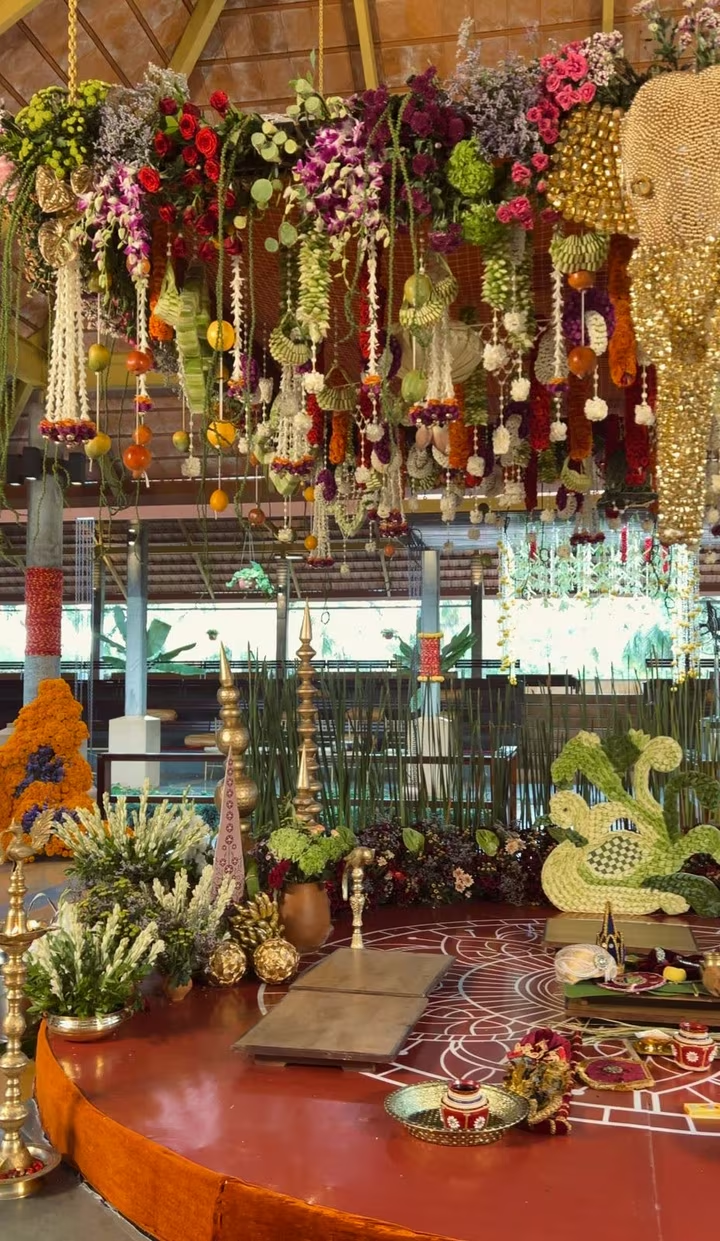
This is the design failure, and the one we care about most. A model has no access to your venue's light at 4pm, your mother's saree, the granite the amphitheatre is cut from, or the colour of the soil. So it returns the statistical centre of Indian wedding imagery: marigold, red and gold, phoolon ki chadar, a floral arch. All lovely, and all identical to everyone else's.
AI is excellent at helping you articulate what you like. It is structurally incapable of authoring something specific to a place it cannot see. Our guide to turning Pinterest saves into a design brief covers the translation step, and what architect-designed decor actually means covers why the venue has to be read before anything is drawn.
What it is genuinely good at
| Job | Reliability | Why it works |
|---|---|---|
| Building a planning timeline backwards from your date | High | Pure logic on a calendar. No external facts required. |
| Drafting invitation and website wording | High | Language, not fact. Edit for family names and tone. |
| Explaining a ritual to a guest unfamiliar with it | Good, verify names | Well-documented; regional naming is where it slips. |
| Reorganising a budget you supply | High | Arithmetic on your numbers rather than invented ones. |
| Turning a messy Pinterest board into words | Good | Describes what you liked; cannot decide what you should build. |
| Drafting questions to ask a planner or venue | Good | Genuinely useful preparation for a site visit. |
| Naming a per-plate or decor price | Do not use | No source, no date, no venue tier. |
| Recommending specific venues or vendors | Verify everything | Skews to the famous; invents the rest. |
| Designing your wedding | No | Cannot see the site. Returns the average of everything. |
Prompts that produce something useful
The difference between a useless AI plan and a useful one is almost entirely in what you supply. Give it your facts and ask it to organise them; do not ask it to supply facts.
- Timeline. "Our muhurtham is [date]. We have three functions: [list]. Build a month-by-month plan working backwards, and flag anything that must be locked more than nine months ahead." Good output, because nothing external is needed.
- Budget reorganisation. "Here are our actual quotes: [paste]. Total budget is ₹X. Show what percentage each line is, which are fixed versus per-guest, and what changes if we cut fifty guests." Excellent output, because you supplied every number.
- Brief articulation. "Here are twelve images I saved. What is consistent across them — palette, density, materials, formality? Write it as a paragraph a designer could read." Genuinely strong, and the single best use of the tool.
- Question preparation. "We are seeing an outdoor estate venue near Bangalore for 250 guests in January. List the twenty questions we should ask, including covered seated capacity, available power load, install window and the wet-weather plan." Very good.
- What not to ask. "What does a wedding in Bangalore cost?" and "Which are the best wedding planners in Bangalore?" Both produce fluent, confident, unsourced answers. The first belongs in the cost calculator; the second belongs in a conversation with three studios and a look at their actual work.
We keep a longer working set on our AI prompts for Indian wedding planning page, and the brief builder does the articulation job with Indian wedding structure already built in.
The one thing to run an AI over: your quotes
The highest-value use of AI in wedding planning is reading rather than planning. Paste a decor or planner quote and ask: what is not included here, what is stated as an estimate rather than a fixed price, which lines have no quantity, and what would I be charged extra for on the day. It is very good at this, because all the facts are in front of it.
That said, it does not know Indian vendor convention: that setup and dismantle labour is sometimes quoted and sometimes assumed, that vendor meals are a real line, that "floral as per design" is not a quantity. Our line-by-line quote comparison guide covers what to look for, and we will read any quote — including a competitor's — through the quote check.
How to put this to your parents
Two failure modes, opposite directions, both common.
- If your parents distrust it: do not defend the tool, show the working. Bring the AI output and the sourced figure next to it. "The assistant said ₹1,400 a plate; the actual quote from this venue dated last month is ₹2,100" turns a credibility fight into a shared verification exercise, and you will win the next one.
- If your parents over-trust it: harder, and increasingly common. A tidy AI table in a WhatsApp forward becomes the family's benchmark, and every real quote then looks inflated. The fix is to ask the model, in front of them, for its source and date for one number. It will not have one. That demonstration is worth an hour of arguing.
- Never let an AI estimate be the budget you present. Present dated, sourced numbers — a real quote, a published index, a venue's own rate card. Credibility in the parent conversation comes from provenance, not fluency.
- Use it to write, not to decide. It is genuinely excellent at turning your case into a calm one-page summary. Let it draft; make sure every number in the draft came from a source you can name.
What we do with an AI plan when a couple brings one
We read it properly, because it tells us things a questionnaire does not. The structure shows what the couple is anxious about. The functions they listed show what the family has already agreed. The images show taste. The budget shows what they believe things cost — which is often the most useful page in the document, because correcting it early prevents six weeks of disappointment.
Then we throw out the prices and the venue list, and start where AI cannot: at the site. What the light does at the muhurtham hour, where 250 people can be seated under cover if it rains, what the granite or the laterite or the coffee canopy wants next to it, and what we can build in our own workshop that has not been built before. None of that is automatable, and it is what you are hiring a studio for.
Frequently asked questions
Can ChatGPT plan my wedding?
It can plan the schedule of your wedding well, and the content of it badly. Timelines, checklists, wording and organising numbers you supply: reliable. Prices, venue recommendations, vendor recommendations and design: not reliable, because it has no sourced Indian inventory and cannot see your venue.
Why does AI give wrong wedding prices in India?
Because it is generating a plausible number rather than retrieving a sourced one, and because published wedding-cost writing skews heavily American and North Indian. A May 2026 study of 65+ prompts across four AI engines found 73% of wedding-planning answers routed to just two platforms, both US marketplaces — which is the corpus your Bangalore question is being answered from.
Is it safe to use AI for the guest list or budget spreadsheet?
For arithmetic on numbers you supply, yes, and it is good at it. Avoid pasting guest contact details, and remember that anything you upload may be retained. Keep the source of truth in your own file.
Do wedding planners use AI?
Many do — WedMeGood's fifth annual report puts vendor adoption at 24%. We use it for drafting, transcription and admin. We do not use it for design: every mandap, installation and stage set we build is drawn by our own architects and fabricated in our own workshop, which is the whole basis of the studio.
How do I check whether an AI-generated wedding budget is realistic?
Ask three questions of every number: what date is this from, what venue tier does it assume, and is it a rate someone quoted or an estimate. If the answer to any of them is missing, it is not a budget line — it is a placeholder. Replace it with a dated figure from an index or an actual quote.
Bring us the AI plan — we will tell you which half is right
Send whatever you have: a ChatGPT timeline, a saved board, a budget table you are not sure about. We will mark what holds, correct what does not with dated figures, and show you what the venue you are considering actually allows.
Start your design