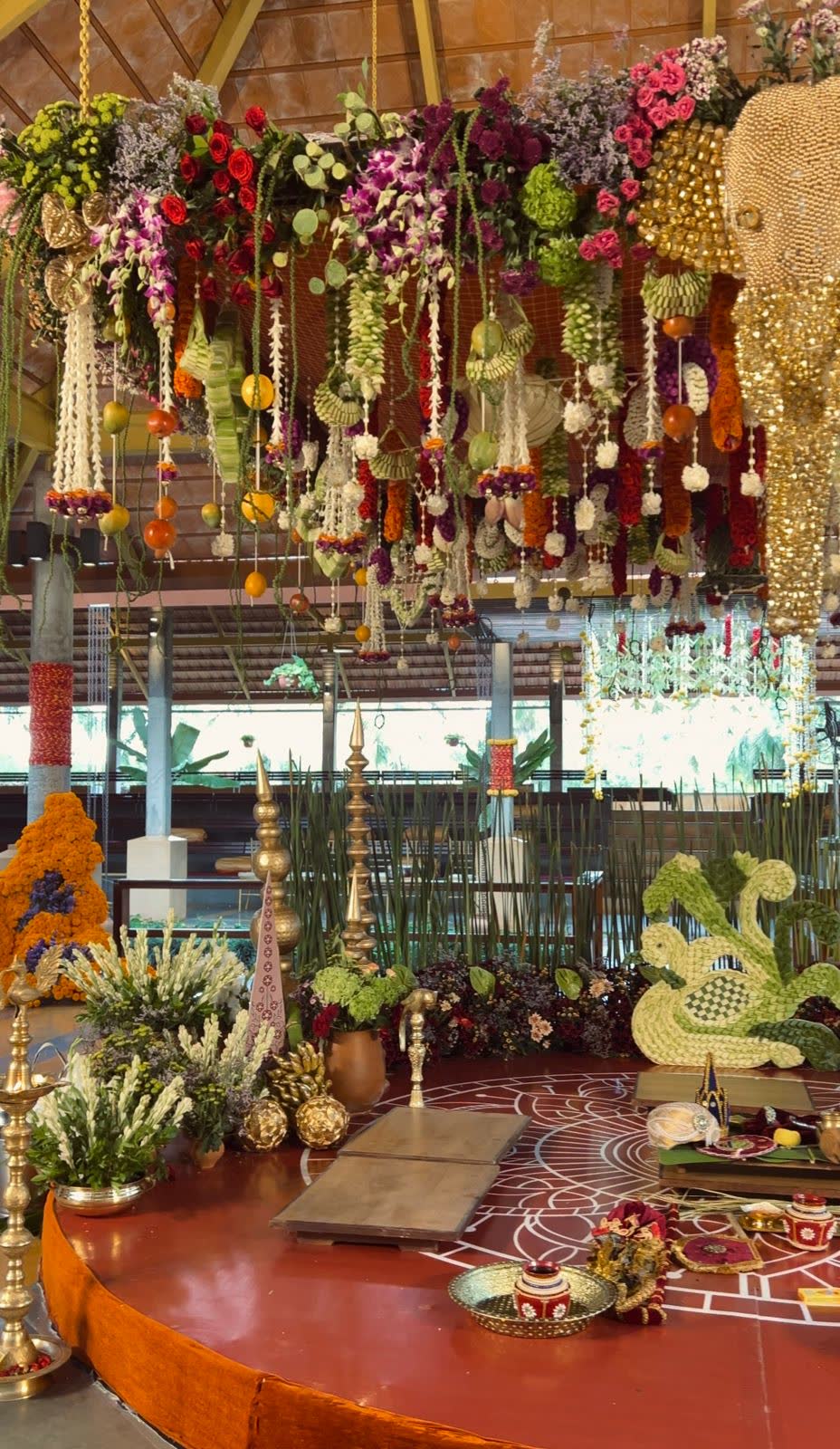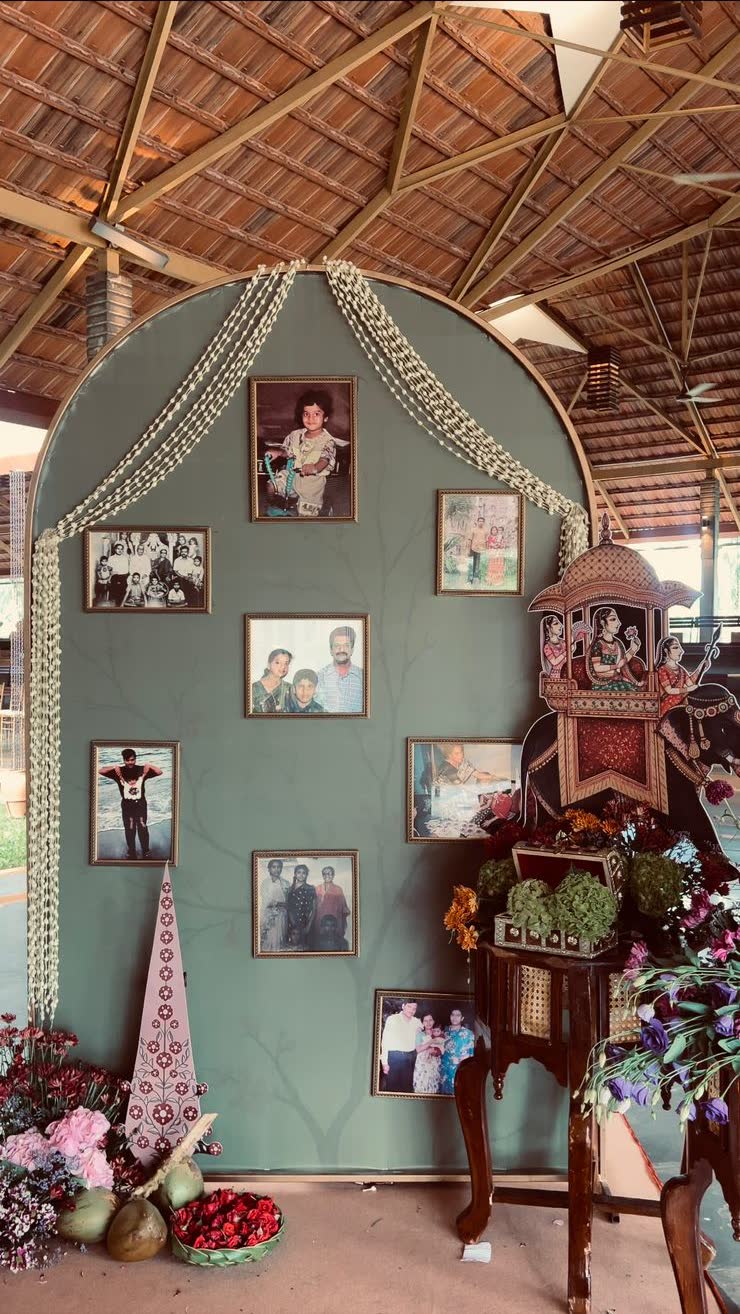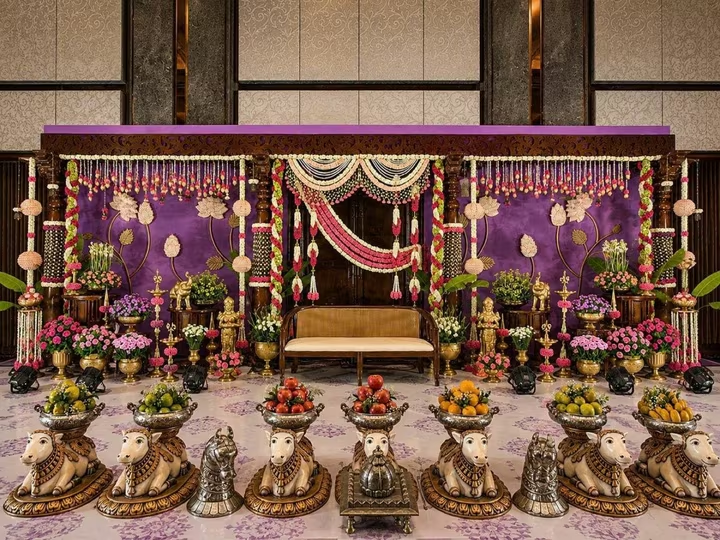
A half-saree ceremony is not a small wedding, and the fastest way to ruin one is to design it like a wedding at 60% scale. The Ritu Kala Samskara — langa voni, pattu langa, or simply "the half-saree function" depending on which part of South India your family is from — is a rite of passage for one girl, watched by a room of women who have all been through it. Everything about it is close-quarters and matriarchal, so a reception stage is the wrong thing to build. Here is how we design them, what they cost, and the four decisions that decide whether it works.
What the ceremony actually is
Ritu Kala Samskara marks a girl's passage into womanhood, traditionally held shortly after she comes of age. In Telugu and Kannada families it is commonly the langa voni or half-saree function; in Tamil households, manjal neeratu vizha; the ritual content differs across communities and so does the scale. What does not change: the girl is seated, blessed by the older women of the family, given her first half-saree, and formally presented.
The design follows directly from that sentence. Because she is seated, the seat is the design and the backdrop is not. Because the older women bless her, the choreography is a queue of aunts and grandmothers approaching one chair rather than an audience facing a stage. Because she is presented, there is one entry and one moment, and it is worth more than everything else in the room combined.
If ritual vocabulary is unfamiliar to part of your family, our Indian wedding glossary and the Kannada rituals glossary cover the terms; the same ritual, seven names explains why the function has a different name in every household at the party.
Planning this yourself? Send us your name and a number and we’ll reply within 24 hours with a realistic budget for it — yours to keep, whoever you end up booking.
Panigrahana is an architect-founded studio: 500+ weddings designed since 2018, rated 4.8/5 across 100 Google reviews (checked 27 September 2026), on a flat planning fee (quoted for the agreed scope) rather than a percentage of what you spend.
The four decisions that decide the design
1. The seat, not the backdrop
Every photograph from this function has the girl seated in it. The seat is therefore the single most photographed object of the day, and it is the object most often left to the venue's standard chair with a bow on it.
We build the seat. A carved bench, a low daybed, a single chair with real presence: something with weight, in a material that reads in daylight. Dress it with a floral swag that frames without swallowing, and keep the backdrop quieter than the seat so the eye goes to the girl rather than past her. The furniture carries the function and the wall supports it, which is the opposite of how a reception is built.
2. Daylight
Most of these functions are morning or early-afternoon, and most South Indian banquet spaces are lit for evening receptions. That mismatch is the commonest technical failure we see: a palette chosen on a phone at night, built in a room flooded with daylight, photographing flat and cold.
Jasmine, tuberose, marigold and pink carnation hold up in daylight. Deep reds go muddy. Metallics that look rich under warm evening light go grey under a skylight. Test the palette in the actual room at the actual hour before you commit. The method is in our colour and lighting test; it costs an hour and saves the whole look.
3. The ritual corner
There is always a table of objects: brass lamps, the thattu of fruit, kumkum and turmeric, bangles, the gejje or salangai, the saree itself folded and waiting. Families lay this out functionally and it ends up looking like a store cupboard in the corner of every wide shot.
Design it as a still life. A console with a proper surface, the brass polished and arranged with intent, greenery, and the saree presented rather than stacked. It is the second-most-photographed area of the function, and treating it seriously costs nothing. It is composition rather than budget.
4. The entry
One entry, one moment. A corridor of jasmine, a carved doorway, an arch of garlands: something the girl walks through rather than past. Keep it narrow enough that a phone-camera crowd cannot fill the frame, and keep the aunts on one side rather than lining both.
For wider entrance design vocabulary, entrance decor ideas and South Indian wedding decor in Bangalore cover what we build most often.
Scale: what actually fits
| Guests | Right venue type | What to build | What to skip |
|---|---|---|---|
| 40–80 | Home, clubhouse, small banquet room | Seat, entry, ritual corner | Stage, ceiling work, lounge sets |
| 80–150 | Hotel banquet, garden venue | Seat, entry, ritual corner, one photo corner | Full stage, elaborate table centrepieces |
| 150–250 | Hotel ballroom, kalyana mantapa | All of the above plus a raised seating platform and entrance arch | Reception-scale backdrop; it will dwarf her |
| 250+ | Ballroom or mantapa | Proper sightline design — most guests will not see the ritual otherwise | Nothing, but be honest that this is now an event, not a ceremony |
Our strong recommendation sits at the 80–150 band. Above 250 the function changes character: the older women who are the entire point of the ritual end up at the back of a room, and the girl is performing to a crowd rather than being blessed by her family. If the guest list must be large, split it: ceremony for the family in the morning, larger lunch afterwards.
What it costs
Decor and production only; catering, photography, clothing and jewellery sit outside this. These are the shapes we quote most often for a Bangalore function, not a price list. Every real number carries its own date and scope.
| Element | Share of the decor budget | Note |
|---|---|---|
| The seat and its immediate floral | ~30% | The highest-return rupee in the room. Never the line to cut. |
| Entry — arch, corridor or doorway | ~20% | Where the single best photograph comes from |
| Backdrop behind the seat | ~15% | Deliberately restrained; supports rather than competes |
| Ritual corner / console | ~10% | Mostly composition. Very cheap for what it returns. |
| Guest area — tables, swags, small vignettes | ~15% | Scales with guest count |
| Lighting and technical | ~10% | Small for a daytime function; essential for an evening one |
For band-level figures across function types, see wedding decor cost in Bangalore and the dedicated half-saree ceremony decoration page.
Two things worth knowing about 2026
First, the ceremony is having a revival, and you can see it in what couples and families are saving. Pinterest's India wedding data for the period from December 2025 to February 2026 shows searches for kasulaperu designs in gold up 275% — the coin necklace worn in Telugu and Kannada households, which is very specifically a South Indian half-saree and bridal object, not a pan-Indian one. Alongside it, Pinterest reports Hindu wedding stage decoration up 940% and mandap decoration up 980% in India over the same window. South Indian ceremonial design is one of the fastest-moving categories on the platform this year.
Second, the ceremony is increasingly being designed rather than assembled. Pinterest's own framing of Indian weddings in 2026 is that they are becoming "visually coordinated, multi-phase experiences" — each function art-directed as its own event rather than sharing a single template. For a half-saree function that is unambiguously good news, because the ceremony has always deserved its own visual language and has usually been handed the wedding's leftovers. Designing each function differently covers how we approach that across a full celebration.
The five mistakes we are called in to fix
- A reception stage. Wide, raised, backdrop-led — built for a couple standing in the centre. A single seated girl on it looks lost, and every photograph has two metres of empty stage on either side of her.
- Evening palette in a daylight room. Deep burgundy and gold chosen at 11pm on a phone, built at 11am under a skylight. Flat, cold, and unfixable on the day.
- The ritual table treated as storage. Brass, fruit, kumkum and the folded saree shoved into a corner, and then in every wide shot forever.
- Too many guests for the ritual. Three hundred people means the grandmothers who are the reason for the function are queuing behind a crowd. Fix it with sightlines and a raised seat, or fix it by splitting the day.
- Rented everything. The same arch that was at two other functions in the same venue that month. Every piece we build is designed and fabricated in our own workshop for the function it is for — nothing comes out of a catalogue, which is the entire basis of the studio. What architect-designed decor means covers why that distinction is not marketing.
How to put this to your parents
This function is usually the parents' occasion more than the daughter's, which reverses the normal negotiation. Here the girl is often arguing for less and the family for more. The same framing settles it either way.
- Argue concentration, not reduction. "The same budget, spent on the seat and the entry instead of spread across the room" is a proposal. "Let's do less" sounds like indifference to a ceremony that matters to them.
- Show them the sightline problem. Most families have never been asked where the grandmothers will stand. Raise it as a question about their mothers and aunts and the guest-count conversation changes tone completely.
- Use the photographs as the arbiter. The function will be remembered through about twenty images. Ask which twenty, and design backwards from that. It is a question every family answers the same way: the seat, the entry, the blessing, the ritual corner.
- Let them own the ritual content entirely. What is performed, in what order, by whom, is theirs. What it looks like is ours. Separating those two cleanly prevents almost every argument we have seen on this function.
Frequently asked questions
What is a half-saree ceremony?
Ritu Kala Samskara is a South Indian coming-of-age rite in which a girl is presented with and formally wears a half-saree — langa voni or pattu langa — for the first time, and is blessed by the older women of the family. Names and ritual detail vary by community and region across Karnataka, Andhra Pradesh, Telangana and Tamil Nadu.
How many guests should a half-saree function have?
Eighty to a hundred and fifty works best. The ritual is matriarchal and close-quarters, and beyond roughly 250 guests the women who are meant to be blessing the girl end up watching from the back of a room. If the list is large, hold the ceremony for family and a wider lunch afterwards.
How much does half-saree ceremony decoration cost in Bangalore?
It depends on venue, guest count and how much is built versus dressed, and any figure quoted without those three is a guess. The useful rule is allocation rather than total: roughly a third of the decor budget on the seat and its florals, a fifth on the entry, and deliberately little on the backdrop.
Can we hold it at home instead of a venue?
Yes, and for 40–80 guests home is frequently the better answer — the ceremony's intimacy suits a living room far better than a banquet hall. The constraints are daylight, power for any lighting, and a clear path for the entry. We design home functions regularly.
Should the half-saree function match the wedding decor?
No. It is a separate occasion with its own emotional register, and giving it the wedding's palette at reduced scale is what makes these functions look like rehearsals. Related, deliberately — not matching.
Tell us the room and the hour and we will design the seat
Send us the venue, the guest count and the time of day. We will come back with the seat, the entry and the ritual corner designed for that specific room's light — drawn by our architects and built in our own workshop.
Start your design