Good varmala ideas start with three constraints, not with a mood board: the garland has to be light enough to lift over a head one-handed, long enough to sit on the chest rather than the chin, and made from a flower that behaves under stage lighting. Those three rule out about half of what gets saved on Pinterest. Below is the flower-by-flower reality, the way we size a garland to the couple, and sixteen designs we have supplied.
The varmala is the shortest piece of design in an Indian wedding and the most photographed. It lasts under a minute, in front of everyone, with no second take. Almost every varmala that goes wrong does so for a reason decided a fortnight earlier, in a conversation nobody thought mattered.
What the varmala ceremony is, across communities
Varmala and jaimala are the same thing under two names. Var-mala is the groom's garland, jai-mala the garland of victory or acceptance, and North Indian families use the words interchangeably for the exchange that opens the marriage in public. In Kannada practice it is the haara exchange alongside dhare and the thali, in Tamil and Telugu practice the maalai maatral before the tali. The vocabulary differs; the object is a flower rope the couple lift over each other's heads.
That matters, because the name decides where the exchange sits in the order of service. Our Kannada wedding rituals glossary sets out the Karnataka order, and if your two families use different words for the same rite, we wrote about that in the same ritual under seven names. Settle which ceremony the garland belongs to before you brief a florist: a garland built for a standing exchange on a stage is not the same object as one worn through an hour of seated ritual.
Planning this yourself? Send us your name and a number and we’ll reply within 24 hours with a realistic budget for it — yours to keep, whoever you end up booking.
Panigrahana is an architect-founded studio: 500+ weddings designed since 2018, rated 4.8/5 across 100 Google reviews (checked 27 September 2026), on a flat planning fee (quoted for the agreed scope) rather than a percentage of what you spend.
The three constraints: weight, drop, wear time
Every varmala decision collapses into three questions: how heavy, how far does it drop, and how long does it have to look alive.
Weight. A garland is lifted over a head by someone in full bridal jewellery, often with a hand holding a dupatta, often while friends lift the groom out of reach. We build ours to be liftable one-handed, and we say no to dense double-rope rose garlands when the bride is already carrying heavy neckwear.
Drop. A garland should land on the chest, not under the chin and not at the waist. We size the drop against the couple and the necklines they are actually wearing, which is why we ask for the outfit photographs before the garland is strung.
Wear time. Fresh ropes are open blooms sitting directly under a stage wash. We publish no tested hours per flower, because we have not tested them under controlled conditions and will not invent a figure. Instead we build the schedule so no garland has to outlive the moment it was made for: strung the same day, delivered cool, held out of the lights, backed by a spare pair.

Flower by flower: mogra, rose, orchid, carnation, baby's breath, marigold
Six materials cover almost every varmala we have supplied. Each behaves differently off the string table and under a stage light, and each has a substitution we reach for when the market lets us down. Local supply matters more than couples expect: Bangalore's market carries mogra and rose in volume most of the year, a Goa beach ceremony adds salt air and wind to the same garland, and in Kerala jasmine is less a choice than an assumption.
| Flower | How it behaves under stage light | Weight class | Drop it suits | What moves the cost | Our substitution |
|---|---|---|---|---|---|
| Mogra / jasmine | Opens and releases scent fast in warm light; we string it on the day, never the night before | Light | Long, the rope being slim | Sold by weight, strung by the metre; the labour is the cost | Kanakambaram with jasmine buds |
| Rose | Reliable colour under a warm wash; outer petals bruise where hands grip | Medium to heavy | Short to medium | Colour and stem grade; imported shades carry air freight | Local rose in the nearest shade, agreed in advance |
| Orchid | Holds form and reads clean on camera; least forgiving of rough handling | Light | Medium | Imported most of the year | Carnation for the mass, orchid on the face only |
| Carnation | The workhorse: holds shape and colour better than rose under a hot wash | Medium | Any | Colour matching across two garlands | Rose, where the palette allows |
| Baby's breath | Photographs as a halo, vanishes against white, browns where crushed | Very light | Accent only | Seasonal; an accent flower priced like a feature | Fine foliage or a white filler |
| Marigold | The most forgiving material there is; loud in mass, dull as a thin string | Medium | Short and dense | Almost nothing in season | None needed, which is the point |
The logic of what to buy local and what to import is in our piece on how Indian wedding flowers are actually bought. It applies to garlands more sharply than anything else, because a garland is small enough that a family will overpay for it without noticing.
Length and drop: measuring against the couple
We do not order garlands by a standard length. We measure them against two people and two outfits: stand the couple as they will stand, note where the heaviest necklace sits, and set the garland's lowest point below that and above the waist tie. A bride in a heavy Kanjeevaram with a long haaram needs a shorter drop than one in a lighter lehenga.
The pair should be matched but not identical. The groom's garland is usually built slightly longer because he is usually taller; building both to one length is how one garland ends up at the sternum and the other at the collarbone in the same frame. Where an outfit is still being stitched we take the measurement from the tailor and build in a fitting.
Designs we have supplied
Sixteen designs, grouped the way we brief them. Every one has been strung for a wedding we planned.
Temple and South Indian
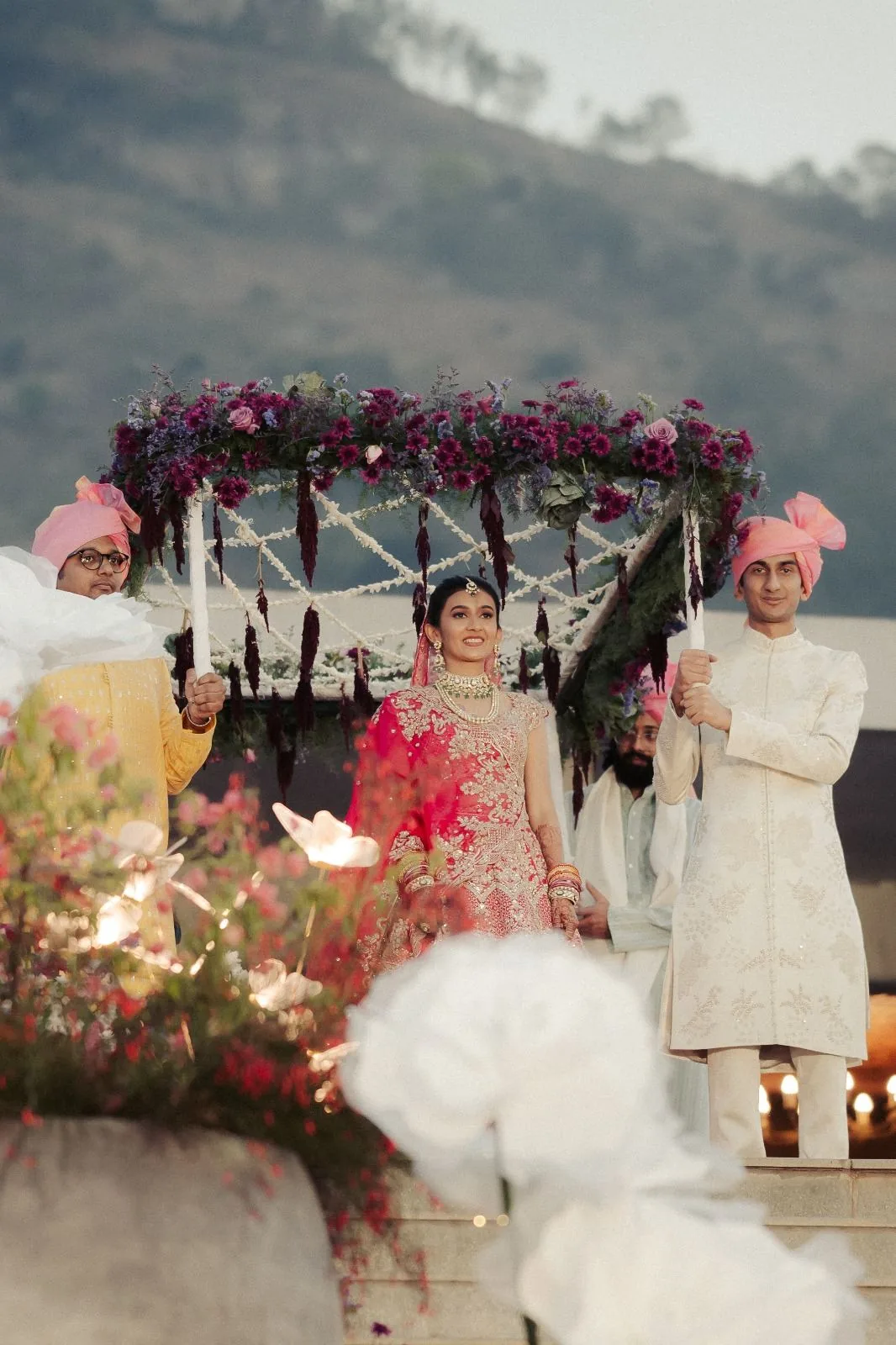
- Red rose and jasmine temple rope. Alternating bands, dense, short drop, as photographed above.
- Kanakambaram and jasmine. Orange and white, slim, the classic Karnataka and Tamil pairing.
- Jasmine bud rope with a gajra finish at each shoulder.
- Sampangi and rose. Built for scent rather than colour.
- Marigold and jasmine layered. Two textures, the cheapest strong-looking garland there is.
- Lotus-centre garland. One lotus at the drop, the rest plain so it reads.
Contemporary and palette-led
- Two-tone carnation. The most colour-accurate option we have.
- Orchid and tuberose. For a ballroom, where light is controlled and the garland is seen close.
- Baby's breath and rose. Best against a dark or lit backdrop, never a white one.
- Petal-stitched garland. Rose petals stitched flat, no stems; almost weightless.
- Mixed foliage with rose accents. Green-led, for a less flower-heavy frame.
- Matched set. Gajra, boutonniere and both garlands cut from one batch.
Non-floral, low-allergy and photo-led
- Banana fibre and leaf garland. Traditional, near-free, and it does not wilt.
- Fabric-flower garland. Stitched blooms built in-house, for a pollen problem.
- Currency or shagun garland. A second, lighter exchange, never the ritual one.
- The second pair. A duplicate held backstage for the photographs, once the first pair has been handled by two hundred people.
The exchange moment: choreography and lift
The varmala is a sightline problem before it is a floral one. The couple need elevation, the crowd needs a defined edge, and the photographers need a lane agreed in advance. We mark that lane on the floor plan and put one person whose only job for those two minutes is holding the front row back.
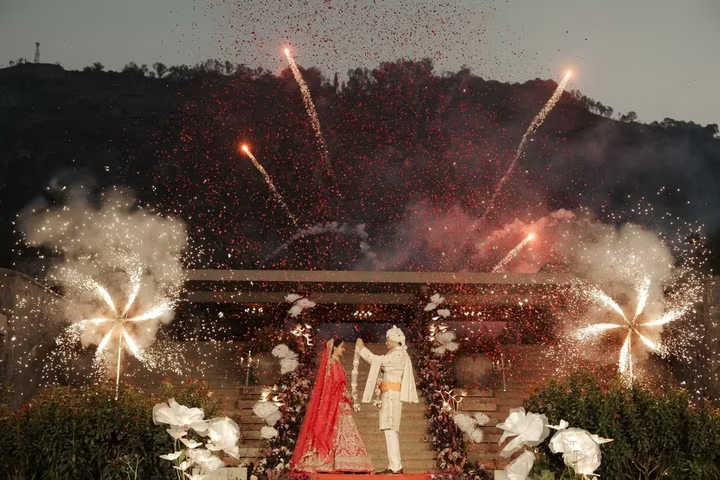
Then the lift. Friends hoisting the groom out of reach is traditional and the run sheet should love it briefly, because a muhurtham window does not care that everyone is enjoying themselves. Two minutes, then land it. The exchange below was built around exactly that: a raised platform, a defined edge, one marshal.

Two of our weddings show how differently this can be staged. At Vikram and Ananya's wedding at The Leela Palace in Bangalore the exchange sat inside a controlled ballroom light plot; at Ajay and Mythili's wedding at Kumarakom Lake Resort it sat outdoors in Kerala humidity. Same ritual, two different briefs to the florist.
Lighting and effects at the varmala
The cheapest version never fails: a clean stage, good light, a petal shower from the sides. Everything above that adds machinery. A petal drop from overhead needs rigging and one rehearsed cue. Cold pyro needs an operator and a venue clearance. Fireworks, like the frame at the top of this page, need the venue's own licence, an operator and a cue timed to a moment that will not repeat.
Our rule is that no effect arrives on the day unrehearsed, and none is cued by someone doing anything else at that instant. We build the varmala lighting state as its own cue, because an exchange lit for a general wash photographs flat. The full staging logic for this moment and its counterpart at the end of the day is in our journal piece on the varmala and the vidaai.
South Indian practice and the poruwa/garland variants
In South Indian ceremonies the exchange is shorter and quieter than a North Indian jaimala, close to the mandap rather than staged at the far end of a ballroom. The order of service in a South Indian Hindu ceremony puts it near the tali tying, so the garlands must be wearable through what follows. That single difference changes the weight brief completely.
The Tamil Hindu ceremony in Sri Lanka includes the same garland exchange, and couples often pair it with a poruwa ceremony on the same day, covered in our guide to the poruwa ceremony. Two ceremonies in one day means two garland sets, and the second is the one that gets forgotten. The regional map of which rite sits where is in our overview of Indian wedding traditions.

Allergies, fragrance and the practical failures
The honest list. Jasmine and tuberose are strongly scented, and a garland worn through a long seated ritual puts that scent under the nose of someone who may be fasting. We ask about this at the design stage, not on the morning. Pollen is the other one: lilies are the usual culprit and we keep them out of garlands entirely. Where there is a genuine pollen problem we build a fabric-flower garland in-house, and nobody in the photographs can tell.
The failures we see are dull rather than dramatic. Garlands that arrive early and sit in a car boot. Garlands strung too tightly to sit flat on a shoulder. Garlands ordered to a colour reference the market cannot supply that week, with nobody told until the morning. That last one has a fix: a written substitution rule agreed in advance, which we explain in our note on how flower substitutions get approved.
Storage, transport and the three-hour rule
Our working rule is that a fresh garland reaches the couple within about three hours of being strung, and spends as little of that time as possible in a warm car. The string table sits as close to the venue as the venue allows, boxes travel flat and cool, and garlands hang on a rail on arrival rather than sitting in a stack. We ask for a cool holding room at the point of contract, not on the day, and in Goa we ask for it indoors and away from the sea-facing side.
The spare pair travels in its own box with its own person. It is the cheapest insurance in the wedding and we have used it often enough not to treat it as optional. The same discipline applies to gajras and bridal flower work, which we set up as a station rather than a delivery.
What varmalas cost and what moves the number
We publish no rupee figure for a varmala, because it is a small line in a floral budget and it moves with four things: flower, density, length, and whether the shades are local or imported. Mogra and marigold are cheap and the stringing labour is what you pay for. Rose sits in the middle, orchid prices like an import. A dense double rope costs roughly twice a single, being twice the material and twice the time.
What matters more is proportion. Economising on the two objects in the most-shared photograph of the wedding has it backwards. Our published wedding data reports set out where the money in a South Indian wedding actually goes, and garlands are not where it leaks. For the wider floral line in this city see flower decoration for weddings in Bangalore, and the bridal entry designs that lead into this moment.
Varmala sign-off: the eight things we close before the wedding week
- Which ceremony the garland belongs to, and where it sits in the order of service.
- Flower and shade, with a named substitution agreed in writing if the market falls short.
- Weight, checked against the jewellery the bride is actually wearing.
- Drop length, set separately for each of the two garlands.
- A fitting, with the real outfits or the tailor's measurements, before the final string order.
- Allergy and fragrance check for the couple and for both sets of parents.
- Delivery window and cool holding space, confirmed with the venue in the contract.
- The spare pair, in its own box with a named person carrying it.
If you are designing this moment now and want it built rather than bought, send us the date and the ceremony order and we will come back with a garland brief you can hand to any florist, ours or not.
Common questions
What flowers are used for varmala?
Mogra or jasmine, rose, carnation, orchid, marigold and baby's breath cover almost every varmala made in India. Jasmine and rose are the traditional South Indian pairing, carnation is the most colour-accurate option, and marigold is the cheapest material that still looks deliberate. Orchid is imported for most of the year and prices accordingly.
How long do fresh varmalas last?
A fresh garland is made for a moment, not for an evening. We do not publish tested hours, because flower behaviour depends on the bloom, the humidity and how hot the stage lighting runs. What we do is string on the day, deliver cool, keep the garlands out of the lights until the exchange, and carry a spare pair.
How heavy should a varmala be?
Light enough to lift over a head with one hand. That is the working test we use, and it matters because the bride is usually wearing heavy jewellery and holding a dupatta at the same moment. Dense double-rope rose garlands look impressive on a table and become awkward the instant someone has to lift one.
What is the difference between varmala and jaimala?
There is no practical difference; they are two names for the same garland exchange. Varmala means the groom's garland and jaimala the garland of victory or acceptance, and North Indian families use both words interchangeably. South Indian traditions call the same rite maalai maatral in Tamil or the haara exchange in Kannada practice.
How much does a varmala cost?
It depends on the flower, the density, the length and whether the shades are local or imported, and we do not publish a single figure because there is not an honest one. Mogra and marigold are inexpensive and the stringing labour is the real cost. Rose sits in the middle and orchid prices like an import.
What is the South Indian equivalent of varmala?
Maalai maatral in Tamil and Telugu practice, and the haara exchange in Kannada ceremonies. The rite is the same exchange of flower garlands, but it usually sits closer to the mandap and closer to the tali tying than a staged North Indian jaimala does, so the garlands often have to be worn through the ritual that follows.
Can we use artificial flowers for a varmala?
Yes, and we build them ourselves when there is a reason to. A fabric-flower garland stitched by our team is the right answer when a couple or a parent has a pollen problem, or when the exchange has to survive a long outdoor wait. Most families still prefer fresh for the ritual garlands and keep fabric for a second pair.
When in the ceremony does the varmala happen?
It opens the marriage in public, so it sits early. In North Indian sequences it often happens at the stage as the baraat arrives, before the couple are seated. In South Indian ceremonies it usually falls near the mandap and close to the tali or thali tying, which is why the garlands there need to be comfortable to wear rather than only to lift.