Planner hire · Bangalore
Hiring a wedding planner in Bangalore: scope, tiers and fee models
Before you hire a wedding planner in Bangalore, settle two things: which scope you are buying, from day-of coordination to full design and production, and how the fee is charged. Two quotes that differ several times over can both be honest if they price different work. This page sets out the tiers, the fee models and what to ask.
This page publishes no price, and that is deliberate. The planning fee is quoted for the agreed scope, and design and decor are quoted separately for their scope and production, because the same tier over 120 guests in a hotel ballroom and 600 guests across three days at an outskirts resort are not the same job. What this page gives you instead is the structure: what sits inside each tier, what each fee model does to the incentive, and the questions that make a quote comparable.
Updated 27 September 2026
Our decor work in Bangalore
See the ceremony spaces, guest areas and details in our Bangalore portfolio. The venue captions identify where each photograph was made.
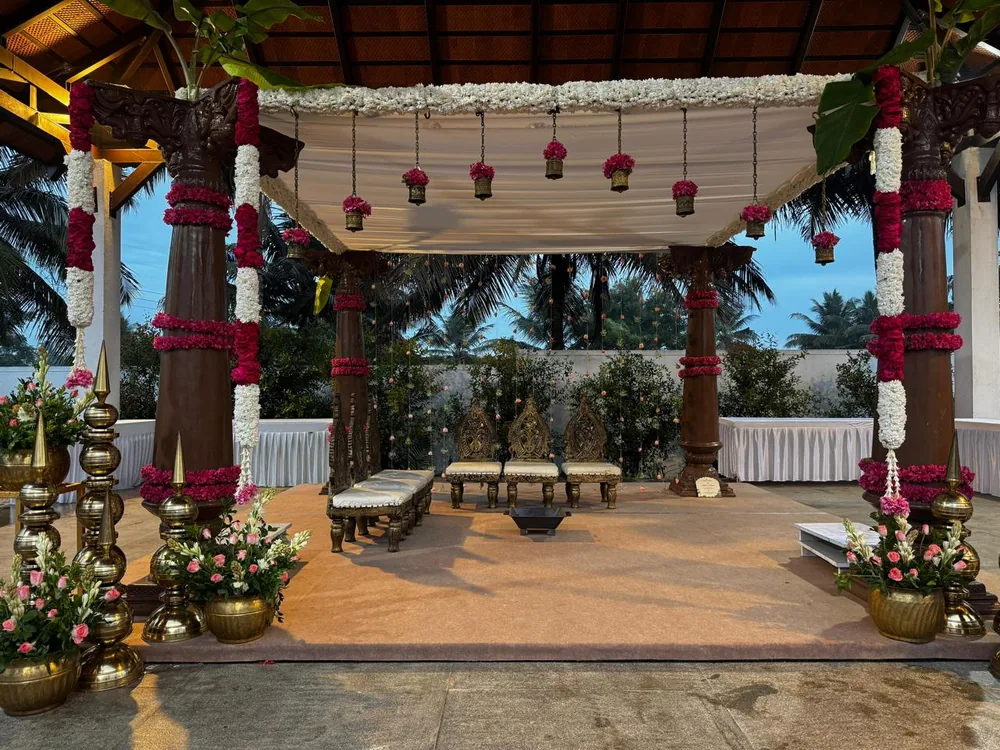

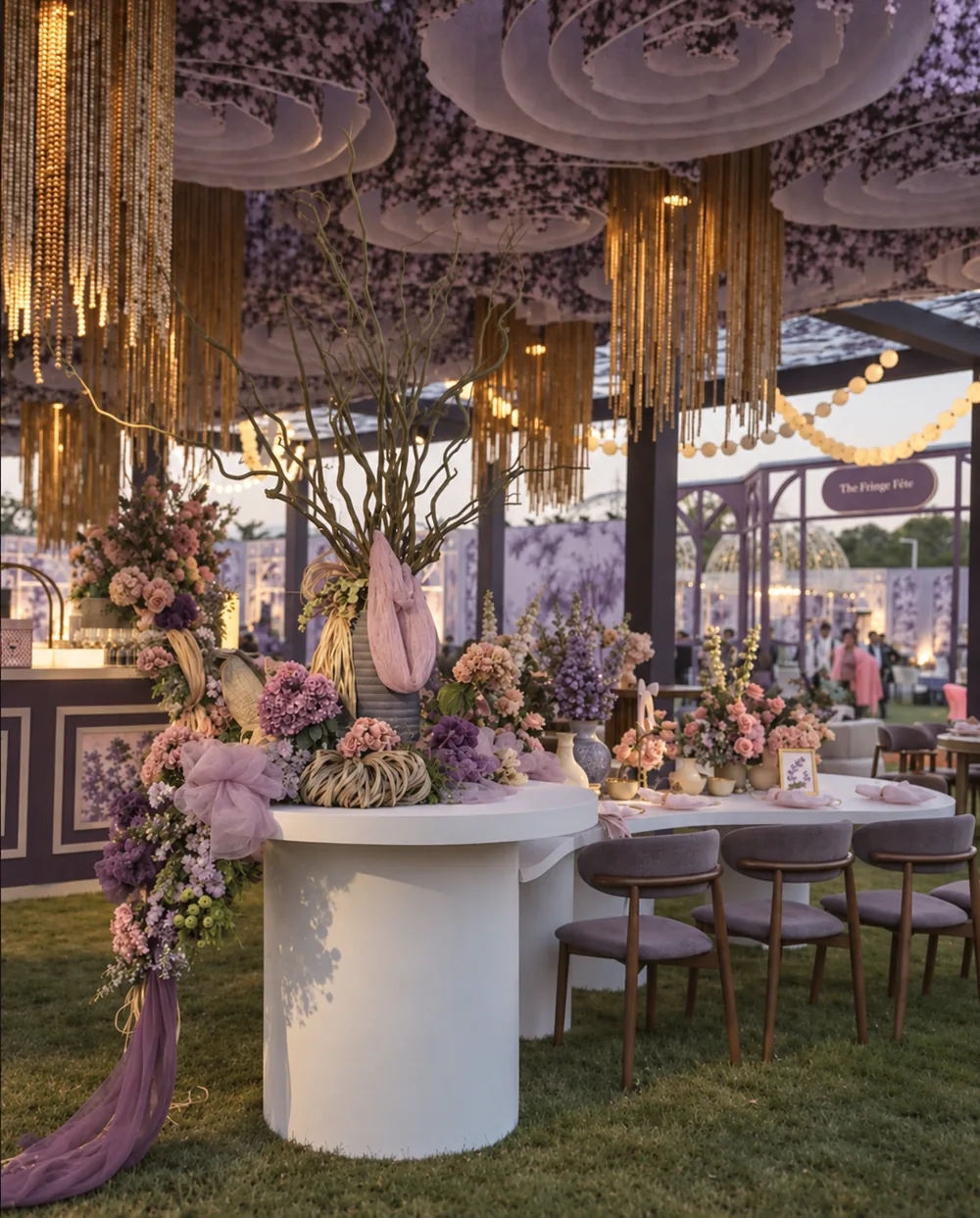
Planning fees and decor scope
Decor starts at ₹5 lakh. Wedding planning starts at ₹2 lakh per day for two events. Both prices exclude GST.
- Design & decor
- From ₹5 lakh excluding GST
- Wedding planning
- From ₹2 lakh per day for two events, excluding GST
Decor production depends on the design and is itemised in the decor proposal. Venue hire, rooms, food and other suppliers are separate. Additional events and the final planning scope are quoted separately.
We have local teams in Goa and Kerala, each led by a founding team member, and our own production warehouses in Bangalore, Goa and Kerala. There is no team travel charge in these three markets.
Current company policy confirmed on 4 October 2026. See the planning and decor responsibilities.
What a planner actually holds — and what the word hides
"Wedding planner" is used in Bangalore for at least four different jobs, sold at four different scopes, by companies that describe themselves identically. That is the single reason quotes look incomparable: two studios can send you numbers that differ several times over and both be honest, because they are quoting different work. Before price, settle work.
The work that has to be held by somebody
- The budget frame — what the wedding is allowed to cost, split by line, before anything is booked.
- Venue selection and the venue contract: inclusions, exclusions, overtime, damage, cancellation.
- Vendor shortlisting, briefing, contracting and the payment calendar that goes with it.
- Design direction — the look of each function, and whether it is authored or assembled.
- Production: drawings, fabrication, load-in, install, power, safety and strike.
- The run sheet: an hour-by-hour document naming who does what, where, and by when.
- Guest logistics — rooms, transport, welcome, seating, special requirements.
- On-site management on each function day, with a named lead and a stated crew size.
- Reconciliation after the wedding: final bills, returns, deposits, damages.
If the person you are hiring does not do one of those, somebody else has to, and that somebody is usually a parent with a day job. Ask, line by line, who owns each one. The gaps are where weddings go wrong, not the vendors.
What is included by tier — scope, not price
These four tiers are the industry's real structure, and they describe scope only. No price is attached to any of them here, on purpose: a tier is a description of work, and the same tier costs different things at different guest counts, function counts and venue types.
| Tier | What it covers | What it does not cover | Right for you when |
|---|---|---|---|
| Day-of coordination | Takes an already-booked wedding and runs the final stretch: vendor reconfirmation, the run sheet, and a crew on site for the function days | Sourcing, negotiation, budget ownership, design authorship, production build | Everything is already booked and you want the days themselves held by professionals |
| Partial planning | Joins at a defined point — usually the venue and a few key vendors are already fixed — and takes the remainder through to delivery | The decisions already made before joining, and usually original design and fabrication | The family has strong views on some vendors and no bandwidth for the rest |
| Full-service planning | Holds the wedding end to end: budget frame, venue, vendor selection and contracts, schedule, payment calendar, guest logistics, run sheet, on-site management, reconciliation | Design authorship and fabrication, unless design is contracted as well | You want one accountable owner, one schedule and one person to call |
| Design and production | Authors the look — concept, drawings, materials, original fabrication, lighting — and produces it on site: install, operate, strike | It is not a substitute for planning; the two remain separate scopes even when one studio does both | How the wedding looks is the thing you care most about |
The commonest expensive misunderstanding in this city: a couple buys full-service planning, assumes decor is inside it, and discovers at the drawings stage that decor is a separate quote. It usually is — at Panigrahana it explicitly is. Ask the question in the first meeting, not the fourth.
How the fee is charged, and which way it points
There are two main ways a planning fee is charged in India, plus two variants of them. The shape of the fee matters more than its size, because the shape decides what happens when you ask to spend less.
| Fee model | How it is charged | Which way the incentive points | The question it forces |
|---|---|---|---|
| Flat fee for a defined scope | One agreed number against a written scope | Neutral on your total spend. The planner gains nothing from a bigger wedding and loses time on a messier one | "What exactly is inside this scope, and what triggers a revision to the fee?" |
| Percentage of total wedding spend | The fee moves with what the wedding costs | Upward. Every rupee added to the wedding adds to the fee — and a request to cut the budget is, structurally, a request to cut the planner's income | "Show me in writing what happens to the fee if we reduce the budget, and what the percentage is calculated on." |
| Hybrid — a floor plus a percentage above a threshold | A flat minimum, then a share of spend above a stated line | Neutral below the threshold, upward above it | "Where is the threshold, what counts toward it, and what if we end up below it?" |
| Day-of or per-function fee | Charged per day or per function delivered | Neutral on total spend; but nobody owned the months before delivery | "Who is accountable for the decisions taken before you joined?" |
Neither of the two main models is dishonest. A percentage scales price with work automatically, and a large wedding genuinely is a larger job — more vendors, more crew, more days, more risk. A flat fee gives you a number on day one that does not move when your parents add eighty guests. What is not defensible is an unstated model, or a percentage whose base — does it include the venue? the taxes? the planner's own decor? — is never written down.
Panigrahana quotes a planning fee for the agreed scope. Design and decor are quoted separately for their scope and production. You should expect to be asked about guest count, function count, number of days, venue type and how much of the design is original before any number is discussed — because those are the things that determine it.
The ₹-tier table you have already read
By the time a couple calls a studio in Bangalore, they have usually read the same four-row table three times: day-of, partial, full-service, premium, with a percentage-of-budget line attached to the full-service row. It appears in near-identical wording across a swarm of 2026 cost guides — planner blogs, marketplace content pages, a caterer's blog, in one case a personal-loan company's blog farming wedding-budget traffic. None of them cites a primary source. Several of them cite each other.
We are not reprinting their rupee bands or their percentage on this page, because we could not verify a single one of those figures against anything other than another blog carrying the same table. That refusal is the point. A budget built on a number nobody will stand behind is a budget that moves.
What the table is genuinely good for: it is the frame your first phone call happens inside, and it is worth knowing that the frame exists. What it is bad for: it prices a tier without pricing a wedding. It has no guest count in it, no function count, no venue type, no number of days, no distinction between rented decor and original fabrication — which are the five things that actually move the number.
A practical test you can run this week. If a planner gives you a fee on the first phone call, before asking guest count, function count, days, venue and how much of the design is original, they are quoting the blog table back at you. That is not a quote, it is a recital.
Zero vendor commission: what it means and what it does not
Panigrahana takes zero vendor commission and clients pay vendors directly. It is a structural claim, not a slogan, and it is worth being precise about both halves of it.
What it does mean
- Vendor invoices are in your name and you pay the vendor, not the planner.
- No commission, rebate or referral fee is taken from a vendor for recommending them.
- A recommendation costs the studio nothing to make and earns it nothing, so it can be made on merit.
- You can ask any recommended vendor for their own quote and compare it.
What it does not mean
- It does not mean the wedding is automatically cheaper. It means the margin is visible instead of buried.
- It does not mean in-house design and decor are supplied without margin. They are produced — drawn, fabricated, installed — and they are quoted separately for their scope and production. Anyone claiming their decor carries no margin is telling you something that cannot be true.
- It does not remove the need to read the venue contract, the overtime clause or the cancellation terms.
- It does not make the planning fee small. Removing an invisible subsidy means the visible fee has to be a real number.
The honest consequence, stated against our own interest: a commissioned planner can quote a smaller planning fee and still earn well, because the rest arrives from vendors. Side by side on a spreadsheet, their fee line can look better than ours. The difference only shows up in the vendor quotes, where you cannot see it.
Questions to ask before you pay an advance
An advance is the point of no return in this industry — it is where leverage transfers. Ask these before it leaves your account, and ask for the answers in the proposal rather than on a call.
The pre-advance checklist
- Which tier am I buying — day-of, partial, full-service, or design and production? Write it in one sentence in the proposal.
- Is the fee flat or a percentage? If a percentage, of what base, and is it capped?
- What happens to the fee if the budget goes down? Get the answer in writing.
- Do you take any commission, rebate or referral fee from any vendor or venue? Ask for it as a clause.
- Will vendor invoices be in my name, and will I pay vendors directly?
- Is design and decor inside this fee, or a separate quote? If separate, when do I see that number?
- Name five things this fee does not include.
- Who is the named lead on site on each function day, and how many crew?
- What are the payment milestones, what does each one release, and what are the dates?
- What are the cancellation, postponement and date-change terms?
- Who signs the venue contract, and who is liable for overtime and damage?
- What is the weather or backup plan, and who pays for it?
- What legal entity will invoice me, and does its registration match the brand name I searched for?
On that last one, our own answer: Panigrahana Weddings has planned weddings since 2018 and is incorporated as Wedvitez Planners Private Limited (CIN U82300KA2023PTC181403). The Bangalore studio is at RMV 2nd Stage, Bengaluru 560054. Ask every studio you shortlist for the equivalent, and check it. It takes four minutes.
What we do not do
A page that only lists capabilities is a brochure. These are the limits, stated plainly, because they are the things couples find out late otherwise.
Stated against our own interest
- We do not quote on a first phone call, and we do not publish a planning fee on this page.
- We are not a venue and we hold no venue inventory. We work with 128+ venue partners, but the contract is between you and the property, and the property's terms are the property's.
- Design and decor are quoted separately from planning. Zero vendor commission does not mean in-house production has no margin.
- We will not take on a wedding where the date, the format and the scope cannot be delivered together. We would rather say that in the first meeting than in the last month.
- If day-of coordination is genuinely all you need, we will say so instead of selling full-service.
- We do not sell a cheaper wedding by quietly substituting cheaper materials into the same drawing.
Service area, equally plainly: Bangalore and drive-to Karnataka — Nandi Hills, Coorg, Chikmagalur, Mysore, Kabini, Sakleshpur and Hampi — plus Goa and Kerala, and the destination work the studio already runs. If your wedding is somewhere else, we will tell you rather than learn a new city on your budget.
The conversation with your parents
In almost every wedding we plan, the couple does the searching and the parents hold the budget and the final yes. So the real job of a page like this is not to sell you — it is to give you something you can forward. These are the five questions that actually get asked across the dining table, and the answers that survive them.
| The question | The answer that holds up |
|---|---|
| "Why pay someone for what the family has always done?" | Because the family has never done it with this many moving parts, and because the person doing it will otherwise be an uncle with a day job and no leverage with a vendor. The question is not whether the work happens — it is whether it happens on a written schedule. |
| "Are they an actual company?" | Registered name, registration number, years operating, office address, and a bank account in the company's name. Ours: Wedvitez Planners Private Limited, CIN U82300KA2023PTC181403, weddings planned since 2018, office at RMV 2nd Stage, Bengaluru 560054. |
| "How do we know they aren't taking money from the caterer?" | Because it is a clause, not a promise: zero vendor commission, vendor invoices in your name, vendors paid directly by you. Ask for it in the proposal. A studio that will not write it down has answered you. |
| "What if they take the advance and vanish?" | Payment milestones tied to named deliverables and dates in the written proposal, not a percentage split someone recited on the phone. Each payment should release something you can point at. |
| "What if the budget has to come down?" | A flat fee for a defined scope does not fall when your budget falls — but nor does anyone lose income by agreeing to the cut. On a percentage, they do. That is the whole argument for knowing the fee model before you sign. |
| "What are we actually buying?" | One named tier, in one sentence, in the proposal — plus a list of five things it does not include. If that list does not exist, the scope does not exist. |
Send them the table, not the brochure. Insight from every planning season we have run: parents do not want to be sold to, they want to be shown that somebody has already thought about the way this goes wrong.
Questions couples ask
What does a wedding planner in Bangalore actually do?
A full-service planner holds the budget frame, selects the venue and negotiates its contract, shortlists and contracts vendors, builds the payment calendar, owns guest logistics, writes the hour-by-hour run sheet, manages every function day on site with a named lead and a stated crew, and reconciles the final bills and deposits afterwards. Narrower tiers exist — day-of coordination runs only the function days, partial planning joins at a defined point. Design authorship and production are a separate scope from planning, even when one studio does both.
How much does a wedding planner cost in Bangalore?
There is no single honest figure, and we publish none. The planning fee is quoted for the agreed scope, because the same tier for 120 guests in a hotel ballroom and 600 guests across three days at an outskirts resort are not remotely the same job. What moves the number is guest count, function count, number of days, venue type, whether the wedding is in the city or outstation, and how much of the design is original fabrication rather than rented stock. Ask each studio to quote against the same written scope and the quotes become comparable.
Is a flat fee or a percentage of budget safer?
They fail differently. A flat fee against a defined scope is neutral on your spending — nobody loses income when you decide to cut the budget — but its failure mode is a narrow scope and a series of "that's extra" conversations, so the exclusions list matters. A percentage automatically scales price with the size of the job, which is fair, but it means every rupee you add adds to the fee and a request to reduce the budget reduces the planner's own income. Neither is dishonest. An unstated model is.
What is the difference between full-service planning and day-of coordination?
Day-of coordination takes a wedding that is already booked and runs the final stretch: reconfirming vendors, writing the run sheet and putting a crew on site for the function days. It does not source, negotiate, own the budget or author the design. Full-service planning holds the wedding from the budget frame through venue and vendor contracts, the payment calendar, guest logistics and the run sheet, to on-site management and reconciliation afterwards. If everything is already booked, day-of is the honest purchase and a good studio will tell you so.
Does a wedding planner save you money on vendors?
Sometimes, and not in the way the claim is usually made. A planner with volume can get better terms, but the larger saving is structural: a written scope stops the same item being bought twice, a payment calendar stops panic decisions, and an overtime clause read in advance stops the bill that arrives after the wedding. Be careful with any planner who promises a fixed percentage saving on vendors — if they can reliably take that much out, ask why the vendor quoted that high to you in the first place.
What does zero vendor commission mean?
It means vendor invoices are in your name, you pay vendors directly, and the planner takes no commission, rebate or referral fee from any vendor or venue for recommending them. It does not mean the wedding is automatically cheaper — it means the margin is visible rather than buried in a vendor's quote. It also does not mean in-house design and decor are supplied without margin: those are produced and are quoted separately for their scope and production. Ask for zero commission as a clause in the proposal, not as a claim on a website.
Is there a minimum budget to hire a wedding planner at Panigrahana?
Decor starts at ₹5 lakh. Wedding planning starts at ₹2 lakh per day for two events. Both prices exclude GST. Decor production depends on the design and is itemised in the decor proposal. Venue hire, rooms, food and other suppliers are separate. Additional events and the final planning scope are quoted separately. We have local teams in Goa and Kerala, each led by a founding team member, and our own production warehouses in Bangalore, Goa and Kerala. There is no team travel charge in these three markets.
How do I verify a wedding planner is legitimate before paying an advance?
Ask which legal entity will invoice you and check that its registration matches the brand name you searched for. Confirm the bank account is in the company's name, not an individual's. Get the payment milestones tied to named deliverables and dates in writing, and read the cancellation and postponement terms before the advance, not after. Ask for the commission position as a clause. Finally, ask who the named on-site lead is and how many crew are staffed on each function day — vague answers there predict vague delivery.
Planning in Bangalore
Tell us the date, the guest count and the ceiling.
Send the date, the rough guest count, how many functions you are planning and the budget ceiling you actually have. We will tell you which tier fits, what the scope would be, and what sits outside it — before any number is discussed.