Every year, couples ask us the same question: when is the best time to get married in Goa? And every year, we give the same honest answer: it depends on what matters most to you. December is not automatically best just because it is the most sought-after. February has advantages that December cannot offer. October has a beauty that neither month can match. Season affects venue availability directly — check our complete Goa weddings guide and our destination wedding Goa cost guide where we break down how costs shift by month. Venue location matters too: our North Goa vs South Goa guide covers exposure differences.
This guide decodes each month of Goa's wedding season — October through March — with honest assessments of weather, venue availability, pricing, and the atmosphere each month brings to a wedding. We have planned weddings in every month of this window and what follows reflects actual experience, not brochure language.
Quick Answer · Goa Wedding Season
Goa’s wedding season runs October to February: October is lush post-monsoon, December is peak on demand and price, February brings the most settled weather. The month-by-month guide below covers availability, pricing and weather risk — the full Goa wedding cost breakdown sits alongside it.
81.8% of Goa weddings in our records fall between November and February. That is from 44 dated Goa weddings and enquiries tracked since January 2026, against 54.2% across the same four months in Bangalore, where the year is far flatter. Only 4.5% of the Goa set sits anywhere in the April-to-September stretch. Goa does not really have a busy season and a quiet one. It has a season, and then a gap.
Check your Goa date: muhurat, rain and venues
Goa's beach and lawn venues are dry-season venues. IMD normals give Panaji 26.7 rain days in July, 6.8 in October, 1.5 in November and 0.2 in December. Drik Panchang's Panaji list has 11 muhurat dates left in 2026, the last on 12 December, and 95 in 2027.
Drik Panchang's Panaji windows for the dates left in 2026
| Date | Panaji window | Listed by |
|---|---|---|
| Sat 21 Nov | 6:40 am to 12:08 am (22 Nov) | Drik Panchang and GaneshaSpeaks |
| Tue 24 Nov | 11:25 pm to 6:42 am (25 Nov) | Drik Panchang and GaneshaSpeaks |
| Wed 25 Nov | 6:42 am to 6:42 am (26 Nov) | Drik Panchang, GaneshaSpeaks and Prokerala |
| Thu 26 Nov | 6:42 am to 5:47 pm | Drik Panchang, GaneshaSpeaks and Prokerala |
| Wed 2 Dec | 10:32 am to 6:46 am (3 Dec) | Drik Panchang, GaneshaSpeaks and Prokerala |
| Thu 3 Dec | 6:46 am to 10:53 am; 11:03 pm to 6:47 am (4 Dec) | Drik Panchang, GaneshaSpeaks and Prokerala |
| Fri 4 Dec | 6:47 am to 10:22 am | Drik Panchang, GaneshaSpeaks and Prokerala |
| Sat 5 Dec | 11:48 am to 6:48 am (6 Dec) | Drik Panchang and GaneshaSpeaks |
| Sun 6 Dec | 6:48 am to 7:42 am | Drik Panchang and GaneshaSpeaks |
| Fri 11 Dec | 3:04 am to 6:52 am on 12 Dec, before sunrise | Drik Panchang, GaneshaSpeaks and Prokerala |
| Sat 12 Dec | 6:52 am to 3:27 am (13 Dec) | Drik Panchang and GaneshaSpeaks |
Month by month in Goa
- October. Panaji averages 6.8 rain days and 24.0–32.0°C in IMD normals. Drik Panchang lists no muhurat date in October 2026 or October 2027.
- November. Panaji averages 1.5 rain days and 22.7–33.5°C in IMD normals. Drik Panchang lists 4 muhurat dates in November 2026 and 11 in November 2027.
- December. Panaji averages 0.2 rain days and 20.9–33.1°C in IMD normals. Drik Panchang lists 7 muhurat dates in December 2026 and 6 in December 2027.
- January. Panaji averages 0.1 rain days and 20.0–32.5°C in IMD normals. Drik Panchang lists 9 muhurat dates in January 2027.
- February. Panaji averages 0.0 rain days and 20.6–32.4°C in IMD normals. Drik Panchang lists 13 muhurat dates in February 2027.
- March. Panaji averages 0.1 rain days and 23.3–32.6°C in IMD normals. Drik Panchang lists 7 muhurat dates in March 2027.
- April. Panaji averages 0.3 rain days and 25.4–33.4°C in IMD normals. Drik Panchang lists 9 muhurat dates in April 2027.
- May. Panaji averages 3.6 rain days and 26.3–33.8°C in IMD normals. Drik Panchang lists 19 muhurat dates in May 2027.
- June. Panaji averages 21.2 rain days and 24.9–30.9°C in IMD normals. Drik Panchang lists 16 muhurat dates in June 2027.
- July. Panaji averages 26.7 rain days and 24.2–29.3°C in IMD normals. Drik Panchang lists 5 muhurat dates in July 2027.
- August. Panaji averages 23.0 rain days and 24.2–29.5°C in IMD normals. Drik Panchang lists no muhurat date in August 2027.
- September. Panaji averages 13.7 rain days and 24.0–30.2°C in IMD normals. Drik Panchang lists no muhurat date in September 2027.
Five-stars to check first for a December date
- W Goa: November to February is the dry, breezy window on the headland.
- The St. Regis Goa: November to February for the Great Lawns and the seasonal beach venue.
- The LaLiT Goa: November to February is the dry, breezy window for the beach and the garden.
Panigrahana is the planning and decor studio, not any of these venues. We check the date with the venue for you.
Check a specific Goa date The check shows Drik's window in your own time zone, the weather for that month and three venues to check first.
Sources: Drik Panchang 2026 and 2027, computed for Panaji, read 27 September 2026; IMD Climatological Tables 1991–2020, Panaji. Dates listed as of 18 October 2026.
October — The Post-Monsoon Discovery
Most couples do not consider October for their Goa wedding because they associate it with monsoon overspill. That assumption is worth examining. By mid-October, the monsoon has substantially cleared from Goa's coastline. What remains is one of the most visually extraordinary landscapes on the Indian coast: intensely green vegetation, clear air freshly washed, and dramatically beautiful evening skies.
- Weather: warm days (28-32°C), pleasant evenings, occasional brief showers possible early October — largely clear from mid-October onward.
- Tourist footfall: very low. The beaches feel private, the towns feel local. A meaningful contrast from the crowds of December.
- Venue pricing: October is typically at shoulder or off-season rates — about 5% below December-January peaks on the venue line, and little else moves. The real October gain is choice: more dates open, and vendors have more attention to give you.
- Availability: very good. Most dates are open well within 6-8 months of the wedding.
- Who it suits: couples who love lush, green, dramatic Goa over the dry, bright Goa of February. Couples who prefer privacy over vibrant energy. Budget-conscious couples who don't want to compromise on venue tier.
November — The Intelligent Choice
November is, in our view, the most underrated month in Goa's wedding calendar. The season has properly begun — weather is reliable, temperatures are comfortable — but the tourist crowds that define December have not yet arrived. The venues are fully operational and attentive. The beaches are peaceful.
- Weather: excellent. Dry, temperatures in the high 20s, low humidity, beautiful evenings. Occasionally slightly overcast which can be ideal for photography.
- Tourist footfall: moderate and growing through the month. Still feels like Goa rather than a tourist destination.
- Venue pricing: shoulder pricing for most of November, transitioning to peak rates in the last week. Book early November dates for best value.
- Availability: good at 10-12 months advance. December enquiries crowd out November options if you wait too long.
- Who it suits: couples who want a proper, beautiful Goa wedding without the December premium. Families who find December travel expensive and prefer less congested flights and hotels.
December — The Peak You Know
December in Goa is exactly what it appears to be in every photograph and every story: vibrant, beautiful, energetic, and expensive. The Christmas-New Year window (roughly December 20th to January 5th) is Goa's most sought-after event window of the entire year. Hotels are fully booked, restaurants require reservations, the beaches are alive, and the atmosphere is genuinely festive in a way no other month can replicate.
- Weather: perfect. Clear skies, temperatures in the mid-to-high 20s, gentle sea breeze, perfect evenings.
- Tourist footfall: maximum. This is peak Goa — vibrant but crowded. Your guests will experience the full Goa energy.
- Venue pricing: peak rates across all properties. Expect 30-50% premium over shoulder months at the same venues.
- Availability: the December 20-January 5 window at properties like Taj Exotica and The St. Regis Goa (formerly The Leela Goa) books out 18 months in advance. If you want this window, you need to be planning now, not in six months.
- Who it suits: couples for whom Goa's atmosphere and energy is a central part of the wedding vision. Couples who have the budget for peak pricing and the lead time to book 18 months out.
January — Peak Without the New Year Premium
Post-New Year January retains everything that makes Goa spectacular in December — perfect weather, full tourist season, vibrant energy — without the New Year premium that inflates every price from December 28th onwards. The first two weeks of January are our second-most-requested window after December.
- Weather: perfect. Arguably the most reliable weather of the entire season — clear skies and stable temperatures.
- Tourist footfall: still high but tapering from the New Year peak. Beaches feel less chaotic than late December.
- Venue pricing: peak season rates but without the extreme surcharges of the holiday week. A meaningful saving versus December 28-January 2.
- Availability: 14-16 months in advance for premium properties. More flexible than the holiday fortnight.
- Who it suits: couples who want peak season conditions without the New Year pricing madness. Our recommendation for anyone who "wants December weather" but finds December prices difficult.
February — Our Personal Favourite
We say this without reservation: February is the month we would personally choose for a Goa wedding if given free rein. The weather remains perfect — in some ways even more pleasant than December as the sea has warmed and the evenings are softer. The tourist crowds that define December-January have begun to thin. Venue flexibility is noticeably improving. Vendors are more available and, at good venues, you get more personal attention.
- Weather: excellent throughout. Warm days, beautiful evenings, low humidity. The sea conditions are ideal for beach events.
- Tourist footfall: moderate and declining through the month. The beach feels like yours in a way it cannot in December.
- Venue pricing: transitioning from peak to shoulder through February. The second half of February often has significantly better rates than January at the same properties.
- Availability: much better than December-January. 10-12 months advance booking gives you strong choice.
- Who it suits: nearly everyone, honestly. The exception is couples whose hearts are set on the Christmas-New Year atmosphere specifically.
March — The Warm Shoulder
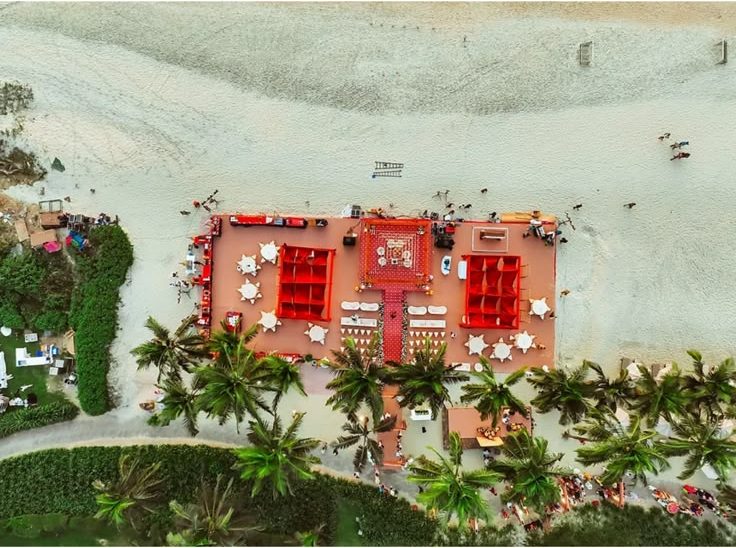
March is the shoulder season where temperature begins to climb. Beach ceremonies in March are still perfectly possible but should be planned for early morning or golden hour — midday heat in March approaches 35°C. Venue pricing in March drops further, and availability is excellent. It is a good month for a budget-conscious couple who is flexible on month.
April to September — The Honest Advice
We will not tell you that outdoor and beach weddings are possible in Goa from June to September. They are not. The monsoon arrives in earnest in late May or early June and does not fully depart until October. It brings spectacular beauty to Goa's landscape — we love what Goa looks like in the monsoon — but it is not a season for outdoor ceremonies or beach receptions. Indoor weddings at major hotel properties are possible year-round; for outdoor Goa weddings, the window is October to March.
Browse all Goa wedding venues and compare availability. For the ultimate Goa experience, explore Taj Exotica Goa — one of the first venues to fill in peak season. Our Goa wedding planning team can advise on the best window for your specific requirements and budget.
Kerala Month by Month — The Second Calendar
Couples comparing Goa almost always compare it with Kerala, and the two calendars do not line up. Kerala’s dry peak is tighter: November to February, and it collides with the muhurtham calendar, so the properties that can hold a full wedding party close first. March to May is hot and humid and works with evening functions. June to August is the south-west monsoon — the cheapest window in the year and entirely usable with a designed indoor scheme. September and October are the retreating monsoon: intensely green, materially better rates, and the window we recommend most often and couples consider least.
The structural difference from Goa is that Kerala’s rain arrives in heavy defined bursts with bright gaps between them, rather than settling in for the day. That is precisely why a designed indoor option works there and an improvised one does not. The month detail is at the Kerala wedding season, and the cost consequences at Kerala wedding cost.
Bangalore and the Drive-To Belt — The Third Calendar
If the wedding could happen inland instead, the calendar changes again. Bangalore and its drive-to belt run best from October to March, and the city itself is far more forgiving than either coast because its rain is shorter and its venues are largely covered or easily covered.
The belt is the exception. Coorg, Chikmagalur and the Ghats receive sustained spells rather than short bursts, hill roads get misty, and the convoy has to run in daylight. A belt wedding in the monsoon window is genuinely beautiful and genuinely cheaper, and it needs the covered option drawn at the same time as the outdoor scheme. See monsoon weddings in Bangalore and destination weddings near Bangalore.
What Monsoon Actually Does — To an Outdoor Wedding
Honestly: less than couples fear and more than venues admit. Rain itself is survivable. What rain brings with it is the real problem — ground that will not hold a structure, cabling that has to be re-routed and protected, florals that arrive heavy and wilt fast, guests who will not walk across wet grass in wedding clothes, and a photographer who loses the light two hours early.
Wind is the element nobody plans for and the one that most often forces a late change. An exposed beach or clifftop site can rule out fabric spans, tall arrangements and lightweight canopies within an hour of the ceremony, regardless of whether a drop of rain falls. Humidity is the third: it decides which flowers survive the day, and it is why local tropical material behaves on both coasts while some imported blooms simply do not.
The Parallel Indoor Design — Drawn at the Same Time
This is the difference between a shoulder-season saving and a shoulder-season gamble, and it is a design discipline rather than a contingency. The indoor scheme is drawn alongside the outdoor one, with the same care, the same palette logic and its own cost, so that switching is a decision rather than a defeat.
The test we apply is simple: would we be content to shoot this scheme? A covered pavilion sized for your guest count passes. A marquee scoped and costed in advance passes. A ballroom across the property that nobody has walked, measured or dressed does not. Our method, written from Kerala where it gets the hardest workout, is at the parallel indoor backup design, with the Goa-specific version at backup plans for outdoor Goa weddings.
Marquee, Clear-Span and Covered Options — Cost and Lead Time
Where a property has no indoor room of the right size, a temporary structure is the answer, and the two things that decide whether it works are lead time and specification. A clear-span structure needs ground that can take it, an engineering check, a power and cooling plan of its own, and a delivery window that does not collide with the rest of the build. None of that can be arranged in forty-eight hours in a coastal monsoon.
Scoped in advance, a marquee is a budgeted line and a calm decision. Arranged as an emergency, it is short-notice pricing for whatever is still available. If your date sits in a shoulder or monsoon window and the venue’s indoor option is weak, price the structure at design stage and decide then whether the saving on the date still stands.
The Call — When You Switch to Plan B
Every weather plan needs a clock, and the clock is more important than the plan. Agree three things in writing before the wedding week: at what hour before each function the decision is taken, who takes it, and against what forecast source. Then hold to it. The most expensive version of a weather plan is the one still being argued about at four in the afternoon while a crew stands idle.
Practically, the call has to come early enough for the switch to be executed calmly — which means asking the venue at the site visit how many hours it needs to turn the indoor space around and who does that work. A covered pavilion that takes twenty minutes to dress is a different proposition from a ballroom needing three hours of furniture moving and a second decor crew.
Off-Season Pricing — What You Can Actually Negotiate
The shoulder and monsoon months are where the real savings are, and they are not only in the headline rate. Availability is wide, which means you can hold two venues while you decide. Negotiating room exists on the things that matter operationally — longer access and build windows, a higher electricity threshold, a capped cooling charge, a better room-block release date — and those are frequently worth more than a discount.
On the underlying rates, the South India Wedding Venue Price Index reads 148 priced Goa venues at a median band of ₹1,000–₹1,300 a plate and 138 priced Kerala venues at ₹1,000–₹1,200, with a median listed room count of 41 in Goa and 35 in Kerala. Food barely moves between the seasons; what moves is rooms, availability and your negotiating position. The full Goa cost structure is at Goa wedding cost.
Weather Clauses — What Belongs in the Contract
Put the weather plan into the paperwork rather than into a conversation. The clauses worth having: the covered or indoor space named and reserved for your dates, the turnaround time to switch, who decides and by when, what the venue charges if the switch happens, and what happens if an access road becomes impassable. For anything built temporarily, add the delivery window and the wind rating.
Then read the cancellation and postponement clauses in the same sitting: the retention schedule by notice period, whether a deposit converts to a credit if a date moves, whether a rescheduled date is repriced at the new season’s rate, and what force majeure actually names. The full list is at the venue contract playbook, and our honest read on insurance at wedding insurance.
Frequently Asked Questions
What is the best month for a wedding in Goa?
February is our personal favourite — perfect weather, thinning crowds, improving venue flexibility. November is the best value month with good weather. December-January gives the most vibrant Goa atmosphere but at the highest cost and requires the most advance booking.
When should you book a Goa wedding venue?
For December and early January: 18 months in advance minimum. For November and February: 12-14 months. For October and March: 8-10 months. The Christmas-New Year window at premium properties books out fastest — sometimes within hours of availability opening at Taj Exotica and The St. Regis Goa (formerly The Leela Goa).
Can you have a wedding in Goa in April or May?
Indoor weddings at major hotels are possible in April. Outdoor and beach ceremonies become risky from April onward as temperatures climb. May onwards toward the June monsoon is genuinely difficult for outdoor events. If April is your only option, choose a venue with strong air-conditioned indoor spaces and plan all ceremonies indoors.
Is October a good month for a Goa wedding?
Late October (after the 20th) is excellent — lush green landscapes, very low tourist footfall, lowest venue rates of the season, and perfectly comfortable weather. Early October has some residual monsoon risk. If you want October, plan for late October dates and build in an indoor backup plan for any daytime outdoor functions.
Can we have a wedding in the monsoon?
Yes, and it is the cheapest window in the year on both coasts, provided the covered scheme was drawn at the same time as the outdoor one rather than improvised on the day. What makes a monsoon wedding work is a designed indoor option you would be content to use, florals chosen for humidity, and a decision clock agreed in writing.
What is the best season for a Kerala wedding?
November to February is the dry peak and it collides with the muhurtham calendar, so venues close early. September and October are the best value window in the year: retreating monsoon, intensely green, materially better rates. June to August is the cheapest and needs a real indoor scheme.
What happens if it rains on the wedding day?
You move to the scheme you already drew, and the cost was already carried. Without a parallel indoor design you are either buying a marquee at short notice or moving a wedding into a room nobody has dressed. The plan is far cheaper as a budgeted line than as an emergency.
When do we decide to move indoors?
Against a clock agreed in advance, not against a mood. Settle three things in writing before the wedding week: at what hour before each function the call is taken, who takes it, and against what forecast source. Ask the venue how many hours it needs to turn the indoor space around, because that sets how early the call has to come.
Does humidity affect flowers and lighting?
Considerably. Humidity decides which flowers survive a full day, which is why local tropical material behaves on both coasts while some imported blooms arrive looking tired. It also affects how lighting reads outdoors in the evening, and wind on an exposed beach or clifftop can rule out fabric spans and tall arrangements within an hour of the ceremony.
Is a marquee worth it for a shoulder-season wedding?
Where the venue has no indoor room of the right size, yes, and only if it is scoped and priced at design stage. A clear-span structure needs suitable ground, an engineering check, its own power and cooling plan and a delivery window that does not collide with the rest of the build. None of that can be arranged in forty-eight hours in a coastal monsoon.
What weather clauses should be in the venue contract?
The covered or indoor space named and reserved for your dates, the turnaround time to switch, who decides and by when, what the venue charges if the switch happens, and what happens if an access road becomes impassable. Read the cancellation and postponement clauses in the same sitting, including whether a rescheduled date is repriced at the new season's rate.
Plan Your Goa Wedding
Find Your Perfect Window in Goa
Every month in Goa's season has something beautiful to offer. Tell us your priorities and we will find the window that suits you perfectly.
Start the Conversation